Choosing between a straight rail and a modular curved rail stair lift starts with understanding how each system is built, where it fits, and why that difference affects cost, installation time, ride quality, and long-term usability. In the stair lift industry, the rail is the track mounted to the stairs that guides the chair, while the carriage is the motorized unit that travels along it and the power system supplies battery or direct electrical energy for operation. I have walked homeowners, occupational therapists, and adult children through this decision many times, and the same questions always come up first: will it fit the staircase, how much customization is required, and what tradeoffs appear after installation. Those questions matter because a stair lift is not just a mobility product; it is a daily access system tied to safety, independence, resale planning, and caregiver workload. A poor match between rail design and staircase geometry can create awkward transfers, excessive clearance issues, or expensive modifications that could have been avoided with a better initial assessment.
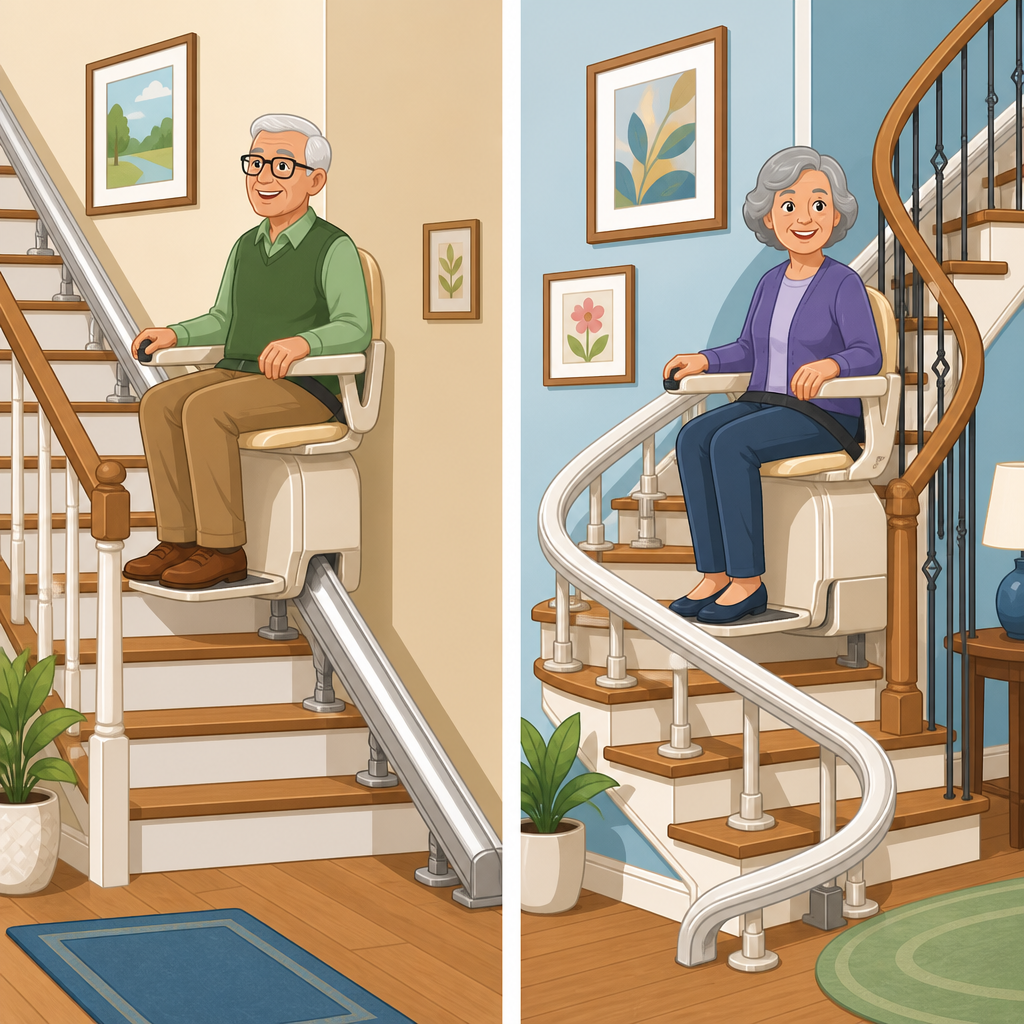
Straight rail stair lifts use a linear track designed for a staircase that runs in one uninterrupted line without turns, intermediate landings, or changes in direction. Modular curved rail stair lifts use pre-engineered sections, bends, and connectors assembled to follow more complex staircases, such as L-shaped, U-shaped, spiral-adjacent, or multi-landing layouts. The distinction sounds simple, but it changes almost every practical decision, from surveying and lead time to mounting strategy and maintenance. In plain terms, a straight stair lift is usually the simpler, faster, and less expensive option when the staircase allows it. A modular curved system exists for homes where a straight track cannot safely or conveniently serve the full route. For readers comparing chair lift types and designs, this hub matters because rail shape is often the first filter that narrows the field before seat style, hinge options, weight capacity, outdoor rating, or transfer aids even enter the conversation.
The most important principle is this: the staircase decides the rail category, not personal preference alone. If the stairs are truly straight from bottom to top, a straight rail lift is usually the correct technical answer. If the stairs include one or more turns or a mid-landing that must be traveled through, a curved solution is generally required. There are edge cases, such as using two straight lifts with a transfer landing between them, but those cases involve additional transfers and are not ideal for many users with balance or hip limitations. Understanding the difference early helps homeowners ask better questions, compare quotes intelligently, and avoid paying for complexity they do not need or expecting simplicity where the staircase will not permit it.
How straight rail and modular curved rail systems are designed
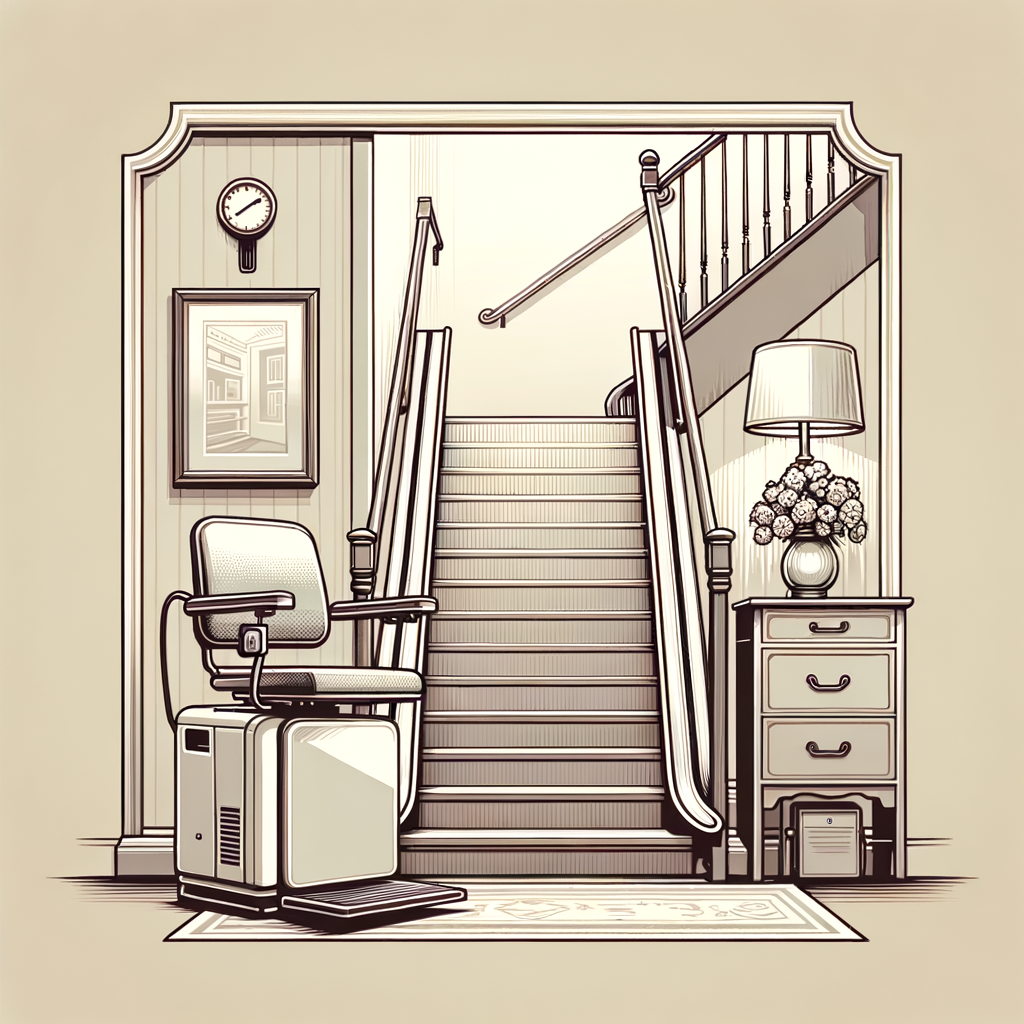
A straight rail stair lift is manufactured around a single constant path. The rail is typically an aluminum or steel extrusion cut to length for the measured run of the stairs, then fixed to brackets anchored into stair treads rather than the wall. Because the path does not change direction, engineering is comparatively straightforward: the gear rack or drive strip remains aligned, the carriage experiences predictable loading, and installers can level bracket spacing consistently. Brands such as Bruno, Harmar, Stannah, and Access BDD all offer straight models built around this efficient geometry. In homes with standard enclosed staircases, straight lifts often include options like folding footrests, power swivel seats, manual or powered hinges, and call-send controls, but the rail itself remains fundamentally simple.
Modular curved rail stair lifts are different because the rail must follow the staircase instead of forcing the user to transfer at a landing. Modular systems use factory-made straight pieces, curved sections, articulated joints, and support brackets that can be assembled to match a staircase with turns. The word modular matters. Unlike a fully bespoke single-piece curved rail fabricated from a one-off bending pattern, a modular curved system uses standardized components configured to suit many common layouts. This can reduce lead time and sometimes cost while still navigating corners and intermediate landings. The design challenge is higher, however, because every transition must maintain smooth carriage travel, proper rack engagement, safe seat orientation, and adequate clearance from balusters, walls, newel posts, and door swings.
In practice, design starts with a site survey. Installers measure stair width, tread depth, riser height, nose projection, total rise, total run, headroom, landing dimensions, and obstruction points. Many dealers now use digital photo measurement, laser tools, or stair mapping systems to improve precision. The survey also includes user factors such as transfer side, body size, hip range of motion, and whether a powered swivel or zero-intrusion parking point is needed. Straight lifts need accurate measurement, but modular curved lifts demand a more detailed layout review because a small error at the bottom can compound by the time the rail reaches the upper landing.
Where each stair lift works best
Straight rail stair lifts work best on staircases with a single uninterrupted flight. That includes many ranch homes with basement access, split-entry homes with direct lower-level stairs, and two-story houses with simple second-floor runs. If the user needs a dependable mobility solution quickly, straight units are often the best fit because they are widely stocked and easier to install. They are also common in temporary recovery situations, such as after knee replacement or stroke rehabilitation, because dealers can often source and fit them faster than more complex systems. For landlords or families planning a future removal, the simpler footprint can also make sense.
Modular curved rail stair lifts are best for staircases with turns, pie-shaped treads approaching a landing, or multiple levels connected by one continuous route. They are especially valuable when the user cannot safely manage a standing pivot transfer at an intermediate landing. In older homes, brownstones, townhouses, and custom builds, the staircase may wrap around a wall or turn around a central open well. In those situations, a single modular curved lift can preserve continuous seated travel from one floor to another. That continuity is not just convenient; for many users with Parkinsonian freezing, severe arthritis, cardiopulmonary fatigue, or bilateral weakness, it is the difference between practical independence and a system they avoid using.
One common misconception is that modular curved lifts are only for luxury homes. In reality, they are frequently the medically appropriate option in ordinary homes with common L-shaped or U-shaped staircases. Another misconception is that any curved staircase automatically requires a fully custom rail fabricated from scratch. Modular systems have broadened the market by covering many layouts without the long production cycle associated with one-piece custom tracks. That said, not every staircase is a candidate for a modular package. Tight radius turns, highly irregular geometry, or severe clearance conflicts may still point toward a bespoke curved solution or a different accessibility strategy entirely.
Cost, installation, and maintenance differences
For most buyers, price becomes the clearest difference very quickly. Straight rail stair lifts usually cost less because manufacturing, shipping, and installation are simpler. While exact pricing varies by brand, region, seat package, and options, straight lifts in the United States commonly start in the low thousands, whereas modular curved systems often land substantially higher because of added components, design time, and labor. A folding hinge at the bottom, a power swivel, or a heavy-duty seat can raise the price in either category, but the rail geometry remains the main driver. In my experience, homeowners often underestimate how much labor goes into fitting turns cleanly and preserving usable stair clearance around them.
Lead time also differs. Straight lifts can often be installed within days if inventory is available. Modular curved lifts may still arrive faster than fully bespoke curved models, but they usually require more planning, more parts verification, and a longer installation window. A straight installation may take a few hours. A modular curved installation can take a full day or more depending on complexity, parking positions, and testing needs. Complex homes may also require coordination around delivery access, because rail sections must be brought indoors and assembled without damaging finished walls or trim.
| Factor | Straight Rail Stair Lift | Modular Curved Rail Stair Lift |
|---|---|---|
| Best staircase type | Single straight flight | Turns, landings, or multi-direction routes |
| Typical customization | Low to moderate | Moderate to high |
| Installation speed | Usually fastest | Usually slower |
| Average cost range | Lower | Higher |
| Reuse potential | Often easier | More limited by layout |
| Maintenance complexity | Simpler troubleshooting | More transition points to inspect |
Maintenance follows the same logic. Straight lifts have fewer alignment variables, so troubleshooting is often simpler. Dealers still inspect batteries, charge contacts, seat interlocks, overspeed governors, footrest safety edges, and rail fasteners, but there are fewer geometric transition points where ride issues can appear. Modular curved systems are reliable when installed correctly, yet they introduce more joints, bends, and position-specific considerations. That does not mean they are fragile; it means preventive service matters more. Homeowners should ask whether the local dealer stocks carriage parts, batteries, charge strips, remotes, and rail connectors, and whether technicians are factory trained on the specific platform being quoted.
User experience, safety, and space planning
The user experience differs in ways buyers often notice only after living with the lift. Straight lifts tend to feel predictable and direct. Start-stop behavior is easy to calibrate, parking locations are obvious, and transfer points are simple to teach to multiple caregivers. Modular curved lifts can be equally smooth, but the chair may rotate relative to the staircase as it navigates turns, and that sensation needs to be comfortable for the rider. Good programming and proper seat positioning make a major difference here. Reputable systems use soft start and soft stop profiles, battery backup, obstruction sensors, seat belt restraints, and swivel locks on landings. Compliance with standards such as ASME A18.1 in the United States is an important baseline when evaluating equipment.
Space planning is another major distinction. A straight rail typically projects a consistent amount from the stair nosings, so clearance calculations are straightforward. A modular curved rail can widen at turns or require more careful bracket placement near posts and corners. This matters in narrow staircases where other household members still need to walk by. Building professionals often review the remaining clear width, the parked chair footprint, and whether the bottom overrun blocks a doorway or traffic path. A hinged rail can solve lower-floor obstructions on some straight lifts, while curved systems may use compact parking or alternative start points to keep hallways usable.
Safety is not only about the ride itself; it is also about transfers onto and off the seat. The best system is the one that provides a stable seated transfer at both ends without forcing the user into twisting, reaching, or stepping backward into open stair space. For some clients, a straight lift to a lower landing is technically possible but clinically poor because the top dismount point leaves little room for a walker. In those cases, a curved route with a better upper parking position can be the safer answer despite the higher price. That is why a proper recommendation should never be based on stair shape alone.
How to choose the right option for your home
The right choice comes from matching staircase geometry, user ability, and budget rather than shopping by category alone. Start by asking whether the staircase is a true straight run from one safe transfer area to another. If yes, compare straight models first. Then evaluate weight capacity, seat width, power features, folding dimensions, and service support. If the staircase includes turns or a mid-landing that the user cannot negotiate independently, request a modular curved assessment and ask the dealer to explain exactly how the chair will park, where charging points are located, and what clearance remains for other stair users.
It also helps to think beyond installation day. Ask how batteries are replaced, how annual service works, what warranty covers labor versus parts, and whether the rail can be removed cleanly later. If the lift may be needed for only a short period, discuss rental or buyback options, though these are more common with straight lifts than curved ones. Finally, involve the actual rider in every trial and demonstration. Comfort with the seat, armrest spacing, footrest height, and swivel action is not a minor detail. It determines whether the stair lift becomes an everyday tool or an expensive device left parked on the rail.
Straight rail and modular curved rail stair lifts solve the same core problem, but they do it through very different design paths. Straight systems deliver speed, simplicity, and lower cost when the staircase is a single direct run. Modular curved systems deliver route continuity on stairs with turns or landings, often making them the only practical seated solution for complex layouts. The real difference is not merely shape; it is the level of customization, installation planning, space impact, and transfer safety each approach brings to the home. When buyers understand that relationship, they can compare quotes more intelligently and focus on function instead of marketing language.
For most households, the best outcome comes from a detailed in-home assessment by a qualified stair lift dealer who measures the staircase carefully and watches the intended user perform real transfers. That process reveals whether a straight rail is enough or whether a modular curved rail is the safer long-term choice. If you are building out your understanding of chair lift types and designs, use this comparison as your starting point, then review related guidance on seat styles, heavy-duty models, outdoor units, and folding rail options before making a final decision. The right rail design should make daily movement safer, easier, and far more predictable.
Frequently Asked Questions
What is the main difference between a straight rail stair lift and a modular curved rail stair lift?
The main difference is the shape and configuration of the rail the chair travels on. A straight rail stair lift is designed for a staircase that runs in one uninterrupted line with no turns, intermediate landings, or changes in direction. Its rail is a straight track mounted to the stair treads, and the carriage moves in a simple, linear path from bottom to top. Because the design is standardized, straight stair lifts are typically faster to manufacture, easier to install, and more affordable than curved options.
A modular curved rail stair lift is built for staircases that include turns, corners, bends, or landings. Instead of using one straight section, it uses multiple rail segments and joining components to create a path that follows the layout of the staircase. This allows the chair and carriage to travel around curves and transitions while staying aligned with the stairs. The term “modular” means the system is assembled from pre-engineered sections rather than always being fabricated as one fully custom one-piece rail, which can help with lead time and flexibility in certain homes.
That structural difference affects nearly everything else: cost, installation complexity, appearance, ride feel, and future adaptability. Straight rails are simpler systems overall. Modular curved rails are more specialized because they must match the geometry of the staircase closely enough to provide safe clearances, comfortable travel, and reliable operation. If a staircase is straight, a straight lift is usually the most practical solution. If the staircase changes direction, a modular curved rail lift is often the appropriate answer because a straight rail simply cannot navigate those transitions.
How does the type of rail affect stair lift cost and installation time?
Rail type has a major impact on both price and scheduling. Straight rail stair lifts are generally the lower-cost option because the rail design is simpler, the parts are more standardized, and installation is more predictable. In many cases, a straight stair lift can be installed relatively quickly because the technician is working with a straightforward layout and fewer specialized components. Measurements are still important, but the process is typically more routine than with a curved system.
Modular curved rail stair lifts usually cost more because they involve more engineering, more components, and a more detailed site assessment. The installer must account for each turn, landing, rise, tread depth, and clearance point along the staircase. Even with a modular system, the rail layout must be carefully planned so the carriage moves smoothly and the chair clears walls, handrails, and any obstructions. The added complexity of fitting multiple rail sections together and tuning the final installation contributes to higher labor and equipment costs.
Installation time also tends to be longer for modular curved systems, not necessarily because the crew is less efficient, but because the staircase itself demands more precision. There may be more brackets, more alignment checks, and more final adjustments to ensure the ride is safe and consistent through each bend. That said, modular curved systems can sometimes offer an advantage over fully bespoke curved rails because pre-engineered sections may reduce manufacturing time and simplify replacement or modification in certain scenarios. For homeowners comparing quotes, it is important to understand that you are not just paying for extra rail length—you are paying for a system designed to follow the real shape of the staircase accurately and safely.
Which type of stair lift provides a smoother ride and better long-term usability?
Both types can provide a safe and comfortable ride when properly selected and installed, but the ride quality is influenced by the staircase layout and how well the rail system matches it. On a straight staircase, a straight rail stair lift often feels very smooth because the carriage travels on a consistent path with no directional changes. There are fewer transition points in the rail, and the motion tends to be simple and predictable. For many homeowners, that translates into a quiet, steady ride with minimal complexity.
A modular curved rail stair lift can also deliver a smooth experience, but it has more variables built into the system because the chair must move through turns and changes in direction. A well-designed curved setup should guide the carriage through those bends in a controlled, comfortable way while maintaining proper seat orientation and user stability. The quality of the ride depends heavily on accurate measurement, proper rail layout, and precise installation. If those elements are done well, a modular curved lift can feel secure and refined even on complex staircases.
In terms of long-term usability, the better option is usually the one that truly fits the home and the user’s mobility needs. A straight lift is often easier to service due to its simpler rail configuration, and the lower initial cost can make it an efficient long-term solution for a straight staircase. A modular curved lift, however, may be more usable in homes where navigating landings and turns is essential. It can also improve access to the full staircase without requiring the user to transfer at a landing or rely on multiple devices. The key is not assuming one system is inherently “better” in the abstract. The best long-term result comes from choosing the rail style that matches the staircase geometry, the user’s physical abilities, and the expected use over time.
Can a straight rail stair lift be used on stairs with a landing or turn?
In most cases, no. A straight rail stair lift is intended for a staircase that follows one direct line from bottom to top. If the stairs include a 90-degree turn, 180-degree turn, intermediate landing, or any curved transition, a standard straight rail cannot continue the ride around that change in direction. The chair and carriage are designed to travel along the rail, so if the rail does not follow the staircase layout, the system cannot provide continuous access from one level to the next.
Some homeowners ask whether a straight lift can be “made to work” by stopping at a landing, but that usually means accepting a compromise rather than solving the mobility problem. For example, a person might install one straight lift on the lower section and another on the upper section, then transfer at the landing. While that arrangement is technically possible in some homes, it is often less convenient and may be unsuitable for users who have limited balance, stamina, or ability to transfer safely. The landing itself also has to provide enough room for maneuvering and turning.
This is where modular curved rail stair lifts become so valuable. They are specifically designed to handle turns and landings as part of one continuous travel path. Instead of forcing the staircase into a straight-lift solution, the rail is configured to fit the staircase. That typically improves safety, convenience, and day-to-day usability. If your staircase changes direction at any point, a professional evaluation will usually confirm that a curved system is the proper category to consider, even if a straight lift appears less expensive at first glance.
What should homeowners consider when deciding between straight and modular curved rail stair lifts?
Homeowners should begin with the physical layout of the staircase, because that determines the category of lift that will realistically work. If the stairs are completely straight, a straight rail lift is usually the most efficient choice. If the staircase includes turns, pie-shaped treads, split levels, or intermediate landings, a modular curved rail system is often necessary. The first and most important question is not “Which one is cheaper?” but “Which one fits the staircase safely and correctly?”
From there, think about daily use. Consider who will be using the lift, how often it will be used, and whether comfort at the top and bottom dismount points matters more than the lowest purchase price. Pay attention to seat position, swivel features, footrest design, charging locations, and how much staircase width remains for others in the household. Also ask how the rail placement may affect doorways, hallways, and walking paths. A good stair lift recommendation should account for both the ride itself and how the equipment fits into normal life at home.
It is also worth understanding the basic system components. The rail is the track mounted to the stairs, the carriage is the motorized drive unit that moves along that rail, and the power system supplies the energy for operation, usually through batteries that charge at designated points or through another electrical arrangement depending on the model. Knowing these terms helps homeowners ask better questions about maintenance, serviceability, and reliability. A clear conversation with a qualified stair lift professional should cover staircase measurements, user needs, installation expectations, likely timelines, and total value over time. When those factors are evaluated honestly, the choice between straight and modular curved rail systems usually becomes much clearer.