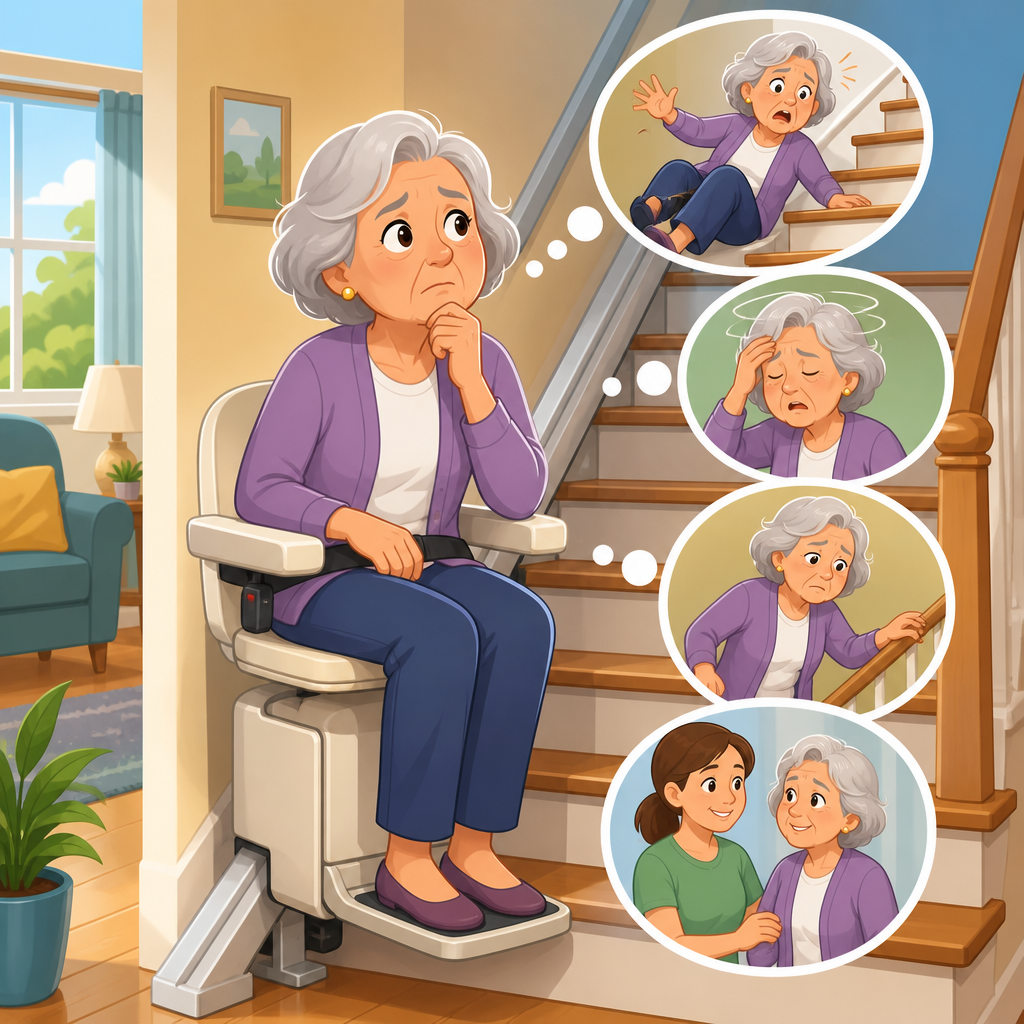
A stair lift can preserve independence for years, but there comes a point when a senior should stop using a stair lift without assistance because the risk of falls, transfers, or medical events begins to outweigh the convenience. Families often ask this question after a near miss: a shaky transfer onto the seat, confusion about the controls, or a moment when the rider forgot to fasten the seat belt. In my work reviewing home mobility setups, those warning signs matter more than the calendar. Age alone does not determine safe stair lift use. Functional ability does.
Understanding when independent use is no longer safe starts with clear definitions. A stair lift is a motorized chair or perch that travels along a rail fixed to the staircase. “Without assistance” means the rider can approach the lift, sit down, secure the belt, operate the controls, ride safely, swivel at the landing, stand up, and walk away without another person physically cueing, steadying, or supervising. “Assistance” may be hands-on help, standby supervision, or remote monitoring, depending on the senior’s condition. The key issue is not whether the lift still runs. The issue is whether the entire transfer process remains safe from start to finish.
This matters because most stair lift incidents do not happen during the ride itself. They happen while getting on or off, when balance, judgment, leg strength, and attention are under stress. A powered seat cannot correct unsafe transfers, unmanaged dizziness, or cognitive lapses. Product standards such as ASME A18.1 and manufacturer guidance focus on equipment safety, but safe outcomes also depend on the user’s physical and cognitive capacity. That is why this topic sits at the center of user safety best practices. It connects maintenance, caregiver training, fall prevention, emergency planning, and medical reassessment into one practical decision: can this person still use the stair lift independently today?
The safest approach is to treat stair lift independence as a functional skill that should be reviewed regularly, especially after hospitalization, a fall, medication changes, or a new diagnosis. The rest of this guide explains the warning signs, the core safety criteria, the role of caregivers and clinicians, and the alternatives when solo use is no longer appropriate.
What makes independent stair lift use safe or unsafe
A senior should stop using a stair lift without assistance when any part of the sequence becomes unreliable. Safe use requires six abilities: stable approach to the chair, controlled sitting, correct use of the seat belt, accurate control operation, safe swivel and exit at the landing, and enough judgment to respond to problems. If one link fails, the whole task becomes unsafe. I have seen lifts in excellent mechanical condition become high-risk because the rider could no longer pivot safely onto the seat or forgot that the chair needed to lock before standing.
Transfer ability is usually the deciding factor. The rider should be able to back up to the seat, reach the armrest securely, lower down without collapsing, keep feet positioned on the footrest, then reverse the process at the top or bottom landing. Difficulty standing from a seated position, poor trunk control, freezing episodes from Parkinson’s disease, severe arthritis pain, or a tendency to grab moving parts are major red flags. A stair lift is not a substitute for transfer assistance equipment. If a person needs significant lifting help to sit or stand, independent stair lift use is no longer appropriate.
Cognition matters just as much as strength. The user must remember the sequence, recognize where the chair is parked, lock in attention long enough to ride, and avoid impulsive actions such as unbuckling early or trying to step off before the chair is fully positioned. Mild forgetfulness is not always disqualifying, but progressive dementia, delirium, poor safety awareness, or visual-spatial confusion can make solo use dangerous quickly. In practice, families often underestimate this risk because the ride looks simple. The sequence is simple only when the user can process it consistently.
Medical stability is another threshold. Dizziness, orthostatic hypotension, uncontrolled diabetes, seizures, fainting history, shortness of breath on exertion, or recent stroke symptoms all change the safety picture. If a senior becomes lightheaded during transfers or has unpredictable weakness, a stair lift ride may end in a fall at the landing. Hearing and vision also matter. The user should be able to see the seat position, footrest, and landing clearly, and hear alarms or caregiver instructions if needed.
Warning signs that independent use should stop now
The most important warning signs are recent falls, near falls, or botched transfers involving the stair lift. One incident may be enough if it reveals a clear loss of capacity. For example, if the rider slid off the seat while trying to sit, stood before the seat finished swiveling, or could not place both feet on the footrest, the risk is already established. Families should not wait for a second event to confirm what the first one made obvious.
Other clear signs include forgetting the seat belt, confusion about the direction switch, leaning sideways during travel, repeated foot drag on the stairs, panic while riding, and inability to rise from the seat at the landing. Watch for slower, less obvious decline too. A senior who once used the lift smoothly may begin bracing against the wall, using furniture to pull up, asking repeated questions, or needing verbal prompts every trip. Frequent calls for help from the top or bottom floor are not minor inconveniences. They are indicators that independent use has already ended in practice.
Behavior changes can be just as telling as physical changes. Increased impatience, nighttime wandering, rushing to answer the door or bathroom urgency can lead a rider to skip safe steps. Sedating medications, alcohol use, poorly timed sleep aids, and opioid pain medication raise the risk further. I pay close attention after hospitalization because deconditioning and medication adjustments often create a sudden drop in transfer safety that families did not anticipate.
| Warning sign | Why it matters | Recommended response |
|---|---|---|
| Recent fall or near fall during transfer | Shows loss of safe sitting or standing control | Stop solo use and arrange reassessment |
| Forgets seat belt or controls | Indicates cognitive or attention decline | Require supervision and medical review |
| Dizziness when standing | Raises risk of collapse at the landing | Check blood pressure, medications, hydration |
| Needs repeated verbal cues | Suggests independent sequence is no longer reliable | Shift to assisted use |
| Cannot stand up from seat smoothly | Transfer strength is inadequate | Consult physical or occupational therapy |
| Nighttime confusion or wandering | Greatly increases unsupervised misuse risk | Restrict solo access and add monitoring |
If any of these signs are present, the practical answer is straightforward: pause solo use until the cause is understood. That pause may last a day while a medication issue is corrected, or it may become permanent after a broader decline. Either way, the decision should be driven by function, not optimism.
How to assess stair lift readiness at home
A good home assessment looks at the whole pathway, not just the chair. Start by observing one full trip from approach to exit. Can the senior walk to the lift with a cane or walker safely? Is there enough landing space to turn? Does the chair park in a position that allows a controlled sit? Are armrests, footrest, and swivel seat used correctly? Does the rider rise without pulling dangerously on the rail or nearby furniture? I recommend documenting these observations rather than relying on memory. Patterns emerge quickly when families write down what happened over several days.
Use a simple pass-or-fail standard: the task must be completed safely, consistently, and without hands-on rescue. “Usually okay” is not good enough for stairs. The rider should also be able to state what to do if the lift stops midtravel, where the key switch is if applicable, and how to call for help. Most manufacturers include manuals and troubleshooting labels; those are useful, but they do not replace direct observation.
Environmental factors often tip a marginal situation into an unsafe one. Poor lighting at either landing, loose rugs, pets underfoot, narrow hallways, low battery charge, or clutter near the swivel exit point can turn a manageable transfer into a hazardous one. As part of user safety best practices, remove trip hazards, improve contrast on the landing edge, and make sure call-send controls are reachable. If the senior uses a walker, confirm there is a stable place for it at both ends of the staircase. Nowhere to place the walker means the transfer ends with an unsupported first step.
When the answer is uncertain, involve rehabilitation professionals. Occupational therapists are especially useful because they assess transfers, cognition, home layout, and device fit together. Physical therapists can evaluate lower-body strength, gait, orthostatic symptoms, and endurance. Their input helps families avoid the common mistake of focusing on the machine when the problem is really balance, vision, medication burden, or post-hospital weakness.
When supervision is enough and when hands-on help is required
Not every decline means the stair lift must be abandoned. Some seniors remain safe with standby supervision. That level may be appropriate when the user is physically capable but needs reminders to slow down, buckle up, or wait for the seat to lock. In those cases, a caregiver can supervise transfers at the top and bottom, verify foot placement, and stay close without lifting. This is often a workable bridge after a brief illness or during medication adjustment.
Hands-on help is required when the user needs physical steadying, lifting, or repeated cueing that affects execution. If the caregiver must guide the hips onto the seat, support the trunk, block the knees, manage a walker, or prevent premature standing, independent use has ended. At that point, the care plan should say so plainly. Ambiguous habits such as “Mom can still use it if someone is nearby” lead to inconsistent risk management across family members and aides.
There is also a point where even assisted stair lift use is not the best option. If transfers require substantial physical support, if the senior cannot follow one-step commands, or if behavior is unpredictable, the safer solution may be relocating sleeping space to the main floor, using a hospital bed downstairs, or considering a home elevator or vertical platform lift if wheelchair access is needed. These options are not overreactions. They are appropriate escalations when the transfer burden exceeds what a stair lift was designed to handle.
Medical conditions and medication changes that often change the answer
Several diagnoses frequently trigger the shift from independent to assisted use. Dementia is the most obvious because it affects sequencing, judgment, and impulse control, but Parkinson’s disease, stroke, diabetic neuropathy, vestibular disorders, severe arthritis, heart failure, and frailty syndrome are just as relevant. After a stroke, a rider may recover enough leg movement to seem independent while still lacking trunk balance or neglecting one side of the body. With Parkinson’s disease, a good morning can be followed by freezing and delayed initiation later in the day. Variable conditions demand time-of-day awareness and conservative planning.
Medication changes are one of the most overlooked causes of sudden stair lift risk. Antihypertensives can increase orthostatic dizziness. Benzodiazepines and sleep medications slow reaction time. New pain medications can impair alertness. Diuretics can create urgent rushing to the bathroom, which causes people to skip the seat belt or stand before the swivel is secure. Any new confusion, grogginess, or balance change within days of a prescription adjustment should prompt immediate review before independent stair lift use continues.
Acute illness matters too. Dehydration, urinary tract infection, low blood sugar, pneumonia, and postoperative weakness can all temporarily remove the capacity for safe transfers. Families often think in permanent terms only, but a temporary stop is a smart safety practice. Resume solo use only after the rider demonstrates safe performance again.
Best practices for families, caregivers, and service providers
The best safety plans are specific. Create a written rule for who may use the stair lift alone, under what conditions, and what to do if those conditions change. Include items such as required footwear, seat belt use every trip, no carrying laundry or pets, and no use during dizziness, illness, or nighttime confusion. Post emergency numbers near both landings and make sure the senior has a phone or alert pendant within reach. If the unit has a key lock, use it when unsupervised access is unsafe.
Maintenance supports safety but does not replace judgment. Keep the lift serviced according to the manufacturer schedule, test seat swivel locks, armrests, footrest safety edges, battery charging points, and call-send controls, and respond quickly to unusual noises or error codes. A chair that stops reliably is essential, but a perfectly maintained stair lift can still be the wrong tool for a user whose abilities have changed. That distinction should guide every maintenance and troubleshooting conversation in this safety hub.
Finally, revisit the decision regularly. A monthly family check-in is reasonable for stable users; weekly review is better after recent illness or decline. Independent stair lift use should continue only when the senior can complete every step safely and consistently. If not, add supervision, shift to hands-on assistance, or transition to a safer alternative before the next near miss becomes a serious injury. Review your current setup today and decide whether the lift still matches the user, not just the staircase.
Frequently Asked Questions
1. When should a senior stop using a stair lift without assistance?
A senior should stop using a stair lift alone when the ride itself is no longer the main issue, but the transfer on and off the seat becomes unsafe. In most homes, the highest risk is not the lift moving up or down the stairs. It is sitting down safely, fastening the seat belt, staying properly positioned during the ride, and standing up steadily at the landing. If a person has started to wobble during transfers, forgets the basic steps, leans dangerously, cannot reliably operate the controls, or has had a recent near fall, that is a strong sign that independent use should be re-evaluated right away.
Other major warning signs include worsening balance, leg weakness, dizziness, slowed reaction time, confusion, poor judgment, blackouts, frequent fatigue, or new medical symptoms such as shortness of breath or tremors. A senior who once used the lift confidently may no longer be safe alone after a hospitalization, stroke, medication change, or progression of dementia or Parkinson’s disease. The key point is that age by itself is not the deciding factor. Function is. If safe use depends on luck, timing, or “good days,” assistance is usually the safer choice.
Families should also pay attention to patterns, not just one dramatic event. Repeatedly missing the seat, forgetting the footrest position, riding without the seat belt, becoming anxious midway, or struggling to stand at the top landing are all practical signs that supervision or hands-on help may now be needed. When these issues appear, it is wise to pause independent use and arrange a formal assessment by an occupational therapist, physical therapist, physician, or qualified mobility professional.
2. What are the biggest warning signs that a stair lift is no longer safe to use alone?
The biggest warning signs are usually visible during the moments just before and after the ride. A senior may still say, “I can do it,” but if they need to grab walls, pull on the armrest to stand, drop into the seat heavily, or cannot pivot safely at the landing, those are serious red flags. Transfers require coordination, balance, strength, and judgment. When any of those decline, the risk rises quickly.
Some of the most important warning signs include frequent near falls, poor sitting balance, forgetting to lock into position, leaving the seat belt unfastened, confusion about which button to press, trouble understanding whether the chair is fully parked, and panic or hesitation while using the lift. If the person starts a transfer before the chair is in the right position, tries to step around the footrest unsafely, or stands up too early, independent use may no longer be appropriate.
Medical and cognitive changes matter just as much. Episodes of dizziness, fainting, sudden weakness, urinary urgency that causes rushing, vision loss, slowed processing, memory impairment, and reduced awareness of danger all increase the chance of an accident. Family members should also take note if the senior minimizes incidents, becomes defensive, or cannot accurately describe what happened during a close call. In practice, one near miss can be a warning, but repeated close calls usually mean the margin of safety is already too small.
3. Can a senior with dementia, Parkinson’s, or balance problems still use a stair lift independently?
Sometimes, but only if they can consistently follow every step safely and predictably. A diagnosis alone does not automatically rule out independent stair lift use. What matters is whether the person can approach the chair, sit down securely, position their feet correctly, fasten the seat belt, use the controls properly, remain seated upright, and stand up safely every single time. With conditions like dementia, Parkinson’s disease, neuropathy, vertigo, or generalized frailty, that ability can change gradually or fluctuate from day to day.
With dementia, the main concern is often judgment and sequencing. A senior may forget the seat belt, become confused about the controls, attempt to get off before the ride is complete, or fail to recognize danger. With Parkinson’s disease, freezing, shuffling, postural instability, tremor, and off-periods can make transfers unpredictable. With balance disorders or leg weakness, the risk may be highest at the top of the stairs, where a misstep can have severe consequences. In all of these situations, independent use may still be possible for a time, but only if performance is stable and reliable, not occasional.
If the family notices inconsistency, fear, impulsive behavior, or dependence on furniture or another person during transfers, supervised use is safer. In many cases, the next best step is not guessing but arranging a skilled evaluation. A therapist can observe the exact mechanics of getting on and off the lift, determine whether assistive strategies could help, and identify when hands-on assistance is necessary. For many families, that assessment brings much-needed clarity and reduces the risk of waiting too long to make a change.
4. What should families do after a near miss or minor incident on a stair lift?
Take it seriously, even if no one was injured. Near misses are often the clearest early warning that independent use may no longer be safe. A shaky transfer, a missed seat, forgetting the seat belt, pressing the wrong control, or stumbling when stepping off should not be brushed off as “just one bad moment.” Those incidents usually point to a larger problem involving strength, coordination, judgment, fatigue, medication effects, or cognitive decline.
The safest immediate response is to stop solo use until the situation is reviewed. Ask exactly what happened, where the difficulty occurred, and whether this has happened before. Watch the senior demonstrate each part of the process if it is safe to do so, including approaching the chair, sitting, fastening the belt, operating the controls, and standing at the landing. Also review outside factors: Was the lighting poor? Were they rushing? Have medications changed? Have there been recent falls, infections, dehydration, hospital stays, or worsening memory problems? These details matter because a mobility setup that worked well six months ago may no longer fit the person’s current abilities.
Next, involve professionals rather than relying only on family impressions. A physician can review medical contributors. A physical or occupational therapist can assess balance, transfers, and cognition in the home environment. A stair lift dealer or service technician can inspect the equipment to make sure the seat, swivel, footrest, armrests, controls, and safety features are functioning properly. The goal is not to remove independence prematurely, but to prevent a more serious event by responding early and thoughtfully.
5. If a senior should not use a stair lift alone anymore, what are the safest alternatives?
The safest alternative depends on why independent use has become unsafe. If the main issue is mild unsteadiness during transfers, supervised use or hands-on assistance from a trained caregiver may be enough. In other cases, simple environmental and routine changes help, such as improving lighting, reducing clutter near the top and bottom landings, scheduling use only when the senior is rested, and reviewing a consistent step-by-step routine. Some people benefit from therapy to improve transfer mechanics or from a medical review to address dizziness, medication side effects, or fluctuating blood pressure.
If the problem is more significant, families may need to consider a larger change in the home setup. That could mean moving the bedroom to the main floor, adding a bathroom on the primary living level, increasing caregiver support, or using a different accessibility solution altogether. The right choice depends on the senior’s prognosis, cognitive status, transfer ability, and whether another person is realistically available to assist every time. For someone with progressive memory loss, repeated falls, or unpredictable medical episodes, relying on solo stair lift use is often no longer a sound long-term plan.
What matters most is matching the mobility tool to the person’s current abilities, not to what worked in the past. Families often hesitate because stopping independent stair lift use can feel like a loss of freedom. In reality, making the change at the right time is often what protects independence in the bigger picture. Preventing a major fall, head injury, or emergency on the stairs is far better than waiting until a crisis forces the decision.