Choosing the best stair lifts for tall users starts with two measurements many buyers overlook: seat height and legroom. Tall riders often fit the weight limit yet still feel cramped because their knees sit too high, the seat pan is too shallow, or the footrest forces an awkward hip angle. In practical terms, seat height is the distance from the folded or deployed seat base to the footrest or floor reference, while legroom is the usable space from the backrest to the front edge of the footrest area. Those dimensions matter because a stair lift is not just transportation; it must allow safe sitting, standing, and riding on narrow stairs without joint strain. After comparing manufacturers, dealer specifications, and in-home fit issues I have seen repeatedly, one point is clear: the best stair lift for a tall user is usually the model with the best overall geometry, not simply the highest published weight capacity. This guide compares the leading options, explains the measurements that actually affect comfort, and helps you choose a stair lift that works for long legs, taller torsos, and bigger shoe sizes.
What tall users should measure before comparing stair lifts
Tall users should measure four things before looking at brands: seated knee angle, hip-to-knee length, lower leg length, and stairway clearance. In homes I have assessed, people over about 6 feet often focus on maximum user height, but many manufacturers do not publish a formal height limit. Instead, fit depends on whether the rider can sit back fully, place both feet securely on the footrest, and stand up without excessive knee flexion. A higher seat can reduce the effort required to stand, especially for users with arthritis, limited quadriceps strength, or previous hip replacement. More legroom matters during travel because knees that project too far forward can feel unstable, particularly on steeper staircases.
The most useful home test is simple. Sit in a straight dining chair, measure from the seat back to the front of your bent knee, then from the floor to the underside of your thigh at the seat edge. Add shoe size and preferred posture. That gives a realistic baseline for comparing stair lift seat depth, seat height, and footrest distance. Also measure stair width. Most straight stair lifts need at least about 27 to 30 inches of staircase width, but a tall user may benefit from more clearance if knees extend forward. On curved stairs, overrun sections and parking positions become even more important because they create safer mounting space at the top or bottom landing.
Seat height, seat depth, and footrest position: the dimensions that decide comfort
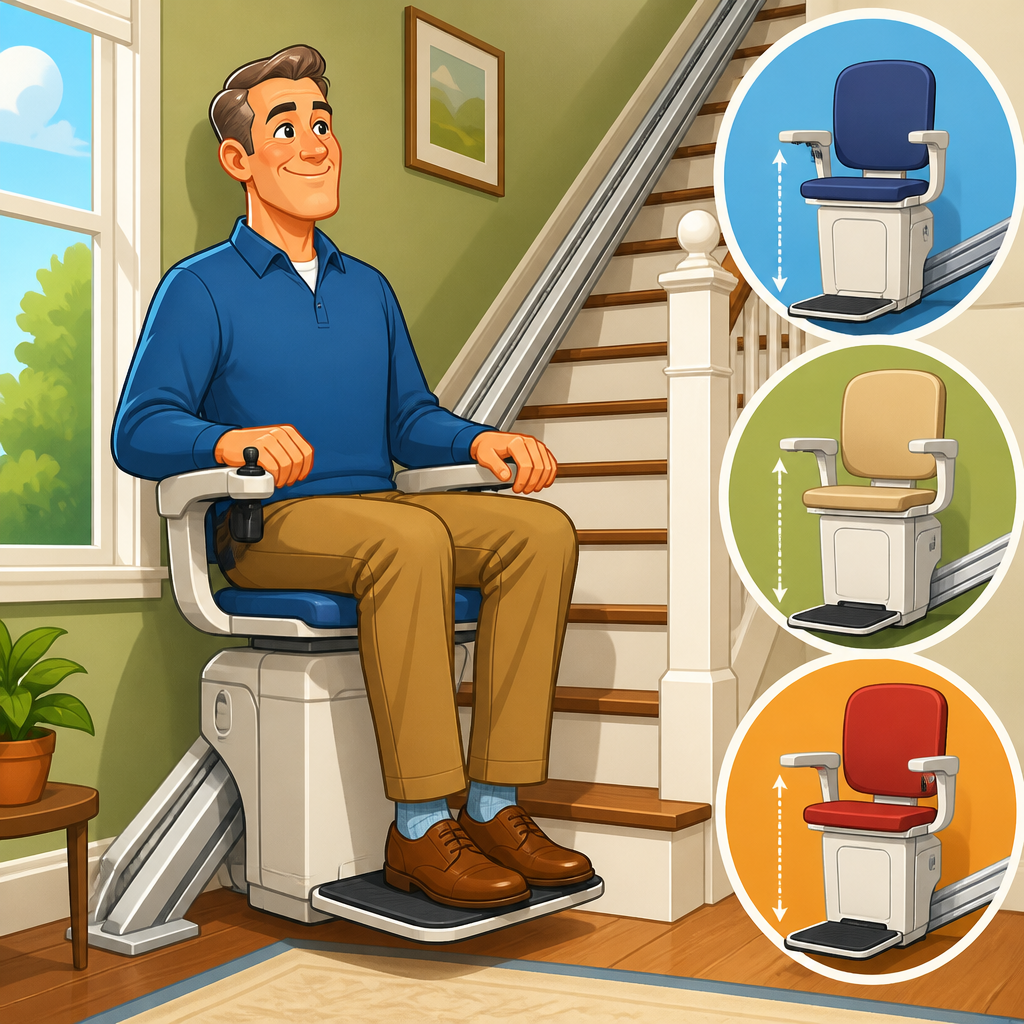
Seat height and legroom are related, but they are not the same. A stair lift can have a relatively generous seat height while still feeling cramped if the footrest sits too close to the seat or the carriage geometry brings the rider’s knees upward. The best stair lift for a tall user typically combines a higher perch, adequate seat depth, a stable backrest angle, and a footrest that supports larger feet without forcing external rotation at the hip. In real installations, this is why test rides matter. Two models can look similar on paper yet feel completely different once a 6-foot-3 rider sits down.
Seat depth is often underrated. If the seat pan is too short, the rider loses thigh support, which increases pressure under the hips and can make the ride feel less secure. If it is too deep, shorter household members may struggle to sit back fully. That is why adjustable or optional seats are useful in mixed-height homes. Footrest size also matters for tall users because large shoes can hang over a short plate, and that increases the chance of catching a toe when mounting or dismounting. Powered footrests are not a fit feature by themselves, but they reduce bending, which becomes more important when a higher seat is selected for easier standing.
Best stair lifts for tall users: leading models compared
The models below are the strongest starting points for tall riders because they are widely available in North America, supported by established dealer networks, and known for better-than-average comfort geometry. Specifications vary by rail configuration and seat option, so final fit should always be confirmed by a local dealer. Still, these comparisons reflect the patterns I see most often in straight stair lift recommendations.
| Model | Why tall users consider it | Seat and legroom notes | Best fit scenario |
|---|---|---|---|
| Bruno Elite Straight | High weight capacity, wide seat, robust chassis | Comfortable seat height and roomy feel for longer legs; generous footrest area | Tall or larger users who want stability and easier sit-to-stand transfers |
| Harmar Pinnacle SL600HD | Heavy-duty straight lift with familiar dealer support | Good seat access and solid platform, though exact legroom depends on setup | Tall users needing higher capacity and straightforward controls |
| Stannah Sadler or Siena variants | Strong ergonomic options, especially posture-focused seating | Seat style can improve knee angle; compact rail helps in tighter stairways | Tall users with joint stiffness or difficult standing mechanics |
| Handicare 110/1000 series | Popular compact designs with multiple seat choices | Fit depends heavily on selected seat; some setups suit longer legs better than others | Homes balancing stair clearance with moderate tall-user comfort needs |
| Savaria K2 | Well-known straight lift with practical configuration options | Supportive ride quality; evaluate seat depth carefully during demo | Tall users prioritizing smooth travel and established service availability |
For many tall users, the Bruno Elite Straight consistently ranks near the top because it combines a substantial seat, a planted feeling in motion, and a layout that tends to accommodate longer femurs better than compact entry-level lifts. It is often the first model I mention when a client says, “I can fit, but I do not want to feel folded up.” The Harmar Pinnacle heavy-duty option is another strong candidate, especially when weight capacity and durable construction are both priorities. Stannah deserves attention because its seating ergonomics can solve fit problems that raw dimensions alone do not explain, particularly for riders with painful knees who need a more open transfer position.
Straight stair lifts versus curved stair lifts for tall riders
Tall-user fit becomes more complicated on curved stair lifts because the rail path, parking positions, and seat orientation can change the transfer angle. On a straight stair lift, you can usually judge comfort by seat geometry and staircase width. On a curved stair lift, the best model is often the one that creates the safest mount and dismount point at the landings. A tall rider may need a powered swivel seat, a longer overrun, or a custom parking location to avoid twisting while standing. These features affect both comfort and fall risk.
Curved systems from Stannah, Handicare, Access BDD, and Bruno can all work well for tall users, but the rail design is custom-built, so general rankings are less reliable than with straight models. In practice, I advise tall riders to prioritize the transfer sequence over the brochure dimensions. Can you place both feet flat? Do your knees clear the wall, banister, or opposite side of the staircase? Can you rise from the seat without pitching forward? A curved stair lift that answers yes to those questions is better than one with a slightly larger seat on paper but an awkward landing position. This is especially true in split-level homes and staircases with pie-shaped treads.
Which features matter most if you are over 6 feet tall
If you are over 6 feet tall, prioritize adjustable or higher seat height, deeper or more supportive seat construction, a larger footrest, and a swivel mechanism that leaves enough room for your knees. Many buyers assume armrest width is the key comfort factor, but for tall users, the critical issue is usually lower-body geometry. A seat that is too low increases the force needed to stand. A footrest that sits too high can compress the knees. A shallow seat can leave the rider feeling perched rather than supported.
Look closely at call/send controls, folding dimensions, and obstruction sensors too. Taller riders often have larger feet, and larger feet are more likely to interact with the edges of the footrest or nearby trim when boarding. In narrower homes, a hinge rail at the bottom may be necessary to prevent a trip hazard, but it should not compromise the rider’s preferred seat position. Battery-powered stair lifts are now standard from most major brands, which means they operate during a power outage and charge at parked points on the rail. That system does not change fit directly, but it does improve reliability, which matters when the user depends on the lift several times a day.
Ranking by use case: best overall, best heavy-duty, best for narrow stairs, best ergonomic seat
The best stair lift for tall users is easier to choose when you rank by use case instead of searching for one universal winner. Best overall for many tall riders is the Bruno Elite Straight because it reliably feels roomy, stable, and easier to stand from than many compact designs. Best heavy-duty option often goes to the Harmar Pinnacle SL600HD, which is a practical choice when user size, transfer confidence, and dealer familiarity all matter. Best for narrow stairs usually lands with compact systems such as Handicare’s slim-profile lines, though tall riders must verify that the space-saving design does not reduce comfort too much.
Best ergonomic seat often points toward Stannah because the company’s seating approach can improve posture and transfer mechanics in ways that matter disproportionately for tall users with limited joint mobility. That category is important because a tall rider does not always need the biggest-looking stair lift; sometimes they need the model that keeps the knees lower and the torso more upright during boarding. Savaria remains a dependable middle-ground option when buyers want a recognized brand with a smooth ride and balanced feature set. The right ranking, then, depends on whether your priority is maximum room, easier standing, staircase clearance, or custom transfer support.
Common mistakes tall buyers make when choosing a stair lift
The first mistake is buying by weight capacity alone. A 400-pound rating does not guarantee tall-user comfort. The second mistake is ignoring the transfer. People test the ride but do not pay enough attention to sitting down and standing up, which is where poor seat height becomes obvious. The third mistake is assuming every dealer stocks every seat option. Some brands offer alternative seats, larger footrests, or powered components, but local availability varies.
Another common mistake is not involving the tallest household member in the final fitting. If multiple people will use the lift, choose the seat geometry around the least forgiving body mechanics, not the average user. Finally, do not skip service questions. Ask who installs the lift, how long parts take, whether annual maintenance is recommended, and what happens if batteries fail. A stair lift is durable medical equipment in daily life, even when sold through accessibility dealers rather than clinical channels. Fit, safety, and support matter more than a small upfront price difference.
How this hub helps you compare the full category
As a hub under chair lift types and designs, this guide is meant to anchor comparative and ranking content for buyers who need more than a generic product roundup. The stair lift market is full of broad “best of” lists that ignore rider height, seat geometry, and the difference between straight and curved installations. This page narrows the field to the factors that actually change comfort for tall users, then points you toward the right comparison path: heavy-duty versus standard, compact versus roomy, ergonomic seating versus raw capacity, and straight versus custom curved solutions.
Use this article as your starting framework whenever you review dealer quotes or related comparisons in this subtopic. If a model looks promising, ask for the exact seat option, footrest dimensions, folded width, and transfer setup for your staircase. A good dealer should be able to explain why a specific configuration suits your height, not just repeat catalog language. That clarity saves money, prevents returns, and leads to a stair lift you can use safely every day.
The best stair lifts for tall users are the ones that solve fit at the seat, knees, feet, and landing, not just on a specification sheet. Seat height affects how easily you stand. Legroom affects comfort and stability during travel. Seat depth, footrest size, swivel clearance, and staircase width all shape whether a tall rider feels secure or cramped. Across the current market, Bruno often stands out for roomy straight-lift comfort, Harmar is strong for heavy-duty needs, Stannah excels in ergonomic seating, Handicare can work well where stairs are tight, and Savaria offers a balanced mainstream option when configured carefully.
The main benefit of comparing stair lifts this way is simple: you avoid paying for a model that technically fits the staircase but does not fit the rider. Start with your body measurements, then confirm the transfer sequence in person, and insist on a clear explanation of seat height and legroom before you buy. If you are building out your shortlist under the broader chair lift types and designs category, use this hub as the baseline and move next to model-specific comparisons and dealer-fit evaluations for your home.
Frequently Asked Questions
Why are seat height and legroom so important when choosing a stair lift for a tall user?
For tall users, comfort and safety depend on more than just the published weight capacity. A stair lift may technically support a taller rider’s body weight, yet still feel cramped or awkward if the seat height is too low, the seat pan is too short, or the footrest sits too close to the chair. When that happens, the rider’s knees may rise above the hips, the thighs may not be fully supported, and the hip and knee joints can stay bent at an uncomfortable angle throughout the ride.
Seat height matters because it affects how naturally a person can sit down and stand up. A taller user usually needs a higher seating position to avoid feeling like they are dropping into a low chair. Legroom matters because it determines whether the user’s knees and lower legs have enough space without pressing too tightly against the footrest or forcing the feet into an unnatural placement. If either measurement is off, the stair lift can feel unstable even if the actual ride is mechanically smooth.
These dimensions also influence everyday usability. A lift that is uncomfortable for a 30-second ride can become frustrating when used multiple times per day. In some cases, poor fit can even make transfers less safe, especially for users with limited balance, arthritis, hip stiffness, or prior knee replacements. For tall riders, the best stair lift is usually the one that provides a more open seated posture, better thigh support, and a footrest position that does not force the knees too high. That is why comparing seat height and legroom should be one of the first steps in the buying process, not an afterthought.
How do I measure seat height and legroom correctly before comparing stair lift models?
The best approach is to measure both your body and the usable dimensions of the stair lift, then compare the two. For seat height, start by measuring from the floor to the back of your knee while wearing the shoes you would normally use on the stairs. This is often called the popliteal height, and it gives a practical baseline for how high a seat should be to support a comfortable sitting and standing motion. For many tall users, a seat that is too low is immediately noticeable during transfers, even before the ride begins.
For legroom, measure from your lower back to the back of your knee, and then consider the distance from the stair lift’s backrest to the front edge or usable area of the footrest. You also want to account for where your feet will actually rest, because a large-looking footrest does not always translate into more usable leg space if the geometry forces your knees upward. A stair lift dealer should be able to provide exact dimensions for seat-to-footrest distance, seat depth, and backrest position.
It is also smart to simulate the seating position in person when possible. Sit in the chair with your feet flat on the footrest and check whether your thighs are well supported, whether your knees feel excessively bent, and whether you can rise from the seat without straining. If the model has a swivel seat at the top landing, test that motion too, since taller users sometimes discover their knees or shins feel crowded during the dismount rather than during the ride itself.
Finally, remember that stair lift geometry varies between models. Two units can have similar weight ratings but very different seating ergonomics. Ask for exact numbers, not just general claims like “comfortable for most users.” Precise measurements are what help tall buyers avoid a lift that fits on paper but feels restrictive in real use.
What stair lift features usually help tall users get better comfort and leg positioning?
Tall users generally benefit most from a combination of higher seat height, deeper or better-shaped seat support, and more generous space between the backrest and footrest. A well-designed seat should support the thighs without feeling too short, because a shallow seat pan can leave taller riders feeling perched rather than properly seated. The best models for taller individuals often create a more open hip and knee angle, which reduces that cramped feeling many people notice right away.
Another useful feature is an adjustable or thoughtfully positioned footrest. The footrest does more than support the feet; it plays a major role in determining knee bend and overall riding posture. If the footrest sits too close or too high relative to the seat, the user may feel folded up during the trip. On the other hand, a better-spaced footrest can make the same ride feel much more natural. Some models also offer power footrests or folding options, which are more about convenience, but they can still improve daily usability for taller riders who do not want to manually reposition a tight or awkward platform.
Seat-to-stand ease is another major factor. Taller users should look for a stair lift with a seat height that allows them to rise with minimal strain on the knees and hips. A swivel seat with secure locking positions is especially important at the top landing, where safe exit matters most. Armrest placement can help as well; supportive armrests make standing easier, but they should not crowd the torso or force the rider into a narrow sitting posture.
In addition, pay attention to overall ride position rather than focusing on one spec alone. A stair lift can have a decent seat height but still feel tight if the backrest angle, seat depth, and footrest spacing are not balanced. For tall users, the best comfort usually comes from a model that offers a more open, supportive seating geometry across all of these components.
Is a heavy-duty stair lift always the best choice for a tall person?
Not necessarily. Heavy-duty stair lifts are often worth considering because they may have wider seats, stronger frames, and sometimes more generous overall dimensions. However, “heavy-duty” does not automatically mean “best for tall users.” Many buyers assume that a higher weight capacity will also provide better legroom or a higher seating position, but that is not always true. Some heavy-duty units are designed primarily for load support and seat width, not for longer legs or taller body proportions.
For a tall user, the more important question is how the lift fits in motion and during transfers. A wider seat can actually be less helpful if the seat height is still too low or the footrest remains too close. In some cases, a standard model with better seat geometry may fit a tall rider better than a bariatric or heavy-duty version. This is why it is important to review dimensional specifications such as seat height, seat depth, backrest shape, and seat-to-footrest distance rather than relying only on category labels.
There are also installation considerations. Heavy-duty stair lifts often require more staircase width and may fold to a larger profile when not in use. If space is limited, choosing a larger model without clear ergonomic benefits may create unnecessary compromises. For households where multiple people use the stairs, folded clearance can be just as important as rider comfort.
The most reliable approach is to treat heavy-duty classification as one possible advantage, not the deciding factor. Tall users should prioritize real fit, safe transfers, and comfortable leg positioning. If a heavy-duty model offers those benefits, it may be an excellent choice. If it does not, a standard lift with better seat height and legroom can be the smarter option.
What should I ask a stair lift dealer or installer to make sure a model will actually fit a tall user?
Start by asking for exact measurements, not broad descriptions. You will want the seat height, seat depth, backrest height, armrest spacing, and the distance from the seat to the footrest. Ask how the manufacturer defines those numbers as well, because measurement methods can vary slightly. For example, one company may describe seat height differently depending on whether the seat is deployed, whether the footrest is included in the reference point, or how the cushion compresses under weight.
Next, ask whether the model can be test-sat before installation. For tall users, a live seating test is extremely valuable because comfort depends on body proportions, not just specs. Sit down, place both feet on the footrest, and check whether your knees feel too elevated, whether your thighs are fully supported, and whether the backrest allows you to sit naturally. Then test the swivel and standing motion at the top position if possible. That part of the experience is often where fit problems become obvious.
You should also ask whether there are optional seats, upgraded chair styles, or alternative configurations for taller riders. Some stair lift lines offer more than one seat design, and the difference can be significant. Inquire about staircase clearance too, especially if a model with better legroom projects farther into the stairway. A lift that fits the rider well still has to work safely within the home’s layout.
Finally, ask the dealer to explain how they assess fit during the in-home evaluation. A knowledgeable installer should be willing to discuss rider height, knee angle, transfer ease, shoe size, and any mobility limitations that affect boarding and exiting. The goal is not simply to install a stair lift that runs; it is to choose one that supports the tall user’s posture, comfort, and safety every single day.