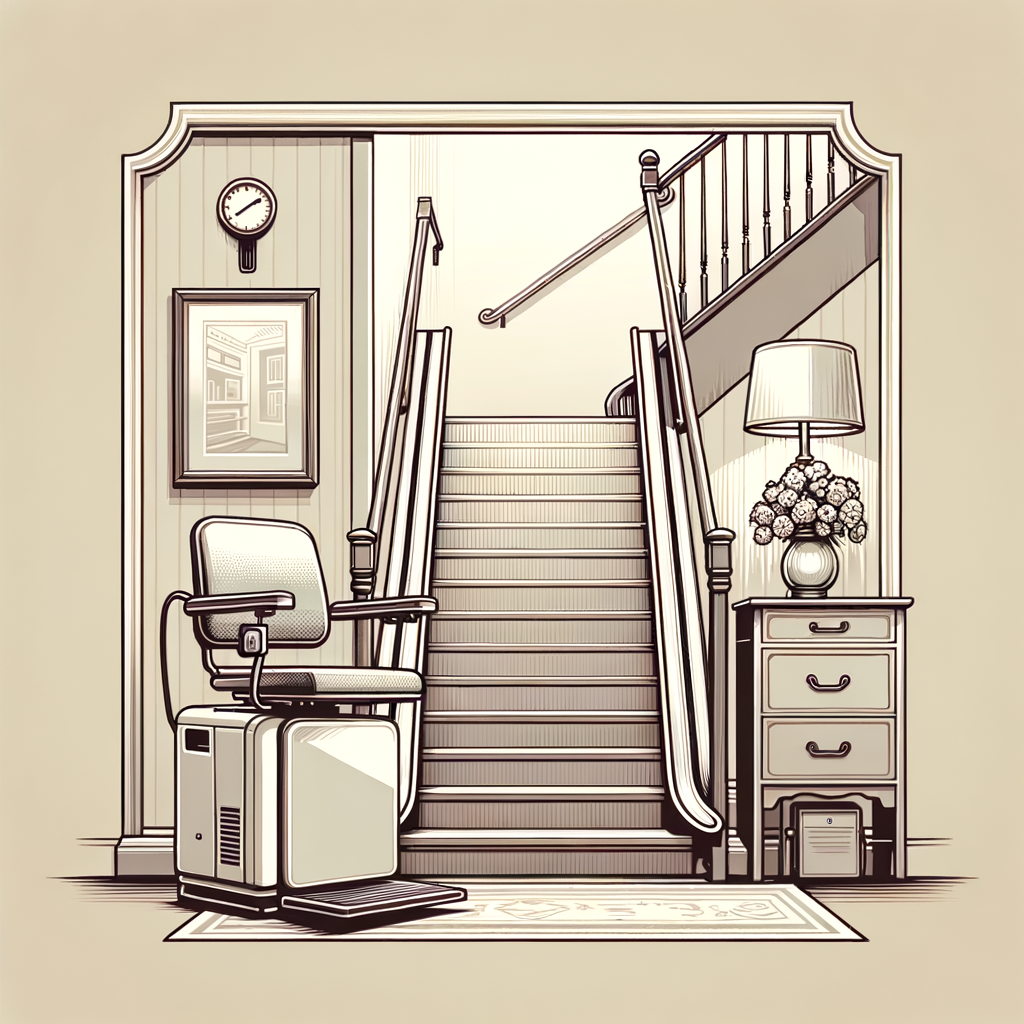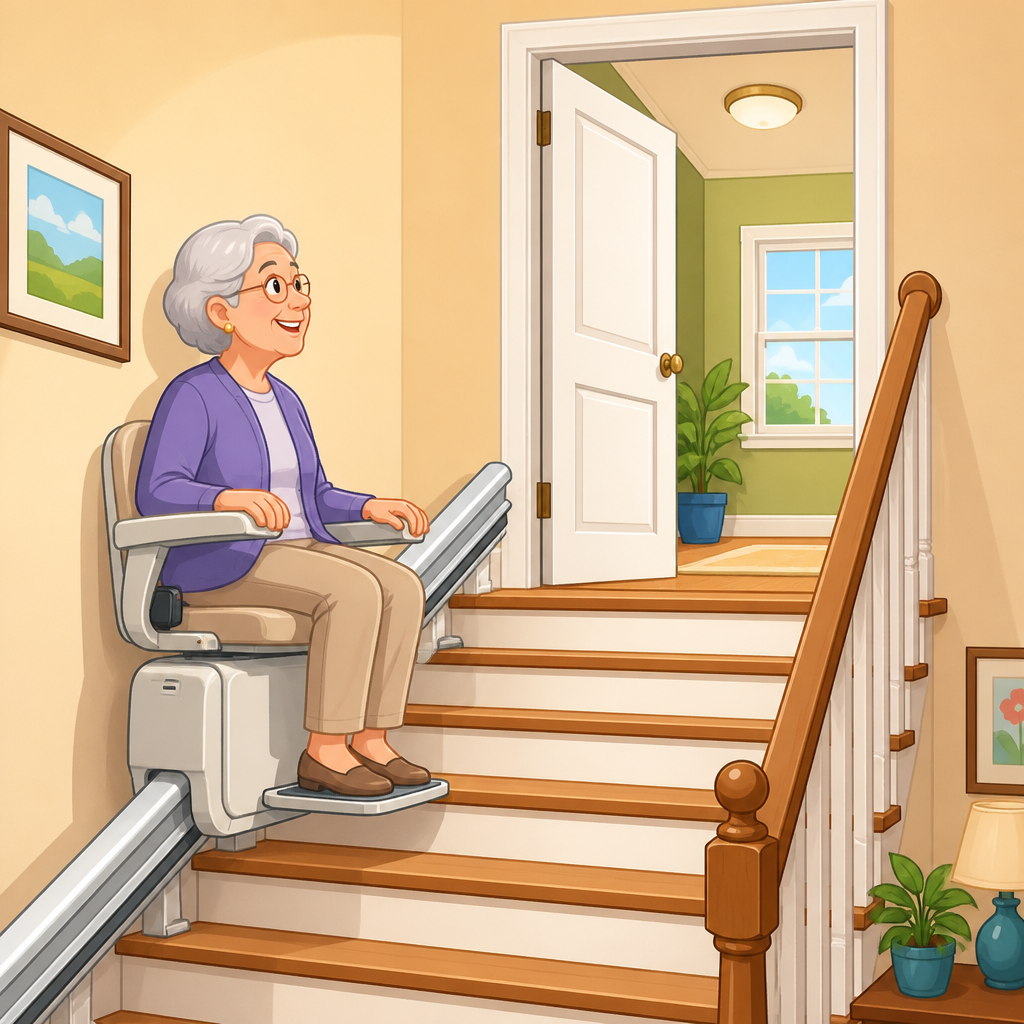
Yes, stair lifts can work on stairs with a doorway at the top, but the right solution depends on landing depth, door swing, track design, and how safely the user can get on and off the chair. In most homes I assess, the key question is not whether a lift can physically reach the top step; it is whether the rider can dismount onto a clear, stable space without blocking the doorway or creating a fall hazard. That distinction matters because a stair lift is a mobility device first and a construction product second. If the top exit point is cramped, the safest answer may be a hinged rail, a track overrun, a perch seat, or even a different lift layout altogether.
When people ask about a stair lift with a doorway at the top, they are usually describing one of three conditions: a door that opens directly onto the landing, a hallway door only a few inches from the final step, or a room entry positioned so close to the staircase that the chair appears likely to interfere with the door leaf. Each condition can be workable, but each requires measuring. Installers typically look at staircase width, top landing length, obstructions such as trim or radiators, electrical supply, user transfer ability, and whether the door opens inward or outward. Small details, like the location of a handrail bracket, can determine whether a standard straight rail fits or whether a custom curved system is needed.
This matters because top-of-stairs accidents are serious. A user who has limited balance, weak knees, or reduced vision needs a predictable unloading zone. The safest installations avoid twisting, backing up, or stepping sideways immediately beside the first drop. Good design also protects everyone else in the home by keeping the doorway usable and preserving egress. In houses where the stair lift serves an older adult aging in place, that one doorway may connect to a bedroom, bathroom, or main corridor, so usability affects daily life, not just lift operation. Understanding the available configurations helps families ask better questions before requesting quotes and avoid paying for a lift that solves one access problem while creating another.
How stair lifts handle a doorway at the top
A stair lift can stop before the doorway, level with the doorway, or beyond the top step on an overrun section of rail. The correct choice depends on clearance. A top overrun is often the best answer because it moves the chair away from the edge of the staircase and places the rider on the landing rather than above the stair void. On many straight stair lifts, the seat can swivel at the top, lock into position, and let the user stand facing the landing. If the door is close, the track may be extended so the chair parks beyond the staircase and away from the swing path.
In practice, I have seen standard straight lifts work well when there is at least modest landing space and the door does not conflict with the seat back, armrest, or user knees. Problems arise when a door opens toward the chair, when the landing is short, or when the rider uses a walker and needs room to turn. In those cases, manufacturers may specify a hinged rail, a manual or powered swivel seat, or a custom curved rail that turns the chair around the obstruction. Major brands such as Bruno, Handicare, Savaria, and Stannah all offer variations designed for difficult top landings, though available options differ by model and local dealer support.
What installers measure before saying yes
A reliable answer starts with a home survey. Installers usually measure from the top landing nose to the lower floor, but for doorway questions they also map horizontal clearances in inches. The critical dimensions include the distance from the top riser to the door casing, usable landing depth with the door closed and open, stair width, and the projection of the folded chair onto the stairs. They also note whether the user mounts from the left or right, because that affects armrest and swivel clearance. On curved stairs, they document turn radius and any intermediate landings.
Safety standards and manufacturer instructions matter here. In the United States, stair lifts are generally evaluated under ASME A18.1 platform and chairlift requirements, while local building and fire code concerns may affect placement near egress routes. A reputable installer will not rely on a brochure image alone. They will check whether the doorway remains operable, whether the folded footrest intrudes into walking space, whether there is a trip risk from the rail end, and whether the rider can maintain three points of contact during transfer. If a salesperson gives an immediate yes over the phone without asking for landing photos or dimensions, treat that as a warning sign.
Common solutions for top-doorway conflicts
Most top-doorway issues fall into a short list of engineering solutions. The best one is the one that gives the rider a stable exit while preserving normal door use for everyone else.
| Solution | How it works | Best use case | Main tradeoff |
|---|---|---|---|
| Top overrun | Rail extends onto landing so the chair stops past the top step | Door is close to stair edge but landing has extra length | Needs clear floor space at the top |
| Swivel seat | Seat turns away from stairs for safer exit | User needs a forward standing position on the landing | Requires arm and trunk control unless powered |
| Hinged rail | Rail section folds to keep door or hallway clear | Rail would otherwise block circulation or a nearby door | Adds cost and mechanical complexity |
| Curved rail | Custom rail steers chair around doorway or onto landing | Awkward geometry or multi-landing stairs | Highest purchase price |
| Perch seat | User rides in a semi-standing posture on a smaller seat | Narrow stairs or limited knee clearance by doorway | Not suitable for every user |
Top overruns are often the cleanest solution because they separate the transfer zone from the stair edge. Hinged rails are more commonly discussed at the bottom of stairs, but they can also solve top circulation problems where a fixed rail would obstruct a doorway. Curved rails are excellent when a standard straight line would place the rider in the wrong spot, although custom fabrication increases lead time and cost. Perch models help on narrow staircases, especially where a full seated profile would bump trim, door casings, or opposite walls.
Door swing, landing space, and user transfer safety
Door swing is one of the most overlooked variables. A door that swings away from the stair landing is usually easier to accommodate than one that swings toward the chair. If the door opens into the user’s dismount path, the rider may need to manage the seat, the door handle, and their balance at the same time, which is poor transfer design. In several home evaluations, I have recommended rehanging the door to reverse the swing because the carpentry cost was far lower than upgrading to a custom curved stair lift.
Landing depth matters just as much. A technically fitting lift is not automatically a safe lift. The rider needs enough room to swivel, plant both feet fully, stand, and step away without pivoting near the top nosing. If a walker or cane is used, the landing must also store and present that mobility aid within reach. Some families assume they can leave the walker in the room beyond the doorway, but that creates a gap between standing and support. The safer plan is to stage the mobility aid at the top landing or use an additional handhold. Occupational therapists often provide valuable guidance on this transfer sequence.
Straight vs. curved stair lifts for this layout
If the stairs are straight and the doorway issue exists only at the top, a straight stair lift with a top overrun or swivel seat often works and is usually the most cost-effective route. Straight lifts are faster to install because the rail is modular, not custom bent. They also tend to be easier to service because parts are standardized across common models. For many homeowners, this is good news: the presence of a doorway at the top does not automatically mean a complex lift.
Curved stair lifts become the better answer when the top landing turns, the doorway sits around a corner, or the ideal transfer point is not directly in line with the staircase. They are custom built from detailed measurements or digital scans. That customization allows the chair to park away from the doorway, tuck around a bend, or stop in a more open hall section. The tradeoff is cost. In current market conditions, a straight lift might fall roughly in the low-thousands installed, while a curved lift can run several times higher depending on rail complexity, powered options, and regional labor rates. The extra expense is justified only when it clearly improves transfer safety and daily usability.
Frequent questions homeowners ask
Can the stair lift block the door completely? Sometimes yes, but that is usually avoidable with better planning. A folded chair may still leave enough clearance for the door to open, or the chair can be parked at the bottom using call-send controls. If the door is a bedroom or bathroom used often, installers should design the system so the doorway remains practical during normal use.
Can a stair lift be installed if the top landing is tiny? Sometimes, but not always. A small landing may still work if the seat swivels securely and the user has good transfer ability. If the person has significant balance limitations, a tiny landing can be a deal breaker. The right answer depends on the user, not just the staircase.
What if the door is at the bottom instead? The same principles apply, but bottom-door conflicts more often call for a hinged rail to keep the hallway or door clear when the lift is parked. Can the seat face away from the doorway? On some models, yes, through manual or powered swivel functions and custom stopping points.
Does the lift attach to the wall by the door? Usually no. Most residential stair lifts mount to the stair treads, not the wall, which is why many homes with tricky top doorways are still candidates. Will the fire door or emergency exit be affected? That question must be reviewed case by case with local code expectations and household evacuation needs.
Buying guidance, costs, and mistakes to avoid
The smartest buying move is a site-specific proposal with drawings or clear photos showing the chair parked, folded, and occupied at the top landing. Ask the dealer where the rider’s feet will land, whether the door opens fully with the seat folded, and what happens during a power outage. Most modern units run on batteries with a charging point at one or both ends of the rail, so they still operate temporarily during an outage. Confirm weight capacity, warranty terms, and service response times. Capacity commonly ranges by model, and heavy-duty options may need more space at the top than standard chairs.
Avoid three common mistakes. First, do not choose solely by lowest price; the cheapest straight lift can become an expensive mismatch if transfer space is wrong. Second, do not ignore the user’s future needs. Progressive arthritis, Parkinsonian movement changes, or a new walker can turn a barely adequate landing into an unsafe one within a year. Third, do not skip professional measurement. Online stair lift guides are useful, but they cannot assess body mechanics in the home. If you are comparing chair lift types and designs across your options, use this page as your starting point, then review model-specific guidance on straight lifts, curved lifts, heavy-duty lifts, and standing stair lifts before committing.
A stair lift can absolutely work on stairs with a doorway at the top, and in many homes it works very well. The deciding factors are not marketing claims or generic diagrams; they are landing clearance, door swing, rail configuration, and the rider’s ability to transfer safely. In straightforward layouts, a standard straight stair lift with a swivel seat or top overrun is often enough. In tighter or more unusual spaces, a hinged rail, perch seat, or custom curved system may be the safer choice.
The main benefit of careful planning is confidence. A properly designed installation lets the user reach the upper floor, exit on stable ground, and keep the doorway functional for daily life. That is what good accessibility equipment should do: reduce effort without creating new hazards. If you are evaluating chair lift types and designs for a home with a top doorway, schedule an in-home assessment, gather exact measurements, and ask the installer to demonstrate the dismount path before you buy.
Frequently Asked Questions
Can a stair lift be installed if there is a doorway right at the top of the stairs?
Yes, in many cases a stair lift can be installed even when there is a doorway at the top landing. The important issue is not simply whether the rail can reach the top step, but whether the user can safely get on and off the chair without stepping into a cramped, unstable, or obstructed area. A doorway at the top can affect how much space is available for the chair to stop, swivel, and allow a safe dismount. It can also create conflicts with door swing, trim, casing, and general traffic flow through the opening.
In practical terms, installers look at the full top landing layout. They evaluate how deep the landing is, which way the door opens, whether the door must remain usable, and whether the rider can place both feet securely on a flat surface before standing. If the landing is tight, there may still be workable options such as a folding rail, a track overrun, a hinged section, or parking the chair slightly away from the doorway. The right answer depends on the specific measurements and not just the presence of the doorway itself.
What measurements matter most when the top of the stairs ends at a door?
The most important measurement is the available landing depth at the top of the stairs. This determines whether the chair can stop in a position that gives the user enough room to swivel, stand up, and step away from the lift safely. If the landing is too shallow, the rider may be forced to stand too close to the stair edge or into the path of the door, which is exactly the kind of fall risk a proper installation is meant to avoid.
Installers also measure the width of the staircase, the clearance from the top nose of the stairs to the door, the direction and arc of the door swing, and the amount of space needed when the seat, arms, and footrest are folded. They may also consider whether there is room for a track overrun so the chair can travel beyond the top step and stop on a safer part of the landing. In some homes, small details such as baseboards, handrails, nearby walls, thresholds, or a radiator near the doorway can influence the final design. That is why a site assessment is so important: two stairways that seem similar at first glance can require very different solutions once the real clearances are checked.
How does the door swing affect whether a stair lift will work?
Door swing can make a major difference. If the door opens out over the top landing or into the space where the chair needs to stop, it may interfere with safe entry and exit. Even if the lift can technically be installed, a poorly positioned door can leave the rider with no stable place to dismount or can force awkward maneuvering around the door leaf. In accessibility terms, that is not a good outcome, because the installation needs to improve safety and independence rather than create a new hazard.
If the door opens away from the stair lift or if there is enough landing depth to keep the chair clear of the swing path, the setup is often more straightforward. In tighter situations, an installer may recommend a different rail configuration, changing the parking position of the chair, adding a top overrun, or in some cases altering the door itself. For example, switching the swing direction or replacing a standard door with a different style can sometimes improve clearance. The best approach is always the one that allows the user to transfer on and off the lift comfortably, with the doorway still functioning properly and without exposing anyone to the risk of stepping near the stair edge.
What stair lift features help when space is limited near the top landing?
Several stair lift features can help solve top-doorway challenges. A top overrun is one of the most useful because it allows the chair to travel slightly beyond the top step, moving the rider farther onto the landing before they stand up. This can create a much safer dismount area, especially when the door is close to the staircase. Folding rails or hinged rails can also help in layouts where the rail would otherwise obstruct a doorway or pathway when the lift is parked.
Swivel seats are another important feature. They let the user rotate the chair away from the stairs before standing, which improves stability and reduces the chance of a misstep near the edge. Fold-up footrests, arms, and seats can preserve hallway or doorway clearance when the lift is not in use. Some models also allow remote parking, which means the chair can be sent to a different end of the rail so it does not sit directly in front of the door. The most appropriate combination depends on the home’s layout and the user’s mobility needs. The goal is not just fitting equipment into a tight space, but making sure the person can use it confidently and safely every day.
Is a stair lift always the best solution if there is a doorway at the top of the stairs?
Not always. A stair lift is often a very effective solution, but it is only the right choice if the user can board and dismount safely. If the top landing is extremely shallow, the door swing creates unavoidable conflicts, or the rider has significant transfer or balance limitations, another mobility option may be better. In some homes, minor modifications can make a stair lift workable; in others, forcing an installation into a poor layout can compromise safety.
That is why a professional assessment matters so much. A knowledgeable stair lift specialist should look beyond whether the chair can physically travel up the staircase. They should assess real-world use: how the rider approaches the chair, whether they can manage the swivel and standing motion, whether the doorway remains usable, and whether there is a clear, stable landing area free from trip hazards. In many homes, the answer is yes, a stair lift can work well with a doorway at the top. But the best installations are the ones designed around safe dismounting, adequate clearance, and long-term usability rather than just making the equipment fit.