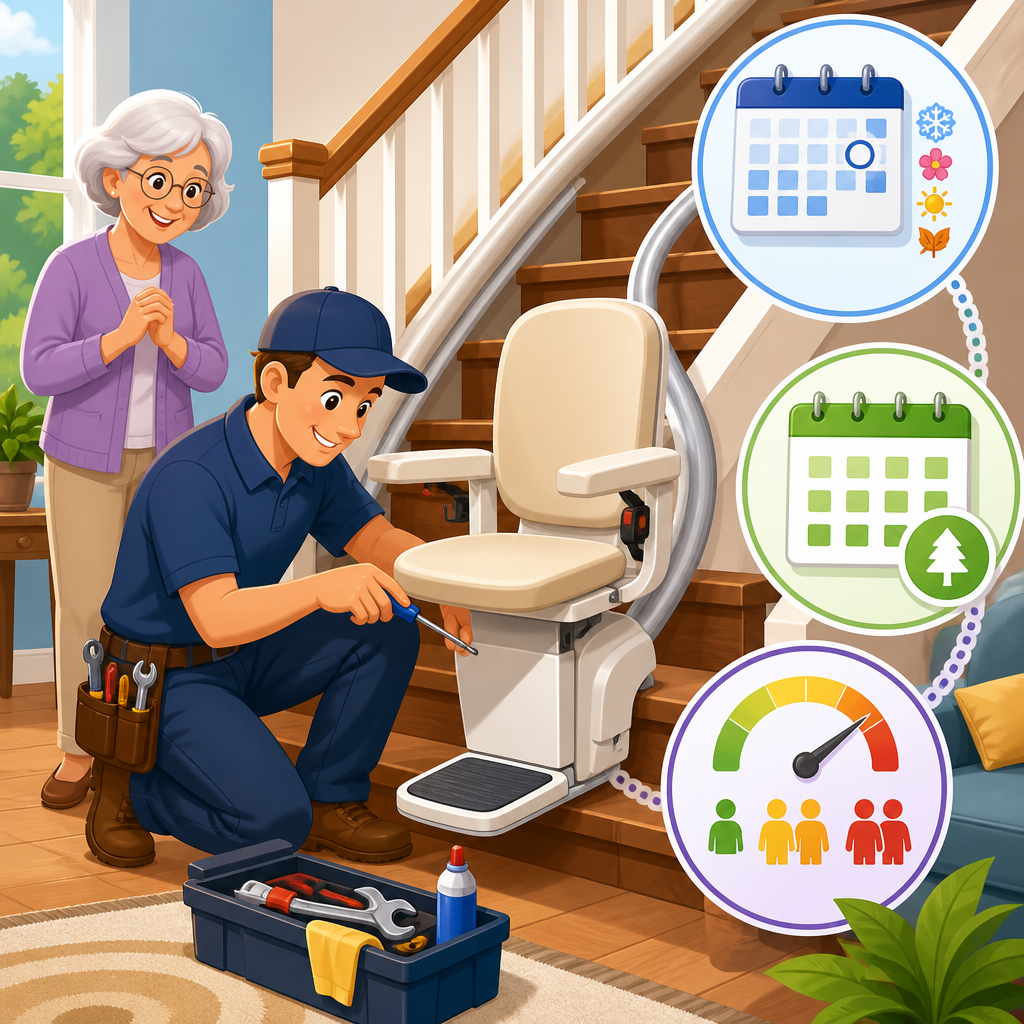
A stair lift works hardest when nobody is thinking about it. That is exactly why a stair lift maintenance schedule by month, year, and usage level matters. In homes where a lift carries someone multiple times a day, reliability is not a convenience issue; it is a mobility and safety requirement. Routine maintenance keeps the chair traveling smoothly, preserves battery life, reduces nuisance faults, and helps owners spot wear before it turns into a breakdown on the stairs.
When I build maintenance plans for homeowners, I separate three ideas. First is time-based care: monthly, quarterly, and annual checks that happen regardless of ride count. Second is usage-based care: a stair lift used twice a week ages differently from one used ten times a day. Third is safety-critical service: inspection and testing of components that protect the rider, including seat belts, limit switches, obstruction sensors, charging contacts, and the overspeed governor on applicable models.
Routine maintenance does not mean taking the lift apart. For most owners, it means cleaning approved surfaces, checking for obvious wear, listening for changes in sound, confirming charging and controls work correctly, and arranging professional service at the right intervals. The manufacturer manual always comes first, because brands such as Bruno, Stannah, Harmar, Handicare, Acorn, and Savaria have different lubrication points, rail designs, diagnostic codes, and battery specifications. Still, the core principles are consistent across modern battery-powered lifts. This guide explains what to do each month, what to schedule each year, and how to adjust the plan for light, moderate, or heavy household use.
What a Stair Lift Maintenance Schedule Should Cover
A complete stair lift maintenance schedule covers cleanliness, mechanical movement, electrical charging, battery condition, rider safety features, and environmental conditions around the rail. Most residential units are battery powered and charge at one or both parking points, or continuously through a charging strip. That means the most common preventable issues are simple: dirty charge contacts, a switched-off power outlet, debris on the rail, weak batteries, and loose footrest or seat components caused by long-term vibration.
From field experience, owners often focus on the motor because it sounds important, but motors are usually not the first maintenance problem on a modern lift. Consumable or exposure-related items fail sooner: batteries, remote-control batteries, armrest switches, hinges, rollers, and safety edges. Upholstery can also hide trouble. If the seat is loose on its swivel, or the hinge action becomes stiff, the rider may compensate with awkward body movement during transfer, which raises fall risk even if the lift still runs.
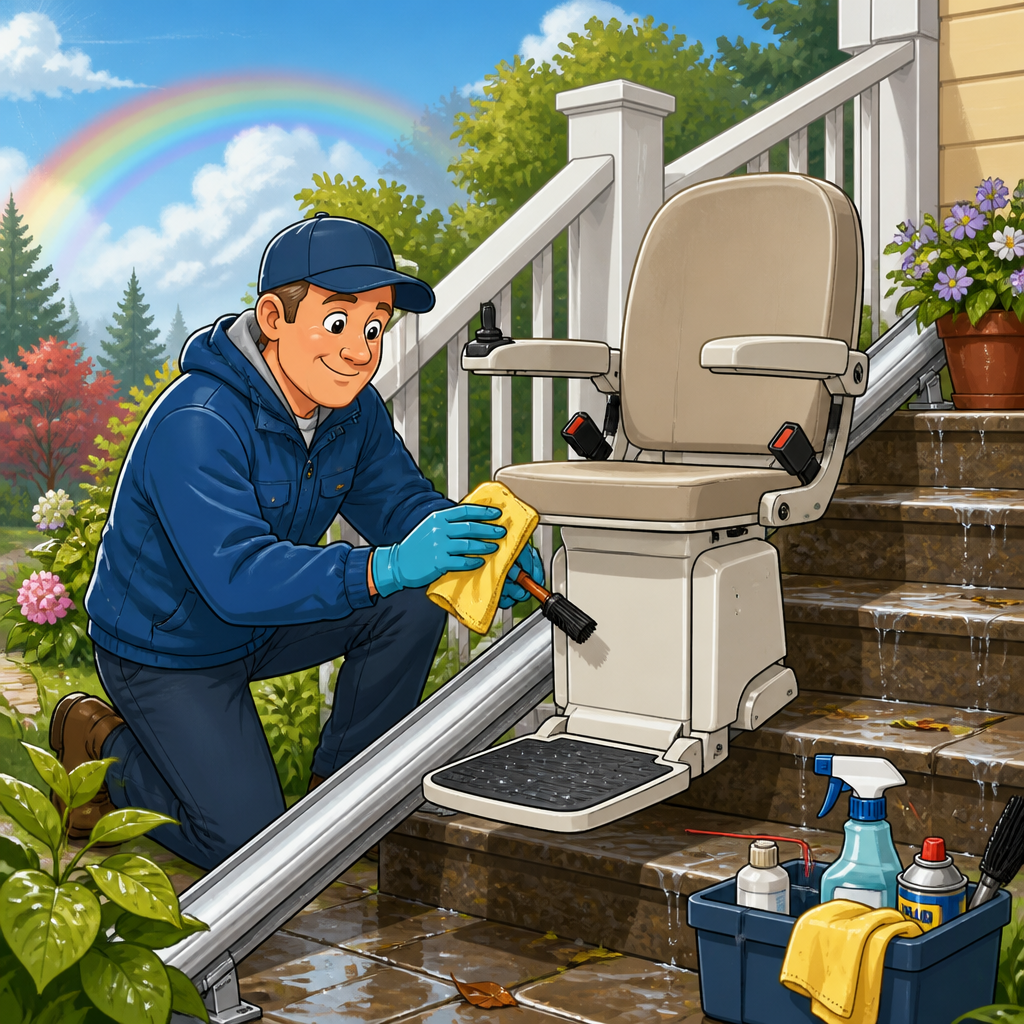
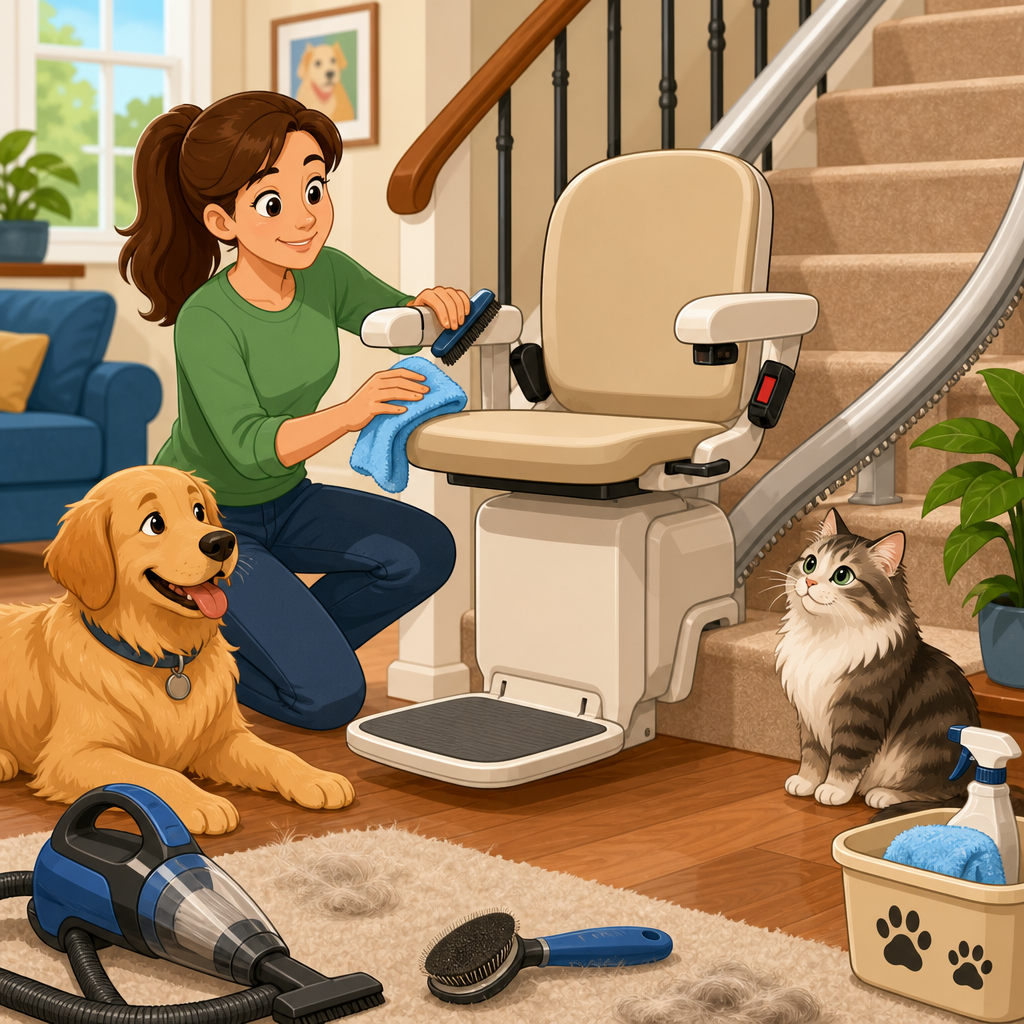
The schedule should also account for the staircase environment. Pet hair, carpet fibers, lint, basement humidity, and airborne grease from nearby kitchens all affect cleaning frequency. Straight stair lifts are typically simpler to maintain than curved models because the rail and carriage geometry are less complex, but curved lifts demand the same discipline. Outdoor stair lifts add another layer: weather seals, cover condition, corrosion checks, and more frequent cleaning of exposed rail surfaces.
Monthly Stair Lift Maintenance Tasks for Most Homes
Monthly maintenance is the backbone of reliable stair lift ownership. Start with a visual inspection while the lift is parked and powered. Look along the rail for dust buildup, hair, pet fur, or objects resting near the track. Check that the chair parks fully on its charging point and that the charge indicator shows normal status according to the manufacturer display or beeper pattern. If the lift is not charging consistently, battery capacity can drop quickly, especially on older units.
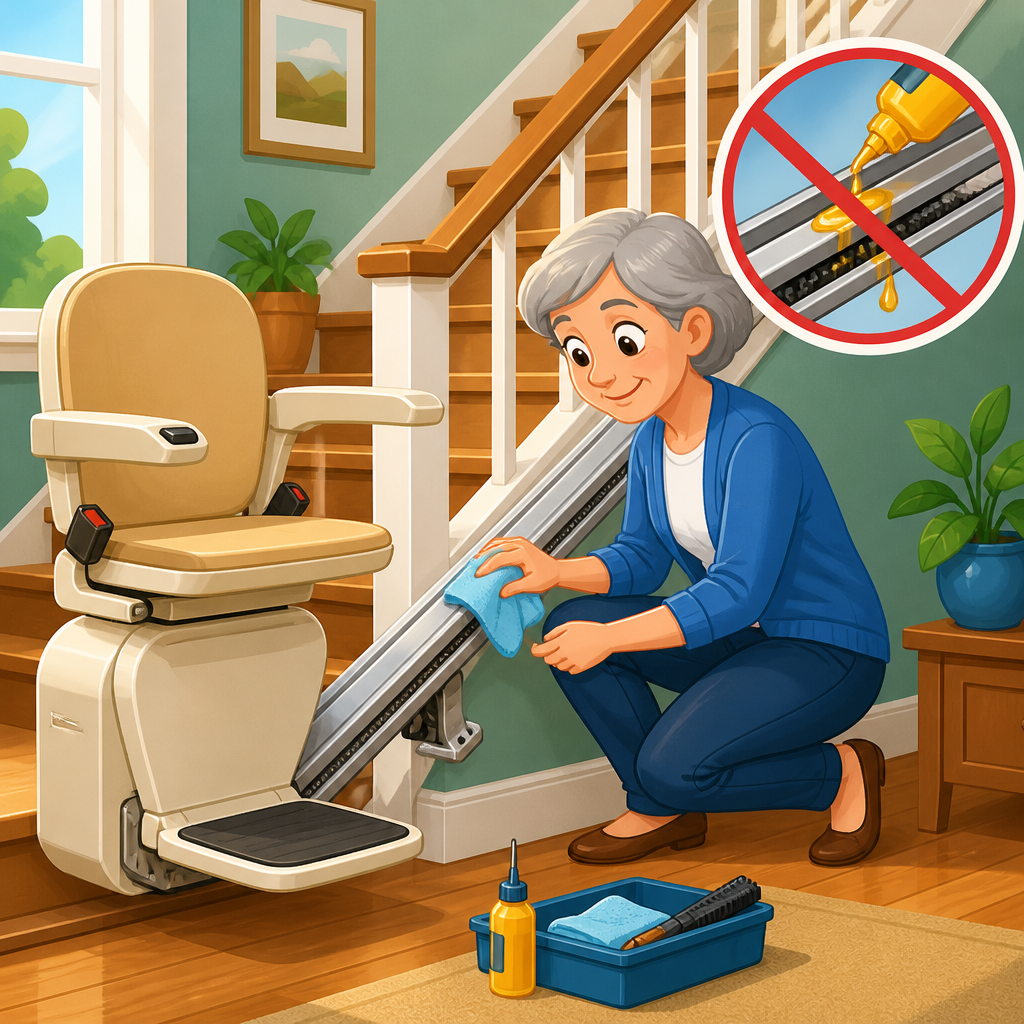
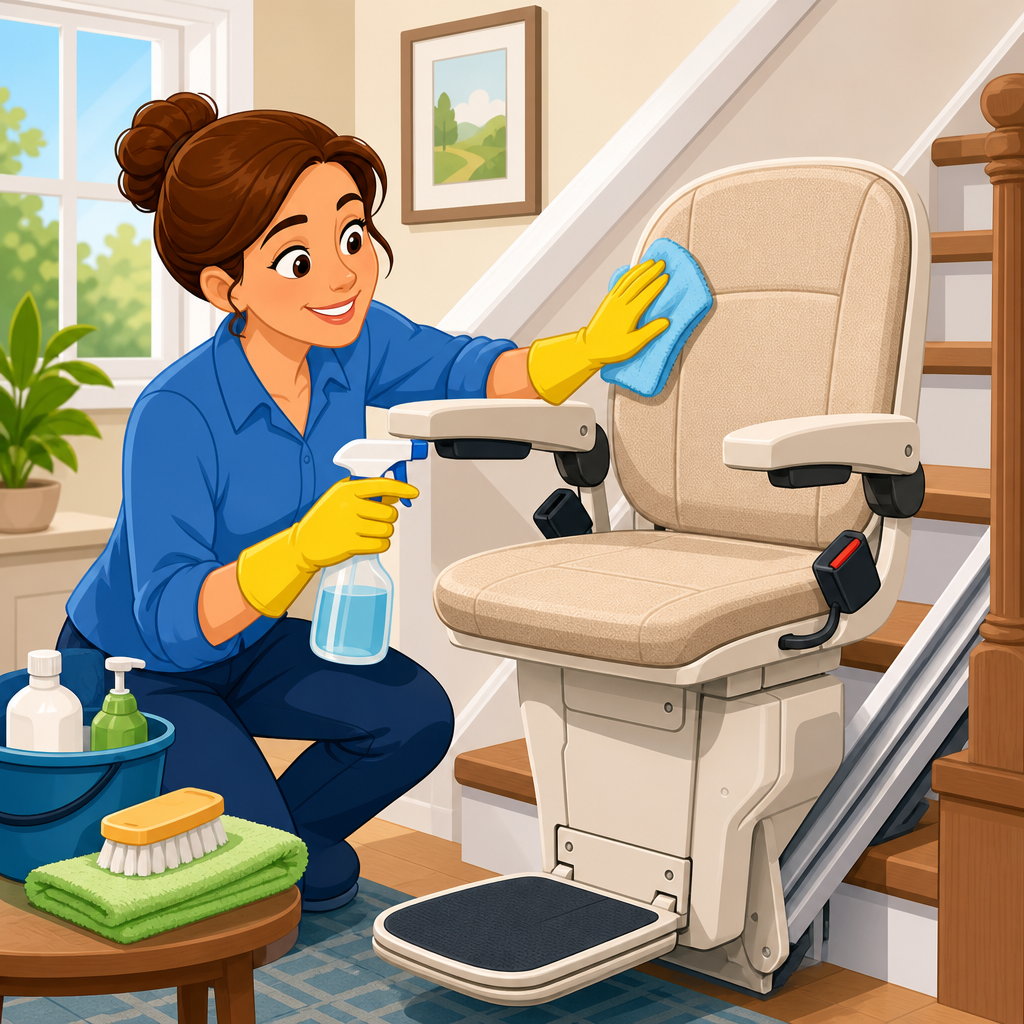
Next, wipe accessible surfaces with a dry or slightly damp microfiber cloth. Clean the seat, armrests, joystick or rocker switch, remote controls, and the exposed rail surface if the manual approves it. Do not spray cleaner directly onto switches, the carriage, or the rail. Moisture intrusion is a common cause of intermittent faults. On many lifts, owners should never apply grease or oil to the rail unless the manufacturer specifically calls for it. Several models use rollers or a rack-and-pinion system designed to run dry or with factory-specified lubrication only.
Run the lift up and down without a rider if that is permitted by the manual. Listen for grinding, clicking, squealing, or hesitation. A healthy stair lift sounds consistent. New noises matter because they often point to a simple fix, such as debris in the drive path, before they become expensive wear. Test the call/send controls from both landings, fold and unfold the footrest and arms, verify the seat swivel lock engages firmly, and inspect the seat belt for fraying or a latch that does not click positively.
Monthly is also the right time to check the staircase itself. Loose carpet edges, items stored near the rail, and poor lighting create operating problems that are not strictly inside the lift but still affect safety. I tell owners to think of maintenance as a system, not just a machine. If a cane, slipper, or power cord can touch the footrest, it belongs elsewhere.
How Usage Level Changes the Maintenance Schedule
Usage level should change both inspection frequency and service urgency. A lift used by one person twice a day may log around 60 trips a month. In a two-story household where the rider goes up and down for meals, laundry, medications, and bedtime, the same lift can exceed 180 trips a month. More cycles mean faster battery wear, more hinge and swivel movement, more exposure to accidental bumps, and a narrower margin for deferred maintenance.
| Usage level | Typical monthly trips | Owner routine | Professional service interval |
|---|---|---|---|
| Light | Under 60 | Monthly cleaning and function check | Every 12 months |
| Moderate | 60 to 150 | Monthly check plus mid-month rail and charging inspection | Every 6 to 12 months |
| Heavy | Over 150 | Twice-monthly inspection, strict charging discipline, quicker response to noise or slowdown | Every 6 months |
Light-use lifts often age more from calendar time than cycle count, especially if they sit parked incorrectly and fail to charge fully. Moderate-use lifts benefit from an extra quick inspection between monthly checks. Heavy-use lifts should be treated like essential medical-adjacent equipment in the home. If a frequent rider depends on the lift every day, waiting for obvious failure is the wrong strategy. Preventive service every six months is justified because the cost of downtime is high, and emergency callouts are usually more expensive than planned visits.
Quarterly and Semiannual Tasks That Prevent Bigger Problems
Every three to six months, owners should perform a deeper non-invasive review and decide whether professional service is due. Start by checking all visible fasteners and trim pieces for looseness, without disassembling any guarded component. Footrests, seat backs, armrest caps, and remote brackets can loosen gradually. If something wiggles that used to feel solid, note it and book service rather than overtightening unknown hardware. Torque values matter on load-bearing assemblies.
Battery behavior deserves close attention at this stage. Most residential stair lifts use sealed lead-acid batteries, often two 12-volt batteries inside the carriage, though some newer designs may vary. Lead-acid batteries commonly last around three to five years, depending on usage, temperature, and charging consistency. Warning signs include slower travel, beeping away from the charging point, shorter operation during power outages, and failure to complete multiple trips after a mains interruption. A technician can load-test the batteries and confirm charger output with a multimeter.
Quarterly or semiannual checks should also include the safety edges and limit functions. These are the sensors that stop the lift if the footrest or carriage meets an obstruction, and the switches that stop travel at the correct upper and lower points. A unit that overruns, stops short, or reverses unpredictably needs service immediately. For households with children or pets, test results matter because obstruction sensors are one of the lift’s most important safeguards.
If the lift is outdoors, shorten the interval. UV exposure hardens plastics, moisture encourages corrosion, and wind-blown grit can collect where owners do not look. Covers should fit securely and be used whenever the lift is parked for long periods. Outdoor call stations often need battery replacement sooner than indoor ones because temperature swings are harder on electronics.
Annual Professional Service: What Technicians Actually Do
Annual professional service is where routine owner care turns into true preventive maintenance. A qualified stair lift technician will typically inspect the rail mounting points, carriage movement, gear or pinion wear, rollers, wiring harnesses, charging system, batteries, seat swivel and lock assemblies, folding mechanisms, call/send controls, diagnostic logs if available, and all safety circuits. The technician should also verify travel speed and stopping performance remain within manufacturer tolerance.
On many models, the service visit includes cleaning inside areas owners should not open, confirming charger voltage, testing battery condition under load, checking the final limit switches, and inspecting the transmission or drive train for abnormal wear. If the unit uses a rack-and-pinion rail, the teeth are inspected for contamination or damage. If the manufacturer specifies lubrication, the technician applies only the approved product and amount. Over-lubrication can attract debris and cause more wear, not less.
Annual service is also the right time to review whether the lift still fits the rider’s needs. I have seen technically sound lifts become functionally unsafe because the user’s mobility changed. A person with reduced trunk strength may now need a perch seat, powered swivel, larger footrest, or transfer aids at the landing. Maintenance is not only about preserving the machine; it is about preserving safe access for the person using it.
Keep records of each visit, including parts replaced, battery age, fault codes, and technician notes. That history helps identify patterns and supports warranty claims. It also makes resale, reconditioning, or relocation easier if the lift is later removed and installed elsewhere, where permitted by the manufacturer and local regulations.
Routine Maintenance Tips Owners Can Do Safely
The best routine maintenance tips are simple, repeatable, and safe. Park the lift on its charging point every time. Keep the rail area clear. Clean controls and exposed surfaces with manufacturer-approved methods. Replace remote batteries when response becomes inconsistent. Watch for changes in travel speed, sound, or seat stability. Test the seat belt latch regularly. If the home loses power, confirm the lift still has enough battery reserve to complete necessary trips and then recharge it as soon as mains power returns.
There are also clear limits. Owners should not remove covers, bypass safety switches, lubricate parts without instructions, or attempt battery replacement unless the brand documentation explicitly allows it and the person is competent to do so. Stair lifts contain pinch points, high-current battery connections, and safety circuits that must work exactly as designed. A do-it-yourself fix that restores movement but disables an obstruction sensor is not a repair; it is a hazard.
For troubleshooting and safety planning, this hub connects naturally to deeper topics such as battery replacement signs, common stair lift error codes, rail cleaning methods by brand, what to do during a power outage, and how to test obstruction sensors correctly. Those related articles help owners solve specific problems, while this page provides the master schedule that ties routine maintenance together.
When to Call for Service Immediately
Some symptoms should move an owner from maintenance mode to repair mode right away. Call for service if the lift stops suddenly, jerks during travel, beeps continuously when properly parked, fails to charge, shows visible cable damage, or has a seat swivel that does not lock securely. The same applies if the footrest sensors trigger without an obstruction, the unit runs only in one direction, or the chair feels loose relative to the carriage.
Another red flag is repeated breaker trips or a dead outlet feeding the charger. Many owners assume the stair lift failed, when the actual problem is upstream power loss. Confirm the outlet is live, but if power is present and charging still fails, stop using the lift until it is checked. Weak batteries can mask charger issues for a while, then leave the rider stranded between levels.
A smart stair lift maintenance schedule by month, year, and usage level keeps small issues small. Monthly checks catch dirt, charging faults, and wear signs early. Usage-based planning ensures heavy-use households do not rely on a once-a-year glance. Annual professional service verifies the mechanical and safety systems that owners cannot assess alone. The result is fewer breakdowns, longer component life, safer transfers, and more confidence every time the chair moves.
If you manage a lift at home, set a recurring monthly reminder, log each inspection, and schedule professional service before problems appear. That one habit turns routine maintenance from an afterthought into dependable mobility protection.
Frequently Asked Questions
What should a stair lift maintenance schedule include each month?
A monthly stair lift maintenance schedule should focus on simple, owner-friendly checks that support day-to-day reliability without taking the place of professional service. Start by looking over the rail and carriage for dust, pet hair, or debris, especially if the lift travels through a busy hallway or near exterior doors where dirt can collect quickly. Keeping the rail clean helps the chair move smoothly and can reduce unnecessary strain on the drive system. Wipe accessible surfaces with a dry or slightly damp soft cloth, and avoid applying grease or household lubricants unless the manufacturer specifically recommends it. Many stair lifts are designed to run best when the rail is kept clean rather than heavily lubricated.
It is also smart to test the controls once a month. Send the lift up and down using the armrest control and any wall-mounted call/send stations to confirm they respond properly. Listen for changes such as grinding, clicking, hesitation, or beeping that seems unusual. Check that the seat swivels and locks securely, the footrest folds properly, and the seat belt latches as it should. If your unit includes safety edges or obstruction sensors, make sure those features are functioning normally according to the manufacturer’s instructions.
Battery charging should be part of every monthly review. Confirm that the lift is parking correctly on its charging points and that no error indicators suggest incomplete charging. If the chair seems slower than normal or gives low-battery alerts despite regular use, that can be an early sign that charging contacts need cleaning or that battery performance is declining. For households that depend on the lift several times a day, these monthly checks are less about “maintenance” in the traditional sense and more about preventing a small issue from becoming a stairway breakdown.
How often should a stair lift be professionally serviced each year?
Most stair lifts should receive professional service at least once a year, even if the unit appears to be working perfectly. Annual service gives a trained technician the chance to inspect components that homeowners should not disassemble or adjust on their own. This typically includes the motor system, gearbox, charging circuit, batteries, carriage operation, seat swivel mechanism, footrest safety switches, track alignment, and any diagnostic codes stored by the unit. A yearly visit is the minimum standard for many manufacturers and is often consistent with warranty expectations or service agreement terms.
That said, yearly service is not always enough for every home. If the stair lift is used many times each day, supports a full-time mobility need, or operates in a home with heavy dust, pet hair, or humidity, a six-month service interval may be more appropriate. Higher usage means more starts, stops, battery cycles, and wear on moving parts. In those situations, preventive servicing is usually far less disruptive and less expensive than waiting for a failure. A technician can catch early signs of battery fatigue, contact wear, rail contamination, or sensor issues before they create intermittent faults.
Another reason annual service matters is that stair lifts often hide wear well. Unlike some household equipment, they may continue functioning until a part is already near failure. A chair that still runs can still have weakening batteries, slightly worn rollers, a loosening seat assembly, or charging contacts that are not making consistent connection. Professional service fills the gap between what owners can observe and what trained maintenance can confirm, which is especially important when the lift is essential for safe access to the home.
How should maintenance change based on low, moderate, or heavy stair lift usage?
Usage level should absolutely shape the maintenance schedule because a stair lift used once or twice a day experiences very different wear than one used ten or more times daily. For low-usage stair lifts, monthly visual checks and one professional service visit each year are often enough, provided the lift stays clean, charges consistently, and shows no change in performance. Even low-use units still need attention because long periods of sitting idle can affect battery health if the chair is not parked on its charging points properly.
For moderate use, such as several trips each day, monthly owner checks become more important and should be done more deliberately. In these homes, owners should pay closer attention to ride smoothness, charging consistency, unusual noises, and wear on frequently handled parts like armrests, swivel seats, and seat belts. An annual professional service is still the baseline, but many owners benefit from discussing their exact usage pattern with the dealer or service provider to decide whether earlier tune-ups make sense.
Heavy-use stair lifts need the most disciplined routine. If the lift is a primary mobility device used throughout the day, reliability is critical, not optional. In these cases, a monthly cleaning and function check should be treated like a standing appointment, and professional service every six months is often the smarter plan. Heavy use accelerates battery cycling and increases wear on switches, rollers, and safety mechanisms. If more than one person uses the lift, or if it serves a caregiver and rider multiple times a day, the system may age faster than homeowners expect. Matching service frequency to usage level is one of the best ways to reduce surprise shutdowns and extend the useful life of the lift.
What are the warning signs that a stair lift needs maintenance sooner than scheduled?
A stair lift should be checked before the next scheduled service if it shows any change in normal behavior. One of the most common warning signs is inconsistent travel, such as slowing down, hesitating at the start, stopping unexpectedly, or moving less smoothly than usual. Unusual sounds matter too. Grinding, repeated clicking, squealing, or louder-than-normal motor noise can point to issues with the rail, drive system, rollers, or other moving parts. Even if the lift still completes the trip, a change in sound or feel is often an early warning that maintenance is overdue.
Charging and battery-related symptoms are another major clue. If the lift begins beeping unexpectedly, shows a fault light, struggles after a power outage, or seems weak when traveling, the batteries or charging contacts may need attention. A chair that is not consistently parked on its charge points can gradually lose reliability, and battery decline can appear first as intermittent performance rather than total failure. Owners should also watch for trouble with call/send controls, seat swivel locking, footrest operation, or safety sensors that seem overly sensitive or not responsive enough.
Physical wear should never be ignored. Loose armrests, a wobbly seat, frayed wiring covers, damaged edges on the footrest, or visible buildup on the rail all justify earlier service. The same is true if the lift starts stopping at slightly inconsistent positions or fails to align well with the landing. Because stair lifts are safety devices, “still working” is not the same as “working correctly.” If anything feels different, especially in a home where the lift is used daily for essential access, scheduling maintenance promptly is the safer decision.
Can homeowners do stair lift maintenance themselves, or should everything be left to a technician?
Homeowners can and should handle basic routine care, but only within the limits set by the manufacturer. The safest do-it-yourself tasks usually include keeping the rail and visible surfaces clean, checking for debris or pet hair, making sure the unit is charging properly, testing controls, and confirming that the seat belt, swivel seat, and footrest are functioning normally. These simple checks are valuable because they help owners notice developing problems early. In many cases, careful observation does more to prevent a breakdown than waiting until the annual service appointment.
What homeowners should not do is just as important. Stair lifts include electrical systems, batteries, drive components, and safety circuits that should not be adjusted, lubricated, or disassembled without training. Applying the wrong lubricant, tightening the wrong fastener, forcing an adjustment, or opening a component cover can create new problems or compromise safety features. It can also affect warranty coverage. If the owner’s manual does not specifically tell you to perform a task, it is best to assume that task belongs to a qualified technician.
The best approach is a partnership: homeowners manage regular observation and light cleaning, while trained professionals handle inspection, calibration, testing, battery evaluation, and mechanical or electrical repairs. That combination works especially well when building a maintenance schedule by month, year, and usage level. Monthly owner attention keeps the lift clean and predictable, while scheduled professional service protects the parts owners cannot reliably assess on their own. For a device that supports mobility every single day, that balanced approach is the most practical and safest long-term strategy.