Working with architects for custom chair lift design starts with one practical truth: no two buildings, users, or circulation patterns are identical. In projects I have supported, the difference between a chair lift that merely fits and one that truly works comes down to early architectural coordination. Custom chair lift design means adapting the rail path, mounting method, controls, seating package, and safety envelope to a specific structure and user profile. Hybrid designs go further by combining standard lift components with bespoke rails, folds, parking positions, or transfer arrangements to solve unusual site conditions without rebuilding the entire product from scratch.
This matters because accessibility failures are usually designed in long before they appear on site. A stair width that looks generous on plan can become too tight once handrails, trim, nosings, door swings, and folded lift dimensions are measured in real life. Historic homes, split-level renovations, curved staircases, and mixed-use buildings often need solutions that balance mobility, code compliance, aesthetics, and cost. Architects influence all of those variables. When they coordinate chair lift requirements with structural framing, electrical rough-in, finish materials, and circulation planning, the result is safer use, fewer change orders, and better long-term value. That is why this custom and hybrid chair lift design hub is essential within chair lift types and designs.
What custom and hybrid chair lift design actually includes
Custom chair lift design is not just about a curved rail. It can include nonstandard overrun lengths, intermediate landings, parking bends, hinged rails at doorways, reduced-profile seats, powered swivels, tailored call-send controls, and integration with a user’s transfer needs. Hybrid design usually means the manufacturer uses a proven drive system, carriage, and seat platform, then engineers project-specific rail geometry or mounting details. In practice, this is often the smartest route because it preserves certified core components while allowing flexibility where the staircase demands it.
Architects need to understand the difference between field customization and engineering customization. Field customization covers choices such as seat height, arm style, upholstery, charge point location, and side of stair placement. Engineering customization involves rail radius, support spacing, bracket strategy, transition geometry, structural loading assumptions, or a custom lower park to keep a hallway clear. For example, on a narrow curved stair in a townhouse, I have seen a standard twin-tube system paired with a custom start position that parked the chair around a corner, preserving the egress path and avoiding a complete stair rebuild. That is a hybrid solution, not an off-the-shelf install.
Most manufacturers also separate cosmetic customization from functional customization. Color-matched rails, wood-trimmed seats, or concealed charging points can help a lift blend into a high-end residential interior, but they do not solve clearance conflicts. Functional customization addresses user needs and site constraints first. A successful design sequence always starts with measurements, user transfer capability, emergency egress, and structural support. Appearance comes after those fundamentals are resolved.
How architects shape project success from concept to installation
Architects are central because chair lifts sit at the intersection of mobility equipment and building design. They review stair geometry, identify conflicts with walls and openings, coordinate electrical service, confirm finish tolerances, and keep accessibility intent aligned with the overall design language. On renovation work, they also determine whether a stair lift is the right intervention at all, or whether a vertical platform lift, residential elevator, or reconfigured floor plan would serve the occupant better. That decision should never be made in isolation by a dealer after finishes are complete.
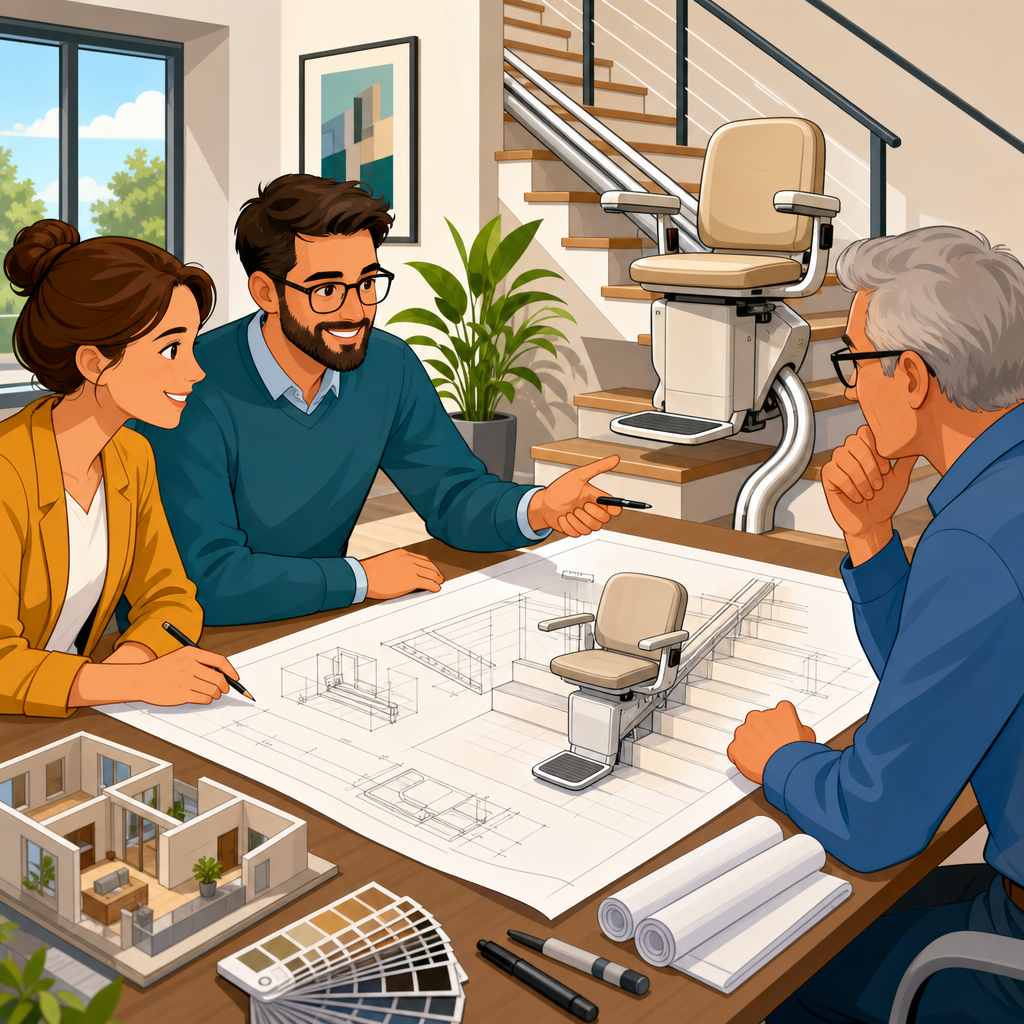
During schematic design, the architect should map user journeys rather than simply mark a lift on a floor plan. Where does the user approach the chair? Can they transfer safely without blocking others? Is there room for a walker, cane, or caregiver beside the landing? During design development, dimensions must move from nominal plan widths to true field conditions, including trim, baluster projections, handrail returns, and radiator covers. During construction documentation, the architect should specify power requirements, outlet locations, reinforcement where needed, and any related door, millwork, or guard modifications. On site, they should verify that the measured stair matches the approved shop drawings.
Real projects show why this level of coordination matters. In one historic renovation, a lower landing door conflicted with the folded footrest sweep. Because the architect flagged the issue before fabrication, the team changed the park position and adjusted the door stop, avoiding a costly rail remake. In another case, an upper landing looked compliant on plan, but a sloped ceiling reduced head clearance during swivel transfer. The architect revised trim details and selected a powered swivel seat, making the lift usable for the client rather than merely installable.
Site assessment, measurements, and stair geometry that drive the design
The accuracy of a custom chair lift project depends on the survey. A proper site assessment records overall stair rise, tread depth, number of risers, pitch angle, landing dimensions, obstructions, handrail profile, baluster spacing, wall conditions, power source, and the user’s physical capabilities. For curved stair lifts, manufacturers commonly rely on photo measurement, digital templating, or laser-based surveying systems because small errors can affect rail fit along multiple bends. Architects should insist that measured dimensions be reconciled with as-built conditions, not original drawings, especially in older homes where settlement and finish buildup are common.
Several geometric factors determine feasibility. Stair width affects whether the folded chair leaves enough clear walking space. Pitch influences user comfort and carriage limits. Landing length determines whether the chair can stop in a safe transfer zone. Inside and outside turn radii affect rail fabrication and seat orientation through curves. Overruns may be needed so the user gets on and off away from the top riser, which reduces fall risk. Headroom, often overlooked, matters most at upper turns and under sloped ceilings. Even floor finish thickness can alter the first-step relationship enough to affect bracket placement.
| Design factor | Why it matters | Typical architectural response |
|---|---|---|
| Clear stair width | Determines passage when chair is folded or occupied | Verify actual clear width between finished surfaces and handrails |
| Landing size | Controls safe transfer and chair parking options | Reserve maneuvering space and review door swings |
| Stair curvature | Drives custom rail fabrication and bracket spacing | Use detailed field measurement and manufacturer review |
| Obstructions | Can block footrest, seat swivel, or user approach | Adjust trim, radiators, millwork, or parking positions |
| Power location | Affects charging reliability and visual impact | Coordinate dedicated outlet or approved supply point early |
When I review surveys with architects, I look for one common omission: human dimensions in motion. A chair lift is not just a machine fitting on stairs; it is a user transferring, rotating, folding, reaching, and sometimes being assisted. Measure the building carefully, but also measure the task.
Balancing accessibility, codes, and real-world usability
Codes and standards shape chair lift design, but they do not remove the need for judgment. In the United States, stair lifts in private residences are often treated differently from commercial accessibility devices, and requirements can vary by jurisdiction, occupancy type, and whether the lift is part of a required accessible route. Product standards, manufacturer instructions, electrical rules, life-safety provisions, and local permitting all matter. Architects should verify whether the project falls under residential, multifamily, healthcare, hospitality, or public accommodation requirements before assuming a chair lift is acceptable as the primary solution.
Usability is broader than minimum compliance. A lift may technically fit and still fail the user if the seat height impedes transfer, the joystick requires too much dexterity, or the folding sequence is too complex. Powered options often improve independence for users with limited grip strength or trunk control, but they increase cost and maintenance points. Parking the chair out of sight may satisfy aesthetic goals, yet a remote park can frustrate users if call-send controls are awkwardly placed. These are design tradeoffs, and architects are well positioned to resolve them with the client and equipment provider.
Egress deserves special attention. On many stairs, the lift rail is mounted near the wall or baluster line to preserve as much walking width as possible. Even then, the folded chair and footrest reduce usable space. In low-traffic single-family settings, that may be acceptable. In multifamily or commercial settings, it may not be. I have advised teams to reject a stair lift where evacuation, stretcher movement, or daily circulation would be compromised, even though a supplier claimed it could be installed. Good custom design starts by asking whether the stair should host a lift at all.
Design integration: structure, finishes, power, and aesthetics
Most chair lifts mount to the stair treads or to engineered brackets supported by the stair structure, not directly to the wall, but architects still need to understand load paths. Existing timber stairs may need reinforcement if treads are cracked, undersized, or poorly anchored. Steel or concrete stairs can present bracket attachment challenges, especially when finish layers conceal the substrate. Early structural review prevents last-minute improvisation in finished interiors. On premium residential work, hidden blocking, refined fastener placement, and coordinated trim details can make the installation look intentional rather than retrofitted.
Electrical coordination is another frequent pain point. Many modern units use battery-powered drive systems that charge at designated points along the rail, but they still need a reliable electrical supply. Architects should coordinate outlet location so cords are unobtrusive and service access remains practical. They should also consider backup behavior during outages, charging contact placement at park positions, and whether a hinged rail needs additional power. If the lower landing is visible from a formal entry, relocating the charge point or selecting a cleaner park geometry can significantly improve the final appearance.
Aesthetics matter because visible assistive equipment affects whether clients accept and consistently use it. Manufacturers now offer slimmer seats, neutral upholstery, and rail finishes beyond plain beige or white. Yet successful integration is less about decoration than visual discipline. Keep the rail line clean, avoid unnecessary junction boxes in sightlines, align parking positions with architectural edges, and ensure folded components do not clash with paneling, art, or door casings. In custom homes, I have seen architects coordinate wall color, handrail metal, and seat finish so the lift receded visually without disguising its function. That is better than trying to hide a device that needs to remain obvious and safe.
Choosing suppliers, coordinating fabrication, and planning for lifecycle performance
Not every stair lift provider is equipped for custom and hybrid work. Architects should ask who performs the survey, whether the rail is factory fabricated from digital measurement, what tolerances are acceptable, how revisions are handled, and which components are standard versus project-specific. Proven manufacturers such as Stannah, Bruno, Handicare, Savaria, and Access BDD vary by market, model range, and support network, so selection should consider local service capability as much as product features. A beautifully engineered rail is a poor solution if no qualified technician can maintain it after installation.
Procurement timing matters because custom rails are not stocked items. Lead times often depend on survey approval, engineering signoff, fabrication slots, shipping, and installer availability. Architects should build this sequence into the construction schedule and avoid finalizing adjacent millwork or wall treatments until the lift shop drawings are reviewed. Commissioning should include ride testing, charge verification, call-send operation, swivel and footrest checks, obstruction sensor testing, and a live transfer demonstration with the intended user whenever possible. Training is not optional; many service calls are rooted in preventable user confusion rather than equipment failure.
Lifecycle performance is the final design responsibility. Ask about battery replacement intervals, annual service recommendations, upholstery durability, parts availability, warranty terms, and whether future seat or control adaptations can be added if the user’s condition changes. A chair lift is rarely a static need. Arthritis may worsen, a caregiver may become involved, or a home may later be sold to someone with different mobility requirements. The best custom chair lift design leaves room for those changes and is documented clearly so future owners, service teams, and remodelers understand what was installed and why.
Working with architects for custom chair lift design produces better outcomes because it turns a late-stage equipment purchase into an integrated accessibility strategy. The key lessons are straightforward. Start early. Survey the actual stair, not the drawing. Define whether the project needs standard, custom, or hybrid chair lift design. Prioritize transfer safety, circulation, and egress before aesthetics. Coordinate structure, power, finish tolerances, and parking positions before fabrication. Select suppliers with proven custom capability and local service strength. Most important, design around the user’s real movement, not just the machine’s footprint.
As the hub for custom and hybrid designs within chair lift types and designs, this topic connects every related decision: curved rails, hinged sections, compact seating, tailored controls, and architectural coordination. When these elements are handled well, the lift feels purposeful, safe, and durable rather than intrusive. That is the main benefit of involving architects deeply in the process: fewer compromises and a solution that supports independent living without undermining the building. If you are planning a project, review your stair geometry, assemble your architect and lift provider early, and develop the design from measured conditions and user needs.
Frequently Asked Questions
Why is early coordination with architects so important in custom chair lift design?
Early coordination is what turns a chair lift from an afterthought into a well-integrated accessibility solution. In custom projects, architects are not simply making room for a product; they are helping shape how the lift interacts with the building, the user, and the daily flow of movement through the space. Stair geometry, landing depths, wall conditions, door swings, handrail locations, electrical planning, and code-related clearances all affect how a chair lift can be designed and installed. When those factors are reviewed at the beginning of design or renovation, the team has the flexibility to refine the rail path, choose the right mounting strategy, and preserve circulation without compromising accessibility.
From a practical standpoint, early collaboration also reduces costly revisions later. A stair lift that is brought into the conversation too late may conflict with trim details, guardrails, structural supports, or egress expectations. In contrast, when the architect, lift specialist, contractor, and owner align early, they can anticipate challenges such as narrow stairs, intermediate landings, curved runs, folded seat projections, or parking positions at the top and bottom of the staircase. This leads to better outcomes for both aesthetics and performance. The result is a system that feels intentional, functions reliably, and supports the needs of the user without creating new obstacles for others in the building.
What elements are typically customized in a chair lift design?
Custom chair lift design involves much more than selecting a standard seat and rail. In most architect-coordinated projects, the rail path is one of the first major variables reviewed. That may include straight sections, curves, overrun segments, parking locations, hinged rail options, or transitions designed to keep the user away from a doorway, hallway, or circulation pinch point. The mounting method is also important. Depending on the stair construction and surrounding conditions, the lift may be better suited to stair-mounted supports rather than wall attachment, which can help preserve finishes and simplify integration with the architectural assembly.
Other common customization points include seat style, swivel direction, arm configuration, footrest behavior, call-send controls, safety sensors, and user interface placement. For some users, transfer comfort is the priority; for others, the key concern is minimizing obstruction when the lift is folded and parked. Architects and lift specialists often also coordinate power supply locations, charging positions, finish compatibility, and visual integration with the surrounding interior. In more complex projects, hybrid designs may combine multiple strategies to address unusual stair layouts, changing user abilities, or shared use environments. The goal is not simply to make the equipment fit, but to make sure it works safely, comfortably, and predictably within the exact conditions of the building.
How do architects help balance accessibility, safety, and building circulation when designing a custom chair lift?
Architects play a central role because they are trained to think about the whole environment, not just the lift itself. A chair lift must serve the user effectively while still respecting how everyone else moves through the building. That means studying stair width, landing dimensions, approach angles, adjacent doors, handrail continuity, and whether the folded chair creates a conflict with daily traffic. On residential projects, this may involve preserving comfortable family circulation and maintaining visual openness. On commercial or institutional projects, it may involve greater scrutiny around public access, life safety considerations, and compatibility with the broader accessibility strategy of the building.
Safety is addressed through coordinated planning of clearances, transfer points, and equipment operation. For example, the architect may help determine the safest top landing orientation for getting on and off the chair, or evaluate whether a lower overrun is needed to move the user away from the edge of the stairs. They can also help identify where a parked lift should sit so it does not interfere with door operation or create a bottleneck. This balance is especially important in custom and hybrid layouts, where no standard template applies. When architects work closely with lift professionals, the design can support user dignity and independence while protecting the practical function of the staircase for everyone else.
Can a custom chair lift be designed for unusual staircases or older buildings?
Yes, and that is one of the strongest reasons to involve architects and specialty lift professionals early. Unusual staircases and older buildings rarely conform to standard assumptions. You may be dealing with tight turns, inconsistent tread dimensions, split-level landings, decorative millwork, masonry walls, historic finishes, or structural conditions that limit where supports can go. In those cases, a custom approach is essential. Detailed measurement, site review, and architectural documentation allow the team to map a rail path that responds to the actual conditions rather than forcing a generic product into a space where it does not belong.
Older buildings in particular benefit from coordinated design because accessibility improvements often need to be made without undermining character or damaging significant architectural elements. A thoughtful custom solution can sometimes preserve original details better than a rushed standard installation. The architect can help identify sensitive materials, conceal supporting components where possible, and ensure the lift aligns with the visual language of the space. At the same time, the lift specialist can address technical realities such as load requirements, charging locations, folding clearances, and user transfer safety. The best results come from treating the staircase as part of a broader design problem, not just a piece of equipment placement.
What should homeowners, facility managers, or project teams expect during the custom chair lift design process?
The process typically begins with understanding the user and the building at the same time. That includes reviewing who will use the lift, how independently they transfer, whether multiple users are expected, and what future needs may need to be accommodated. In parallel, the team studies the stair configuration, landing conditions, nearby doors, power access, finish materials, and any architectural or structural constraints. From there, the architect and lift provider can evaluate layout options, including rail routing, parking positions, seat orientation, and whether a more specialized or hybrid design approach is needed.
As the project moves forward, stakeholders should expect detailed coordination rather than a simple product order. Measurements are verified carefully, drawings or templates may be produced, and the design team may compare trade-offs between footprint, comfort, appearance, and cost. If the chair lift is part of a renovation or new construction effort, installation sequencing also matters. It is often easier to prepare blocking, power, finish transitions, and access routes before final installation. By the end of the process, the strongest projects are the ones where everyone understands not only what is being installed, but why each design choice was made. That level of coordination leads to a chair lift that is safer, more intuitive for the user, and better integrated with the architecture of the space.