Stair lifts for L-shaped staircases with intermediate landings solve one of the most common access problems in multi-level homes: how to travel safely around a ninety-degree turn without relocating a bedroom, risking a fall, or committing to a full residential elevator. An L-shaped staircase typically has two straight runs connected by a landing, and that change in direction affects rail design, power requirements, installation time, and price. In practice, buyers usually face three broad categories: a two-part transfer setup using separate straight lifts, a fully curved rail built for the exact stair geometry, or a hybrid design that combines modular curved sections with straight segments. I have assessed these layouts in older townhouses, newer suburban homes, and split-level properties, and the same lesson comes up repeatedly: the best solution depends less on the idea of a “turn” and more on landing depth, user mobility, stair width, and transfer tolerance. Because this page serves as a hub for custom and hybrid designs, it explains how these systems work, when each approach is appropriate, what measurements matter, how safety standards apply, and which design tradeoffs should shape the buying decision.
What makes an L-shaped staircase lift different
A stair lift for an L-shaped staircase is different from a basic straight stair lift because the rider must pass a change in direction at an intermediate landing. That landing may be square, rectangular, pie-shaped, or partially obstructed by a wall, radiator, doorway, or handrail return. On a straight staircase, the rail is generally a single linear track mounted to the treads. On an L-shaped staircase, the system must either stop at the landing and require a transfer, or continue through the turn on a rail shaped to the stair path. The distinction matters because curved travel changes carriage engineering, charging point placement, footrest clearance, and installation tolerances.
Many homeowners assume the landing itself creates enough room for any lift to turn, but that is not true. Manufacturers specify minimum clearances for overrun, seat swivel, and rail bend radius. A compact seat may fit where a heavy-duty chair will not. Likewise, a user who can stand briefly may be fine with a transfer platform on the landing, while a rider with poor balance, advanced arthritis, or neurological weakness usually needs continuous seated travel on one rail. In other words, the staircase shape is only the starting point; the user profile determines whether a custom or hybrid stair lift is genuinely safe.
Straight, curved, and hybrid designs: how they compare
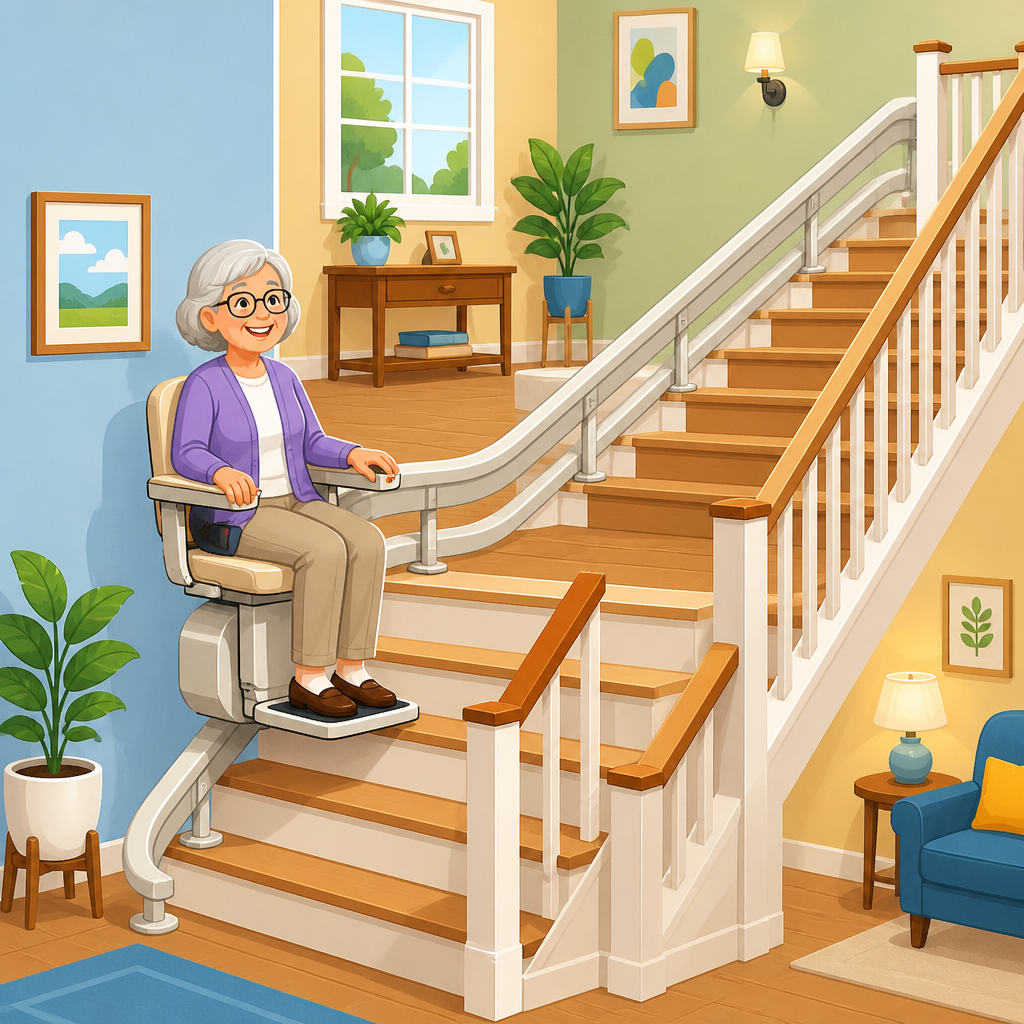
Within custom and hybrid designs, there are three practical solution paths for L-shaped staircases with intermediate landings. The first is the dual straight-lift arrangement: one straight lift serves the lower run, and a second serves the upper run. The rider exits at the landing and transfers to the second seat. This can lower initial cost and speed installation, especially when the landing is large and the user can pivot safely. The second is a fully curved stair lift. Its rail is made to exact measurements so the chair can ride continuously around the corner. The third is a hybrid or modular curved system, which uses prefabricated bend components and straight sections to handle common turning layouts more quickly than a fully bespoke rail.
In homes I have surveyed, the hybrid option often becomes the most practical middle ground. It can be more affordable than a fully custom rail while avoiding the physical demand of a landing transfer. However, modular systems are not universal. If the staircase has unusual riser variation, narrow inside corners, offset nosings, or a very short top run, a manufacturer may still require a custom fabrication. Curved and hybrid systems also need more detailed measurements than straight lifts, including tread depth, rise, nosing projection, and obstructions along both the inner and outer radius of the turn.
| Design type | Best use case | Main advantage | Main limitation |
|---|---|---|---|
| Two straight lifts | Large landing and rider can transfer safely | Lower cost and faster delivery | Requires getting on and off twice |
| Fully curved rail | Continuous seated travel is essential | Single ride through the turn | Highest price and longest lead time |
| Hybrid modular curved | Common L-turn layout with moderate budget | Balances comfort, speed, and cost | Not suitable for every stair geometry |
When a custom curved stair lift is the right answer
A custom curved stair lift is the right answer when safety depends on uninterrupted travel. That includes users who cannot stand securely on a landing, who use oxygen tubing or other equipment that complicates transfers, or who fatigue quickly and should not perform multiple seat changes. Custom rails are manufactured from a measured survey, often supported by photo documentation or digital scanning. The rail can be routed tightly to the inside of the staircase to preserve walking space, or to the outside if the inside radius is too tight for the chosen carriage.
Brands such as Handicare, Stannah, Access BDD, and Bruno have long treated curved lifts as premium products because they require more engineering and production time. Typical features include powered swivel seats, folding rails at the lower end where a doorway must stay clear, multiple charge points, and call-send controls at each level. In several projects involving Victorian-era homes, a custom inside-rail design preserved enough width for ambulatory family members while still allowing the user to reach the upper floor without assistance. That outcome is why custom rails remain the benchmark when mobility limitations are significant and the staircase geometry is unforgiving.
How hybrid and modular systems reduce complexity
Hybrid and modular systems reduce complexity by using standardized rail parts to solve common turns. Instead of manufacturing every bend from scratch, the installer assembles straight lengths, preset corners, and support brackets according to a planned layout. This approach can cut lead times, improve serviceability, and make pricing more predictable. It is especially effective on modern L-shaped stairs where tread dimensions are consistent and the landing turn is close to ninety degrees. For homeowners comparing chair lift types and designs across a broader renovation plan, this category deserves careful attention because it frequently delivers most of the function of a custom curved lift with fewer delays.
That said, modular does not mean generic. A reputable dealer still performs a site survey, verifies stair width, checks parking positions, and confirms that the folded seat, arms, and footrest will not block required passage. Battery-powered drives are standard, but the charging contacts must align with practical stop positions. If a unit cannot charge at both ends of travel, the user can end up stranded after someone parks the chair incorrectly. I have seen this happen in rental properties where multiple family members move the seat. Good design avoids that problem before installation, not after a service call.
Measurements, clearances, and structural considerations
Accurate measurement is the foundation of a successful installation. Dealers generally measure from the top landing edge to the bottom floor, record each tread depth and riser height, identify nosing profiles, and note the exact dimensions of the intermediate landing. They also document banisters, skirting boards, radiators, window ledges, door swings, and any protruding trim that can interfere with the moving carriage or the rider’s knees. The critical question is not simply “Will a stair lift fit?” but “Will it travel, park, fold, and charge without compromising safe use of the stairs?”
Most stair lifts are mounted to the stair treads rather than the wall, so structural soundness of the staircase matters more than wall construction. Wood stairs are usually straightforward. Concrete or steel-supported stairs may require specialized fixings. Building code details vary by jurisdiction, but installers commonly review whether the remaining walk space is acceptable for the household. While residential lifts are not a substitute for means-of-egress compliance, blocking the stair too aggressively can create practical and safety issues. A narrow staircase with an inside-mounted rail may still work if the seat and footrest fold compactly and the parking position is chosen intelligently.
Safety features, standards, and daily usability
The safety features that matter most on an L-shaped stair lift are seat belts, obstruction sensors, overspeed protection, secure swivel locking, and reliable battery backup. On a turn, the carriage experiences changes in direction and speed control that make smooth operation especially important. Reputable manufacturers design systems to recognized safety standards, with controls that stop the lift if the footrest or carriage meets an obstacle. In daily use, this protects pets, dropped objects, and the rider’s own feet. It is not a substitute for keeping the staircase clear, but it is an essential safeguard.
Usability often comes down to details people overlook during the sales visit. Can the rider operate the armrest controls with limited finger strength? Does the seat height allow an easy sit-to-stand transfer? Is there enough top overrun so the user dismounts away from the stair edge? Can the footrest be power-folded if bending is difficult? In one home with a shallow upper landing, moving the parking point by a few inches transformed an awkward dismount into a safe one. Those details explain why the best installations feel uneventful: the engineering disappears because the user is never forced into a risky motion.
Cost drivers, maintenance, and long-term value
Cost varies widely, but the biggest drivers are rail complexity, seat type, power options, and installation difficulty. Two straight lifts may cost less upfront than one curved unit, yet that equation changes if the rider soon needs caregiver assistance for every landing transfer. Fully curved lifts command the highest price because of fabrication and fitting, while hybrid systems sit in the middle. Buyers should also ask about warranty length, battery replacement intervals, service response times, and the availability of local technicians. A lower quote is not a bargain if parts support is weak.
Routine maintenance is modest but important. Batteries are consumables, track surfaces should stay clean, and annual servicing helps catch carriage wear, charging issues, and sensor faults early. Over years of ownership, the long-term value of the right design is measured less by the purchase invoice and more by reduced fall risk, preserved independence, and delayed need for disruptive remodeling. For many families, an L-shaped stair lift buys time to age in place safely while they evaluate larger decisions about care, downsizing, or home adaptation.
Choosing stair lifts for L-shaped staircases with intermediate landings starts with a clear understanding of the user, not just the staircase. If the rider can transfer safely and the landing is generous, two straight lifts may be effective. If uninterrupted seated travel is necessary, a custom curved rail is usually the correct answer. If the layout is common and the budget needs balance, a hybrid modular design often provides the best mix of comfort, speed, and cost. Across all three options, accurate measurement, thoughtful parking positions, and attention to daily usability determine whether the lift truly improves independence.
As the hub for custom and hybrid designs within chair lift types and designs, this page establishes the framework for evaluating more specialized articles on modular rails, bespoke curved systems, landing transfer layouts, heavy-duty seats, and space-saving options. The main benefit is simple: the right design turns a difficult staircase into a predictable, safe route through the home. Before comparing quotes, arrange an in-home assessment, ask for exact clearance drawings, and match the lift to the rider’s abilities today and likely needs over the next several years.
Frequently Asked Questions
What type of stair lift is usually needed for an L-shaped staircase with an intermediate landing?
In most cases, the right solution depends on how the staircase is built and how the user wants to travel between floors. An L-shaped staircase has two straight sections joined by a ninety-degree turn at a landing, so the first question is whether a rider can safely transfer at the landing or whether they need a continuous seated ride from one floor to the other. If a transfer is acceptable, some homes can use two straight stair lifts, one on each run, with a safe place to get off at the landing and board the second unit. This can be a practical lower-cost option when the landing is large, the user is steady enough to transfer, and the goal is to reduce complexity.
However, many buyers prefer or require a single ride without standing up or changing seats. In that situation, a custom curved stair lift is usually the better fit. Even though the staircase is only making one ninety-degree turn, the rail still has to be designed specifically for the exact dimensions of the stairs, landing, width, and obstructions such as handrails, trim, doorways, or nearby walls. The rail may curve through the landing, turn tightly around the inside corner, or follow the outside edge depending on space and user needs.
A third category involves platform lifts for wheelchairs, but those are generally less common for standard interior L-shaped staircases because they require more room and different structural considerations. For most seated users, the decision typically comes down to two straight units versus one custom curved unit. A professional assessment is important because what looks simple on paper can change once measurements, staircase width, landing depth, folding clearances, and parking positions are evaluated in person.
Is a curved stair lift always necessary for a staircase with a ninety-degree turn and landing?
No, not always. A curved stair lift is common for this layout, but it is not the only possible approach. Whether it is necessary depends on the rider’s mobility, the amount of available space on the landing, and how important it is to have a seamless ride without transferring. If the user can safely stand, pivot, and sit again at the landing, two straight stair lifts may work well. This setup can lower the initial purchase price and simplify future service because straight lifts often use more standardized parts and rails.
That said, a transfer at a landing is not ideal for everyone. For a person with significant balance issues, weakness, dizziness, joint pain, or a high fall risk, getting off midway may defeat the main purpose of installing a stair lift in the first place. In those cases, a custom curved stair lift that carries the user around the corner in one trip is often the safer and more comfortable answer. It can also be more convenient for caregivers and more confidence-building for users who are anxious about stairs.
There are also layout-specific reasons a curved unit may be required. Some landings are too small for a safe transfer. In other homes, door swings, narrow clearances, or traffic flow make a two-lift arrangement awkward. On the other hand, if the landing is spacious and the user is strong enough to transfer comfortably, two straight lifts may be completely reasonable. The key point is that “L-shaped staircase” does not automatically mean “curved stair lift,” but many homeowners ultimately choose curved models because they provide the most natural and secure travel path.
How does the intermediate landing affect installation, rail design, and overall price?
The intermediate landing has a major impact on all three. From a rail design standpoint, the landing changes the project from a standard straight installation into something more customized if a single continuous lift is being used. The installer must account for the turn itself, the length of both stair runs, the geometry of the landing, and how the chair will approach, travel through, and exit the corner. Even a basic ninety-degree turn can vary significantly from house to house, which is why precise measurements are critical.
The landing also affects where the chair can be parked and whether overruns are possible at the top or bottom. An overrun is extra rail beyond the staircase that lets the user get on or off in a safer location away from the stair edge. In L-shaped layouts, the landing may create opportunities for safer parking positions, but it can also introduce constraints if there are doors, hallway openings, radiators, trim details, or limited space near the turn. These factors influence not only comfort and safety but also how visible or compact the installed system will be.
In terms of installation time, a two-straight-lift setup may be faster if both runs are straightforward and the landing allows easy access. A custom curved stair lift usually takes longer overall because the rail must be designed to the staircase and then manufactured to match those measurements. The in-home survey itself is detailed, and the fabrication process adds lead time before installation day. Once the rail is made, the actual installation may still be completed efficiently, but curved projects almost always involve more planning than straight ones.
Price is often where the landing matters most to buyers. Straight stair lifts are generally the most affordable category. Two straight lifts cost more than one straight unit, but they may still come in below the cost of a single custom curved lift depending on the brand, options, and local labor rates. A curved lift is usually more expensive because of the custom rail, more complex engineering, and model-specific features needed to navigate the turn. Additional items such as powered swivel seats, folding rails, upgraded upholstery, call/send controls, and extended warranties can raise the total further. This is why an on-site quote is much more useful than a generic price range for an L-shaped staircase.
What measurements and home details matter most when choosing a stair lift for an L-shaped staircase?
Several details matter, and they all influence whether the lift will fit safely and comfortably. The most obvious measurement is the width of each stair run, but that is only the beginning. Installers also need the depth and height of each step, the total travel distance, the dimensions of the intermediate landing, and the exact geometry of the ninety-degree turn. Small differences in angle, trim, newel posts, and wall projections can change the rail path and determine whether the system should run on the inside or outside of the staircase.
Clearance is equally important. A good stair lift should allow the chair, footrest, and user to travel without striking walls, handrails, doors, or other obstacles. The folding dimensions matter when the lift is parked because the household still needs to use the staircase. If a doorway opens near the landing, or if the turn is tight, the rail may need a specific parking point or a folding section. Headroom and upper-floor clearance also matter, especially when the user is getting on and off at the top or near the landing.
Electrical and power considerations are another part of the evaluation. Most modern stair lifts use battery-powered operation with a charging system connected to a standard household outlet. On an L-shaped staircase, the charger location and parking positions need to be planned carefully so the lift remains charged where it is most often left. Homes do not usually need major electrical upgrades for a standard battery-operated seated lift, but the survey should still confirm outlet availability and identify any practical routing issues.
Finally, the user’s body size, strength, flexibility, and transfer ability are just as important as the staircase itself. Seat height, weight capacity, armrest spacing, swivel function, and control style all affect day-to-day usability. The best lift is not simply the one that fits the stairs; it is the one that fits both the staircase and the person using it. That is why reputable providers evaluate the home and the rider together rather than relying on staircase measurements alone.
Are stair lifts for L-shaped staircases safe, reliable, and a realistic alternative to moving or installing a home elevator?
Yes, for many households they are a very realistic and effective accessibility solution. An L-shaped staircase with a landing is a common barrier in multi-level homes, and a properly selected stair lift can restore safe access without the cost, construction, and disruption associated with a residential elevator. Modern stair lifts are designed with multiple safety features such as seat belts, obstruction sensors, lockable controls, swivel seats for safer dismounting, and battery backup operation during power outages. When installed correctly and used as directed, they provide a stable seated ride that greatly reduces the risk of stair-related falls.
Reliability is generally strong when the lift is matched appropriately to the staircase and maintained according to the manufacturer’s recommendations. Curved units for L-shaped stairs are custom-built, but they come from established manufacturers that design these systems specifically for everyday residential use. Like any mechanical device, they do require periodic service, especially in busy households, but that is very different from being unreliable. In practice, most problems are avoided by choosing a reputable dealer, confirming local service availability, and keeping up with inspections, battery replacement schedules, and routine maintenance.
As an alternative to moving, a stair lift is often attractive because it allows a homeowner to stay in a familiar environment while preserving access to bedrooms, bathrooms, or laundry areas on another level. Compared with a home elevator, a stair lift is typically faster to install, significantly less expensive, and far less invasive structurally. It does not require a hoistway, major remodeling, or giving up as much interior space. The tradeoff