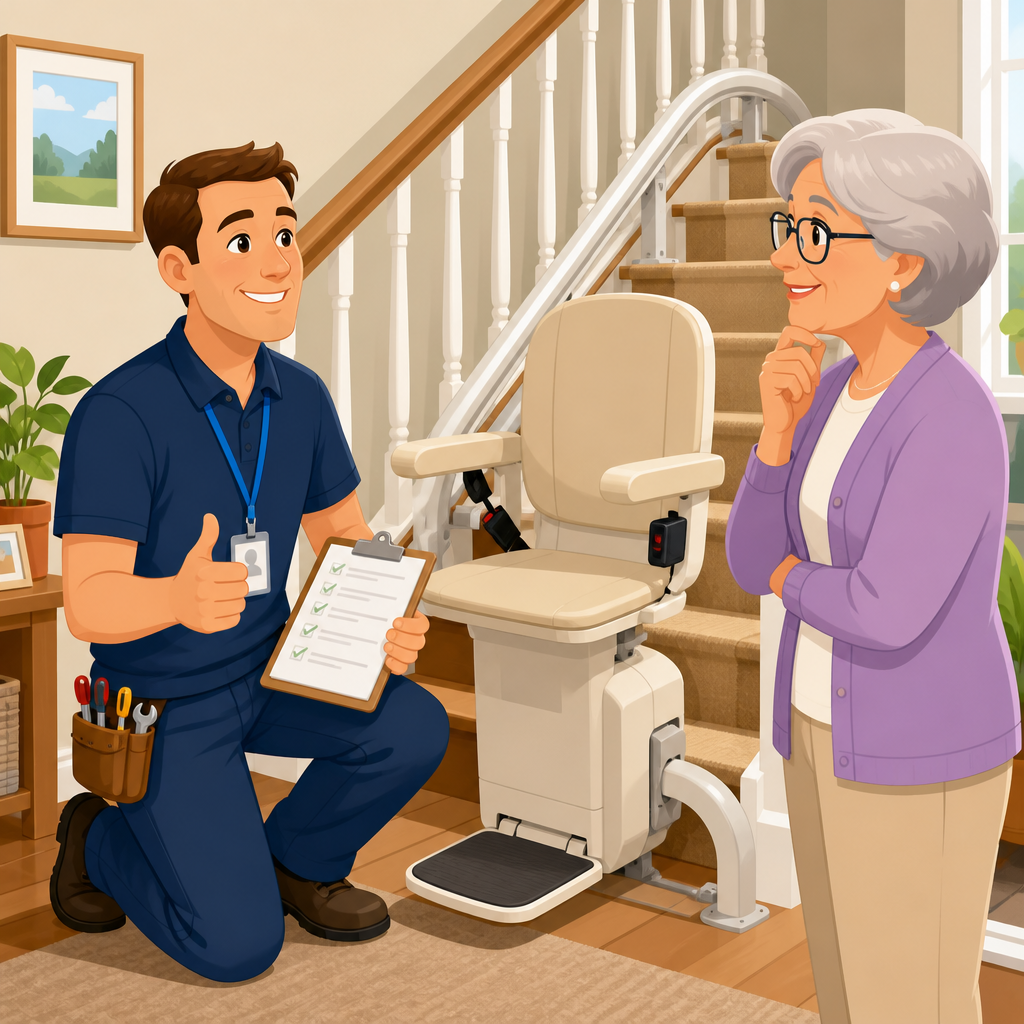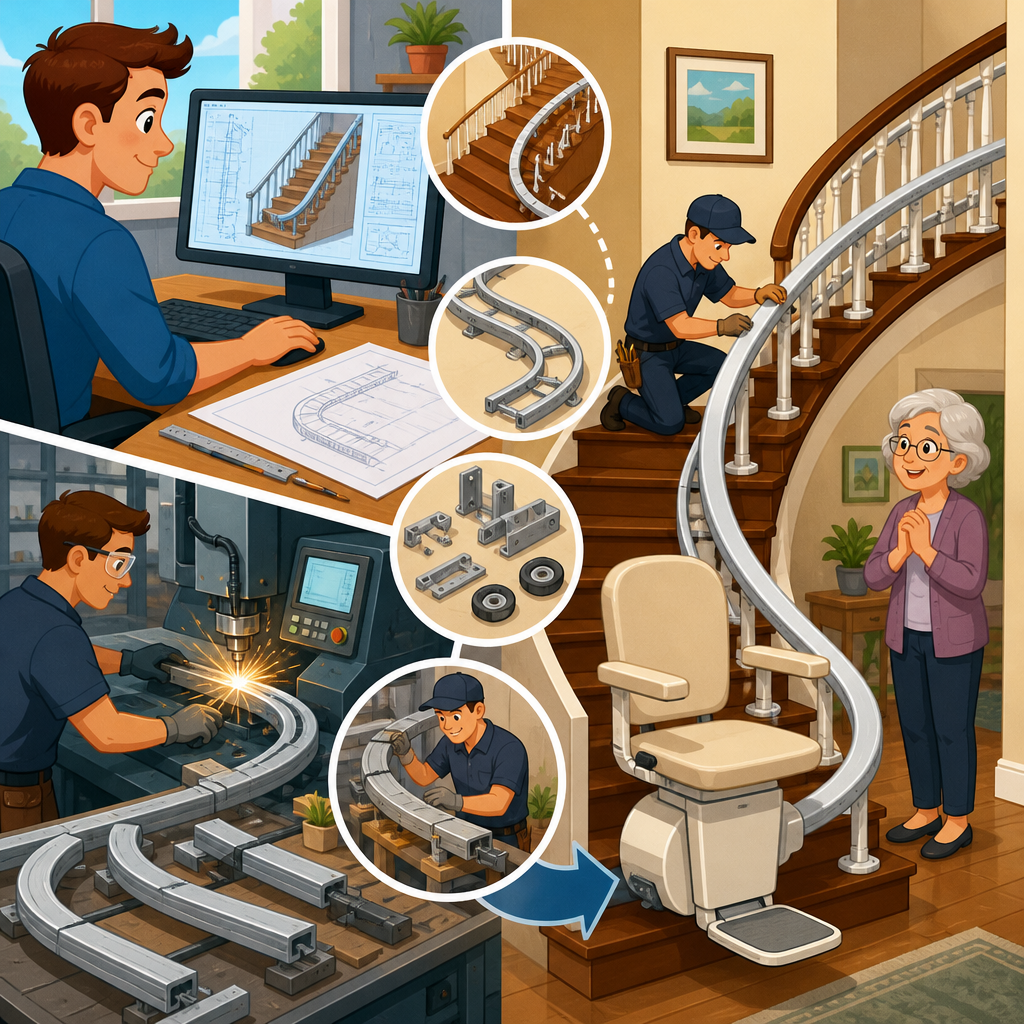
Curved stair lifts take longer to manufacture and install because every system is built around one specific staircase, not around a standard template. In the installation and setup category, this makes curved models the central topic for understanding installation timeline and costs, since they combine surveying, design, fabrication, site readiness, electrical checks, delivery scheduling, and final commissioning in one process. A stair lift is a motorized chair or perch that travels along a rail fixed to the stairs, and a curved stair lift uses a custom rail shaped to follow turns, landings, intermediate steps, and changing angles. By contrast, straight stair lifts typically use modular rails cut to length from stock, so they move from quote to installation far faster.
I have worked on projects where homeowners assumed the visible rail bend was the only difference. In practice, the bend is the easy part to notice and the hardest part to engineer consistently. A curved system has to account for rise, going, stair width, nose projection, headroom, start and stop positions, seat swivel clearance, hinge requirements near doors, and the user’s transfer safety at both ends. Those variables directly affect lead times and pricing. If one dimension is off, the chair can clip a wall, obstruct a doorway, reduce walking space, or stop short of a safe landing position.
Understanding why curved stair lifts take longer matters for two reasons. First, realistic expectations prevent stressful last-minute decisions, especially when a lift is needed after surgery, a hospital discharge, or a fall. Second, timeline knowledge helps buyers compare quotes intelligently. A shorter promise is not always better if it skips detailed surveying, underestimates permitting or electrical work, or relies on rushed fabrication. This hub article explains the full installation timeline and costs picture, from the first home assessment through commissioning, so you can see where delays happen, which steps are essential, and how to reduce avoidable setbacks without compromising safety, reliability, or fit.
Why curved stair lifts are custom products, not off-the-shelf equipment
The main reason a curved stair lift takes longer to manufacture is customization. Every curved rail is designed for one staircase geometry. Even in houses built by the same developer, small differences in plaster thickness, handrail placement, floor finishes, trim details, and landing dimensions can change the rail design. Installers do not simply choose a left-hand or right-hand model and order a standard bend kit. They capture detailed measurements, increasingly with digital photogrammetry or a dedicated surveying tool, then send those dimensions to engineering for a rail drawing and carriage path review.
Manufacturers such as Handicare, Stannah, Access BDD, Bruno, and Platinum typically run curved orders through a design approval workflow before production. The rail path must maintain usable stair width and suitable clearances around elbows, newel posts, radiators, and door swings. If the parking position is at the bottom near an entry door, the design may need a powered hinged rail to avoid blocking access. If the top landing is narrow, the chair may need an overrun so the user gets on and off away from the stair edge. Each option adds design checks, parts, and production time.
Material selection also affects the schedule. Some rails are fabricated from tubular steel with welded bends, while others use modular systems with custom-machined sections. Powder coating, carriage matching, charge point placement, and call/send controls all require coordination. Because the chair, rail, footrest, and charging layout work as one system, the manufacturer cannot finalize production until the survey data is validated. That is why curved stair lift lead times commonly run several weeks, while straight stair lifts can often be fitted in days.
Surveying and design approval: where the timeline is often won or lost
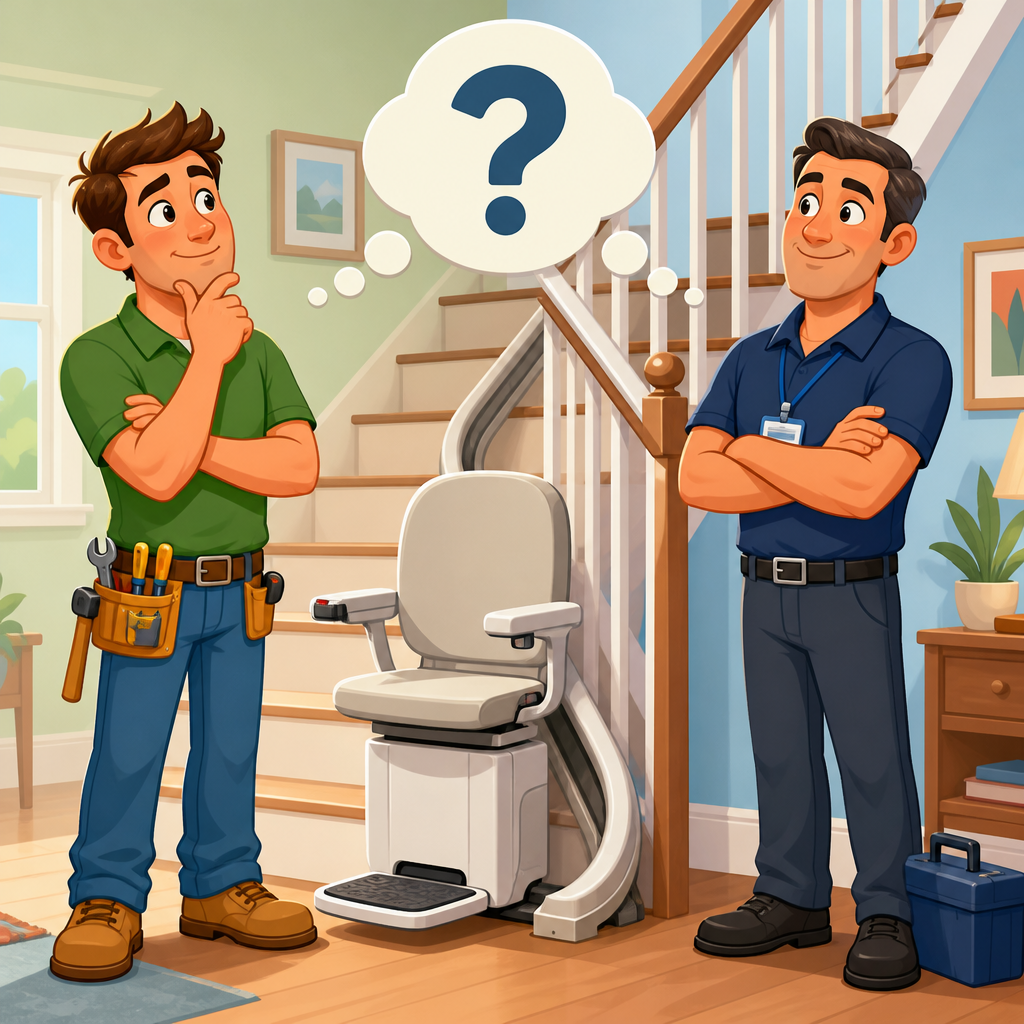
The home survey is the foundation of the project timeline. A proper curved stair lift survey records stair pitch, tread depth, riser height, total travel, inner and outer string dimensions, landing lengths, obstructions, electrical outlet locations, and transfer space. Experienced surveyors also assess how the user sits, stands, and turns. In my experience, this user-centered review often changes the recommended parking position or seat type more than the staircase measurements do. For example, a customer with limited hip rotation may need a powered swivel and a higher seat height, which then affects clearance on tight bends.
Errors at this stage create the longest delays because they are discovered late, usually after manufacturing or during installation. If a rail arrives and misses a doorway by an inch, the installer cannot improvise safely. A remake may be required, resetting the schedule. That is why reputable providers build time into surveying, drawing review, and factory signoff. Many also provide a technical drawing or route preview so the customer can confirm parking points and any hinged sections before fabrication begins.
Access issues can extend surveying time as well. Split-level homes, decorative iron balusters, spiral-like transitions, or stairs with uneven winders demand more detailed modeling. Multi-user households sometimes request parking around a corner to preserve hallway space, which sounds simple but can add complexity to the rail path and charging points. Good design approval prevents surprises later, but it does mean the front end of the project moves more slowly than buyers expect.
Manufacturing stages that add time and affect cost
Once the design is approved, the order enters manufacturing. Curved rail production usually includes converting survey data into a fabrication drawing, cutting material, forming or bending the rail, welding or joining sections, machining mounting interfaces, finishing, quality control, and packaging for shipment. The carriage and seat may come from standard product families, but the rail is the schedule driver because it is unique to the home. Factories often batch similar finishing colors or process capacity by line, so a custom order may wait for its production slot.
Quality control is another time factor that buyers rarely see. Curved rails must hold tight tolerances along their route so the chair travels smoothly without excessive vibration, noise, or leveling issues. Charge contacts need to align precisely at park points. If the lift includes powered features such as an automatic swivel, folding footrest, or powered hinge, those components are tested as part of system compatibility. Skipping these checks would shorten lead time, but it would increase call-backs, adjustments, and safety risks.
Costs rise at the same stages where time increases. Engineering time, custom fabrication labor, packaging for oversized freight, and lower economies of scale all make curved lifts more expensive than straight models. In many markets, a straight stair lift may start around a few thousand dollars installed, while curved systems commonly cost several times more depending on complexity and options. The price difference is not simply a brand premium; it reflects one-off manufacturing, specialist installation labor, and a longer project management process.
Typical timeline differences between straight and curved stair lifts
Most buyers ask one direct question: how long does a curved stair lift take from order to installation? The most accurate answer is usually several weeks, with faster or slower outcomes depending on survey complexity, factory capacity, shipping distance, and home readiness. Straight stair lifts can often be quoted, stocked, and installed within a few days because the rail is cut on site or supplied in standard lengths. Curved systems cannot move that quickly unless a provider already holds unusual spare inventory for a nearly identical staircase, which is rare.
| Project stage | Straight stair lift | Curved stair lift | Why curved takes longer |
|---|---|---|---|
| Initial assessment | Often same day or next day | Often same day or next day | User needs are similar, but curved stairs require more technical measurement |
| Survey and design | Minimal or standard measurement | Detailed survey plus engineering review | Custom rail path must be modeled and approved |
| Manufacturing | Stock rail cut to size | One-off rail fabrication | Custom bending, machining, finishing, and quality control |
| Shipping | Smaller, simpler logistics | Larger custom shipment | Oversized sections and coordinated delivery windows |
| Installation | Usually a few hours | Usually longer, sometimes a full day | Multiple rail sections, tight clearances, setup, testing, and user training |
For planning purposes, many homeowners should expect the curved stair lift timeline to include assessment, survey, factory lead time, delivery, installation, and handover rather than just the day the installers arrive. If the lift is urgently needed, ask whether a temporary downstairs sleeping arrangement, short-term care plan, or straight lift on a secondary staircase is feasible while the custom unit is being built.
Installation-day factors that can slow the final fit
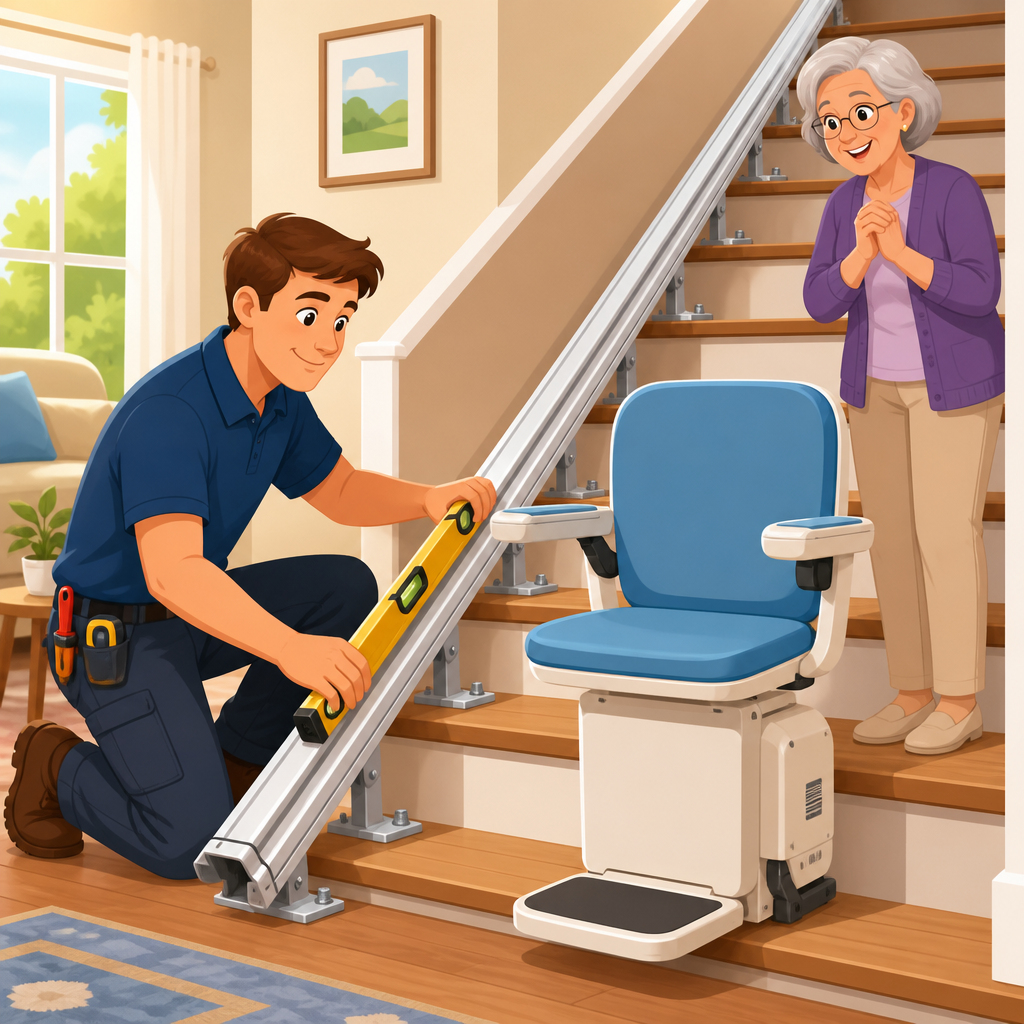
Even after manufacturing is complete, installation can take longer than homeowners expect. Curved rails often arrive in sections that must be carried carefully into the home, assembled on the stairs, aligned, and secured to brackets fixed to the treads. Tight hallways, fragile finishes, limited parking for the installation vehicle, or apartment access restrictions can all add time before the first bracket is even placed. In older homes, installers sometimes need to work around uneven treads or delicate trim while maintaining the manufacturer’s fixing requirements.
Electrical setup is usually straightforward because most modern stair lifts use battery-powered carriages that charge at park points from a nearby outlet. Still, installers must verify the outlet, route any charger leads safely, and confirm the lift charges correctly at designated stops. If the chosen park position changes because of clearance discovered on the day, the charging arrangement may also need adjustment. Powered hinges, retractable rails, and remote call stations add more commissioning steps.
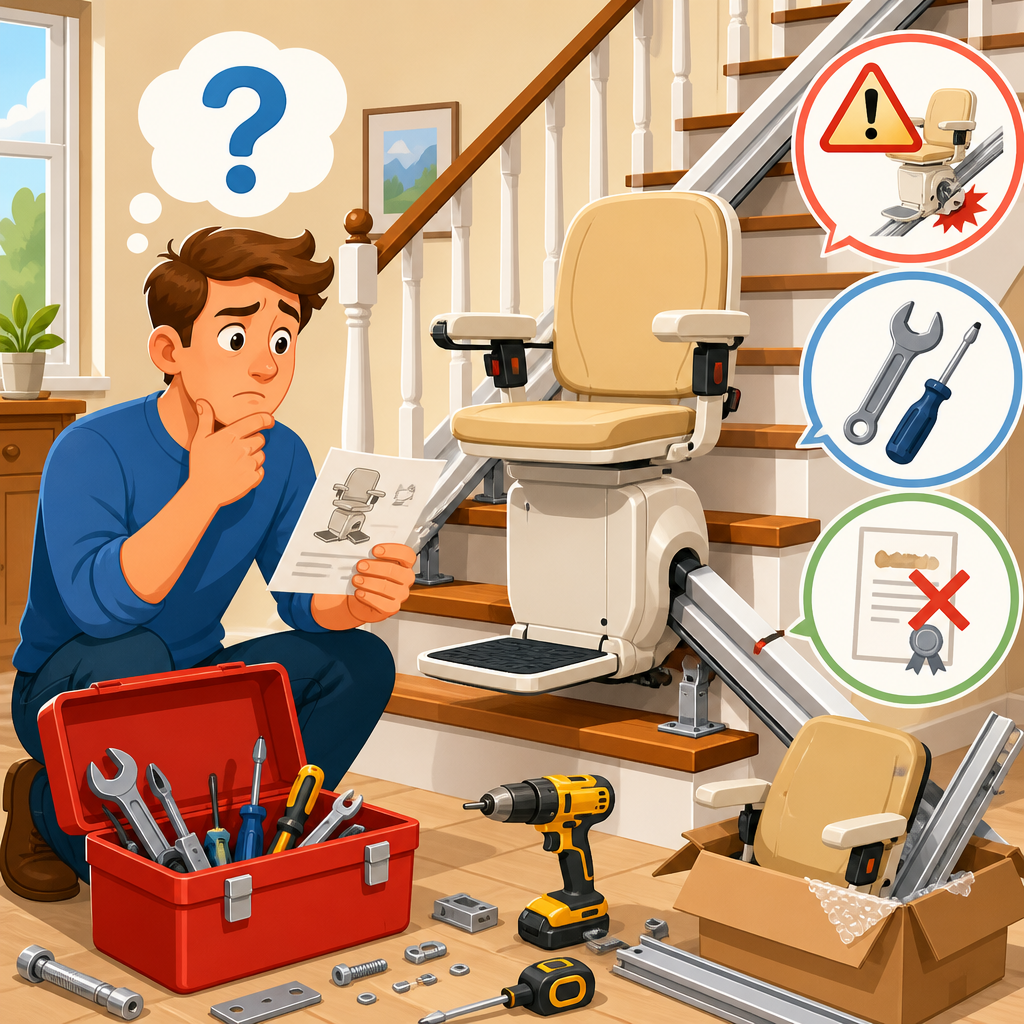
Final testing is non-negotiable. The installer runs the lift through full travel, checks seat swivels and interlocks, confirms safety edges, verifies charge contact alignment, and trains the user. In my experience, user training can be the difference between confidence and abandonment. A technically perfect installation is not successful if the customer does not understand folding, parking, using the seat belt, or sending the chair away. Curved installations often need more training because parking positions and transfers are more customized.
Cost drivers: what homeowners are actually paying for
When people compare curved stair lift costs, they often focus on the visible chair and rail. The real cost structure is broader. Buyers are paying for assessment time, technical survey work, engineering, custom manufacturing, logistics, installation labor, warranty support, and aftercare. Options such as powered swivel seats, folding rails, upgraded upholstery, heavy-duty capacity, perch seats, and advanced remote controls raise the price because they increase component costs and fitting complexity.
Property features can push costs further. A staircase with multiple landings, reverse turns, narrow sections, or parking needs away from the main stair run requires more rail and more engineering. Rural delivery locations may add freight or scheduling costs. Buildings with management approval requirements or restricted installation hours can increase labor costs. If electrical improvements are needed, those may be priced separately by an electrician rather than by the stair lift company.
There are also long-term cost considerations. The cheapest quote is not always the lowest ownership cost if service coverage is weak, spare parts are slow to source, or the rail design leaves little walking room and causes daily frustration. A well-designed curved lift should balance safe transfer points, comfortable ride quality, and minimal intrusion into the stairway. That balance is worth paying for because it reduces adjustments, call-backs, and regret after installation.
How to reduce delays and control installation timeline and costs
Homeowners can shorten the process by preparing early. Schedule the assessment as soon as a mobility change becomes likely, not after a discharge date is set. Clear the staircase and landings before the survey. Gather photos, rough dimensions, and details about any doors near the stairs. If more than one person will use the lift, say so up front. That helps the provider recommend the right seat height, controls, and parking positions before design begins.
Ask precise questions during quoting. What is the current factory lead time? Is the rail manufactured domestically or overseas? Will the company provide a final drawing before production? Are electrical works included? What happens if measurements need correction after order placement? Can installation be booked provisionally while the rail is in production? Direct answers reveal how organized the provider is and whether the quoted timeline is realistic.
Finally, choose a company with experienced surveyors and installers, not just a competitive price. The fastest projects I have seen were not rushed; they were well managed. Accurate measurement, clear communication, and a disciplined handoff between sales, survey, factory, and installation teams prevent the expensive delays that make curved stair lifts feel slow. If you are comparing options under installation and setup, use this page as your hub for installation timeline and costs, then request a detailed survey and written quote based on your exact staircase. That is the surest way to get a safe fit, a realistic schedule, and fewer surprises.
Frequently Asked Questions
Why does a curved stair lift take longer to manufacture than a straight stair lift?
A curved stair lift takes longer to manufacture because it is not pulled from standard inventory in the same way many straight stair lifts are. Straight models often use modular rails that can be cut to length and installed on a wide range of staircases with relatively minor adjustments. A curved stair lift, by contrast, is built around one exact staircase. That means the process starts with a detailed survey of the home, where measurements are taken for every turn, landing, rise, tread, obstruction, and parking position. Even small details such as a narrow hallway, a door swing, or a radiator near the staircase can influence the final design.
Once those measurements are collected, the rail must be engineered to match the staircase’s unique path. The rail is then fabricated to those specifications, including any bends, transitions, start points, and overrun sections. Because the system is custom-made, the manufacturer also has to confirm that the chair can travel smoothly around corners while maintaining proper clearances for knees, arms, and footrest movement. This design and fabrication stage adds time because accuracy is critical. If a curved rail is even slightly off, it may not fit correctly or operate as intended. In practical terms, curved stair lifts take longer because they involve surveying, custom design, specialized fabrication, quality checks, and coordinated delivery rather than a simple off-the-shelf installation process.
What parts of the survey and design process add the most time to a curved stair lift project?
The survey and design stages add time because they are the foundation for everything that follows. During the survey, the staircase is assessed in detail, not just measured generally. The installer or surveyor looks at the number and angle of turns, the width of the staircase, the size of landings, headroom, wall features, handrails, doorways, and any obstacles that could affect rail placement or chair travel. They also determine where the lift should start and stop, whether a hinged rail or folding components are needed, and how the lift can be parked to reduce obstruction in the home.
After the site visit, those measurements are translated into a technical design. This is where extra time often enters the project. The manufacturer or design team must model the rail path precisely so the lift can move safely and comfortably through each curve. If the staircase has multiple bends, split-level landings, tight transitions, or unusual geometry, the design work becomes more complex. In some cases, measurements may need to be clarified, revised, or reviewed before fabrication begins. The team may also need to account for user-specific requirements, such as seat height, weight capacity, transfer needs, or the safest dismount point. All of this matters because a curved stair lift is not only being built to fit the stairs; it is being built to fit the user, the home, and the operational demands of that exact space.
Can installation be delayed even after the curved stair lift has been manufactured?
Yes, installation can still be delayed after manufacturing if site conditions, logistics, or final readiness issues are not fully aligned. Even when the custom rail and lift components are finished, the home still needs to be ready for installation. The staircase must be clear, accessible, and in suitable condition. If flooring work, decorating, remodeling, or structural repairs are still underway, the installer may need to postpone the appointment to avoid damaging the lift or compromising the fit.
Electrical readiness can also affect timing. While many stair lifts run from batteries that charge at designated points on the rail, the charging points still need access to a suitable power supply. If an outlet is missing, blocked, or found to be unsuitable during final checks, an electrician may need to make changes before the lift can be commissioned. Delivery scheduling is another common factor. Curved rails are larger and more specialized than standard components, so they must be transported and delivered carefully, often in coordination with installer availability. Once on site, the system still has to be assembled, secured to the staircase, tested, and commissioned. If any final adjustment is needed for alignment, charging, swivel operation, folding components, or travel limits, that can also extend the timeline. In short, manufacturing is a major milestone, but it is not the only one that determines when the lift becomes fully operational.
How do staircase complexity and home layout affect the installation timeline and cost?
Staircase complexity and home layout have a direct impact on both timeline and cost because they influence nearly every stage of the project. A simple curved staircase with one gentle bend is very different from a staircase with multiple turns, intermediate landings, narrow sections, low headroom, or awkward start and finish positions. The more complex the staircase, the more detailed the surveying and design work becomes, and the more specialized the rail fabrication must be. This usually increases both production time and manufacturing cost.
The layout of the home also matters. Installers need enough space to bring in rail sections, tools, and lift components safely. Tight entrances, narrow corridors, or difficult access to the staircase can slow the installation process. The team may need extra time to maneuver components into position or adjust how the lift is assembled on site. In addition, a complex layout may require custom parking solutions so the chair does not block a hallway, doorway, or landing when not in use. Features such as powered swivel seats, automatic folding rails, or call stations may also be included to improve usability in a restricted space, and each added feature introduces more setup and testing requirements. Because curved stair lifts are tailored systems rather than standard products, complexity in the staircase and the surrounding home almost always translates into a longer project timeline and a higher overall installed price.
What happens during final installation and commissioning of a curved stair lift?
Final installation and commissioning is the stage where the custom-designed system is fitted, tested, and prepared for everyday use. The installation team mounts the rail securely to the staircase, not typically to the wall, and then installs the chair or perch unit, charging points, controls, and any optional features such as a powered hinge or powered swivel seat. Because the rail has been manufactured for one specific staircase, the fit must be checked carefully along the full travel path. The installer verifies that the lift moves smoothly around each bend, stops accurately at the intended positions, and maintains proper clearance from steps, walls, and nearby obstacles.
Commissioning goes beyond simply turning the lift on. The installer will test the safety sensors, battery charging function, seat swivel locks, footrest operation, remote controls, and start-stop performance. They will also confirm that the user can get on and off safely at the top and bottom of the stairs. If needed, small adjustments are made to seat position, travel limits, or parking points to improve comfort and practicality. Once the mechanical and electrical checks are complete, the user is shown how to operate the lift, fold it away, charge it properly, and respond to basic alerts or faults. This final step is essential because a stair lift is a motorized chair or perch that travels along a rail, so safe operation depends on both proper setup and proper instruction. The commissioning stage is one of the reasons curved stair lifts take time, but it is also what ensures the finished system is safe, reliable, and suited to the exact home where it is installed.