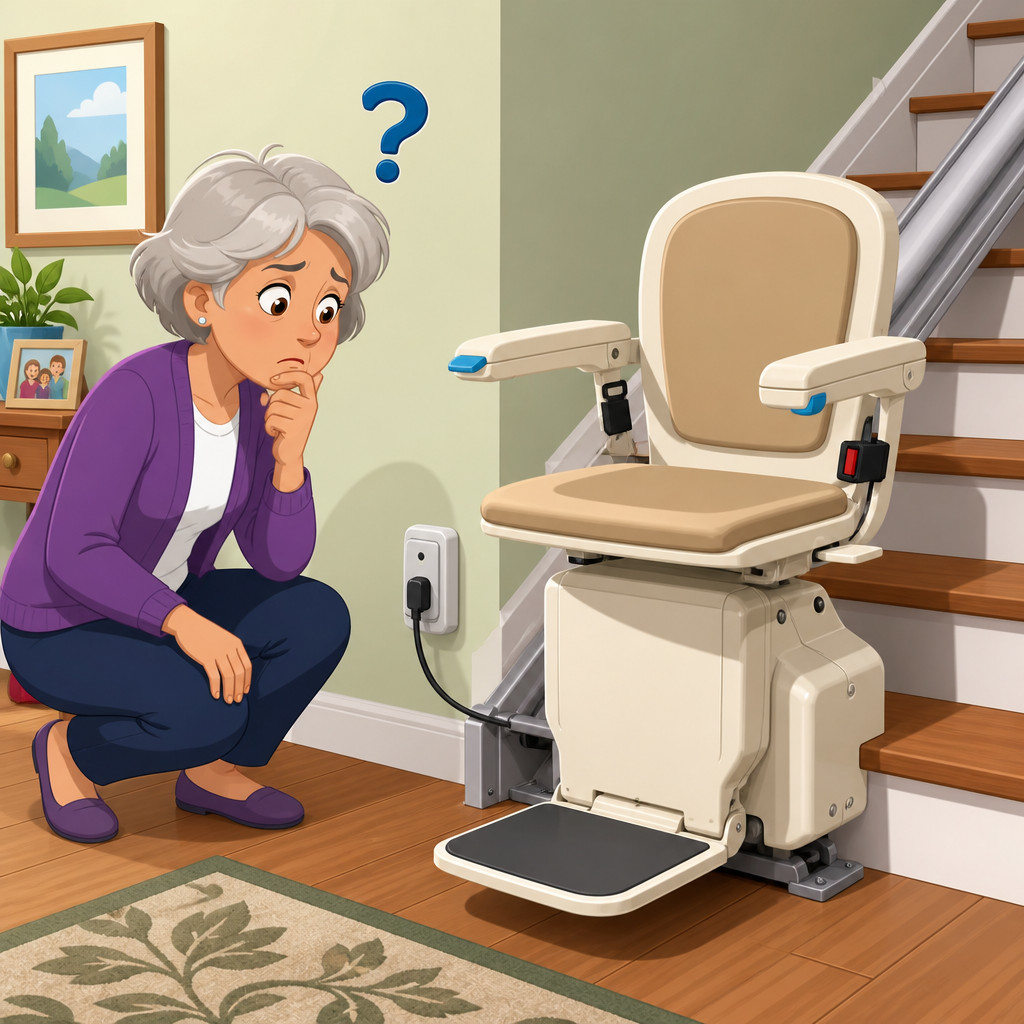
A stair lift charging light that stays off usually means the batteries are not receiving power, and that matters because most stair lifts depend on continuous charging to stay reliable, safe, and ready during a power cut. In service calls I have handled, an unlit charging indicator is one of the earliest warning signs before customers notice slow travel, beeping faults, or a lift stopping partway on the rail. The charging light itself is simple: it shows that the charger, charge points, wiring, and batteries are communicating as they should. When that chain breaks anywhere, the light may go dark.
Understanding the problem starts with a few key terms. The charger converts household mains electricity into the low-voltage power the lift uses to maintain its batteries. The batteries, usually sealed lead-acid units inside the base of the chair, power the motor and control board. Charge contacts or charging strips sit at a parking point on the rail, often at the top or bottom, and touch matching points on the carriage when the lift is parked correctly. The charging light may be on the armrest, near the diagnostic display, or integrated into a status panel depending on the brand. On models from Bruno, Stannah, Acorn, Harmar, and Handicare, the exact indicator behavior differs, but the logic is the same: no light means no confirmed charging state.
This issue matters for three reasons. First, battery-powered stair lifts are designed to run from batteries even when the home loses power, so charging is essential to that backup function. Second, batteries that sit partially discharged wear out faster through sulfation and reduced capacity. Third, many charging faults are small and fixable if caught early, such as a switched outlet, a dirty contact, or a chair parked an inch away from the charge point. Left alone, those simple problems can lead to expensive battery replacement, emergency callouts, or a lift that is unavailable when a user needs it most.
This guide is the hub for common issues and fixes within stair lift maintenance, troubleshooting, and safety. It explains the most likely causes of a stair lift charging light not being on, how to narrow the fault safely, what you can check yourself, and when the problem points to parts that should be tested by a qualified technician. If you want a practical answer before booking service, start with power, parking position, and contact cleanliness. Those three checks solve a large share of charging-light complaints.
What an unlit charging light usually means
If the charging light is not on, the most common explanation is that the stair lift is not parked on a live charging point. Many owners assume the lift charges anywhere on the rail. Most do not. They charge only at specific top and bottom positions, and some have a charge point on one end only. I regularly see lifts left a few centimeters short of the correct spot after someone manually nudged the chair, used the seat swivel, or stopped mid-rail to carry items. The result is simple: the carriage misses the contact, the charger cannot reach the batteries, and the indicator stays dark.
A second common explanation is loss of mains power to the charger. Stair lift chargers are often plugged into a nearby outlet under the staircase, in a hallway cupboard, or near the top landing. That outlet may be controlled by a wall switch, shared with a vacuum, or protected by a tripped breaker or GFCI. If the charger has no incoming AC supply, the batteries take over and the lift may still run for a while, which can make the problem easy to miss. By the time the user notices beeping or sluggish movement, the batteries may already be significantly discharged.
Other possibilities include dirty charging contacts, loose low-voltage connections, failed batteries, a charger that has stopped outputting voltage, or a fault on the control board that prevents charging recognition. Less often, the light itself has failed while charging still works, especially on older units with separate LED boards. That is why diagnosis should always focus on the whole charging system, not the indicator alone.
Start with the simplest checks first
The fastest way to troubleshoot a stair lift charging light not on is to rule out the easy causes in a sensible order. Begin by parking the lift firmly at the top or bottom charge station according to the manufacturer’s instructions. If your model beeps when it is off charge, listen for that warning. If it has a diagnostic display, note any code before moving the chair. Then confirm the seat is locked in the travel position, the footrest is not obstructed, and the carriage has not stopped just short of the final park point. On several models, the difference between charging and not charging can be less than an inch.
Next, inspect the power source. Is the charger plugged in securely? Is the outlet live? A simple lamp test often answers that. Check the home’s consumer unit or breaker panel for a tripped circuit. If the outlet is on a residual-current device or GFCI, press reset if appropriate. Some chargers also have a small indicator light on the power supply brick. If that light is off and the outlet is live, the charger itself may be faulty.
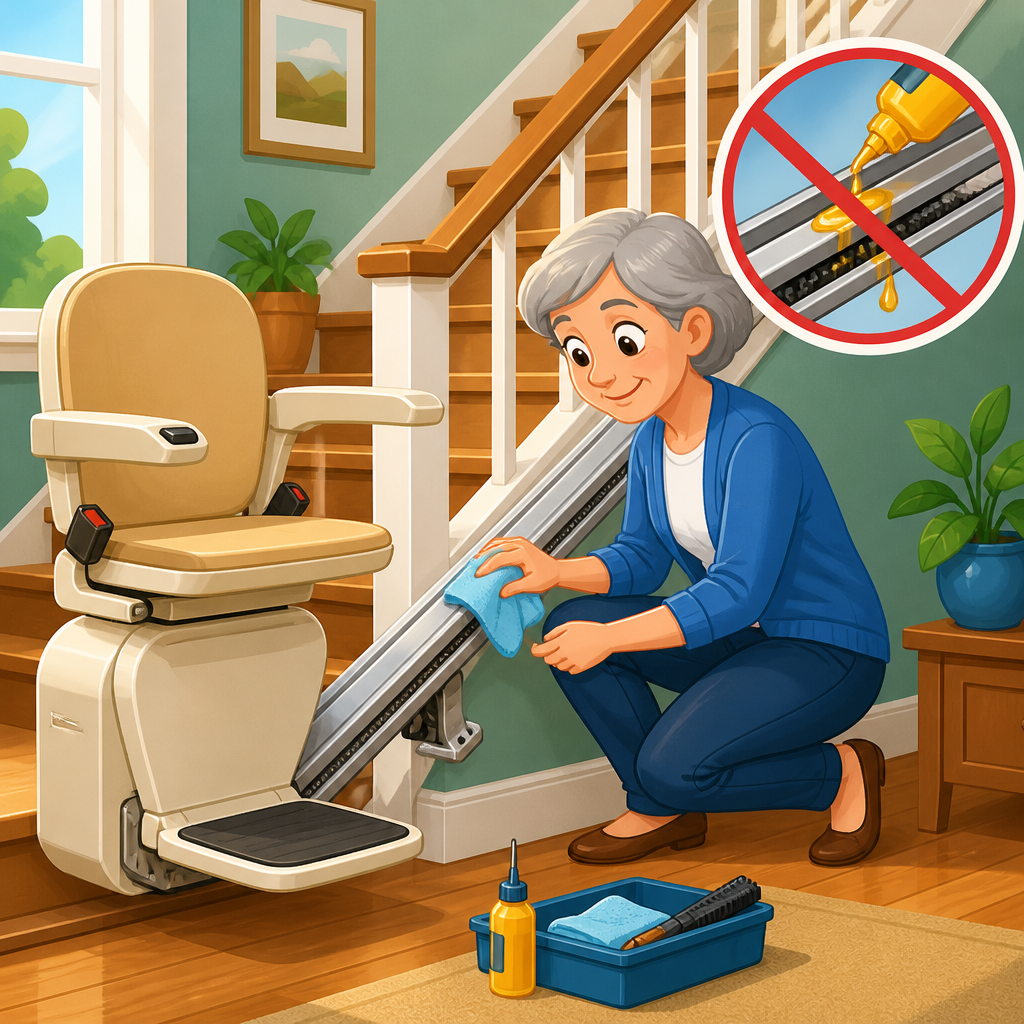
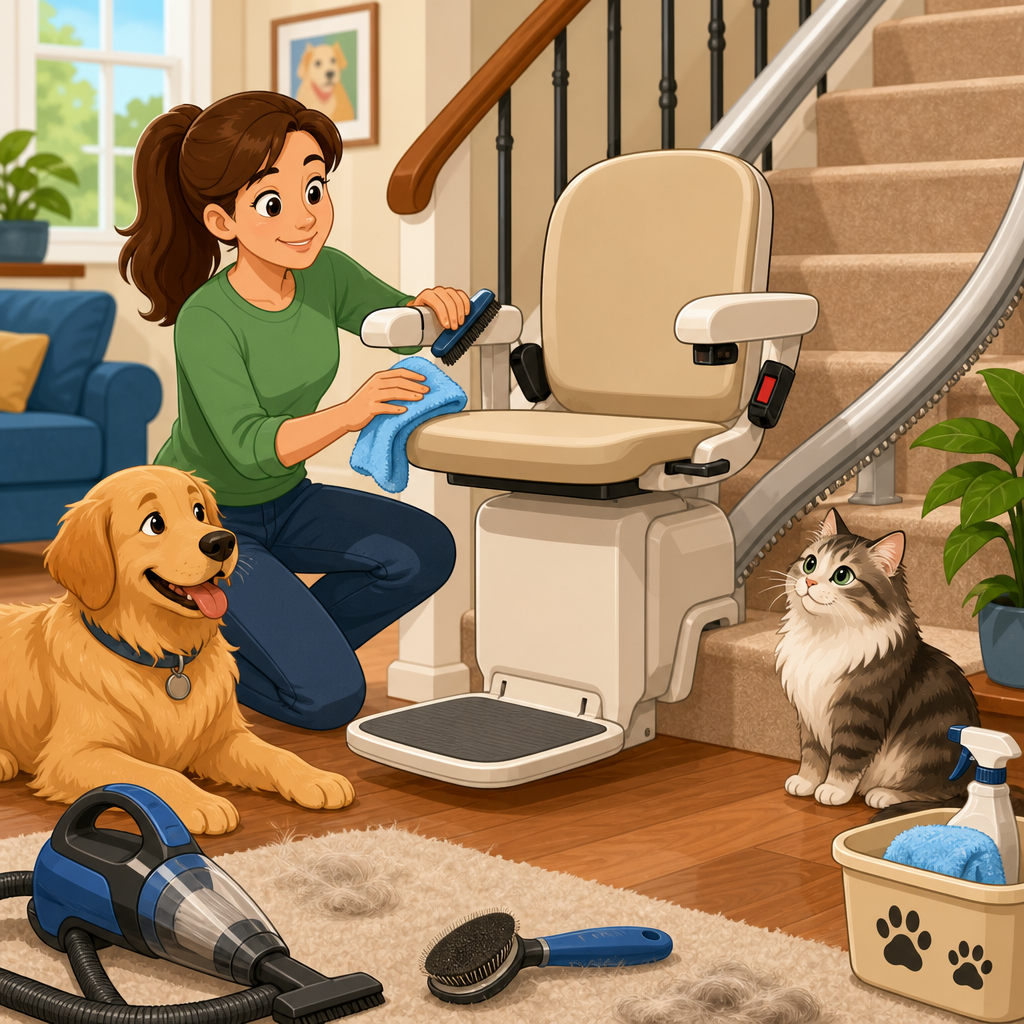
Then look at the charging contacts. These may be copper strips on the rail, spring-loaded pins on the carriage, or metal pads that meet when parked. Dust, pet hair, oxidation, and cleaning residue can interfere with contact. I have seen polish overspray insulate the rail strips enough to stop charging entirely. A gentle wipe with a dry microfiber cloth is a safe first step. Do not use abrasive paper unless the manufacturer or technician advises it, because removing plating can shorten contact life.
| Symptom | Most likely cause | What to check first | Typical fix |
|---|---|---|---|
| Charging light off, lift still runs | Charger unplugged or outlet dead | Outlet power, charger indicator, breaker | Restore mains power or replace charger |
| Charging light off at one end only | Lift not parked on active charge point | Correct parking position, end-of-rail stop | Repark chair fully at charge station |
| Intermittent charging light | Dirty or misaligned contacts | Rail strips, charging pins, debris | Clean or adjust contacts |
| Light off, beeping, weak travel | Battery voltage low | Battery age, runtime, charger output | Charge system repair and battery replacement |
| Light off, no movement at all | Safety circuit or control fault | Diagnostic code, seat lock, key switch | Professional service diagnosis |
Power supply problems that stop charging
A stair lift charger cannot maintain batteries without steady mains power, so supply issues deserve careful attention. In many homes, the charger plugs into a standard 120-volt outlet in North America or 230-volt outlet in the UK and Europe, then converts that to a lower DC voltage. Common charger outputs are around 24 to 33 volts DC depending on design. If the outlet fails, the chair often continues operating on battery reserve, creating a false sense that everything is fine. This is why I advise clients to notice the charging light daily, not only when the lift misbehaves.
Switched outlets are a surprisingly common culprit. A user or cleaner turns off a wall switch without realizing it controls the stair lift socket. I have also traced charging complaints to extension leads pulled loose behind furniture, overloaded power strips, and GFCI receptacles tripped by unrelated appliances in adjacent bathrooms or garages. In older properties, a mildly loose plug can arc or warm up enough to interrupt power intermittently, producing a charging light that flickers on and off with no obvious pattern.
If the outlet is live but the charger shows no output, replacement is often straightforward, but only with the exact approved part. Chargers are not generic accessories. Voltage, amperage, connector polarity, and charging profile must match the lift. Using an incorrect charger can undercharge, overheat, or damage sealed lead-acid batteries. Reputable service providers test charger output under load, because a charger can show voltage with no load and still collapse when connected.
Parking position and contact alignment faults
Many charging faults come down to geometry. The chair must stop in the precise place where the carriage contacts meet the rail contacts. If the lift overshoots, undershoots, or parks slightly twisted due to wear, it may miss that connection. Hinged rails, manual swivel seats, and powered footrests can all affect final parking if a limit switch is out of adjustment or a user changes the normal sequence. On some lifts, sending the chair with a call-send remote restores correct parking better than riding it into place manually.
Misalignment can happen gradually. Rollers wear, rail joints settle, and contact brackets get bent during cleaning or moving furniture. I have seen bottom charge contacts pushed out of line by a vacuum cleaner head and top contacts shifted after carpet replacement changed clearances near the rail. Spring-loaded charging pins can also stick, especially where household dust combines with humidity. The symptom is often intermittent: the light turns on only after nudging the chair or pressing the armrest lightly.
Visual inspection helps. Contacts should look clean, square, and evenly meeting. If one pin is compressed while the other remains extended, or if metal pads touch only at an edge, charging may be unreliable. Some manufacturers specify a contact pressure range and gap measurement, which technicians check during annual servicing. That small mechanical adjustment can restore stable charging without any electrical parts replacement.
Battery and charger failures
When power and contact issues are ruled out, the next suspects are the batteries and charger. Most modern stair lifts use two 12-volt sealed lead-acid batteries wired in series for a 24-volt system. Typical service life is around three to five years, though heavy use, frequent power cuts, and long periods off charge can shorten that. As batteries age, internal resistance rises and capacity falls. The charger may still be working, but the batteries no longer accept or hold charge properly, causing the light to behave abnormally or the lift to report low-voltage faults.
Battery failure rarely appears without clues. Travel may sound strained on an incline. The lift may slow near the top of the rail where load increases. Warning beeps may occur after each trip. Diagnostic displays may show battery-related codes, though code meanings vary by brand and model. In my experience, users often assume the motor is failing when the real problem is a pair of tired batteries pulling voltage down under load.
Technicians confirm battery condition with resting voltage, charging voltage, and load testing, not by age alone. A healthy 12-volt SLA battery at rest typically reads around 12.7 to 13 volts after charging, while significantly lower readings can indicate discharge or deterioration. Under load, weak batteries drop sharply. If both batteries are original and one has failed, replacing the pair is best practice because mixed-age batteries charge unevenly and shorten each other’s life.
Control boards, safety circuits, and hidden faults
Not every dark charging light is a charger problem. Stair lifts include safety edges, overspeed governors, seat-swivel interlocks, footrest switches, key switches, and control boards that supervise operation and charging logic. A fault in these circuits can prevent the system from recognizing the parked state or can disable charging to protect components. For example, if a seat is not fully locked forward, some lifts will not complete normal ready status. If a carriage safety edge remains activated by carpet contact or debris, the lift may stop short of the charge point every time.
Control board faults are less common than contact or battery issues, but they do occur, especially after power surges, moisture ingress, rodent damage to low-voltage wiring, or years of vibration loosening connectors. In one case, I found a fractured solder joint on a charging input terminal that caused random no-charge events whenever the rail flexed under load. Another recurring issue is a damaged call-send station transmitting continuously and confusing system logic on certain older models.
These faults are difficult to diagnose without the service manual, meter readings, and brand-specific error codes. That is the point where professional support becomes the safe choice. A technician can compare charger output at the source, at the rail, and at the battery terminals, then isolate whether the problem lies in wiring, board regulation, or recognition circuitry.
Safe fixes, maintenance habits, and when to call for service
The safe owner-level fixes are limited but effective. Repark the chair at the known charge point. Confirm the seat and footrest are in their proper travel positions. Restore power to the charger outlet. Clean visible charging contacts gently with a dry cloth. Check for obvious obstructions around safety edges and the rail. If your manual permits it, verify the key switch is on and any isolation switch has not been turned off. After that, monitor whether the charging light returns consistently at both the top and bottom parking positions.
What owners should not do is equally important. Do not open the carriage covers if you are not trained. Do not short contacts with metal tools to “test” for power. Do not spray lubricants, contact cleaner, or household cleaners onto charge strips unless the manufacturer specifically approves them. Do not fit aftermarket batteries or chargers based only on similar voltage labels. Stair lifts are medical-adjacent mobility devices, and reliability depends on correct parts and settings.
Preventive maintenance reduces charging faults dramatically. During annual service, a qualified technician should inspect charger output, battery health, contact alignment, rail condition, final limits, and fault history if the controller stores it. For households with pets, weekly wiping of the rail and parking area helps keep hair away from charge points. For lightly used lifts, it still matters to run and park the chair correctly; batteries age from time and charge conditions, not just trip count. If the charging light remains off after the simple checks, if the lift beeps repeatedly, or if movement becomes weak or erratic, book service promptly rather than running the batteries flat.
A stair lift charging light not on is usually the first visible sign that the charging path has been interrupted somewhere between the wall outlet and the batteries. The most common causes are simple: no mains power, incorrect parking, dirty or misaligned contacts, tired batteries, or a failed charger. Less common but important causes include safety interlocks, wiring faults, and control board problems. Working through those possibilities in order saves time and often prevents an avoidable breakdown.
The main benefit of understanding these common issues and fixes is reliability. When you know what the charging light represents, you can catch problems early, protect battery life, and keep the lift ready for daily use and emergency situations. Start with the easy checks, use only approved parts, and treat intermittent charging as a warning rather than a minor annoyance.
As the central guide in stair lift maintenance, troubleshooting, and safety, this article gives you the framework for diagnosing a dark charging light with confidence. If the basic checks do not restore charging, arrange a professional inspection and keep the lift parked at its correct charge point until help arrives. A quick response now is the simplest way to avoid a no-start stair lift later.
Frequently Asked Questions
Why is my stair lift charging light not on?
If your stair lift charging light is not on, the most common reason is that the batteries are not currently receiving power from the charging system. In practical terms, that can mean the lift is not parked on a charging point, the mains power supply to the charger has been interrupted, the charger itself has failed, or there is a problem with the wiring, charge contacts, or rail connection. On most modern stair lifts, the charging light is there to confirm that the charger, charging points, and batteries are communicating properly. When it stays off, it is often one of the earliest signs that something is wrong, even before you notice slower travel, warning beeps, or the lift stopping unexpectedly.
Because most stair lifts run on batteries and rely on continuous charging while parked, an unlit charging indicator should not be ignored. The lift may still work for a while if the batteries still hold some charge, which can make the issue easy to overlook at first. However, once the batteries begin to discharge, performance often drops quickly. If the light is off, start by checking whether the lift is fully parked in its normal charging position, whether the wall switch or fused spur supplying the unit is on, and whether there has been a recent power cut or tripped circuit. If those basics are fine, the issue may be with the charger, charging contacts, or internal electrical components, and a service inspection is the safest next step.
Can a stair lift still work if the charging light is off?
Yes, a stair lift can often continue to operate for a limited time even when the charging light is off, but that does not mean the system is healthy. Most stair lifts are battery-powered and use the household electrical supply mainly to keep those batteries charged. If the charger stops feeding the batteries, the lift may still run on the remaining battery power for several trips. That is why many people first notice a charging problem only after the lift begins to slow down, beep, or stop partway through a journey.
The important point is that continued operation without a charging light is temporary, not normal. Once the battery charge drops too far, reliability and safety are affected. The lift may struggle under load, fail to complete travel, or show fault codes depending on the make and model. It may also become unavailable exactly when it is most needed, including during a power outage, which is one of the key reasons stair lifts are designed with battery backup in the first place. If your lift still moves but the charging light is off, treat it as an early warning. Limit unnecessary use, park the lift correctly on a known charging point, and arrange troubleshooting before the batteries become deeply discharged and potentially damaged.
What should I check first when the stair lift charging indicator is not lit?
The first things to check are the simple external causes, because many charging faults turn out to be power supply or parking position issues rather than major component failures. Begin by making sure the stair lift is parked exactly where it is meant to charge. Many lifts only charge at one or two precise locations on the rail, usually at the top and bottom. If the carriage is slightly out of position, the charge contacts may not line up, and the light may stay off even though nothing is actually broken.
Next, confirm that the mains power supply to the charger is on. Check the wall switch, fused spur, plug, or isolator that feeds the stair lift system. If your home has had a power cut, electrical work, or a tripped breaker recently, the charger may simply have lost supply. It is also worth looking for obvious signs such as a loose plug, a switched-off socket, or damage to accessible wiring. If your model has diagnostic lights on the charger unit itself, those can also help identify whether the charger is receiving power and producing output.
After that, inspect the charging points if they are visible and safely accessible. Dirty, bent, or worn charging contacts can prevent proper connection. Dust, pet hair, or oxidation sometimes builds up where the lift meets the charge strips or charging pins. Do not dismantle anything, but if your manufacturer allows it, a gentle visual check and basic cleaning of exposed contacts can sometimes help. If all of these checks look normal and the charging light still does not come on, the fault may involve the charger, batteries, or internal wiring, which should be handled by a qualified stair lift engineer.
Does an unlit charging light mean the batteries need replacing?
Not always. A charging light that is off does not automatically mean the batteries are bad. It means the charging system is not showing a normal charge condition, and the batteries are only one part of that system. In many cases, the real cause is loss of mains power, incorrect parking position, dirty charge contacts, a failed charger, a blown fuse, or damaged wiring somewhere between the power supply and the batteries. Replacing batteries without confirming the actual fault can lead to unnecessary cost and may not solve the problem.
That said, weak or aging batteries are still a common part of the overall picture, especially if the lift has been operating for several years or has already shown signs such as slowing down, reduced range during a power cut, or audible low-battery warnings. In service situations, it is not unusual to find that a charging fault has gone unnoticed long enough for the batteries to become deeply discharged, and repeated deep discharge can shorten battery life significantly. So while the light being off does not prove the batteries are the root cause, it can certainly lead to battery damage if left unresolved.
The best approach is to diagnose the charging path first: power supply, charger, charge contacts, wiring, and battery condition. A professional can usually test charger output and battery voltage quickly to determine whether the batteries are simply uncharged, no longer holding capacity, or not receiving current at all. That distinction matters, because the correct repair could be as simple as restoring power to the charger or as involved as replacing multiple components.
When should I call a stair lift engineer about the charging light being off?
You should call a stair lift engineer if the charging light stays off after you have checked the lift is parked correctly and confirmed the power supply is on. You should also arrange service promptly if the lift is beeping, moving slowly, stopping mid-rail, showing a fault code, or failing to operate reliably. These symptoms often appear soon after charging problems begin, and waiting usually increases the risk of a complete loss of service. If the lift is essential for mobility in the home, early attention is especially important.
Professional help is also the right choice if there are signs of damaged cables, intermittent charging, visible sparking at the contacts, repeated breaker trips, or uncertainty about where the charger is located. Stair lifts combine batteries, charging electronics, safety circuits, and moving mechanical parts, so guessing can create unnecessary risk. An engineer can test the charger output, inspect the charge points, verify the wiring, check the battery condition under load, and identify whether the issue is a simple power interruption or a failing component.
In short, call for service sooner rather than later. An unlit charging indicator is often an early warning rather than a final failure, and addressing it early can prevent a breakdown, avoid battery damage, and keep the stair lift dependable and safe to use every day.