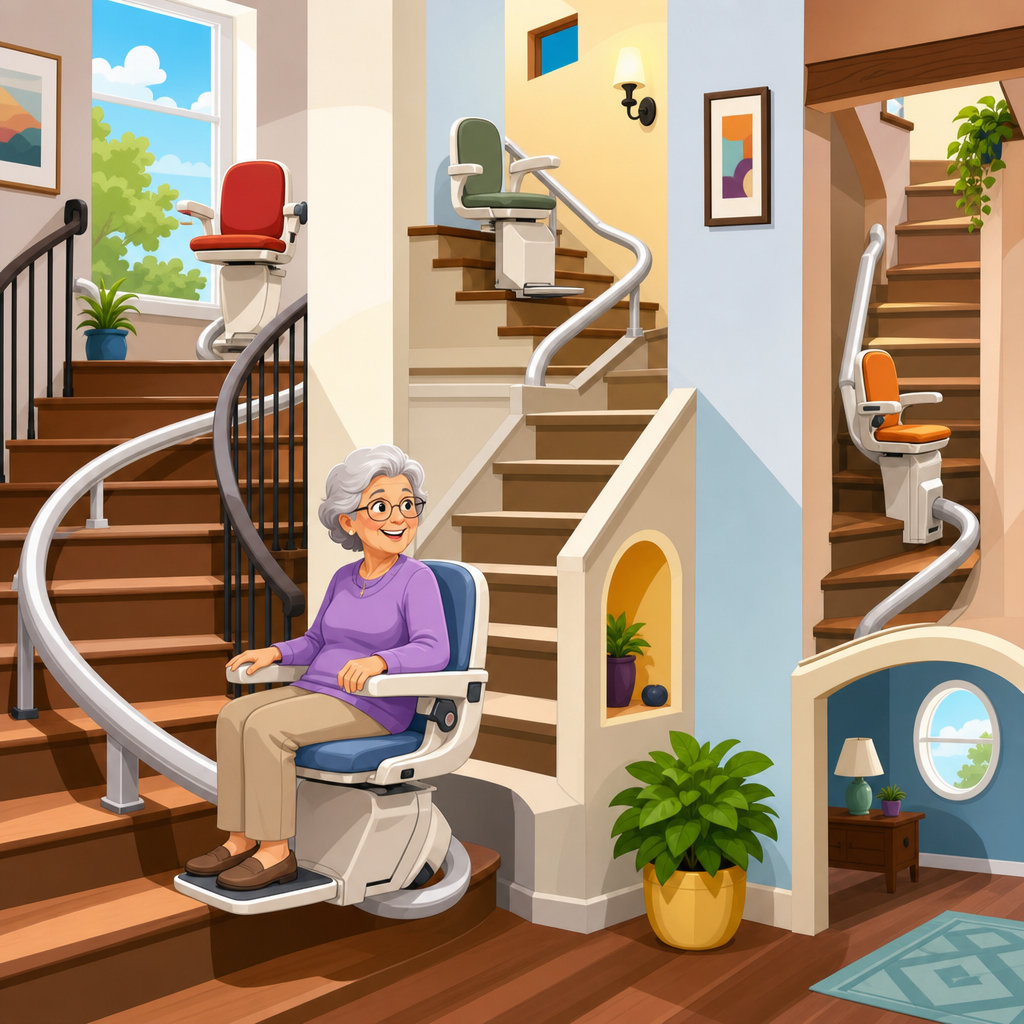
Custom chair lifts for unusual stair layouts solve a problem that standard straight or curved models often cannot: how to move safely and comfortably through homes with split landings, narrow turns, mixed gradients, or limited clearance. In the chair lift industry, “custom” usually means a system engineered around the exact geometry of a staircase, while “hybrid” refers to designs that combine features such as modular rail sections, powered swivels, perch seats, folding components, or platform transitions to fit difficult spaces. I have worked with homeowners, installers, and occupational therapists on projects where a stock lift simply was not viable, and the difference between a workable design and a frustrating one always came down to careful measurement, user needs, and building constraints. This matters because an unusual staircase is common in older homes, townhouses, and remodels, and for many households the alternative is unsafe stair use, major renovation, or relocating from a home they want to keep.
These systems deserve a hub-level explanation because buyers rarely have just one question. They want to know whether a chair lift can handle pie-shaped steps, half-landings, spiral-like turns, doorway conflicts, or steep attic stairs. They also need practical guidance on rail design, seat configuration, power supply, weight capacity, transfer safety, and cost. A custom chair lift is not one product category; it is a design process that adapts a mobility system to architecture. Some projects use a fully bespoke curved rail bent from a digital survey. Others use hybrid solutions, such as a short straight lift to a mid-level landing combined with a second unit, or a curved rail with a heavy-duty seat and automatic folding footrest. Understanding the available combinations helps households compare options realistically and avoid paying for features that do not improve access.
For this sub-pillar hub under Chair Lift Types & Designs, the goal is to explain how custom and hybrid designs work, when they are necessary, and which decision points shape the final specification. The central truth is simple: unusual stairs can often be served effectively, but success depends on matching the user, staircase, and installation method with precision. Standard assumptions fail quickly on nonstandard stairs. The best custom solutions are built from exact measurements, clear transfer requirements, and a full review of obstructions, parking positions, and emergency use. When those pieces are handled properly, a difficult staircase can become safe, intuitive, and durable without sacrificing the function of the home.
What counts as an unusual stair layout
An unusual stair layout is any staircase that falls outside the dimensions and path a standard straight chair lift can serve. In practice, that includes stairs with one or more 90-degree or 180-degree turns, intermediate landings, tapered or winders steps, unusually steep pitch, very narrow width, offset starts, doorways at the top or bottom, radiators or trim projecting into clearance space, and multilevel runs that change direction more than once. I have also seen “unusual” apply to stairs that are technically straight but too short for a safe transfer zone, especially where a hallway door opens directly onto the top tread. In these cases, the challenge is not rail travel alone; it is safe mounting and dismounting.
Most manufacturers begin by separating layout issues into geometry, clearance, and user transfer needs. Geometry covers the path the rail must follow. Clearance refers to folded seat width, knee room, footrest depth, and whether others can still use the staircase. Transfer needs include whether the rider can sit and stand from a standard seat, needs a powered swivel, benefits from a perch seat, or requires a higher seat base to reduce hip and knee flexion. This framework is practical because the same staircase may need very different solutions for different riders. A compact seat on a narrow curved stair may work for one person, while another needs a standing or perched model because bending the knees fully is painful.
Older housing stock is a major driver of custom demand. Victorian homes, converted brownstones, cottages, and many mid-century split-level houses were not designed with lift installation in mind. Remodeling can make the problem harder by adding handrails, built-ins, or altered landing geometry. The important point is that unusual does not mean impossible. It means the lift must be engineered rather than selected off a shelf.
How custom and hybrid chair lifts are designed
The design process starts with a detailed site survey. Reputable dealers use manual measurement protocols, photo documentation, and increasingly a digital stair survey tool that captures stair pitch, tread depth, riser height, landing dimensions, and every directional change. Curved rail manufacturers commonly convert those measurements into CAD-based rail drawings before fabrication. Because the rail is mounted to stair treads rather than the wall in most residential systems, small dimensional errors can produce poor alignment at landings, uncomfortable ride quality, or transfer positions that are simply unsafe. On complex runs, a precise survey is the difference between a seamless installation and expensive rework.
Custom does not always mean fully bespoke from end to end. Many successful installations are hybrid designs assembled from known components. A dealer may combine a modular curved rail with a manual hinge track at the bottom to avoid blocking a doorway, pair a slimline seat with a powered footrest to reduce bend-to-reach movements, or specify two linked lifts for separate flights where one continuous ride would be prohibitively expensive. In practice, hybrid design is about using the right combination of rail path, seat style, controls, and parking arrangement to solve a very specific access problem.
Engineering decisions revolve around ride path, transfer safety, and obstruction management. The rail may need overrun sections at the top or bottom so the user gets off away from the edge of the stairs. A parking curve can move the chair off the main staircase into a hallway recess. A powered swivel seat can align the rider toward the landing before standing. Advanced systems include call/send controls, safety edges on the footrest and carriage, battery backup charging points, and diagnostic displays for maintenance. These are not luxury add-ons on difficult stairs; they often make the installation functional in daily life.
| Layout challenge | Common custom or hybrid solution | Why it works |
|---|---|---|
| Single 90-degree turn with landing | Curved rail with top overrun | Provides safe exit on landing and continuous travel |
| Narrow staircase | Slim seat, folding arms, powered footrest | Preserves walking space and reduces user strain |
| Doorway at stair base | Hinged rail or parking bend | Keeps doorway clear when lift is not in use |
| Steep stairs with limited knee room | Perch or standing-style lift | Allows travel in a semi-standing posture |
| Split-level home | Two coordinated lifts or multibend curved system | Matches discontinuous floor levels efficiently |
| Heavy user or bariatric need | Reinforced seat and higher-capacity drive system | Maintains safety margin and stable ride quality |
Best solutions for specific unusual staircase types
Curved staircases with one or more landings are the classic custom lift application. These rails are manufactured to follow the inside or outside edge of the stair, depending on the best balance of clearance and rider comfort. Inside rails are usually shorter and can lower cost, but tight turns may reduce knee room. Outside rails provide a broader turning radius, often improving comfort, though they use more space. For homes with decorative banisters or limited wall-side clearance, choosing the rail side is a technical decision based on measurements, not appearance alone.
Winder stairs and pie-shaped steps require special attention because the lift does not care about tread shape as much as mounting location and carriage path. If the narrowing treads pinch the rider’s feet or knees on the inside route, an outside rail may be safer. Split landings create another design fork: one continuous curved lift or two separate lifts. A continuous ride is more convenient, but two lifts may cost less, install faster, and simplify servicing. I often recommend evaluating both when the user can transfer independently on a landing and budget is tight.
Narrow and steep stairs often lead to perch-seat or standing-capable designs. These models reduce the amount of sitting space required and can help riders with limited knee flexion. However, they demand good balance and upper-body control, so they are not universal solutions. In homes where a standard seated lift would leave too little passing room, a compact perch model can be the only practical choice. By contrast, spiral stairs are usually poor candidates for conventional chair lifts because the radius is too tight and the rise changes rapidly; in many of those cases, a home elevator, vertical platform lift, or reconfigured access route is the better answer.
Seat, rail, and control options that make custom lifts usable
The success of a custom chair lift is often decided by smaller specification choices rather than the rail itself. Seat height, arm width, back shape, footrest size, and swivel operation all affect whether the rider can transfer safely. A powered swivel seat is especially useful when arthritis, weakness, or balance issues make twisting difficult. An automatic footrest reduces the need to bend down. Folding rails, seats, arms, and footrests matter on narrow stairs because they preserve circulation for other household members. If multiple users will rely on the lift, programmable seat positions and easy-to-read controls become more important than they might appear in a showroom.
Drive systems also vary. Most modern residential lifts use a rack-and-pinion or cable drum mechanism with battery power charged from the mains at designated points on the rail. Battery-powered travel is now the norm because it allows operation during a power outage and generally produces smoother starts and stops. On a complex custom rail, however, charging contacts and parking stations must be planned carefully so the chair can reliably recharge in its normal resting positions. Neglecting this detail leads to service calls and dead batteries, particularly in homes where users park the chair away from the default station.
Controls should be intuitive and redundant. A simple rocker or joystick on the armrest works well for most riders, while wall-mounted call/send stations at each landing let family members move the chair out of the way. Some premium models add remote controls, diagnostic fault codes, and linked smart servicing tools, but usability still comes first. If a rider has visual impairment, reduced hand strength, or cognitive changes, large tactile controls and consistent seat orientation can matter more than advanced electronics.
Costs, installation timelines, and how to evaluate providers
Custom chair lift pricing varies widely because every unusual stair brings a different rail length, number of bends, seat package, and installation complexity. As a realistic market range, straight lifts often start in the low thousands of dollars, while curved custom systems commonly land much higher, especially with powered options or heavy-duty specifications. Multi-flight designs, parking bends, and top or bottom overruns add cost because they add fabrication and fitting complexity. Buyers should ask for itemized quotes that separate base unit cost, rail fabrication, electrical work if needed, installation labor, warranty terms, and future service rates. Without that breakdown, it is difficult to compare offers accurately.
Lead time is another major distinction between standard and custom products. A straight lift can sometimes be installed quickly if inventory is available. A custom curved rail usually requires survey approval, factory engineering, fabrication, shipping, and then installation scheduling. Delays can occur if the stair survey is incomplete or if construction changes the staircase after measurement. That is why experienced dealers insist on final dimensions and sometimes postpone survey signoff until flooring, trim, or remodeling work is complete.
Provider selection should focus on survey quality, manufacturer support, and aftercare. Ask who performs the survey, whether the rail is fabricated by a recognized manufacturer, what the local service response time is, and whether the dealer stocks common parts. Confirm weight capacity, folded width, warranty coverage on batteries and electronics, and compliance with relevant standards such as ASME A18.1 where applicable in the United States. A strong installer will discuss limitations openly. If a company promises every difficult staircase can take a lift without tradeoffs, that is a warning sign.
When a custom chair lift is the right choice, and when it is not
A custom chair lift is the right choice when the user wants to remain in the home, the staircase can provide safe transfer zones, and the installation preserves acceptable access for others. It is often more economical and less disruptive than moving, adding a bedroom downstairs, or undertaking major structural renovation. For many clients, the strongest benefit is immediate everyday safety: fewer risky stair attempts, less caregiver strain, and better use of the full home. In split-level properties and historic houses especially, a custom design can protect both independence and the character of the building.
It is not always the best solution. If the rider cannot transfer safely onto a seat even with adaptations, a vertical platform lift or home elevator may be more appropriate. If the stair is exceptionally narrow, spiral, or structurally compromised, installation may be impractical. Households should also think about future needs. A seated chair lift may work now, but if progressive conditions are likely to require wheelchair access later, planning for a different system can avoid paying twice. Occupational therapists and accessibility-focused contractors are valuable on these decisions because they assess the person, not just the staircase.
Choosing among custom and hybrid chair lift designs comes down to precision. The best outcomes follow a clear sequence: assess the user, survey the staircase in detail, compare realistic design paths, and select a provider with proven curved-lift experience and local service support. Unusual stairs do not eliminate access; they demand a smarter specification. If you are researching options under Chair Lift Types & Designs, use this hub as your starting point, then move into detailed pages on curved rails, perch seats, heavy-duty models, and multi-level solutions to match your layout and mobility needs.
Frequently Asked Questions
What makes a chair lift “custom” for an unusual stair layout?
A custom chair lift is designed around the exact shape, dimensions, and limitations of a specific staircase rather than relying on a standard straight run or a basic curved rail. This is especially important in homes with split landings, narrow corners, changing gradients, low headroom, offset steps, or awkward entry and exit points where a conventional model may not fit safely or comfortably. In practice, custom means the rail path, mounting points, seat configuration, and travel behavior are engineered to match the staircase as it actually exists, not as a typical stair design might look on paper.
For unusual layouts, installers usually start with a detailed site survey that records tread depth, riser height, staircase width, turning radius, landing size, obstruction points, and the user’s transfer needs. From there, the system may incorporate specialized rail bends, compact parking positions, powered folding footrests, powered swivel seats, or perch-style seating for users who have difficulty bending their knees. The goal is not just to make the lift fit, but to make sure it operates smoothly, leaves as much walking space as possible, and allows safe boarding and dismounting at both ends. That tailored engineering is what separates a true custom solution from a standard product adapted with minor adjustments.
Can a custom chair lift work on stairs with tight turns, split landings, or mixed gradients?
Yes, and that is one of the main reasons custom systems exist. Unusual staircases often present combinations of design challenges that standard units are not built to handle effectively. Tight turns may require a rail that curves precisely around a corner without pushing the seat too far into the stairwell. Split landings may call for a transition that carries the user across one section, around an intermediate platform, and onto another run at a different angle. Mixed gradients can require rail and carriage engineering that maintains stability and ride quality even when the slope changes from one section to the next.
In many of these cases, manufacturers and installers use hybrid design strategies. A hybrid chair lift may combine modular rail sections with custom-fabricated bends, along with features such as folding arms, compact footrests, powered swivels, or narrower seat options. In very restricted stairways, a perch seat may be used so the rider can travel in a more upright position while preserving clearance. The final design depends on both the staircase and the user. A staircase that looks impossible at first glance can often be made accessible with the right combination of rail geometry, seat style, and safety features. The key is a careful assessment by a specialist who understands both structural constraints and mobility needs.
How is a custom chair lift measured and installed in a home with limited space?
The process typically begins with a professional survey, and for unusual stair layouts, that survey is far more detailed than a simple tape measurement. Installers may use digital measuring systems, templates, or photo-based documentation to capture the exact route the rail must follow. They look at staircase width, tread condition, landing depth, wall projections, handrails, radiators, doors, and any other features that could affect the rail or seat movement. They also consider how the user gets on and off the lift, because safe transfer space at the top and bottom is just as important as the rail path itself.
Once the measurements are complete, the lift is configured so it mounts to the stair treads rather than the wall in most cases, which helps reduce the need for major structural changes. For tight spaces, the design may include a hinged rail to avoid blocking a doorway, a compact carriage to preserve walking room, or folding components that minimize intrusion when the lift is parked. Installation itself is usually more straightforward than many homeowners expect. Even with a custom rail, the work is generally completed without major remodeling, although highly unusual layouts can take longer than a basic straight-lift installation. After installation, the technician tests travel, charging points, seat rotation, obstruction sensors, and emergency controls, then adjusts the system to ensure smooth performance throughout the entire route.
Are custom chair lifts safe and comfortable for daily use?
When properly designed and installed, custom chair lifts are intended to be both very safe and very comfortable for everyday use. In fact, customization often improves safety because the system is built specifically to address the staircase’s problem areas rather than forcing a standard product into a difficult environment. Safety features commonly include a seat belt, obstruction sensors on the footrest and carriage, battery backup for operation during power outages, lockable controls, smooth start-and-stop operation, and swivel seating for safer exit onto a landing. On unusual stairs, these details matter even more because the lift may be navigating turns, variable slopes, or confined boarding areas.
Comfort depends on matching the lift to the user as well as the staircase. A well-chosen seat height, armrest position, footrest design, and swivel function can make transfers easier and less tiring. For users with limited knee flexion or balance concerns, perch seating or powered features may significantly improve usability. Good custom design also reduces jolts, awkward posture, and cramped riding positions by aligning the seat and rail path correctly throughout the trip. The result should feel secure, predictable, and easy to use multiple times a day. As with any mobility equipment, long-term comfort and safety also depend on routine servicing, proper user instruction, and selecting a lift from a reputable manufacturer and installer.
How much do custom chair lifts for unusual stair layouts typically cost, and what affects the price?
Custom chair lifts usually cost more than standard straight models because they require specialized measurement, engineering, fabrication, and installation. The price can vary widely depending on the complexity of the staircase and the features needed to make the lift practical for the user. A staircase with one gentle turn is generally less expensive than one with multiple bends, split landings, narrow passage points, or changing inclines. The type of seat, rail material, parking options, powered functions, and any required clearance solutions can all influence the final cost.
Hybrid configurations can also affect pricing. For example, a system that combines modular rail sections with custom cornering, a powered swivel, folding footrest, and hinged lower rail may be more economical than a fully bespoke design in some situations, but more complex than a conventional curved lift. Installation difficulty, local labor rates, warranty coverage, and service availability also play a role. The best way to understand cost is to get an in-home assessment and a written quote that explains exactly what is included. Homeowners should focus not only on the initial price, but also on fit, safety, ease of use, reliability, and after-sales support. With unusual stair layouts, the least expensive option is not always the best value if it compromises comfort, access, or long-term performance.