Installation tips for heavy-duty stair lifts start with one core truth: these systems are engineered for higher weight capacities, wider seats, reinforced rails, and stronger drive components, so installation must be more precise than with standard residential models. In practice, a heavy-duty stair lift usually refers to a unit rated above the common 250 to 350 pound range, with many models supporting 400, 500, or even 600 pounds depending on rail design, seat width, and staircase geometry. As someone who has reviewed lift specifications with dealers, measured staircases in older homes, and seen failed installs caused by rushed planning, I can say the installation process determines whether the lift feels secure, comfortable, and quiet for years. This matters because buyers often choose heavy-duty lifts for users with limited mobility, larger body frames, or the need for additional seat space, and those users cannot tolerate unstable mounting, awkward transfers, or underpowered performance.
A stair lift is not mounted to the wall; it is typically fixed to the stair treads through brackets that distribute load into the staircase structure. That distinction is essential when planning a heavy-duty lift, because the higher rated load increases demands on tread integrity, rail alignment, power supply reliability, and clearance management. A successful installation protects safety, preserves usable staircase width, and matches the user’s body size and transfer needs. It also reduces callbacks for common issues such as seat interference, charging faults, footrest collisions, and rail vibration. This hub article covers the full installation picture for heavy-duty lifts, from pre-install assessment and code-aware planning to rail configuration, electrical setup, testing, and long-term service considerations, giving you a practical foundation for evaluating any heavy-duty stair lift project.
Start with load capacity, user fit, and staircase measurements
The first installation tip for heavy-duty stair lifts is to treat measurements and user assessment as inseparable. Installers should never begin by asking only, “How wide is the staircase?” They should also ask who will use the lift, how they transfer, whether they need a powered swivel, and what body dimensions affect seat depth, arm spacing, and footrest position. A unit rated for 500 pounds on paper can still be a poor installation if the user’s hip width exceeds the seat’s effective width or if knee position causes contact with the opposite wall. In field assessments, I have found that fit problems are more common than true motor problems. Measuring the user’s seated width, thigh length, and transfer side often prevents expensive rework later.
For the staircase itself, record overall width, tread depth, riser height, nose projection, top landing clearance, bottom overrun space, and any obstructions such as radiators, trim, doors, handrails, or low window sills. Most manufacturers measure rail length from the top landing down to the bottom landing along the stair nosings, but heavy-duty models may require additional space because the seat and carriage are larger. Pay close attention to the narrowest point, not the average width. Many straight heavy-duty lifts need roughly 36 inches of staircase width for comfortable use, though some can work on less with compromises. Curved heavy-duty lifts often need more planning because wider seats create larger swing paths on turns and landings.
Stair tread condition is equally important. Because brackets fasten to treads, cracked hardwood, loose carpeted plywood, water-damaged timber, and inconsistent stair repairs can undermine the installation. A qualified installer should inspect for movement, squeaks, split nosings, and weak anchoring into stringers. Where tread integrity is questionable, reinforcement may be necessary before the lift goes in. That is especially true in older homes where cosmetic renovations hide structural wear. Heavy-duty lifts impose both static and dynamic loads, and while modern rail systems spread force effectively, they still depend on a stable stair structure. If the staircase flexes under normal walking, address that problem first.
Choose the right rail configuration for straight, curved, and outdoor stairs
Once measurements are complete, the next decision is rail type. Straight heavy-duty stair lifts are the simplest to install because the rail runs in one line, ships in modular or cut-to-length sections, and usually can be fitted in a few hours by an experienced crew. They are also easier to service and often less expensive than curved systems. However, not every staircase suits a straight lift. If the stairs include intermediate landings, pie-shaped steps, or direction changes, a curved rail is usually required to maintain safe travel and proper seat orientation. For heavy-duty applications, curved rail design must account for larger carriage dimensions and broader turning radii. That means custom fabrication, detailed templating, and stricter landing checks.
Track overruns deserve special attention. A top overrun moves the seat away from the stair edge at the upper landing, reducing fall risk during transfer. A bottom overrun can park the chair clear of a doorway or keep the seat off the staircase in a hallway. In heavy-duty installations, overruns are often more than a convenience; they can be the difference between a safe transfer and a dangerous pivot near the stair drop. Hinged rails are another useful option when the lower rail would block a door or walking path. Make sure the hinge mechanism is rated appropriately and verify that the user can operate it, whether manually or with power assistance.
Outdoor heavy-duty lifts introduce another layer of installation planning. The rail and carriage must be corrosion resistant, electronics need weather protection, and the site should be evaluated for drainage, wind exposure, ice accumulation, and sun damage. In coastal regions, salt air can shorten component life if the model is not truly outdoor rated. Installers should use manufacturer-approved covers, stainless hardware where specified, and charging points protected from standing water. The staircase surface matters too; concrete steps can require different anchors than wood, and uneven masonry can complicate bracket spacing. Outdoor installations succeed when environmental exposure is considered part of the engineering, not an afterthought.
Verify clearances, seat positioning, and transfer safety before drilling
Before any bracket is fixed, dry-fit planning should confirm that the user can board, ride, and exit the lift without awkward body movement. Heavy-duty stair lifts have wider seats and broader armrests, which improve comfort but consume more space during swivel and folding. Installers should map the chair in both travel and parked positions. Check whether knees or feet project into a wall, banister, or opposite handrail. Confirm whether a powered footrest is needed to avoid bending during setup. If the user has reduced trunk control, test whether a standard seatbelt is sufficient or whether a retractable harness style offered by some manufacturers is more practical.
Upper landing transfers deserve the most scrutiny. The seat must lock securely at the transfer point, and the user should be able to stand into a stable, obstacle-free area. I have seen technically correct installations that still created unsafe transfers because a closet door opened into the swivel path or because the top step edge sat too close to the parked seat. For larger users, armrest height and seat-to-landing relationship affect leverage during standing. Some installations benefit from a short top extension, a different seat perch height, or relocation of nearby furniture to create a clean transfer zone. Installation quality is not just about making the lift run; it is about making daily use predictable and dignified.
| Installation factor | What to verify | Why it matters for heavy-duty lifts |
|---|---|---|
| Stair width | Measure the narrowest point, including trim and handrails | Wider seats and carriages need more clearance in travel and when folded |
| Top landing | Check swivel space, door swings, and standing room | Safer transfers reduce fall risk for larger or less stable users |
| Tread strength | Inspect for movement, cracks, and weak substrate | Higher loads require stable mounting points and less flex |
| Power supply | Confirm charger location and reliable outlet access | Battery-powered lifts still depend on charging continuity |
| Rail overrun | Determine if top or bottom extension is needed | Moves transfers away from stair edges and improves access |
| Obstructions | Note radiators, sills, trim, doors, and hall traffic | Large seats and footrests can collide if route planning is poor |
Plan mounting, power, and code-aware installation details carefully
Heavy-duty stair lift installation depends on proper bracket spacing and fastener selection. Installers should follow the manufacturer’s engineering schedule exactly, because bracket intervals may differ from standard-capacity models. Heavier loads often require more frequent support points or specific placement near rail joints, start points, and overruns. Fasteners should be matched to the tread material and installed into sound structure, not just finish surfaces. When stair coverings are thick, confirm compression does not loosen the mount after use. Torque specifications matter. Over-tightening can damage wood fibers or distort brackets; under-tightening allows movement that becomes noise, wear, and eventual instability.
Most modern stair lifts are battery powered, with charging points at one or both ends of the rail. That means the lift runs during a power outage, but only if the batteries are maintained and the chair actually reaches the charge contacts. For installation, the key is dependable charger placement. A nearby outlet should be unswitched, accessible, and able to support the charger without extension cords. In some homes, I recommend having an electrician add an outlet rather than relying on a distant receptacle that creates trip hazards or gets unplugged for a vacuum. If the model has automatic charge strips, alignment must be checked after final seat loading because slight rail or carriage shifts can affect contact quality.
While stair lifts in private homes are not regulated identically everywhere, installers should still work with recognized safety standards and manufacturer instructions. In North America, many reputable suppliers build to ASME A18.1 related requirements for platform and stairway chairlifts, and electrical components may carry UL or ETL certification. Local building rules, fire egress concerns, and landlord or condominium requirements can also affect placement. A common practical rule is to preserve a usable path of travel on the stairs when possible and to avoid creating a barrier at exits. In commercial or public settings, heavy-duty accessibility needs may call for a vertical platform lift or elevator instead of a stair lift, so product choice should always match the environment.
Commission the lift thoroughly and prepare for long-term service
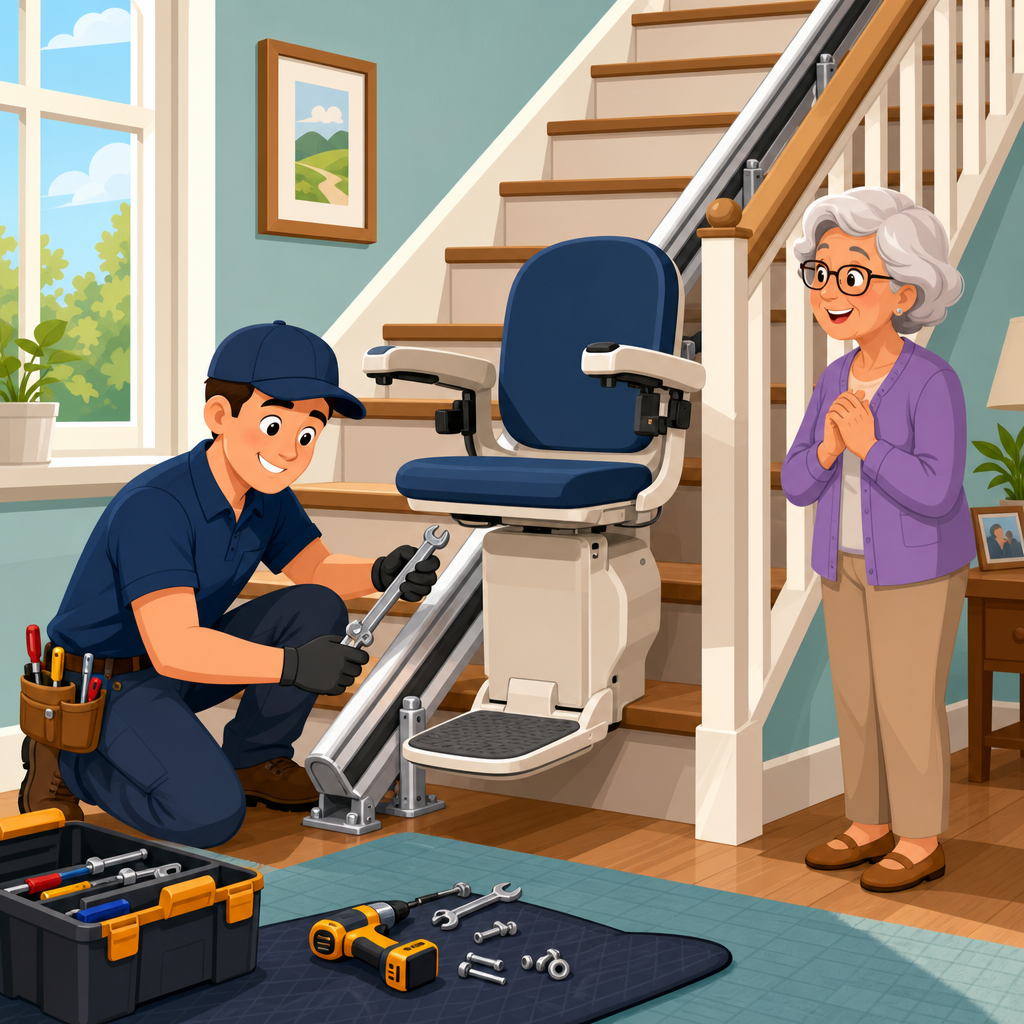
After mounting and wiring, commissioning is where a professional installation proves itself. The installer should run the lift multiple times empty and under realistic load, checking start and stop smoothness, leveling at landings, swivel lock engagement, obstruction sensors, seatbelt function, call-send controls, folding action, and battery charging. Listen for rail chatter, bracket creaks, or carriage hesitation. Heavy-duty units should not sound strained when properly installed. Final adjustment may include seat height, arm width if the model allows it, footrest angle, and remote placement. The user should practice boarding, fastening the belt, operating the controls, and exiting at both landings until the process feels routine.
Maintenance planning should be part of installation day, not postponed until something fails. Heavy-duty lifts benefit from scheduled service because their higher loads can accelerate wear on rollers, gear interfaces, seat pivots, and batteries if alignment is off. Most manufacturers recommend annual service at minimum, though high-use households may justify more frequent inspections. Batteries often last several years, but lifespan depends on charge habits, ambient temperature, and cycle count. Keep the rail clean, avoid lubricants unless the manufacturer specifies them, and never ignore beeps, slow travel, or incomplete swiveling. For this heavy-duty lifts hub, the main takeaway is simple: the safest lift is the one measured accurately, matched to the user, installed to specification, and maintained proactively. If you are comparing heavy-duty stair lift options, use these installation criteria as your checklist and ask every dealer to explain exactly how they will handle fit, clearance, structure, power, and follow-up service.
Frequently Asked Questions
What makes installing a heavy-duty stair lift different from installing a standard stair lift?
Heavy-duty stair lifts are designed for higher user weight capacities, and that changes the installation requirements in several important ways. Unlike standard models, which often serve users in the 250 to 350 pound range, heavy-duty units are typically engineered to support 400, 500, or even 600 pounds. To do that safely, manufacturers use wider seats, reinforced chassis components, stronger drive systems, and more robust rail assemblies. All of that means the staircase must be measured more carefully, the mounting points must be evaluated more thoroughly, and the rail system must be aligned with greater precision.
In practical terms, installers need to account for stair width, landing clearance, seat-to-wall spacing, and the path of travel from top to bottom. A staircase that can accept a standard lift may not automatically be suitable for a heavy-duty version, especially if the seat and footrest require more room when folded or in use. The added weight capacity also places greater importance on proper bracket spacing, rail attachment, and manufacturer-specific support requirements. A precise installation is not just about making the lift fit; it is about ensuring long-term structural stability, smooth performance, and safe operation under higher loads.
How do you know if a staircase can support a heavy-duty stair lift?
The first step is understanding that most stair lifts mount to the stairs, not the wall, so the condition and construction of the staircase itself matter most. A qualified installer will inspect the treads, stringers, and overall stability of the stair system to verify that it can handle both the lift hardware and the operational loads created by heavier users. If the stairs are loose, damaged, uneven, or built with weaker materials, those issues may need to be corrected before installation begins. Heavy-duty models can generate greater force during use, so even small structural weaknesses become more important.
Beyond structural soundness, staircase geometry also plays a major role. Installers will measure width, rise, run, total track length, top and bottom landing space, and any turns or obstructions. Heavy-duty stair lifts usually require more clearance than standard units because of wider seat dimensions and heavier rail construction. Door swings, handrails, baseboard projections, and nearby walls can all affect whether the unit can be installed safely and comfortably. In some cases, the staircase may technically support the lift, but the available space may still be too tight for safe entry, exit, or seat rotation. That is why an in-home assessment is one of the most important parts of the process.
Why are accurate measurements so important for heavy-duty stair lift installation?
Accurate measurements are critical because heavy-duty stair lifts are less forgiving when it comes to clearance, alignment, and user positioning. With a larger seat, reinforced rail, and higher-capacity drive system, the installation must match the staircase very closely to maintain comfort and safety. Even a small measuring error can affect how the carriage travels, how the seat lines up with the landing, or whether the user has enough room to get on and off the lift securely. If the top or bottom stop positions are off, the lift may still run, but it may not deliver a safe transfer point for the user.
Proper measuring also affects long-term equipment performance. Rail angle, bracket placement, and level transitions all influence how smoothly the motor and transmission operate over time. A poorly measured installation can create unnecessary strain on the system, increase vibration, or lead to premature wear. For heavy-duty units, where the loads are greater by design, these issues can become more pronounced. Professional installers typically follow manufacturer-specific measurement procedures and verify dimensions multiple times to ensure the lift fits the staircase correctly, clears obstructions, and delivers dependable operation under real-world conditions.
Should you prepare the staircase or home before installing a heavy-duty stair lift?
Yes, preparing the area in advance can make installation smoother and can help avoid delays or safety issues. Start by clearing the staircase and both landings of rugs, décor, furniture, storage items, and anything else that could interfere with measuring or rail placement. If there are loose treads, worn carpeting, damaged stair nosings, or unstable handrails, those issues should be addressed before the lift is installed. Heavy-duty stair lifts rely on solid, predictable mounting surfaces, so even minor stair damage is worth correcting ahead of time.
It is also smart to think about access and usability around the lift once it is in place. Make sure there is enough room at the top and bottom of the stairs for safe boarding and dismounting, especially if the user uses a walker, cane, or other mobility aid. Depending on the model, the installer may need access to a nearby power source for battery charging, and the area around that outlet should be in good condition. If the home has narrow hallways, swing doors near the landings, or other layout constraints, those should be discussed during the planning stage. Good preparation helps ensure the installer can place the rail correctly, test the unit fully, and confirm that the finished system works safely in everyday use.
Is professional installation necessary for a heavy-duty stair lift, or can it be a DIY project?
Professional installation is strongly recommended and, in most cases, essential for a heavy-duty stair lift. These systems are not simple plug-and-play mobility devices. They involve precise measurement, structural mounting, rail alignment, electrical charging setup, limit calibration, and safety testing. Because the lift is expected to carry higher loads than a standard model, every part of the installation has to be completed to manufacturer specifications. Improper bracket placement, misaligned rails, or incorrect stop settings can compromise user safety and reduce the life of the equipment.
Another important reason to use a professional is accountability. Certified or experienced stair lift installers understand local code considerations, manufacturer requirements, and best practices for safe operation. They also test seat swivels, footrest sensors, call/send controls, charging points, and obstruction systems before the job is complete. Many manufacturers require professional installation to preserve warranty coverage, and that alone can make a major difference if service is needed later. For heavy-duty stair lifts, the stakes are simply too high to rely on guesswork. A professional installation gives the user confidence that the unit is fitted correctly, performs smoothly, and is ready for dependable daily use.