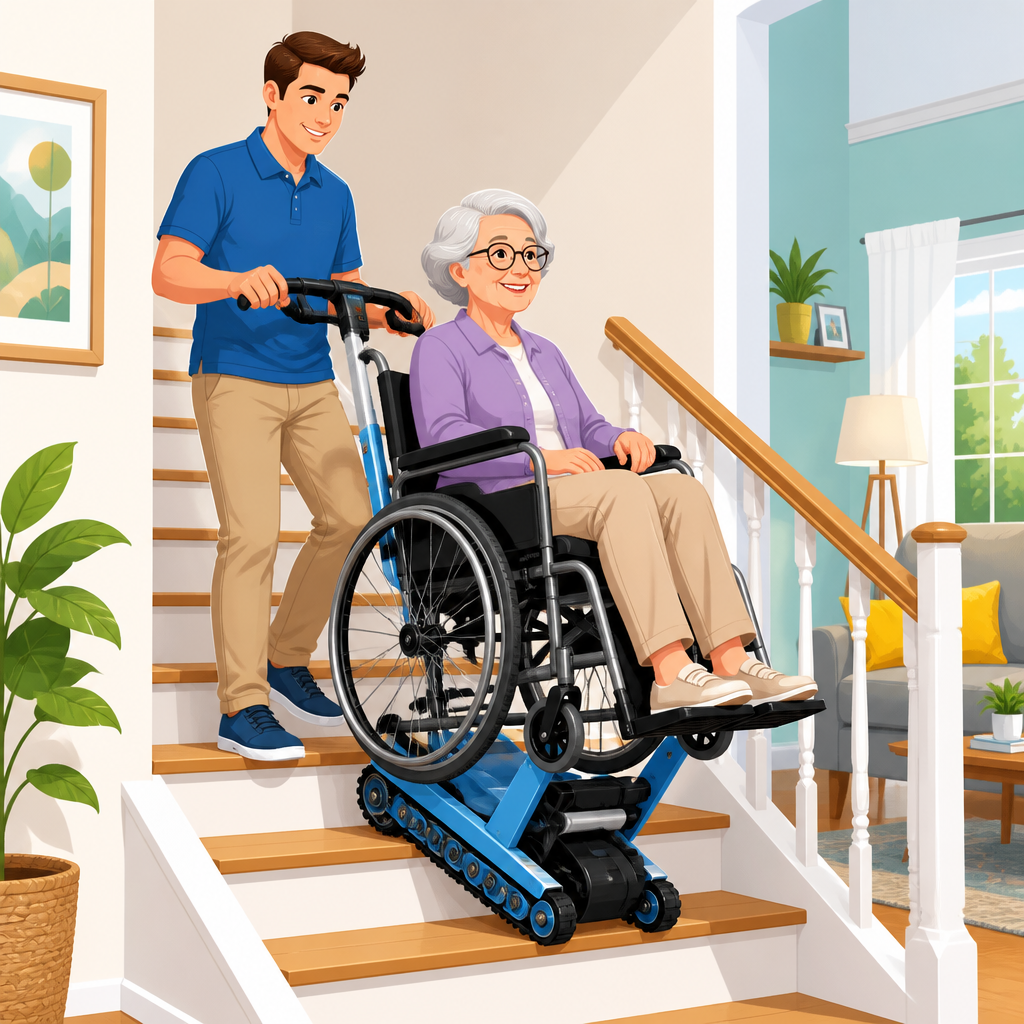
Portable wheelchair stair climbers for homes without permanent modifications solve a very specific access problem: how to move a wheelchair user up or down stairs safely when installing a traditional stair lift, vertical platform lift, or residential elevator is not practical. In accessibility work, I have seen this issue most often in rental properties, multigenerational homes, historic houses, split-level layouts, and residences where budgets or building constraints make fixed equipment unrealistic. A portable stair climber is exactly what the name suggests: a mobile device, typically battery powered, that helps a caregiver transport a seated user over stairs without attaching rails, cutting floors, or altering the structure.
The term portable lifts covers several related products, but not all of them do the same job. Some units are evacuation-style chairs intended for emergency descent only. Others are powered stair climbers designed for routine home use and can travel up and down straight interior staircases. More advanced models can attach to a manual wheelchair, while some include an integrated transport seat similar to a medical stair chair. Understanding these distinctions matters because buyers often search for one solution and accidentally compare products built for entirely different use cases.
This topic matters because stairs remain one of the most common residential barriers to aging in place. According to housing and aging research from organizations such as AARP and the Joint Center for Housing Studies of Harvard University, most older adults want to remain in their homes, yet many homes were not designed for mobility limitations. Permanent lift systems can be excellent long-term answers, but they require installation space, structural compatibility, electrical planning, and owner approval. Portable wheelchair stair climbers fill the gap when speed, flexibility, and reversibility are the priority.
For many families, the practical question is simple: can a person in a wheelchair get safely between floors today, without remodeling? This hub article answers that question and organizes the portable lifts category clearly. It explains how portable wheelchair stair climbers work, who they suit, where they outperform fixed lifts, where they fall short, how much they typically cost, what stair conditions affect performance, and what standards, training, and maintenance buyers should review before making a decision.
What portable wheelchair stair climbers are and how they work
A portable wheelchair stair climber is a mobility device that uses powered tracks, rotating tread mechanisms, or assisted wheel systems to move a seated passenger over stairs under caregiver control. In home settings, the most common models use rubber tracks that grip the stair nosings and advance one step at a time. The operator tilts the chair to a prescribed angle, engages the motor, and guides the unit while the mechanism carries the combined weight over each tread. Because the machine does the lifting, caregiver strain is dramatically reduced compared with manual carrying.
Most home-focused units fall into two design families. The first is an integrated chair climber, where the passenger sits in the device itself. These models resemble premium evacuation chairs but are intended for repeated daily or weekly use. The second is a wheelchair-compatible climber, where brackets or docking points allow the machine to connect to a manual wheelchair. In practice, integrated chair models are often easier to maneuver in narrow halls, while wheelchair-attached models preserve the user’s familiar seating, posture supports, and transfer routine.
Battery power is central to portability. Quality units typically use rechargeable battery packs and include onboard displays for battery level, speed settings, and fault alerts. Many models also include electromagnetic braking, anti-slip tracks, safety belts, head supports, and fold-down handles. Better systems publish maximum user weight, recommended stair angle, minimum landing dimensions, and compatibility with straight versus winding staircases. Those specifications are not marketing details; they determine whether the unit will function safely in a real home.
When portable lifts are the best choice for a home
Portable wheelchair stair climbers are usually the best fit when the household cannot or should not modify the property permanently. I recommend them first in rentals, because tenants often cannot install rails or platform lifts without landlord approval. They are also highly useful in historic homes where owners want to preserve architectural features, and in split-level houses where short runs of stairs make a full elevator or lift difficult to justify economically.
Another strong use case is temporary or uncertain need. After surgery, injury, or a neurological event, a family may need access support quickly while long-term plans are still being evaluated. A portable climber can be delivered and put into service far faster than a custom-installed stair lift. It also works well when a user divides time between two locations, such as a primary residence and a relative’s home, because the device can travel with the caregiver if vehicle transport is practical.
These devices are also effective for homes where multiple stairways create a coverage problem. A fixed stair lift serves one staircase only unless several units are installed. A portable climber can be used on different interior stairs, provided each stairway meets the device’s requirements. That flexibility is one of the category’s biggest advantages and a core reason portable lifts occupy a distinct place within chair lift types and designs.
How portable climbers compare with fixed residential lift options
Buyers often ask whether a portable stair climber is better than a stair lift, platform lift, or home elevator. The right answer depends on independence, caregiver availability, transfer ability, and expected frequency of use. Portable climbers are rarely a complete replacement for fixed access systems, but they can be the smartest option in the right context.
| Option | Best for | Main advantage | Main limitation |
|---|---|---|---|
| Portable wheelchair stair climber | Homes needing flexibility and no permanent modifications | Mobile, fast to deploy, usable on more than one staircase | Usually requires a trained operator |
| Seated stair lift | Users who can transfer safely to a lift seat | Independent operation on a dedicated stairway | Rail installation required; not ideal for many wheelchair users |
| Vertical platform lift | Wheelchair users needing direct roll-on access over short rises | Accommodates wheelchair without transfer | Needs space, permitting, and permanent installation |
| Residential elevator | Long-term full-home accessibility | Highest convenience and property-wide access | Highest cost and greatest construction impact |
The key operational difference is independence. A fixed seated stair lift may allow a user to ride alone if they can transfer safely and manage controls. A portable wheelchair stair climber almost always requires another person to operate it. That distinction should drive the decision more than price alone. If the goal is fully independent access several times every day, a permanent lift usually wins. If the goal is safe assisted access without remodeling, portable equipment is often the strongest match.
Cost and timing also matter. Portable systems generally cost far less than elevators and many platform lift projects, and they can often be deployed without permits because they are not attached to the building. However, lower installation complexity does not mean lower evaluation standards. The operator still needs training, the stair geometry still needs verification, and the user’s posture, transfer method, and medical stability still need review.
Critical buying factors: stairs, user needs, and caregiver workflow
The first buying factor is stair geometry. Measure width, tread depth, riser height, total number of steps, landing size, and turning space at the top and bottom. Some portable wheelchair stair climbers handle only straight stairs with generous landings. Others can manage certain curved or winding staircases, but only if the operator has enough space to position the unit safely. Narrow stairs, uneven surfaces, thick carpet overhang, and irregular step dimensions can eliminate otherwise promising models.
The second factor is the rider’s physical and seating needs. User weight capacity is critical, but it is not the only fit criterion. Buyers should also consider trunk control, head support requirements, contractures, pressure management, transfer tolerance, and whether the person can remain comfortable at the device’s operating angle. A user with poor postural stability may need an integrated headrest, chest harness, or a model that interfaces with their own wheelchair to maintain familiar support surfaces.
The third factor is caregiver workflow. In real homes, ease of use determines whether a device gets used consistently. Ask who will operate the climber, how often, at what times of day, and after how much physical exertion. A stair climber that technically fits the staircase but is too heavy to unfold, charge, position, and guide will fail in practice. I have seen successful outcomes when families run a full mock routine: transfer, seat securement, ascent, landing turn, descent, folding, storage, and battery charging.
Noise, storage footprint, and transportability are also practical issues. Some units fold compactly enough for a closet or vehicle trunk. Others are portable only in the sense that they are not bolted down; they may still weigh more than many caregivers can lift comfortably. Manufacturers such as SANO, AAT, and Garaventa have long influenced this category, but exact suitability always comes down to the home’s stairs and the user’s support needs, not the logo on the frame.
Safety standards, training, and maintenance requirements
Safety starts with using the right device for the right purpose. An evacuation chair designed mainly for emergency descent should not automatically be treated as a daily home mobility solution. Daily-use stair climbers need stable drive systems, secure restraints, predictable braking, and clear operating instructions. Reputable suppliers should provide documented training, hands-on demonstration, and written maintenance schedules. If a seller cannot explain battery cycle expectations, charging protocol, stair limitations, and emergency stopping procedures, that is a warning sign.
Look for products that align with recognized medical device and accessibility expectations in your market, including applicable FDA registration in the United States where relevant, and manufacturer documentation on testing and intended use. Buyers should also ask whether local service is available, how replacement batteries are sourced, and what turnaround time applies if the unit needs repair. A portable lift is only useful if it is operational when the household needs it.
Routine maintenance is straightforward but not optional. Tracks or drive wheels must be inspected for wear, fasteners checked, belts and harnesses assessed, and batteries charged according to manufacturer guidance. Operators should practice on stairs without the rider before first use and repeat training if a new caregiver takes over. In my experience, the safest households treat portable stair climbers like any other medical mobility equipment: they log issues early, avoid improvised repairs, and schedule preventive service before failures occur.
Costs, ownership models, and how this hub connects the portable lifts category
Portable wheelchair stair climber pricing varies widely by capacity, control system, wheelchair compatibility, and brand support. Basic transport-oriented units may start in the low thousands of dollars, while advanced powered climbers for routine residential use often cost substantially more. Buyers should budget not only for the device, but also for training, spare batteries, maintenance, and possible accessory kits such as headrests, foot supports, docking brackets, and vehicle storage solutions.
Rental and used-equipment options can make sense, especially for short-term recovery or trial periods, but they require caution. Confirm battery health, service history, parts availability, and whether the model is still supported by the manufacturer. Used equipment without supplier training is a false economy. For many households, the most sensible path is a professionally guided assessment followed by a trial on the actual stairs where the device will be used.
As the hub page for portable lifts within the broader chair lift types and designs topic, this article should guide readers toward more detailed subtopics: portable stair chairs, wheelchair-attached climbers, emergency evacuation chairs, rental versus purchase decisions, battery and maintenance planning, and home stair measurement checklists. The main takeaway is clear. Portable wheelchair stair climbers are not universal solutions, but they are highly effective when a home needs stair access without permanent modifications. Match the device to the staircase, the rider, and the caregiver’s routine, then insist on training and a real-world trial. If you are evaluating home accessibility options now, start with an in-home assessment and compare portable lifts against fixed systems before you commit.
Frequently Asked Questions
What is a portable wheelchair stair climber, and when does it make more sense than a permanent lift?
A portable wheelchair stair climber is a mobile device designed to help move a wheelchair user up or down a staircase without installing permanent equipment in the home. Unlike a traditional stair lift, vertical platform lift, or residential elevator, a portable stair climber is not fixed to the stairs or structure. It is typically brought out when needed, used by a trained caregiver or operator, and then stored away. That makes it especially useful in homes where permanent modifications are impractical, prohibited, or too expensive.
In real-world residential settings, portable stair climbers often make the most sense in rental properties, historic homes, split-level houses, older homes with narrow entry points, and multigenerational households where needs may change over time. They can also be a strong option when the cost and complexity of structural work would be disproportionate to how often stair access is needed. For example, if a wheelchair user only needs occasional access to a basement family room, a main-floor bedroom setup, or a short run of entry stairs, a portable system may solve the immediate access problem without the disruption of construction.
That said, “better” depends on the situation. Permanent lifts are generally more convenient for frequent daily use because they can often be operated more independently and do not require setup each time. Portable stair climbers, by contrast, are usually best viewed as a practical access solution for specific circumstances: temporary needs, changing family arrangements, limited budgets, lease restrictions, or buildings where preserving the existing structure matters. The key advantage is flexibility. The key tradeoff is that most models still require an attendant and careful operator training.
Are portable wheelchair stair climbers safe for home use?
Yes, portable wheelchair stair climbers can be safe for home use when the right device is selected for the staircase, the user, and the wheelchair, and when the equipment is operated exactly as intended by the manufacturer. Safety does not come from the machine alone. It comes from matching the device to the environment, respecting weight limits, securing the wheelchair properly, maintaining battery and mechanical components, and ensuring that anyone operating it has been trained and is comfortable using it.
Several factors determine whether home use will be safe. First is staircase compatibility. The width of the stairs, depth of each tread, height of risers, number of landings, and turning space at the top and bottom all matter. Some devices work best on straight staircases, while others may be able to manage more complex layouts under limited conditions. Surface condition matters too. Loose carpet, uneven edges, damaged nosings, or slippery finishes can affect safe operation. A home assessment is important because a unit that performs well in one house may not be appropriate in another.
Second is the combined weight of the user, wheelchair, and any medical equipment being transported. Manufacturers provide specific capacity ratings, and those limits should never be treated as rough estimates. Third is the user’s positioning and support needs. If the wheelchair user has poor trunk control, requires tilt or specialized seating, uses oxygen, or has sensitivity to movement, those details should be reviewed before choosing a stair climber. Finally, operator skill is critical. Even the best equipment should not be used casually or without hands-on instruction.
As a practical rule, families should request a live demonstration in the actual home whenever possible. A proper trial can reveal whether the turning space is sufficient, whether the caregiver can manage the controls confidently, and whether the user feels stable during ascent and descent. Safety is not just about whether a device can technically go up stairs. It is about whether it can do so consistently, smoothly, and predictably in that specific home.
Can a portable stair climber be used with any wheelchair and on any staircase?
No. This is one of the most important limitations to understand. Portable wheelchair stair climbers are not universally compatible with all wheelchairs or all staircases. Some models are designed to work with a person remaining seated in their wheelchair, while others function more like an evacuation or transfer chair and may require moving the user into a dedicated transport seat. Even among wheelchair-compatible systems, there are restrictions related to frame style, wheel size, overall dimensions, center of gravity, and tie-down or attachment points.
Power wheelchairs, lightweight manual wheelchairs, bariatric chairs, custom rehab chairs, and tilt-in-space models can all present different compatibility issues. A power wheelchair may be too heavy for certain portable climbers, while a highly customized seating system may make secure positioning more complex. Accessories such as headrests, ventilator mounts, lateral supports, backpacks, and footplate extensions can also affect fit and balance. That is why equipment should always be evaluated with the actual wheelchair and the actual user, not just by looking at a brochure.
The staircase itself is just as important. Width is a common limiting factor, particularly in older homes. Tight turns, intermediate landings, wedge-shaped steps, exterior stairs exposed to weather, and steep stair geometry can all rule out certain devices. Some units require more landing space than homeowners expect, especially at the top of the staircase where the operator must safely transition onto the next level. A staircase may look manageable but still fail to provide the clearance needed for stable operation.
The safest approach is a full compatibility assessment. That should include the wheelchair model, occupied weight, caregiver handling needs, stair measurements, landing dimensions, and any environmental variables such as thresholds, rugs, door swing conflicts, or storage constraints. Portable stair climbers can be excellent tools, but only when chosen as a precise fit for both the mobility equipment and the home layout.
Do portable wheelchair stair climbers require a caregiver, or can the wheelchair user operate one independently?
In most home situations, portable wheelchair stair climbers require a trained caregiver or attendant to operate them. While design features vary by manufacturer, these devices are generally not intended to give a wheelchair user fully independent stair access in the way an elevator or some platform lifts might. The reason is straightforward: navigating stairs involves balance control, positioning, speed management, and safe transitions at landings, all of which are usually handled by the operator rather than the wheelchair user.
This is a major consideration for families choosing between portable and permanent accessibility solutions. If the user needs to move between floors multiple times per day and independence is a primary goal, a portable climber may not be the ideal long-term answer. However, if there is a reliable caregiver available and stair use is occasional or situation-specific, a portable unit can be a very effective workaround. For many households, that tradeoff is acceptable because it avoids major remodeling while still providing access when needed.
Caregiver training should not be treated as optional. Even if a unit appears simple to use, the operator should understand startup procedures, battery management, securement methods, stair approach angles, emergency stopping procedures, and how to maintain control during transfers onto and off the staircase. It is also wise to have more than one household member trained, so access is not dependent on a single person being present. In some cases, a family may also coordinate training for home health aides or other regular support staff.
When evaluating independence, think beyond the stair run itself. Consider whether the user can position the wheelchair appropriately at the base of the stairs, whether someone is available whenever access is needed, and whether the device can be stored and retrieved easily. Portable stair climbers are often excellent from a flexibility and cost standpoint, but they usually work best as an assisted-access solution rather than a fully independent mobility system.
What should homeowners or renters look for before buying or renting a portable wheelchair stair climber?
The first thing to look for is a professional assessment of the home and the user’s mobility needs. A stair climber should never be chosen based on price alone or on the assumption that all devices function the same way. Start with staircase measurements, wheelchair type, total occupied weight, and the user’s physical support needs. Then look at how often the stairs will be used, who will operate the equipment, and whether the goal is a short-term workaround or a longer-term access strategy.
Battery performance and charging requirements are also important. A portable unit is only useful if it is consistently ready when needed. Ask how many trips can be completed on a charge, how long charging takes, what warning systems indicate low battery, and how the unit behaves if battery power drops during use. Storage matters too. In smaller homes or apartments, even a “portable” device can become inconvenient if it is bulky, heavy, or difficult to reposition when not in use.
Homeowners and renters should also ask about training, service, and support. Does the supplier provide in-home instruction? Is there follow-up support after delivery? How quickly can repairs or maintenance be handled? Are replacement batteries and parts readily available? If the unit is being rented, clarify who is responsible for servicing, how emergency issues are handled, and whether a replacement unit can be provided if equipment fails. Those practical details can matter just as much as the product specifications.
Finally, compare purchase versus rental based on actual usage patterns. Renting may make sense for short-term recovery, trial periods, or temporary household changes. Buying may be more economical if stair access will be needed regularly over an extended period. In either case, prioritize fit, safety, and operator confidence over marketing claims. The best portable wheelchair stair climber is