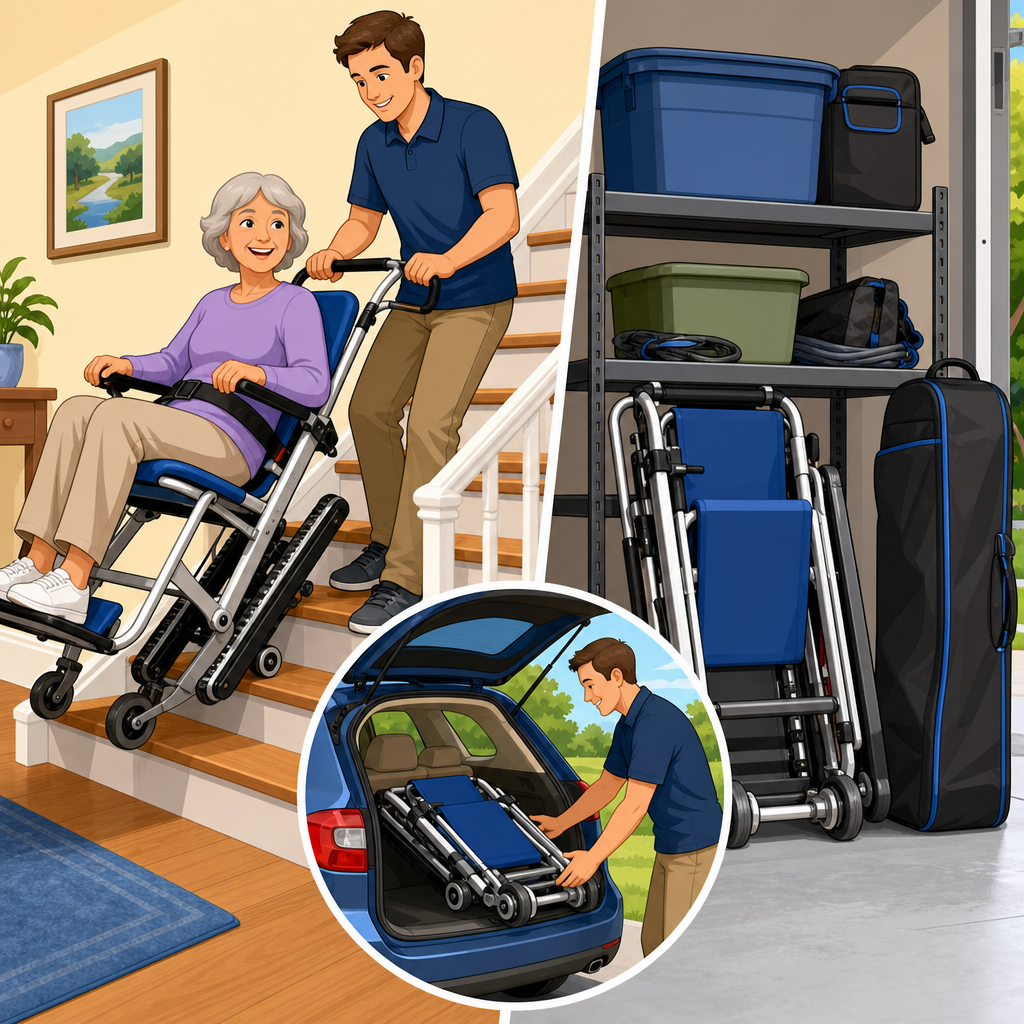
Portable chair lifts solve a specific mobility problem: how to move safely between levels when a permanent stair lift, home elevator, or vertical platform lift is impractical, too expensive, or not allowed by the building. In mobility equipment, “portable” does not mean lightweight in the casual sense. It means a lift can be moved, stowed, transported, or deployed without structural changes to the property. That distinction matters because buyers often expect suitcase convenience and are surprised to learn that many portable chair lifts still weigh more than fifty pounds, require battery management, and need disciplined setup to remain safe. After helping families compare and install these devices in homes, clinics, churches, and temporary event spaces, I have seen the same pattern repeatedly: the right portable lift can preserve access and independence, but only when setup, storage, charging, and handling are treated as part of the product, not as afterthoughts.
Portable chair lifts come in several forms. The most common category is the portable stair chair with motorized track assistance, used to move a seated passenger up or down stairs with an attendant controlling the unit. A second category is the foldable patient lift with a seat or sling, designed for transfers from floor to chair, bed to chair, or chair to toilet rather than for stair travel. A third category includes temporary platform-style lifting devices used in public settings for short-term accessibility needs. Because this page serves as a hub for portable lifts within the broader chair lift types and designs topic, it focuses on the setup and storage practices that apply across these designs: assessing the site, preparing the equipment, training caregivers, protecting batteries, and storing the lift so it remains ready for reliable use.
These details matter for three reasons. First, improper setup can create immediate fall, tip, pinch, or runaway hazards. Second, poor storage shortens service life by damaging batteries, upholstery, joints, and braking systems. Third, portable equipment is often purchased during stressful transitions after surgery, stroke, or a new diagnosis, so the learning curve needs to be clear and practical. A portable chair lift should reduce friction in daily life, not add uncertainty. The following sections explain exactly how to choose a setup location, perform pre-use checks, use the correct handling method, and store a portable lift so it stays safe, compliant, and dependable.
Know the Main Portable Lift Categories Before Setup
Setup starts with identifying the lift type, because each category has different safety limits. A motorized stair chair usually has tracked treads, a seat, an attendant handle, restraint belts, and a rechargeable battery pack. It is built for controlled stair travel with a trained operator behind or below the passenger depending on the model. Brands vary, but specifications commonly include a weight capacity between 300 and 500 pounds, stair angle limits, and minimum landing clearance requirements. These devices are not interchangeable with a standard evacuation chair, which may be intended only for descending stairs during emergencies and not for daily mobility use.
Foldable patient lifts, often called portable sit-to-stand lifts or mobile floor lifts, present a different setup profile. They depend on base leg width, mast stability, sling compatibility, caster condition, and floor surface friction rather than stair geometry. I regularly remind buyers that a portable patient lift can be easy to fold for transport yet still require a surprisingly large turning radius in a bathroom or bedroom. Temporary platform-style lifts add another layer, because they must satisfy setup tolerances for level surfaces, guard edges, and operational clearance. The best setup decision is impossible if the product category itself is wrong for the mobility task.
Assess the Space Like an Installer, Not a Shopper
The most common mistake I see is measuring only the staircase width or doorway opening. Real setup requires a full path-of-travel assessment. For stair chairs, measure the clear stair width between obstructions, tread depth, riser height consistency, landing length at top and bottom, handrail intrusion, door swing conflicts, and whether the attendant has safe footing throughout the route. Curved stairs, winders, narrow landings, and thick carpet can all affect performance. For portable patient lifts, assess bed height, chair frame clearance, toilet base interference, threshold transitions, and whether the base legs can fit under furniture. If the route includes outdoor use, note slope, expansion joints, wet surfaces, and temperature exposure.
Good installers also look for the hidden variables. Is there enough light for an attendant to see control labels and foot placement? Will the lift be used by one trained caregiver or several family members with different strength levels? Can the unit be positioned without twisting through a tight hallway? In public settings, is there an accessible staging area where the device can be unfolded without blocking egress? Thinking this way prevents the common scenario where a lift is technically compatible with the staircase or room dimensions but awkward, tiring, or unsafe in actual daily use.
Pre-Use Setup Checklist That Prevents Most Problems
Before every use, portable chair lifts need a repeatable setup routine. This is not excessive caution; it is standard risk control. Start with battery status, power connection integrity, and visible signs of damage. Confirm that locking pins, folding joints, mast latches, or handle telescoping mechanisms are fully engaged. Check seat belts, chest harnesses, calf supports, footrests, armrests, and anti-tip components. On stair chairs, inspect tracks or treads for wear, contamination, or debris. On patient lifts, verify sling loops, spreader bar attachment points, and caster locks according to the manufacturer’s instructions. Finally, test the controls without a passenger to confirm smooth response.
| Setup check | Why it matters | What to do |
|---|---|---|
| Battery charge | Low voltage can stop a lift mid-task | Charge fully and confirm indicator status before use |
| Frame locks and pins | Partially engaged joints can collapse under load | Visually inspect and tug-test each locking point |
| Belts, sling, or seat supports | Poor restraint fit increases fall risk | Adjust snugly and match accessories to the user and model |
| Wheels, tracks, or treads | Debris or wear affects control and stability | Clean contact surfaces and inspect for damage |
| Path clearance | Obstructions force unsafe repositioning | Remove rugs, cords, clutter, and swinging door conflicts |
Facilities often turn this checklist into a laminated card attached to the charger station. At home, a simplified written routine works just as well. The key is consistency. When portable lifts are shared among caregivers, undocumented habits lead to skipped steps. A three-minute inspection is far cheaper than a repair call, an injury, or a failed transfer.
Safe Setup on Stairs: Angle, Landing, and Operator Position
Portable stair chairs demand the most disciplined setup because the margin for error is smaller on stairs than on level floors. The chair should be opened fully, locked according to the manufacturer’s sequence, and positioned square to the first tread before loading the passenger. The rider’s feet must be secured on the footrest, and restraint straps should be snug enough to prevent forward slide without restricting breathing. If the model uses powered tracks, the operator must understand the proper engagement angle. Too shallow and the tracks may not grip correctly; too steep and the center of gravity becomes harder to control. Manufacturers specify this angle range for a reason, and operators should practice with an empty chair first.
Landing management is just as important. The top and bottom landings must offer enough room to enter and exit without pivoting in a cramped position. I have seen otherwise excellent stair chairs become poor choices in split-level homes where the bottom landing ends immediately at a wall or narrow doorway. In those cases, setup requires planning where the attendant will stand, how the passenger will transfer, and whether a second helper is necessary. For commercial or institutional use, staff training should include stair-by-stair drills, communication cues, and a policy that prohibits use beyond the rated slope, width, and weight limits.
Battery Care and Charging Habits That Extend Lift Life
Most portable chair lifts rely on sealed lead-acid or lithium-ion battery systems. Regardless of chemistry, battery neglect is one of the main reasons portable lifts fail when needed most. Best practice is simple: charge after use, avoid prolonged storage at complete discharge, and follow the manufacturer’s temperature guidance. Sealed lead-acid batteries are especially vulnerable to sulfation when left partially discharged. Lithium-ion systems tolerate partial charging better, but they still degrade faster when exposed to heat, freezing conditions, or incompatible chargers. Only use the charger specified for the exact model, because voltage mismatch can damage the battery management system or reduce run time.
Charging location matters too. Store the lift near a grounded outlet in a dry, ventilated area where the cord will not create a trip hazard. In clinics and multi-user homes, I recommend assigning a dedicated charging space and a simple sign-out routine. That avoids the all-too-common situation where someone moves the lift for convenience and forgets to reconnect it. If the lift will be stored for weeks, check the manual for maintenance charging intervals. A battery replacement is normal over the life of the unit, but early failure is usually preventable with disciplined charging and temperature control.
Storage Conditions: Protect the Frame, Upholstery, and Moving Parts
Portable lifts last longer when stored folded correctly, kept clean, and protected from moisture, dust, and impact. After use, wipe hand-contact surfaces and any exposed frame components with a cleaner approved by the manufacturer. In healthcare settings, follow the facility’s infection control protocol and contact-time requirements for disinfectants, since harsh chemicals can degrade vinyl, paint, and labels over time. Never store a wet lift after rain exposure or cleaning. Dry the tracks, wheels, hinges, and charging contacts first, because corrosion often begins in small unobserved spots and later shows up as noisy operation, stiff folding joints, or intermittent power.
Choose a storage area that is level, out of direct sunlight, and protected from freezing or excessive heat. Garages are convenient, but they are not always ideal if humidity swings widely or vehicles crowd the storage zone. Closets and utility rooms work better when there is enough clearance to remove the lift without dragging it sideways. Keep heavy objects off folded units, especially on armrests, control heads, and back handles. If the lift is transported in a vehicle, secure it to prevent shifting. Repeated impacts during transport are a quiet cause of bent brackets, cracked plastic housings, and loose fasteners.
Training Caregivers and Users for Real-World Reliability
No setup process is complete without hands-on training. Reading the manual matters, but practical drills matter more. Every primary caregiver should practice opening the unit, locking components, positioning the passenger, operating the controls, and storing the lift afterward. For stair chairs, practice on the actual staircase with no passenger first, then with a trained assistant simulating body weight before real use. For patient lifts, rehearse sling placement, leg spreading, turning radius management, and emergency lowering. The goal is not merely basic competence. It is calm, repeatable handling under everyday pressure, including after a long day or during a nighttime transfer.
Training should also include decision rules. Operators need to know when not to use the lift: if the battery is low, if a pin will not seat, if a caster binds, if the passenger exceeds capacity, if the stairs are wet, or if the user’s medical condition has changed. In my experience, confidence comes from clear limits, not from vague reassurance. Families who post a short use-and-stop checklist near the storage area make fewer mistakes than families who rely on memory. For organizations, annual refresher training and incident review are worth the time because portable mobility equipment is only as safe as the least-trained person using it.
Maintenance, Compliance, and When to Replace a Portable Lift
Portable chair lifts are not install-and-forget products. They need scheduled inspection, preventive maintenance, and timely part replacement. Follow the manufacturer’s service intervals for batteries, belts, tracks, casters, slings, and fasteners. Keep the user manual, serial number, purchase record, and service log together. If the equipment is used in a healthcare, education, worship, or event setting, document inspections consistently. Many organizations align their programs with OSHA safe handling expectations, ADA access planning where relevant, and the manufacturer’s published operating instructions. For patient lifts and transfer devices, sling compatibility must be treated seriously; mixing brands without approval is a common and preventable error.
Replacement decisions should be based on condition and supportability, not sentiment. If parts are discontinued, battery run time drops sharply, labels become unreadable, or the frame develops play at key joints, the lift may no longer be a good risk even if it still functions. Portable equipment ages faster when moved frequently, loaded into vehicles, or shared across users with different body sizes. A lift that no longer fits the user’s weight, posture, transfer ability, or home layout should be replaced with a better-matched model. The central lesson is straightforward: proper setup and storage are what turn a portable chair lift from a backup device into a dependable mobility solution. Evaluate your space, train every operator, follow the checklist, and store the lift correctly so it is ready when access cannot wait.
Frequently Asked Questions
What does “portable” really mean for a chair lift, and what should buyers expect during setup?
In the mobility equipment world, “portable” usually means the chair lift can be moved, transported, stored, or deployed without permanently altering the building. It does not usually mean the unit is small, lightweight, or easy for one person to carry like a suitcase. That distinction is important because many first-time buyers assume a portable chair lift will be simple to unfold and use immediately. In reality, these devices are built for stability, occupant safety, and controlled movement, so they often have a substantial frame, a battery system, secure seating, and braking or track-guidance components that add weight and bulk.
During setup, users should expect a preparation process rather than instant use. That may include unfolding the frame, locking components into place, checking the seat and restraint system, confirming battery charge, positioning the lift correctly at the staircase or level change, and making sure the route is clear. Some models are designed for attendant operation, which means a caregiver or trained helper is expected to manage positioning and movement. Others may be more self-contained but still require careful handling before every use. Portable also means the lift does not require structural changes such as rail installation, drilling, or permanent mounting, which makes it useful in rental properties, temporary recovery situations, multi-location care, and buildings where permanent accessibility equipment is not allowed.
The best approach is to read the manufacturer’s instructions closely and set realistic expectations. Buyers should plan for safe transport, adequate storage space, and a setup routine that can be repeated consistently. Understanding the true meaning of portability helps prevent frustration and makes it easier to choose equipment that fits the user’s strength, support needs, building layout, and daily routine.
What are the most important safety checks to complete before using a portable chair lift on stairs or between levels?
Before every use, start with a basic equipment inspection. Check that the chair lift is fully opened or assembled according to the manufacturer’s instructions, that all locking mechanisms are engaged, and that the seat, armrests, footrest, and safety belt or harness are secure. If the model uses batteries, confirm there is enough charge for the trip and verify that any status indicators show normal operation. If the unit has wheels, tracks, braking components, or descent-control features, inspect them for wear, debris, or anything that could interfere with smooth movement.
Next, assess the environment. The staircase or path between levels should be dry, well lit, and free of obstacles such as rugs, cords, clutter, pet toys, or loose items. Measure and confirm that the staircase dimensions, landing space, and turning area are compatible with the specific lift model. Portable chair lifts are not universal; some work only on straight staircases, some need wider landings, and some are inappropriate for tight turns or uneven surfaces. Also check for handrail placement, door swing clearance, and any thresholds that might complicate positioning at the top or bottom of the stairs.
User readiness matters just as much. Make sure the rider is seated properly, weight is within the rated capacity, and feet and clothing are clear of moving parts. If the lift requires an attendant, that person should know the operating procedure, body mechanics, and emergency steps before attempting a transfer. It is wise to practice setup and operation without a rider first. A portable chair lift can be a smart solution, but only when the device, the staircase, and the user’s needs are all aligned. Routine safety checks are what turn portability into practical, dependable access.
How should a portable chair lift be stored when it is not in use?
Proper storage begins with the manufacturer’s specific guidance, because folding method, battery care, and acceptable storage position can vary by model. In general, the lift should be cleaned, powered down if required, and folded or secured in its designated storage configuration before being put away. Do not force hinges, latches, or collapsible sections. If any part resists movement, stop and confirm the correct sequence. Storing the unit improperly can damage structural components or create safety issues the next time it is used.
Choose a clean, dry, temperature-stable location with enough room to protect the lift from impact, moisture, dust buildup, and tripping hazards. A hallway corner, garage, utility room, or closet may work if there is sufficient clearance and the equipment does not block exits, doors, or walkways. Avoid leaving the unit on stairs, near heating vents, in damp basements, or in places where it may be struck by vehicles, carts, or heavy household items. If the lift includes a battery, follow the recommended charging routine and storage conditions. Some batteries should remain partially or fully charged during storage, while others have more specific maintenance intervals. Ignoring battery care can shorten service life and leave the lift unavailable when it is needed most.
It is also smart to store accessories together. Keep chargers, straps, manuals, spare parts, and transfer aids in a dedicated bag or container near the lift so setup is not delayed by missing components. If multiple caregivers use the device, post a simple checklist nearby covering folding, charging, inspection, and next-use readiness. Good storage is not just about saving space. It protects the equipment, preserves reliability, and makes everyday use safer and less stressful.
Can a portable chair lift be transported in a car or taken between different buildings?
Yes, many portable chair lifts are designed to be transported between locations, but that does not automatically mean transport is quick or effortless. The key question is whether the unit’s size, weight, folding dimensions, and loading method match the vehicle, the caregiver’s physical ability, and the intended frequency of travel. Some portable lifts fit into an SUV, van, or larger trunk when folded. Others may require two people to load safely or benefit from a ramp or vehicle lift-assist system. Before purchasing, check the folded measurements, total weight, heaviest individual component if the unit separates, and whether the manufacturer recommends any special carrying or tie-down procedures.
When moving the lift between buildings, think beyond the vehicle. Consider where the device will be unloaded, whether there is enough landing space at both the origin and destination, and whether each staircase is compatible. A chair lift that works well in one home may be awkward or unsafe in another if the stairs are narrower, steeper, curved, or crowded by railings and doorways. Also factor in setup time, battery level, and weather exposure. Rain, extreme heat, and freezing temperatures can affect electronics, grips, battery performance, and safe handling if the lift is transported or stored in challenging conditions.
For frequent transport, create a repeatable process. Use proper lifting technique, secure the lift during travel so it does not shift, and inspect it after unloading before each use. If transporting the device is part of everyday caregiving, it may be worth choosing a model specifically marketed for easier breakdown and vehicle loading rather than assuming all portable chair lifts offer the same convenience. Portability across buildings is a real advantage, but it works best when travel logistics are treated as part of the overall setup plan.
What setup and storage mistakes should people avoid with portable chair lifts?
One of the biggest mistakes is assuming portability means the unit can be used casually without training or planning. Skipping the manual, failing to practice setup, or letting untrained helpers operate the lift can lead to unsafe transfers and equipment misuse. Another common problem is not verifying fit with the environment. Buyers sometimes focus on the idea of avoiding a permanent stair lift but forget to measure staircase width, landing depth, turning space, and user transfer needs. Even a well-made portable chair lift can be a poor choice if the home layout does not support safe operation.
Storage mistakes are equally important. Leaving the lift in a damp garage, on a staircase, or in a place where it blocks egress can create both safety and maintenance issues. Neglecting battery charging schedules, allowing debris to build up in moving parts, or stacking heavy items against the folded lift can shorten the unit’s life and compromise performance. Some owners also overlook the importance of storing straps, chargers, and instructions together, which creates confusion during urgent use.
Another mistake is underestimating physical demands. If the device requires an attendant, that person must be comfortable with positioning, control, and transport. Choosing a model that is too heavy, too awkward to load, or too complicated to deploy often leads to inconsistent use. The best way to avoid these problems is to match the lift to the actual setting, the rider’s mobility needs, and the caregiver’s abilities. A portable chair lift is most effective when setup is simple enough to be done correctly every time and storage is organized enough to keep the equipment ready, protected, and safe.