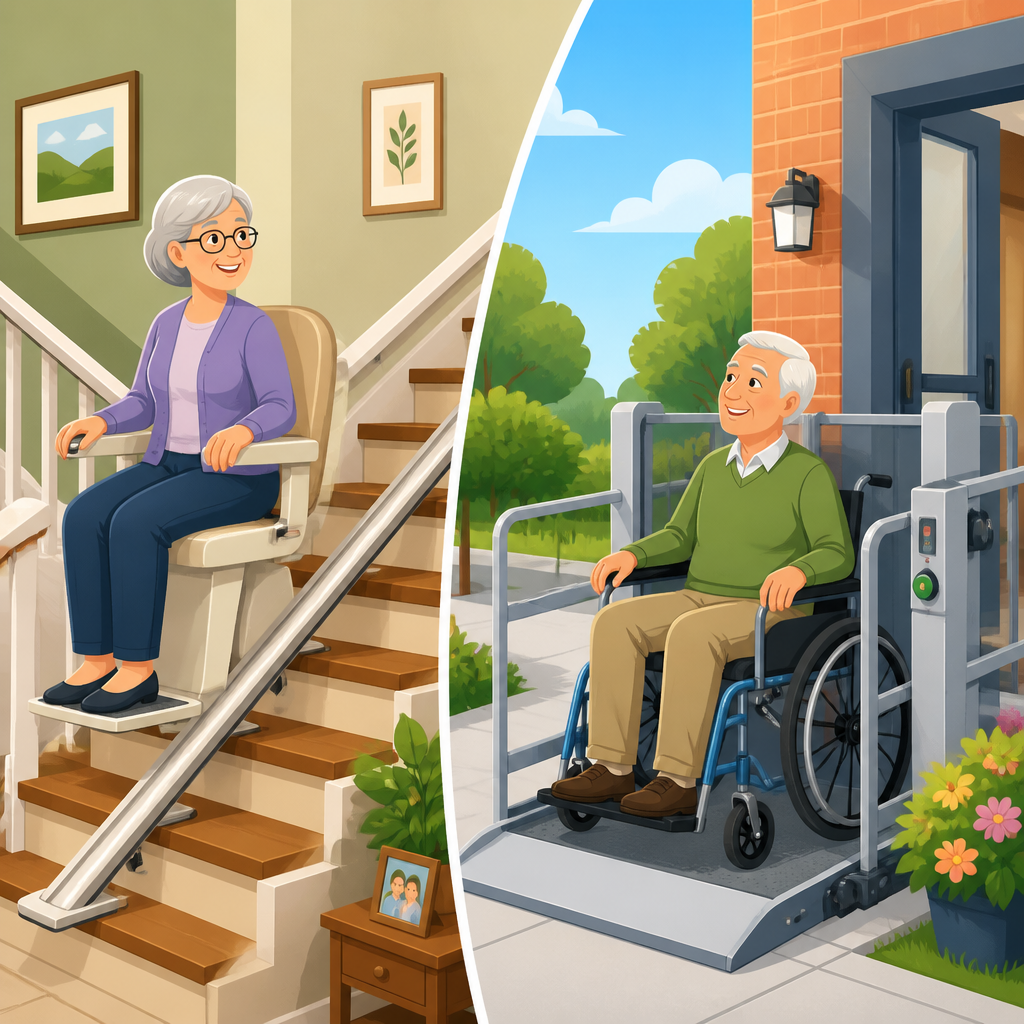
Choosing between a stair lift and a wheelchair lift starts with one practical question: how will the user move safely, comfortably, and independently through a home or building every day? Both systems are designed to overcome changes in elevation, but they solve the problem in very different ways. A stair lift carries a seated rider along a rail mounted to the staircase, while a wheelchair lift raises a person in a wheelchair or standing on a platform between levels. That distinction affects cost, installation, space planning, usability, maintenance, and long-term suitability.
In projects I have worked on, families often begin by asking which option is cheaper. That matters, but price alone rarely leads to the right accessibility solution. The better question is which product matches the user’s mobility profile, transfer ability, home layout, and future needs. Someone who can sit, stand, and pivot safely may do well with a stair lift for years. Someone who uses a power wheelchair, cannot transfer independently, or needs caregiver support usually requires a wheelchair lift from the start.
This comparison matters because the wrong choice can create safety risks, wasted expense, and daily frustration. Accessibility equipment should reduce barriers, not introduce new ones. The Americans with Disabilities Act influences many commercial accessibility decisions, while residential planning often follows manufacturer specifications, local building codes, and best practices from organizations such as the National Association of Home Builders. Understanding the design differences early helps homeowners, caregivers, builders, and facility managers choose a system that supports safe access today and remains workable as needs change.
At a basic level, stair lifts are best understood as seated transportation on stairs. They typically include a motorized chair, footrest, armrests, seat belt, call-send controls, and a rail that follows a straight or curved staircase. Wheelchair lifts, often called vertical platform lifts or inclined platform lifts depending on travel path, are platform-based systems built to carry a wheelchair user without requiring a transfer. That design makes them more inclusive for many users, but it also increases footprint, structural requirements, and cost.
How stair lifts and wheelchair lifts differ in core design
The clearest design difference is the rider position. A stair lift assumes the user can transfer onto a seat, remain upright during travel, and exit safely at the landing. A wheelchair lift assumes the mobility device travels with the user. That single factor changes nearly every engineering and user-experience detail.
Stair lifts are usually installed on one side of the staircase and mounted to stair treads rather than the wall. Straight stair lifts fit uninterrupted flights and are typically faster to quote and install. Curved stair lifts are custom fabricated to match turns, intermediate landings, or spiral geometry. Most residential units run on batteries charged from household power, which means they continue operating during many power outages for multiple trips.
Wheelchair lifts come in two main forms. A vertical platform lift moves up and down like a compact elevator over short rises, commonly from porch to entry, garage to first floor, or one interior level to another. An inclined platform lift travels along the staircase on a rail while carrying the wheelchair on a foldable platform. Vertical models are more common in homes because they are simpler to use with power wheelchairs and create less obstruction on the stairs when not in use.
From a design standpoint, stair lifts are more compact and less invasive. Wheelchair lifts are more universal in who they can serve. That is why product selection should begin with the user, not the staircase.
Who is best served by each accessibility solution
A stair lift is usually the best fit for a person with limited walking endurance, mild to moderate balance issues, joint pain, or reduced stair-climbing ability who can still transfer independently or with minimal help. Common examples include older adults with arthritis, people recovering from hip or knee surgery, and users with cardiac or pulmonary limitations who fatigue on stairs. In these cases, the stair lift preserves access without major remodeling.
A wheelchair lift is usually the better choice for someone who relies on a manual or power wheelchair full time, has minimal standing ability, cannot safely pivot onto a stair lift seat, or expects mobility needs to progress. It is also often the better option when a caregiver assists with transfers, because caregiver handling on or near stairs is one of the highest-risk situations in home mobility support.
In my experience, the gray area includes users who currently transfer but do so inconsistently. A person with multiple sclerosis, Parkinson’s disease, post-stroke weakness, or advancing neuropathy may manage a stair lift today yet struggle within a year. In those cases, choosing a wheelchair lift can prevent paying twice. By contrast, if the user only needs temporary support during rehabilitation, a stair lift may be the more sensible and economical solution.
| Factor | Stair Lift | Wheelchair Lift |
|---|---|---|
| User transfer ability | Requires seated transfer | No transfer required |
| Mobility device accommodation | Usually not transported with user | Designed for manual and power wheelchairs |
| Footprint | Smaller on stairs | Larger platform and landing clearance |
| Typical installation complexity | Lower, especially on straight stairs | Higher due to structure, gates, power, and code issues |
| Best use case | Ambulatory user with stair difficulty | Wheelchair user or non-transferable rider |
Space, layout, and installation requirements
Space planning often decides the issue before budget does. Stair lifts need adequate stair width, stable treads, and clear landing areas. Many manufacturers recommend a minimum staircase width near 29 to 30 inches for residential models, although exact requirements vary by chair design and local code. The user also needs room to get on and off at the top and bottom without stepping into a dangerous position. Options such as a folding rail or powered swivel seat can improve safety where a doorway or hallway crowds the landing.
Wheelchair lifts require more deliberate layout planning. A vertical platform lift needs enough room for the platform, side panels, gates, approach clearances, and safe maneuvering space for the wheelchair. If used outdoors, weather protection, drainage, corrosion resistance, and frost-depth foundation details become important. Inclined platform lifts preserve the wheelchair trip but can consume significant stair width when deployed, which may affect egress and code compliance.
Installation time differs significantly. A straight stair lift can often be installed in a few hours. A curved stair lift may take longer because the rail is custom built from site measurements, often using photo measurement or digital scanning. A wheelchair lift installation may involve electrical work, concrete pads, framing modifications, permit review, and inspections. In commercial or multifamily settings, fire and life safety considerations become especially important.
For homeowners comparing chair lift types and designs, this is where hub-level planning matters: look beyond the device itself and assess circulation paths, turning radius, entry thresholds, and how the user approaches the lift on both levels.
Cost, maintenance, and long-term ownership
Stair lift pricing is generally lower than wheelchair lift pricing, but the spread can be wide. A straight residential stair lift often costs far less than a curved stair lift, because straight rails are standardized while curved rails are custom manufactured. Wheelchair lifts typically cost more due to heavier-duty components, gate systems, platform construction, and more involved installation. Site work can add substantially to the total project price.
Operating costs are usually manageable for both products, yet maintenance should not be treated as optional. Stair lifts need rail cleaning, battery checks, seat and footrest inspections, and periodic service of drive components and safety sensors. Wheelchair lifts need similar preventive service plus gate interlocks, platform condition checks, hydraulic or screw-drive system inspection depending on model, and verification of limit switches and emergency lowering features.
When I evaluate ownership value, I focus on usable years rather than purchase price. A lower-cost stair lift that becomes unsuitable after twelve months is not truly cheaper than a wheelchair lift that serves the user for a decade. Resale and reuse are also different. Straight stair lifts are sometimes easier to recondition or relocate than curved units. Platform lifts are more site-specific and may carry higher removal and relocation costs.
Buyers should ask every dealer for a full lifecycle picture: product price, installation scope, permit responsibility, service response times, battery replacement intervals, warranty terms, and annual maintenance expectations. Those details reveal the real cost.
Safety features, codes, and common decision mistakes
Both systems can be safe when correctly specified, professionally installed, and used as intended. The key phrase is as intended. A stair lift is not a substitute for a wheelchair lift when the user cannot transfer safely. A wheelchair lift is not automatically the best solution if the available space creates hazardous approaches or blocks required exit paths.
Common stair lift safety features include obstruction sensors, seat belts, overspeed governors, swivel-and-lock seats at the landing, folding footrests, and call-send controls that let another household member move the chair remotely. Common wheelchair lift safety features include non-skid platforms, guard panels, ramp flaps, gate interlocks, emergency stop controls, battery backup or manual lowering systems, and constant-pressure controls that stop movement when released.
Code compliance varies by jurisdiction and by whether the installation is residential, public-facing, or part of a multifamily property. Many platform lifts are designed around ASME A18.1 requirements, a widely recognized safety standard for platform lifts and stairway chairlifts. Local building officials may also evaluate landing dimensions, electrical specifications, guarding, and means of egress. This is why experienced dealers coordinate early with contractors and inspectors rather than treating the lift as an afterthought.
The most common decision mistakes are choosing based only on price, underestimating disease progression, ignoring caregiver workflow, and failing to measure approach clearances. Another frequent mistake is assuming an outdoor application is just an indoor model with a cover. Outdoor lifts need weather-rated components and careful attention to drainage, temperature range, and slip resistance.
How to choose the right option for your home or facility
The right choice comes from a structured assessment. First, define the user’s current and likely future mobility. Can the person stand, pivot, and sit without significant fall risk? Do they use a cane, walker, manual wheelchair, or power wheelchair? Is caregiver assistance required now, or likely soon? Second, evaluate the property. Measure stair width, landing depth, turning radius, door swings, thresholds, and exterior exposure. Third, identify goals. Some buyers need the fastest path to safe bedroom access. Others need a no-transfer solution that supports aging in place for many years.
For homes, I recommend involving three voices early: the user, a qualified lift dealer, and if needs are complex, an occupational therapist or accessibility specialist. For commercial or shared-use properties, add the architect, contractor, and authority having jurisdiction. Their input helps prevent a design that works on paper but fails in real use.
As a hub within general design and comparison topics, the clearest takeaway is this: stair lifts prioritize compact seated travel on existing stairs, while wheelchair lifts prioritize inclusive platform access with fewer transfer demands. Neither is universally better. The best accessibility solution is the one that matches the user’s body mechanics, the building’s constraints, and the expected timeline of need.
If you are comparing chair lift types and designs, start with a professional site assessment and an honest review of future mobility. That simple step leads to safer installations, smarter spending, and equipment that truly supports independence.
Frequently Asked Questions
What is the main difference between a stair lift and a wheelchair lift?
The biggest difference is how each system moves the user. A stair lift is designed to carry a seated person along a rail attached to the staircase. The user transfers onto the lift seat, fastens a seat belt, and rides up or down the stairs while the chair travels along the stair line. A wheelchair lift, by contrast, uses a platform to raise and lower the user between levels. In many cases, the person can remain in their wheelchair throughout the trip, which eliminates the need for a transfer.
That basic distinction has a major effect on convenience, accessibility, and daily use. Stair lifts are often a practical solution for people who can sit down safely and stand up again at the top or bottom of the stairs. They are commonly chosen for aging in place, for users with reduced balance, or for households where the staircase is the main barrier. Wheelchair lifts are usually the better fit when a person relies on a wheelchair, scooter, or walker and needs a more direct, no-transfer way to move between elevations.
It also affects installation and space planning. Stair lifts follow the path of the stairs and typically take up less structural space, while wheelchair lifts require room for a platform, entry and exit clearances, and sometimes construction changes depending on the travel height and location. In simple terms, if the user can comfortably transfer to a seat, a stair lift may be enough. If the goal is to move the person together with their mobility device, a wheelchair lift is generally the more appropriate accessibility solution.
How do I know whether a stair lift or a wheelchair lift is better for the user’s mobility needs?
The best choice depends on how the person moves every day, not just on the staircase or height change itself. Start by looking at whether the user can safely transfer from a wheelchair, walker, or standing position onto a stair lift seat. If that transfer is difficult, painful, or unsafe, a wheelchair lift is often the better long-term option because it reduces physical strain and supports more independent use. For many households, this is the single most important decision point.
You should also think about the user’s current and future condition. Someone with mild balance limitations today may do well with a stair lift, but if their mobility is declining or they are expected to rely more heavily on a wheelchair over time, a wheelchair lift may provide better long-term value. Choosing based only on present needs can lead to reinvestment later, so it is wise to plan ahead when possible. Conditions involving lower-body weakness, chronic pain, fatigue, neurological disorders, or limited caregiver support can all influence which system is more practical.
Comfort and confidence matter as much as technical function. Some users feel secure and comfortable sitting on a stair lift, while others prefer the stability of remaining in their wheelchair on a platform. Caregiver involvement is another important factor. If a family member must assist with transfers, positioning, or turning in a tight stair landing, a wheelchair lift may significantly simplify daily routines. In many cases, the right answer comes from balancing transfer ability, safety, independence, future mobility changes, and the physical layout of the home or building.
Which option is usually more affordable to install and maintain?
In many residential situations, a stair lift is usually the more affordable option upfront. Because it mounts directly to the staircase and generally requires less structural modification, installation is often simpler and faster. Straight stair lifts tend to be the most budget-friendly, while curved stair lifts cost more because they are custom-built to match the exact shape of the stairs. Even so, they are still frequently less expensive than installing a full wheelchair lift, especially when the travel distance is modest and the user does not need to remain in a wheelchair during transport.
Wheelchair lifts often involve a higher initial investment because the equipment is larger and the installation requirements can be more complex. The project may require dedicated space, electrical work, safety gates or doors, and compliance with local codes. Depending on whether the lift is installed indoors or outdoors, there may also be added expenses for weather protection, landing construction, or platform access improvements. The total cost can vary widely based on travel height, lift capacity, and whether the setting is residential or commercial.
Maintenance should be considered alongside purchase price. Stair lifts typically have fewer large structural components and may be simpler to service, but they still require routine inspections, battery checks, and periodic maintenance to ensure safe operation. Wheelchair lifts are robust systems designed for heavier loads and frequent use, but that can also mean more involved service needs over time. The most cost-effective solution is not always the cheapest to buy. It is the one that fits the user properly, minimizes future modifications, and provides dependable performance for years of daily use.
How much space is needed for a stair lift versus a wheelchair lift?
A stair lift generally works well when space is limited because it follows the line of the existing staircase. The rail is mounted to the stair treads, not usually to the wall, and the seat, footrest, and arms often fold up when the lift is not in use. That makes stair lifts especially appealing in homes where preserving hallway and landing space is important. However, the staircase still needs to be wide enough for safe use, and there must be enough room at the top and bottom for the rider to get on and off comfortably.
Wheelchair lifts require more dedicated clearance because they rely on a platform rather than a compact seat. The lift needs enough room for the platform itself, safe entry and exit areas, and any required gates, doors, or enclosures. If the user will enter the lift while seated in a wheelchair, turning radius and approach angle also become important. This is why wheelchair lifts often need more planning, especially in tight interior spaces or older homes where layouts were not designed for modern accessibility equipment.
Space needs can also vary based on where the lift is installed. An outdoor wheelchair lift may be easier to accommodate near a porch, deck, or garage entry, while an indoor stair lift may be the least disruptive option inside the home. A professional site assessment is the best way to identify clearance issues, code considerations, and day-to-day usability concerns. Even when both options are technically possible, one may fit the available space much more naturally and create a smoother experience for the user.
Is one option safer or more convenient for everyday use?
Both stair lifts and wheelchair lifts are designed with safety features, but the safer and more convenient option depends on the user’s abilities and the environment where the lift will be used. Stair lifts typically include seat belts, swivel seats, footrest sensors, and obstruction detection. For users who can sit and transfer steadily, these features provide a reliable and comfortable way to navigate stairs without climbing them. The ride is usually smooth, and the controls are simple, which can make daily use easy and predictable.
Wheelchair lifts are often more convenient for users who depend on a wheelchair or who have difficulty standing or transferring. Because the user can often stay on the platform in their chair, there are fewer physical steps involved in using the equipment. This can reduce fall risk during transfers and can also lessen caregiver strain. Safety features may include non-slip platforms, guard panels, emergency stop controls, interlocks, and backup power options. For many users with more significant mobility limitations, that direct platform access makes the system feel safer and more practical every day.
Convenience also includes how the lift fits into normal routines. A stair lift may be quicker and less invasive for one ambulatory user, while a wheelchair lift may be far more efficient in a multi-user household or in settings where preserving wheelchair access is essential. The right choice is the one that the user can operate consistently, confidently, and safely without unnecessary effort. When evaluating safety, it is important to think beyond the ride itself and consider transfers, landings, caregiver assistance, emergency operation, and how the user’s mobility may change over time.