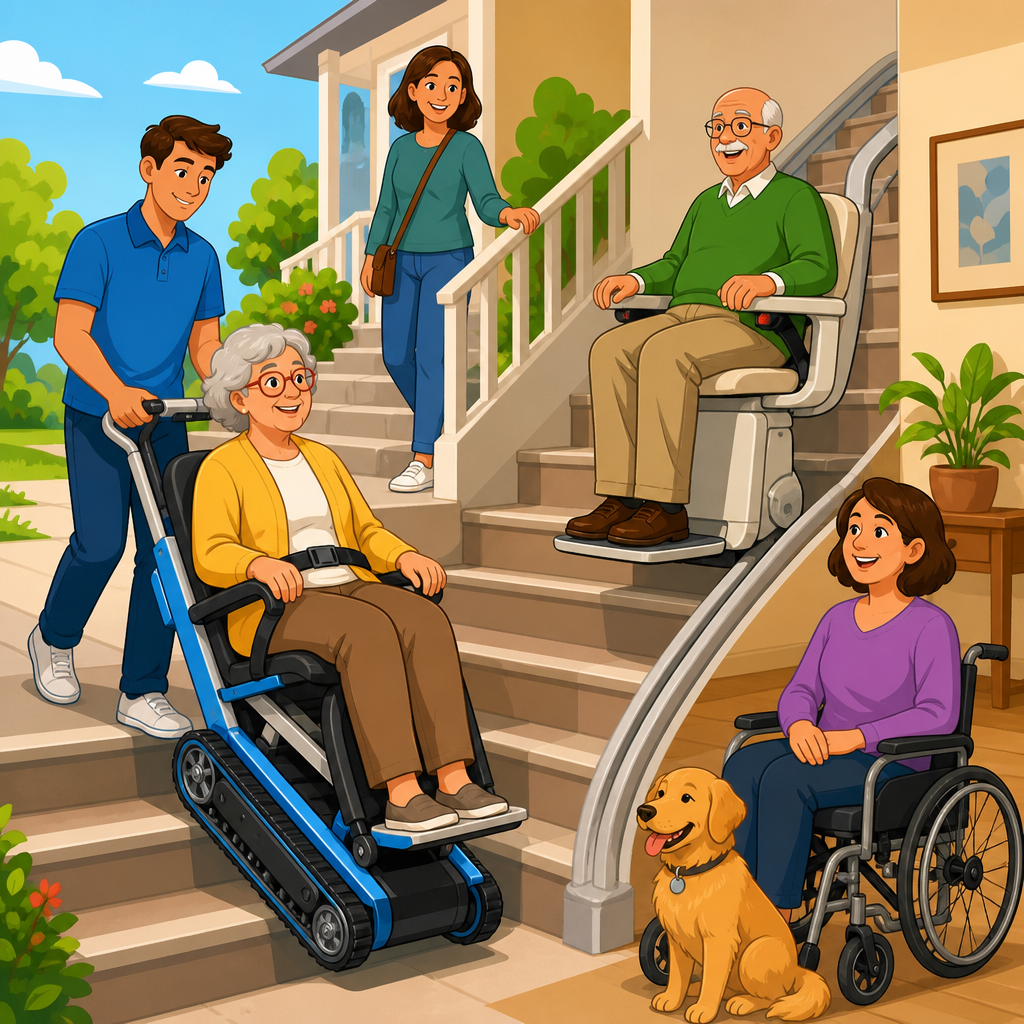
Portable stair climbers and portable chair lifts serve people who need temporary, flexible help moving over stairs without committing to a permanent installation. In the broader category of chair lift types and designs, portable lifts are the most adaptable option because they can travel with the user, move between properties, and often work in buildings where a fixed rail system is impractical. I have evaluated mobility equipment for families, therapists, and facilities, and portable systems consistently come up when the main question is not simply “Can someone use stairs?” but “What solution fits changing needs, changing locations, and changing budgets?”
A portable stair climber is usually a powered or manual device designed to move a seated passenger or mobility aid up and down steps with assistance from an operator. A portable chair lift, in this context, refers to a transportable seating system that provides stair access without being mounted permanently to the staircase. Unlike traditional stair lifts, which use a fixed track attached to the treads or wall, portable lifts rely on onboard motors, tracks, wheels, braking systems, and attendant control. Some models are designed for emergency evacuation, while others support routine daily access in homes, clinics, schools, and public venues.
This distinction matters because the right lift depends on who is using it, where it will be used, and how often. A homeowner recovering from knee surgery has different needs than a wheelchair user visiting relatives, a school planning evacuation compliance, or an assisted living community moving residents during outages. Portable lifts matter because stairs remain one of the most common barriers in older homes, walk-up apartments, small businesses, and historic buildings. According to housing and aging trends across North America and Europe, a large share of existing homes were not built for step-free access, and retrofitting can be expensive or restricted by layout, landlord rules, or preservation requirements.
Choosing correctly requires understanding user strength, transfer ability, staircase geometry, operator training, weight capacity, battery life, storage space, and safety standards. It also requires honesty about limitations. Portable lifts can be excellent tools, but they are not the best answer for every person or every staircase. The sections below explain who should use a portable stair climber or chair lift, when these devices outperform permanent lifts, and how to evaluate portable lifts as part of a complete accessibility plan within the larger chair lift types and designs category.
What Portable Lifts Are and How They Differ From Fixed Stair Lifts
Portable lifts solve a different problem than fixed stair lifts. A fixed stair lift is best when one staircase is used every day by the same resident and the property can support installation. It offers independent travel, a mounted rail, and familiar seat controls. A portable lift, by contrast, is best when the user moves between locations, the need may be temporary, or the stairs cannot accept a permanent rail. In practice, I often describe portable lifts as mobility equipment for variable environments rather than architecture-specific equipment.
There are three common categories. First, powered stair climbers with tracked bases carry a seated passenger while an attendant guides the machine over each step. Second, evacuation chairs are lightweight devices used to move people downstairs during emergencies; some are skid-based and optimized more for descent than ascent. Third, portable wheelchair stair climbers attach to or support a wheelchair so a user can remain in their chair during movement on stairs, though these require compatible dimensions and a skilled operator. Brands and models vary widely, but the core design question is always stability, control, and transfer management.
The biggest difference is independence. Most portable lifts require another person to operate them safely. That is why they are ideal for households with a reliable caregiver, medical transport teams, school staff, or facility personnel, but less ideal for someone living alone who wants solo access several times a day. Another major difference is infrastructure. Portable lifts need charging, storage, and training, but they do not require permits, carpentry, rail fitting, or electrical changes in the way many permanent systems do. This makes them attractive where building constraints are the deciding factor.
Who Benefits Most From Portable Stair Climbers and Chair Lifts
The best candidates are people whose mobility limitations are significant but not necessarily permanent in one place. Post-surgical patients are a classic example. After hip replacement, spinal surgery, or complex fracture repair, many people can sit safely but cannot climb stairs without pain, instability, or physician restrictions. Renting or purchasing a portable stair climber can bridge a recovery period of several weeks or months without the cost of installing a rail that may no longer be needed after rehabilitation.
Older adults with declining balance, leg weakness, or cardiopulmonary fatigue also benefit, especially when they split time between homes or visit family in inaccessible properties. I have seen portable lifts work well for grandparents who manage well on level surfaces with a walker but become unsafe on basement or front-entry stairs. The portable model gives the family a controlled way to manage visits without forcing a home remodel before every holiday gathering.
People with neurological conditions can also be strong candidates. Individuals with multiple sclerosis, Parkinson’s disease, muscular dystrophy, or stroke-related weakness may have fluctuating function. On good days they may manage a few steps; on bad days they may need full transport assistance. A portable lift matches that variability better than a rigid one-solution approach. Facilities such as schools, churches, therapy practices, and community centers also benefit when they need accessible movement for occasional users rather than constant daily use by one person.
Travelers and renters form another important group. If someone lives in a leased property, a historic building, or a shared family home, installing a permanent stair lift may be impossible or financially unreasonable. A portable chair lift offers access without altering the building. For care agencies, a single portable unit may serve multiple clients in different homes, making it operationally efficient. That flexibility is the defining advantage of portable lifts.
When Portable Lifts Are Better Than Permanent Installation
Portable lifts are better when the access problem is temporary, the property is unsuitable for rails, or multiple locations are involved. Narrow stairs, steep turns, fragile finishes, and landlord restrictions frequently block permanent stair lift projects. In older townhouses and small apartment buildings, the staircase may not maintain enough clear walking width once a rail and folded seat are installed. In those cases, a portable solution preserves the stairway for everyone else while still allowing assisted access when needed.
They also make financial sense in short-term scenarios. A permanent stair lift often includes site survey, fabrication, installation labor, and removal if the family moves. A portable lift shifts the spending toward equipment rather than property modification. For a six-week rehabilitation period or intermittent use at a second home, that tradeoff can be rational. Facilities often prefer portable units because one device can cover several staircases, especially in campuses with low-frequency need.
Emergency readiness is another reason. A permanent stair lift is not an evacuation device and may not be usable during fire events or power disruptions. Portable evacuation chairs are specifically designed for rapid descent under controlled handling. Schools, hospitals, office buildings, and hotels use them to support people who cannot use stairs in an emergency. In those environments, the portable lift is not replacing a fixed lift; it is covering a safety function that a fixed lift cannot.
| Situation | Portable Lift Advantage | Main Limitation |
|---|---|---|
| Post-surgery recovery | No permanent installation for short-term use | Usually needs an attendant |
| Rental or historic property | No rail, drilling, or structural alteration | Storage space required |
| Multiple homes or facilities | One device can travel between sites | Training must be consistent everywhere |
| Emergency evacuation planning | Designed for stair descent during crises | Not usually a daily comfort device |
| Very frequent solo daily use | Usually not the best fit | Fixed lift often provides better independence |
Safety, Training, and Staircase Requirements
The most important question is not “Will the lift fit on stairs?” but “Can this specific user and operator use it safely on this specific staircase?” Manufacturers publish maximum user weight, minimum landing dimensions, stair angle tolerances, and battery performance, and those details matter. A safe match requires adequate tread depth, stable landings, enough turning space at top and bottom, and a staircase free of loose rugs, poor lighting, or damaged nosings. Curved or spiral stairs can be especially challenging, and not every portable stair climber is rated for them.
Operator training is essential. Even with powered tracking systems that reduce lifting effort, attendants must know how to position the passenger, secure belts, manage center of gravity, and transition on and off the landing. In real use, the highest-risk moments are often transfers before the stairs begin and after they end. I strongly recommend hands-on demonstration with the supplier, followed by supervised practice using the actual staircase. Facilities should document competency just as they would for patient transfer equipment.
Safety standards should guide selection. Reputable manufacturers reference testing protocols, braking systems, anti-tip features, emergency stop controls, and battery status indicators. For evacuation equipment, standards and local fire or life-safety requirements may apply depending on building type and jurisdiction. It is also wise to coordinate with an occupational therapist or physical therapist when the user has spasticity, limited trunk control, severe osteoporosis, or anxiety with movement. The safest portable lift is the one matched to the person, staircase, and operator skill, not simply the one with the strongest motor.
Costs, Maintenance, and Ownership Decisions
Portable lift pricing varies by category, capacity, and motor system. Basic evacuation chairs can cost far less than powered daily-use stair climbers, while advanced tracked units and wheelchair-compatible systems may run into several thousand dollars. Some suppliers offer rentals for recovery periods, which can be the smartest option when need is temporary. Buyers should ask whether the quote includes charger, spare battery, restraint system, training, service support, and replacement wear parts such as tracks or wheels.
Maintenance is simpler than maintaining a rail system, but it is not optional. Batteries degrade, tracks wear, fasteners loosen, and seat or restraint components need inspection. A portable lift stored in a garage, vehicle, or damp basement may deteriorate faster than one kept indoors in climate-controlled conditions. Before recommending any model, I look at who will charge it, where it will be stored, and whether the organization has a schedule for inspection. A neglected portable lift is unreliable at exactly the moment it is needed most.
Ownership decisions should also consider workflow. A family using the device twice a month may value compact folding and low weight over premium comfort. A clinic transporting patients all day may prioritize battery endurance, quick sanitation, and higher weight capacity. Resale value and parts availability matter too. Established brands with service networks are generally safer long-term choices than obscure imports with limited support. The cheapest unit on day one can become the most expensive if batteries fail early or replacement parts cannot be sourced.
How Portable Lifts Fit Within Chair Lift Types and Designs
As a hub within portable lifts, this topic connects to every major discussion under chair lift types and designs. Straight stair lifts, curved stair lifts, outdoor stair lifts, standing stair lifts, and platform lifts all address access in different architectural and user scenarios. Portable lifts occupy the niche where flexibility overrides permanence. They are not a universal substitute for mounted equipment, but they are often the smartest first step when needs are still evolving or when the building simply will not cooperate.
That is why portable lifts should be evaluated as part of a decision tree. If the user needs independent daily access on one staircase, compare fixed stair lift models first. If the user remains in a wheelchair and has the space and budget, a platform lift may be preferable. If the need is caregiver-assisted transport across changing environments, portable stair climbers move to the front of the list. This hub should lead readers naturally into deeper comparisons such as portable stair climber versus fixed stair lift, evacuation chair versus daily-use portable chair lift, and portable lift safety checklist for caregivers.
The central takeaway is simple: portable stair climbers and portable chair lifts are best for people who need adaptable stair access, not permanent architecture changes. They work especially well for temporary recovery, variable neurological conditions, renters, travelers, caregivers, schools, clinics, and emergency planning teams. They require proper training, realistic expectations, and careful matching to staircase conditions. If you are building out your understanding of chair lift types and designs, use this portable lifts hub as the starting point, then compare specific models, use cases, and safety standards before making a purchase or rental decision.
Frequently Asked Questions
Who is the best candidate for a portable stair climber or portable chair lift?
A portable stair climber or portable chair lift is usually best for someone who needs help getting over stairs but does not want, need, or cannot install a permanent stair lift. That often includes older adults with changing mobility needs, people recovering from surgery or injury, wheelchair users visiting homes or buildings with stairs, and families caring for a loved one in a temporary living situation. These systems are especially useful when mobility needs may improve, fluctuate, or depend on the setting. For example, a person may move safely on flat ground but still need assistance on stairways, or they may need support only during rehabilitation.
Portable models are also a strong fit for caregivers, therapists, schools, clinics, churches, and facilities that assist multiple users in different locations. Because the equipment can be transported and shared, it offers flexibility that fixed rail systems cannot. In my experience evaluating mobility equipment for families and care settings, the best candidates are those who value adaptability, have a clear need for stair access in more than one place, and want a solution that can be used now without making permanent changes to the property.
When does a portable option make more sense than a permanent stair lift?
A portable option makes more sense when the environment, timeline, or ownership situation makes permanent installation difficult or unnecessary. If someone rents their home, lives in a multi-family building, travels often, or expects their mobility limitations to be temporary, a portable stair climber or chair lift can be the more practical choice. It can also be the right answer when a staircase is not ideal for a fixed rail system due to layout challenges, narrow dimensions, building restrictions, or the need to preserve the look and structure of the property.
Portable systems are also valuable when the same person needs stair assistance in several locations, such as at home, at a relative’s house, during appointments, or while traveling. A permanent stair lift solves one staircase very well, but a portable lift can solve many staircases reasonably well when used appropriately. That is why it is often considered the most adaptable option within the broader category of chair lift types and designs. If long-term daily independent use on one staircase is the main goal, a fixed lift may be better. But if flexibility, transportability, and temporary use matter most, portable equipment often has the advantage.
Can portable stair climbers and chair lifts work for caregivers and facilities, not just individuals at home?
Yes, and this is one of their biggest strengths. Portable stair climbers and chair lifts are frequently used by caregivers, home health providers, physical therapists, transport teams, schools, senior communities, and medical or residential facilities that need to help different people in different buildings. Instead of installing a separate lift at every staircase, a portable unit can be moved where it is needed. That can make it a practical investment for organizations that want mobility support without extensive renovations.
For family caregivers, portability can be just as important. A son or daughter may need to help a parent at one home during the week and another location on weekends. A therapist may need equipment that can be used in several client settings. A facility may need to assist visitors or residents in older buildings where permanent rail systems are not realistic. In these situations, portable equipment can fill a very specific gap: it provides stair access support without tying the user or provider to one fixed staircase. The key is making sure staff or caregivers are properly trained, the user is medically appropriate for the device, and the stair environment meets the manufacturer’s safety guidelines.
What should someone consider before choosing a portable stair climber or chair lift?
The most important factors are the user’s physical needs, the caregiver’s role, and the type of stairs involved. Start with how the person transfers, sits, and tolerates movement on stairs. Some users need a seated transport solution, while others may benefit from a stair-climbing system designed to carry a wheelchair or mobility device. Weight capacity, body support, head and trunk control, and comfort during operation all matter. If the equipment requires caregiver assistance, the caregiver’s strength, training, and confidence should also be part of the decision.
You should also look closely at the staircase itself. Stair width, landing size, turning areas, step height, surface condition, and handrail placement can all affect compatibility. Battery life, portability, storage, and transportation between locations are also important, especially if the equipment will travel regularly. Finally, think about frequency of use. For occasional or temporary stair access, a portable unit can be ideal. For heavy daily use on the same staircase, a permanent lift may be more efficient. A professional assessment from a mobility equipment provider, therapist, or accessibility specialist is the best way to match the right device to the user and setting.
Are portable stair climbers and portable chair lifts safe for temporary and flexible stair access?
They can be very safe when the right equipment is matched to the right user and used according to training and manufacturer instructions. Safety depends less on the word “portable” and more on proper fit, appropriate operation, and real-world stair conditions. A quality portable stair climber or chair lift should have features such as secure restraints, stable support, controlled ascent and descent, reliable braking or track systems, and clear operating procedures. Many are specifically designed to give caregivers a safer, more controlled way to move someone over stairs than manual lifting would allow.
That said, these are not one-size-fits-all devices. The user’s health status, balance, posture, weight, and transfer ability need to be considered carefully. So do the caregiver’s training level and the staircase layout. Before purchase or use, it is wise to confirm whether the model is suitable for straight stairs, curved stairs, indoor or outdoor conditions, and the user’s mobility profile. When selected thoughtfully, portable systems can provide excellent temporary and flexible access. They are often the safest option in situations where a permanent lift is not possible and carrying someone manually would create far greater risk for both the rider and the caregiver.