
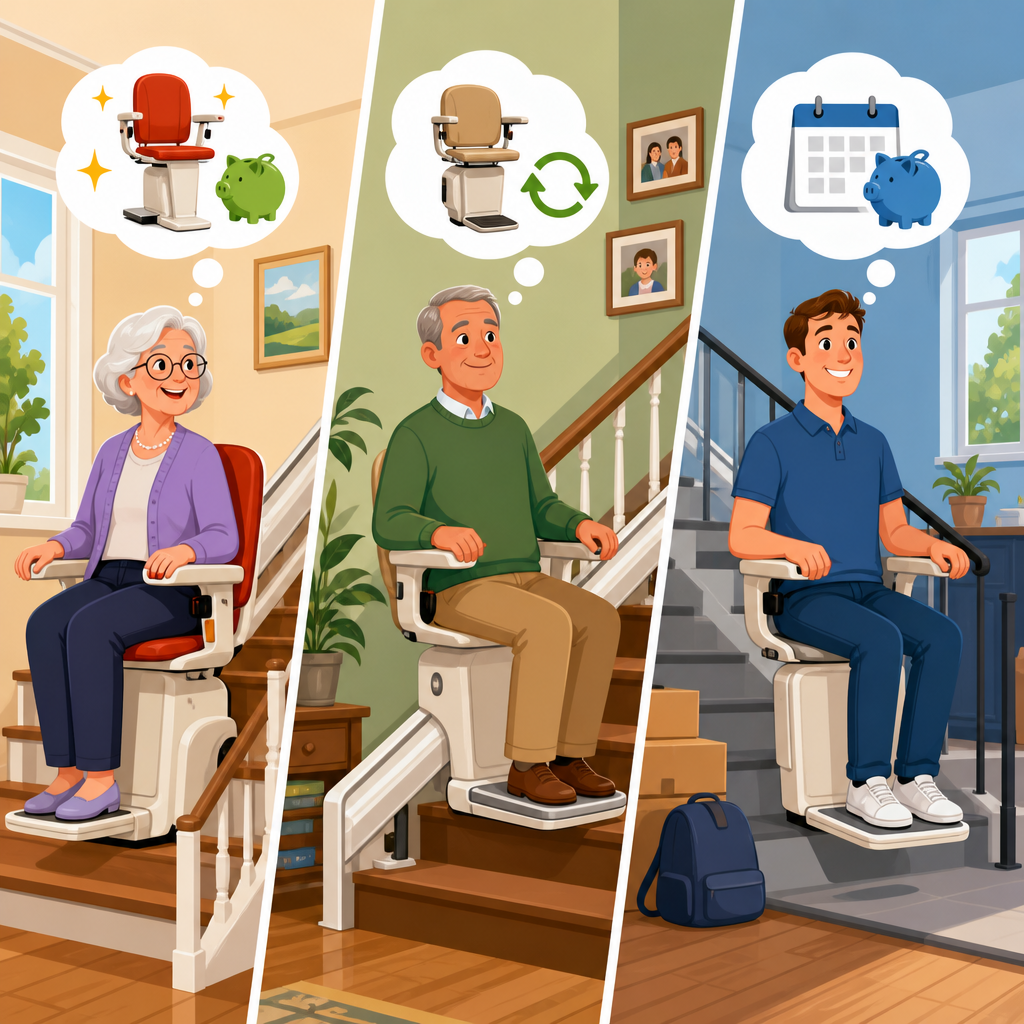
Choosing between a new, refurbished, or rental stair lift is mostly a question of time horizon, condition of the staircase, and total cost of ownership. In practical buying terms, the cheapest stair lift is not always the one with the lowest upfront price. A rental may cost less for three months, a refurbished unit may offer the best value for one to three years, and a new stair lift often becomes the smartest budget-friendly option when reliability, warranty coverage, and long-term use matter most. For families comparing options under financial pressure, understanding those differences prevents expensive mistakes.
A stair lift is a motorized chair or perch that travels on a rail mounted to the stairs, helping users move safely between levels without climbing. “New” means factory-fresh equipment with full manufacturer support. “Refurbished” usually means a previously installed unit that has been inspected, repaired, cleaned, and resold by a dealer. “Rental” generally means a temporary agreement, often using reconditioned straight-rail equipment, with monthly fees and removal terms. Those terms sound simple, but actual pricing depends on whether the staircase is straight or curved, whether the home needs electrical work, and how long the lift will be used.
This topic matters because stair lifts sit at the intersection of mobility, safety, and household budgeting. A fall on stairs can create hospital costs far beyond the price of a lift, yet many buyers still need the most economical path. In projects I have reviewed with dealers and families, the biggest source of confusion has been comparing quotes that bundle different items: rail length, power swivel seats, installation, service calls, and transferability. A low advertised price can quickly stop being low once those details are added. That is why this guide serves as a hub for budget-friendly options within buying guides and product reviews.
Before comparing use cases, it helps to know the baseline market. In the U.S., new straight stair lifts commonly start around $2,500 to $5,500 installed, while new curved lifts often begin near $10,000 and can climb well beyond $15,000 because the rail is custom built. Refurbished straight units often land between roughly $2,000 and $4,000 installed, depending on age, brand, and warranty. Rental stair lifts frequently involve an initial setup fee plus monthly charges, making them appealing for short recovery periods. Curved rentals are rare because custom rails are expensive to fabricate, deliver, and remove.
What determines the true cheapest stair lift option
The true cost of a stair lift comes from five factors: equipment price, installation, ongoing service risk, expected duration of use, and resale or removal value. If you only compare sticker price, you may choose the wrong category. For example, a $900 setup fee plus $150 per month looks affordable until month ten, when the total reaches $2,400 and you still own nothing. By contrast, a refurbished straight lift at $2,700 installed may cost more on day one but less over a year, especially if it includes a limited warranty and a maintenance visit.
Straight versus curved stairs is the biggest cost divider. Straight lifts use standardized rails that can often be cut to length, removed, and reused. That makes both refurbished sales and rentals feasible. Curved lifts require a rail engineered to the exact turns, landings, and parking positions of a specific staircase. Because that rail is custom, the new-versus-used savings are smaller, and rentals are far less common. In many homes, a “used curved lift” still requires a newly manufactured rail, so buyers get used chair components but not a fully used system.
Battery design also matters. Most modern stair lifts are battery powered and charge at points on the rail, allowing operation during a power outage. Older non-battery designs can be cheaper on paper but less desirable in practice. When I evaluate budget options, I treat battery replacement as a normal lifecycle cost rather than a defect. A dealer should disclose battery age, charger condition, and whether the unit passed load testing. Brands that maintain parts availability, such as Bruno, Harmar, Stannah, and Access BDD through various regional channels, generally provide better long-term value than obscure discontinued models.
Another overlooked variable is service coverage. A bargain unit loses its value quickly if the nearest qualified technician is two counties away or if key components are no longer stocked. Ask who performs the installation, whether they are factory trained, and what response time applies for breakdowns. Budget-friendly buying is not about paying the least today; it is about minimizing total spending while preserving safe daily use.
New stair lifts: when the higher upfront price is actually cheapest
New stair lifts carry the highest initial price in most situations, but they are often the cheapest option for long-term users. If someone expects to rely on the lift for several years because of arthritis, multiple sclerosis, COPD, stroke aftereffects, or age-related mobility decline, a new model usually wins on total value. You get a full manufacturer warranty, current safety features, fresh batteries, and the best chance of parts support over time. Those factors reduce downtime and repair surprises, which matters when the lift is essential, not optional.
New lifts also make sense for complex staircases or heavier-duty requirements. If the user needs a higher weight capacity, a folding rail, power footrest, powered swivel seat, or a narrow-profile design for tight stairs, a new system gives the widest selection. For curved stairs, the economics strongly favor new in many cases because the rail must be custom made anyway. A dealer may offer reused carriage components, but the total project often remains close enough to new pricing that the warranty and support of a new unit become the better bargain.
Consider a homeowner planning to age in place for five years or more on a straight staircase. A new lift at $4,200 installed with a multi-year warranty may cost less overall than a refurbished lift at $3,100 plus two service visits and battery replacement over that same period. The difference is not universal, but it is common. In my experience, buyers focused on pure upfront savings often underestimate the cost of interruptions, especially when a broken lift effectively makes part of the home unusable.
Refurbished stair lifts: best value for medium-term use
Refurbished stair lifts are usually the sweet spot for budget-conscious buyers who need a dependable solution for one to three years. A properly refurbished unit should be more than cleaned and resold. Reputable dealers inspect the motor, gearbox, carriage rollers, seat assembly, safety edges, controls, charger, and batteries; replace worn components; test the unit under load; and install it with a warranty. When those steps are documented, the savings can be meaningful without taking on the risk associated with unknown private-party equipment.
The best candidates for refurbished stair lifts are straight staircases with standard dimensions and users whose needs are unlikely to change quickly. If someone is recovering from a progressive condition but still wants a moderate-cost solution now, refurbished often works well. It is also a practical choice when the home may be sold in the near future and the family wants accessibility without paying premium new-equipment pricing.
There are limits. Refurbished inventory depends on what dealers have available, so seat style, rail finish, and advanced options may be limited. Warranty periods are usually shorter than for new lifts, and highly specific fit requirements may be harder to satisfy. Still, among budget-friendly options, refurbished straight lifts consistently offer the best balance of cost, reliability, and speed of installation.
Rental stair lifts: cheapest for short-term recovery and temporary care
Rental stair lifts are usually the cheapest option when the expected need is brief, such as after knee replacement, hip surgery, an injury, or a temporary home hospice arrangement. A rental shifts the decision from ownership to access. Instead of paying full equipment cost, the household pays an installation or reconditioning fee, monthly rent, and eventual removal. If the lift is needed for only a few months, that structure can produce the lowest cash outlay.
Most rental programs focus on straight stair lifts because the rails are reusable. Dealers can install them quickly, sometimes within days if inventory is available. This matters after hospital discharge, when time is more important than customization. Rentals also simplify exit planning. Once the user recovers or moves, the dealer removes the lift, and the family does not need to market used equipment privately.
The downside is cumulative cost. Rentals become less economical as months pass, and service terms vary widely. Some monthly agreements include maintenance; others charge extra for non-warranty calls. Cosmetic wear is usually normal, but damage fees may apply. If a family is unsure whether the need will last six months or two years, they should compare the projected rental total against refurbished purchase pricing before signing.
Cheapest option by use case
The most useful way to compare stair lift categories is by use case rather than by headline price. The table below reflects common U.S. buying scenarios and the option that is usually cheapest after considering duration, service risk, and staircase type.
| Use case | Usually cheapest option | Why |
|---|---|---|
| Post-surgery recovery, 2 to 4 months, straight stairs | Rental | Low upfront spend and simple removal after recovery |
| Temporary hospice or visiting relative, under 6 months, straight stairs | Rental | Fast installation without long-term ownership costs |
| Expected use 1 to 3 years, straight stairs | Refurbished | Lower purchase price than new with better total cost than extended rental |
| Daily long-term use, 4+ years, straight stairs | New | Best warranty, newest parts, lower repair risk over time |
| Any long-term use on curved stairs | New in most cases | Custom rail drives cost, shrinking savings from used components |
| Need for premium features or high weight capacity | New | Wider model selection and current safety options |
| Need uncertain, likely 6 to 12 months, straight stairs | Compare rental versus refurbished closely | Break-even point varies by setup fee and monthly rate |
This framework is more reliable than generic “best stair lift deals” lists because it accounts for how mobility equipment is actually used. A cheap solution that fails at month eight is not cheap. A slightly higher-cost option that fits the user, includes support, and avoids a fall often is.
How to compare quotes and avoid false bargains
Always request itemized quotes. Each proposal should show model name, rail type, weight capacity, seat and control options, installation cost, warranty terms, service-call policy, battery status, and removal charges if it is a rental. Without those details, apples-to-apples comparison is impossible. I also recommend asking whether the quote includes permits if required locally, trim modifications, parking overruns, and any electrical work for a nearby outlet.
Be cautious with private-party listings on Facebook Marketplace, Craigslist, or estate-sale channels. A used stair lift can look inexpensive, but rail compatibility, missing hardware, unavailable parts, and professional reinstallation costs often erase the savings. Dealers buying back units and refurbishing them professionally create value precisely because stair lifts are not plug-and-play appliances. They are safety devices that must be matched to a staircase and tested under load.
Ask three direct questions: How long is this needed? Is the staircase straight or curved? Who services the lift if it stops working? Those answers usually narrow the field quickly. Then review financing, Medicaid waiver programs in some states, Veterans benefits where applicable, nonprofit reuse programs, and Area Agency on Aging resources. The cheapest option may be a better product paired with outside funding.
Budget-friendly stair lift strategy for this buying-guides hub
For most households, the decision is straightforward once the use case is clear. Choose rental for short-term straight-stair needs, refurbished for medium-term value on straight stairs, and new for long-term use, curved staircases, or advanced feature requirements. That is the central rule connecting every budget-friendly stair lift article in this buying-guides hub: low upfront price matters, but duration of use and service support determine real affordability.
If you are comparing quotes now, start by mapping your likely timeline in months, not years, and confirm whether the staircase is straight or curved. Then ask each dealer for total cost through the period you expect to need the lift. This simple step exposes false bargains immediately. The best budget choice is the one that keeps the user safe, the stairs accessible, and the total spend predictable. Use this framework to shortlist the right category, then move on to detailed model reviews, warranty comparisons, and installation questions before you buy.
Frequently Asked Questions
Which stair lift option is usually the cheapest overall: new, refurbished, or rental?
The cheapest option depends on how long the lift will be needed and what type of staircase it must fit. For very short-term use, a rental is often the lowest-cost choice because the upfront expense is much smaller than buying outright. That can make excellent financial sense for recovery after surgery, temporary mobility issues, or a short stay with a family member. However, rental costs add up month by month, so what looks cheapest at the beginning may become the most expensive path if the lift is kept longer than expected.
For medium-term use, refurbished stair lifts often provide the best balance between price and value. A professionally reconditioned unit typically costs less than a brand-new model while still offering reliable performance, especially on standard straight staircases. For one to three years of use, this can be the most cost-effective middle ground because the buyer avoids long rental accumulation without paying full new-unit pricing.
For long-term needs, a new stair lift often becomes the most economical choice in real-world ownership terms. Although the purchase price is higher upfront, a new unit usually includes stronger warranty coverage, newer components, fewer repair concerns, and a longer expected service life. When reliability matters over many years, the total cost of ownership can be lower than repeatedly paying rental fees or dealing with the limitations of an older unit. In other words, the cheapest stair lift is not always the one with the smallest initial invoice; it is the one that best matches the expected duration of use and the conditions of the home.
When does renting a stair lift make the most financial sense?
Renting makes the most financial sense when the need is clearly temporary and likely to last only a few weeks or months. Common examples include post-surgery recovery, rehabilitation after an injury, hospice situations, or a short-term living arrangement with a relative. In these cases, paying a modest installation charge plus monthly rental fees can be far less expensive than purchasing a unit that may only be used briefly.
That said, rental economics depend heavily on the staircase itself. Straight stair lifts are usually the most rental-friendly because providers can install and later remove preconfigured rail systems more easily. Curved staircases are different. Because curved rails are typically custom-built for the exact dimensions and turns of the staircase, true rental savings may be limited or unavailable. Even if a company offers a rental structure for a curved lift, the customization costs can significantly reduce the value advantage.
It is also important to look beyond the monthly rate. Ask whether the quote includes installation, removal, service calls, battery replacement, and maintenance during the rental period. A low advertised monthly fee does not always reflect the total amount paid. If there is a good chance the lift will be needed longer than initially expected, it is wise to compare the full projected rental cost over six, twelve, and eighteen months against the price of a refurbished or new stair lift. That comparison often reveals the break-even point where renting stops being the cheapest option.
Is a refurbished stair lift a smart budget choice, or is buying new worth the extra cost?
A refurbished stair lift can be a very smart budget choice when purchased from a reputable dealer that thoroughly inspects, reconditions, and tests the equipment. For many households, especially those needing a straight stair lift for one to three years, refurbished units offer strong value. They typically cost meaningfully less than new models while still providing the core features most users need, such as seat swivels, safety sensors, seat belts, and battery backup.
The key issue is not simply whether the lift is refurbished, but how it was refurbished and what protections come with it. A quality dealer should be able to explain what parts were replaced, how the drive system and batteries were tested, what cosmetic work was done, and what warranty is included. A professionally refurbished unit with service support can be a much better financial decision than an older low-priced lift sold privately without installation, safety checks, or after-sale assistance.
Buying new is usually worth the extra cost when long-term reliability, full warranty coverage, and access to the latest features are top priorities. New stair lifts are often the best fit for permanent mobility needs, heavier daily use, or households where downtime would create serious safety or access problems. In those situations, the higher upfront investment can pay off through lower repair risk, better manufacturer support, and a longer useful lifespan. So if the goal is the lowest short-to-medium-term ownership cost, refurbished may win. If the goal is long-term peace of mind and predictable performance, new often proves to be the stronger value.
How does staircase type affect whether new, refurbished, or rental is the cheapest option?
Staircase type has a major impact on cost because straight and curved stair lifts are priced very differently. A straight staircase is generally the most affordable scenario regardless of whether the unit is new, refurbished, or rented. Straight rails are standardized, easier to install, and more widely available in both new and reconditioned inventory. That creates more pricing competition and gives buyers more flexibility to choose the most economical use-case option.
Curved staircases change the equation because they typically require a rail custom-made to follow turns, landings, or intermediate bends. That custom fabrication increases cost substantially, and it also reduces the practicality of refurbished and rental options. While the chair portion of a stair lift may be reusable, the curved rail often must be made specifically for that home. This means a curved “rental” may still involve significant one-time charges, and a curved “refurbished” lift may only be partially refurbished because the rail itself remains custom to the staircase.
In practical terms, straight staircases usually provide the best opportunity to save money with rental or refurbished options. Curved staircases often shift the value calculation toward buying a new system, especially if the need is ongoing. That is why any meaningful price comparison should start with a proper home assessment rather than just online price ranges. The staircase layout, length, width, number of turns, and mounting conditions all influence which option is truly cheapest in the real world.
What costs should be compared besides the purchase or rental price?
To determine the cheapest option accurately, it is essential to compare total cost of ownership rather than just sticker price. For purchases, that includes installation, warranty coverage, maintenance, possible repairs, battery replacement over time, and any service call charges after the initial coverage period ends. A stair lift with a lower purchase price may not be the better deal if it comes with limited warranty protection or higher expected maintenance costs.
For rentals, buyers should look at the full structure of charges: initial installation, monthly rental fees, minimum contract length, removal fees, maintenance coverage, and what happens if the rental extends beyond the original term. It is also smart to ask whether there are restocking, relocation, or cancellation fees. These details matter because they can substantially change which option is cheapest over even a modest period.
There are also indirect costs to consider. Reliability has a financial value, especially for users who depend on the lift every day. If a breakdown creates mobility barriers, missed appointments, or the need for emergency help, a cheaper but less dependable unit may end up costing more in practical terms. Warranty length, dealer responsiveness, and parts availability all affect real ownership value. A careful comparison should weigh not only what is paid today, but what is likely to be paid over the entire expected period of use. That is the clearest way to decide whether new, refurbished, or rental is truly the budget-friendly choice for a specific use case.





