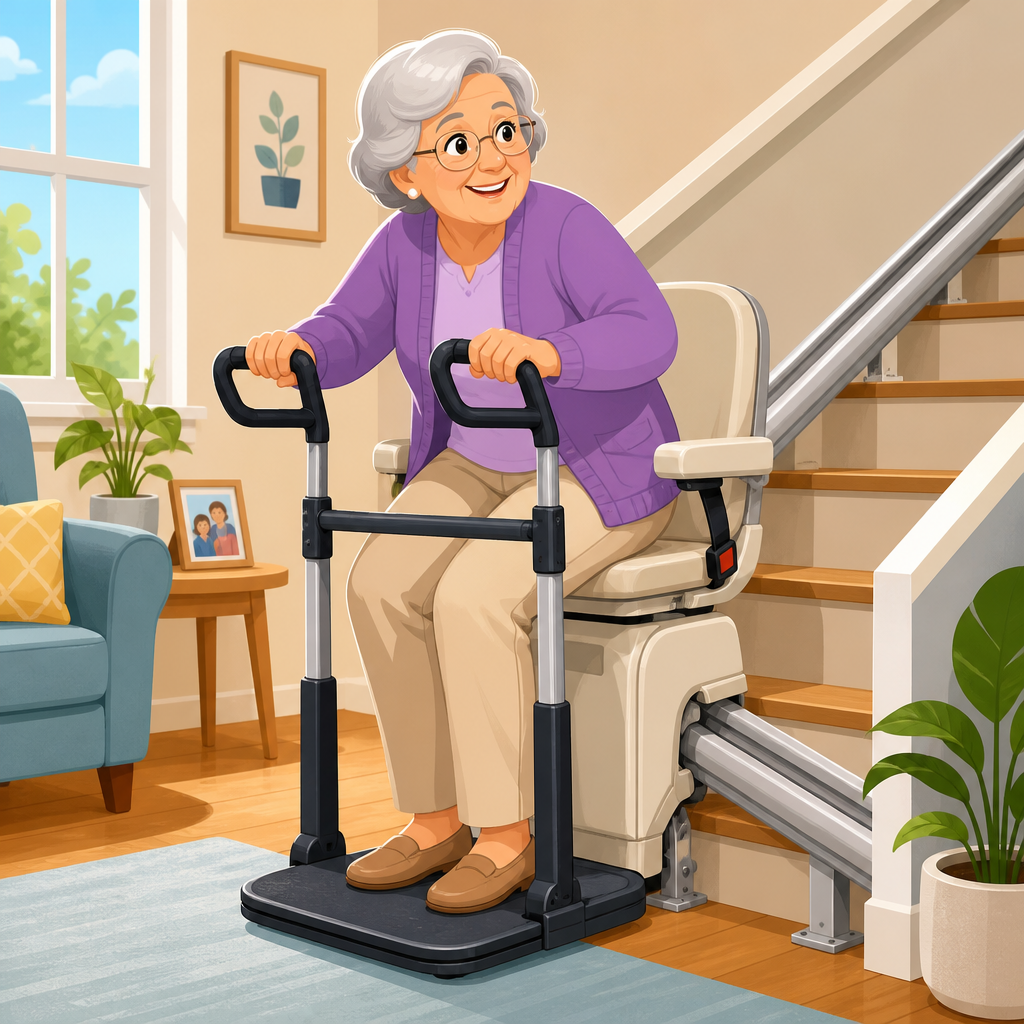
Stand-assist devices for seniors who have trouble rising from a stair lift seat solve a common but often underestimated mobility problem: the transfer from sitting to standing at the end of a stair lift ride. A stair lift can safely move a person between floors, yet the trip is only complete when the rider can stand, pivot, and walk away without losing balance. In my work with older adults and family caregivers, this transfer point is where near falls happen most often, especially when leg strength is reduced, arthritis limits knee extension, or dizziness appears after sitting. A stand-assist device provides leverage, lifting support, or controlled forward momentum so the user can rise with less strain and lower fall risk.
In practical terms, stand-assist devices include several categories: grab bars mounted near the top or bottom landing, floor-to-ceiling tension poles, transfer handles, seat-assist cushions, compact mechanical sit-to-stand aids, and powered lift chairs placed adjacent to the landing area. Some devices are passive, meaning they give the user something solid to push from. Others are active, using springs, gas cylinders, or motors to help elevate the body. The right choice depends on the senior’s diagnosis, strength, balance, home layout, and whether they transfer independently, with supervision, or with hands-on assistance.
This matters because the consequences of a poor transfer can be serious. According to the Centers for Disease Control and Prevention, falls are a leading cause of injury among older adults, and many falls happen during routine transitions rather than dramatic events. The top and bottom of stairways are already higher-risk locations. Add a moving seat, a narrow landing, and a user who hesitates before standing, and the environment demands careful planning. A good stand-assist setup can reduce caregiver strain, protect the user’s confidence, and extend safe use of a stair lift before more intensive support becomes necessary.
As a hub topic within mobility aids and devices, this subject also connects to broader accessibility planning. Families who search for help rising from a stair lift often discover related needs: walker compatibility at the landing, better handholds in hallways, transfer training from a physical therapist, or a full home safety review. That is why it helps to treat stand-assist devices not as isolated gadgets, but as part of a coordinated mobility strategy built around transfers, gait, endurance, and the physical dimensions of the home.
What causes difficulty rising from a stair lift seat
Most standing problems from a stair lift seat come from a mismatch between the user’s physical capacity and the mechanics of sit-to-stand movement. To stand safely, a person needs sufficient ankle positioning, knee extension strength, hip power, trunk control, and confidence shifting body weight forward over the feet. Seniors with osteoarthritis, spinal stenosis, Parkinson’s disease, stroke history, neuropathy, or general deconditioning often lose one or more of these components. A stair lift seat can make the issue more noticeable because the user must stand at a precise point, sometimes after a long seated ride that stiffens joints.
Seat height is another major factor. If the stair lift seat is lower than the person’s ideal transfer height, the hips start below the knees, increasing the force needed from the quadriceps and gluteal muscles. If armrests are too short, too soft, or awkwardly positioned, they do not provide meaningful push-off support. Swivel seats help the rider face the landing, but they also add a sequencing step. I have seen users rotate the seat correctly yet pause too long, then attempt to stand with their feet tucked under the chair or placed on different levels of flooring, which immediately compromises balance.
Medication effects, orthostatic hypotension, and fear of falling also matter. A senior may be strong enough on paper but still struggle after standing because blood pressure drops, depth perception is reduced, or the landing feels cramped. These issues are why a simple recommendation like “install a grab bar” is not always enough. The transfer must be assessed as a whole movement pattern from seat rotation through standing, turning, and initial walking steps.
Types of stand-assist devices that work near stair lifts
Several device categories can help, but they are not interchangeable. Fixed grab bars are the most common and often the best first option when the user can stand independently but needs a firm handhold. They must be anchored into framing or installed with a rated mounting system appropriate for the wall type. Floor-to-ceiling transfer poles are useful when wall placement is poor or when support is needed in a very specific position beside the stair lift seat. Because they create a vertical grasp point, they often help users pull slightly forward while pushing through the legs.
Transfer handles and free-standing support frames can bridge a short distance between the seat and the walking path. These are helpful when the landing opens into a hallway and there is no natural place for the hands to go after leaving the armrest. Seat-assist cushions, including spring-assisted or hydro-pneumatic models, can provide modest lifting help, but they are usually better for standard chairs than stair lifts because fit, sliding risk, and interference with seat belts or swivel functions can become problems. They should never compromise the integrity of the lift seat or the user’s positioning.
Mechanical sit-to-stand aids are more substantial. Nonpowered transfer aids, often used with caregiver assistance, support a partial-stand transfer by allowing the user to pull up on a central handle while a caregiver stabilizes the device. Powered standing aids can offer greater elevation and security for users with more advanced weakness, but they require enough landing space and a predictable transfer routine. In some homes, the better answer is not modifying the stair lift itself but placing a powered recliner-lift chair close to the landing so the first seated surface after the transfer is also easy to stand from.
| Device type | Best for | Main benefit | Important limitation |
|---|---|---|---|
| Wall-mounted grab bar | Independent users needing light support | Simple, durable, low profile | Requires correct wall location and secure anchoring |
| Floor-to-ceiling transfer pole | Users needing vertical leverage beside the seat | Strong pull point without wall drilling in some models | Needs proper ceiling/floor conditions and exact placement |
| Support frame or transfer handle | Users needing hand progression after standing | Creates a safer path away from the lift | Can clutter a narrow landing |
| Seat-assist cushion | Users with mild weakness on standard seating | Adds forward lift assistance | Often unsuitable on stair lift seats |
| Mechanical sit-to-stand aid | Users needing caregiver-assisted transfers | Higher level support and control | Requires training and more floor space |
How to choose the right device safely
The right stand-assist device starts with a functional assessment, not a catalog. The key question is: what exactly fails during the transfer? If the user cannot generate enough forward momentum, a vertical pull point or raised seating surface may help. If they can stand but immediately wobble, the priority may be bilateral support, footwear, or a walker staged within reach. If they need a caregiver to cue every step, a more structured transfer aid may be safer than expecting a single grab bar to solve the problem.
I typically look at five variables. First is seat-to-floor height relative to the user’s lower leg length. Second is upper-extremity capacity, including grip strength and shoulder pain; someone with severe rotator cuff disease cannot rely heavily on pulling. Third is cognitive sequencing, because the user must remember to swivel, position the feet, lean forward, and push or pull in the proper order. Fourth is landing geometry: width, turning radius, door swing, and where mobility aids can be parked. Fifth is the assistance level available. A spouse may be willing to supervise but unable to physically lift.
Clinical input is valuable here. A physical therapist or occupational therapist can analyze transfer mechanics and recommend specific devices based on strength, balance, and home setup. Stair lift manufacturers and installers should also be consulted before adding anything that touches, obstructs, or changes use of the lift. Reputable brands follow standards such as ASME A18.1 for platform lifts and stairway chairlifts in applicable contexts, while grab bar products often reference ADA dimensions or load ratings, even in private homes where ADA rules do not formally apply. The principle is straightforward: use equipment with published ratings, clear instructions, and installation methods that match the structure.
Installation, placement, and home layout considerations
Placement determines whether a device helps or creates a new hazard. A grab bar should support the natural arc of movement from seat edge to full standing, not force a twist across the body. On top landings, I often see bars mounted too far forward, making the user reach before their feet are stable. A better location is usually slightly ahead and to the side of the dominant hand, where the person can first place both feet flat, lean forward, then contact the bar as they rise. For users who push off the armrests first, a second handhold one step later can be even more important than the first.
Clearances matter. The landing must accommodate the parked stair lift seat, the user’s feet, any mobility aid, and the swing path of doors. If a walker is used, it should be staged so it is reachable without overreaching or stepping sideways unsupported. Lighting should be bright and even, ideally with motion-sensing or rocker-style switches. Flooring should be firm, level, and slip resistant; thick mats at the landing are a frequent problem because they catch walkers and alter foot placement.
Professional installation is strongly recommended for anything load-bearing. Consumer-grade suction bars are not appropriate for this application. Floor-to-ceiling poles must be tightened to manufacturer specifications and rechecked periodically. If a device crowds the stair lift’s rail, footrest, or call/send controls, it can interfere with safe operation. I advise families to run repeated dry transfers after installation at different times of day, including when the user is fatigued, because a setup that seems fine during a daytime demonstration may prove awkward in ordinary use.
How stand-assist devices fit into the wider mobility aids and devices plan
As the hub for mobility aids and devices, this topic sits in a larger decision tree. A senior who struggles to rise from a stair lift seat may also need a cane review, a properly fitted walker, bedside support, toilet safety rails, or vehicle transfer assistance. Solving only the stair lift transfer can leave weak links elsewhere. In practice, the best outcomes come from standardizing support across the home so movement patterns stay consistent. If the person uses a two-handed walker after standing, the landing setup should let them transition to that walker the same way every time.
This is also where progression planning matters. Early-stage support may involve one grab bar and transfer coaching. Moderate impairment may require a transfer pole, gait belt training for a caregiver, and a rollator with reliable brakes staged at the landing. Advanced impairment may call for a powered standing aid, home health involvement, or reconsideration of whether stair lift use remains appropriate at all. The goal is not to preserve one device indefinitely, but to keep the person mobile and safe as function changes.
Related topics under accessibility and mobility solutions include transfer benches, lift recliners, walker accessories, wheelchair-friendly doorway modifications, non-slip flooring, and emergency alert systems. Each of these can interact with stair lift transfers. For example, a senior with Parkinson’s may benefit from cueing strips on the floor, a U-step style walker recommended by a therapist, and a transfer pole near the lift. A senior recovering from knee replacement may instead need temporary raised seating, ice management, and a short-term bedside commode to reduce stair trips during rehabilitation.
Common mistakes, costs, and when to get professional help
The most common mistake is choosing by product description instead of transfer ability. Families often buy the first “standing aid” they see online, only to learn it needs more hand strength, space, or coordination than the user has. Another mistake is relying on the stair lift armrest as if it were a medical support rail. Armrests are helpful, but they are not substitutes for a properly planned transfer system. I also frequently see walkers parked too far away, bars installed at decorative rather than functional heights, and caregivers trying to lift under the arms, which can injure both people.
Costs vary widely. A basic, professionally installed grab bar may cost far less than a mechanical transfer aid, while powered standing devices can run into the thousands. Price, however, should be weighed against fall risk, emergency care costs, and caregiver burnout. Many families find that a targeted home assessment saves money because it narrows the purchase to what will actually work. Funding may sometimes be available through veterans’ programs, Medicaid waiver services in certain states, or local aging agencies, though coverage for home modifications and mobility equipment is inconsistent.
Get professional help when the user has had a recent fall, needs hands-on assistance to stand, shows new weakness, or cannot reliably follow transfer steps. In those cases, the safest next step is a therapist-led evaluation and a coordinated plan with the stair lift provider. Stand-assist devices for seniors who have trouble rising from a stair lift seat work best when matched to real movement needs, installed correctly, and integrated with the rest of the home mobility plan. Review the landing setup, ask for a transfer assessment, and choose equipment that makes every ride end as safely as it begins.
Frequently Asked Questions
What is a stand-assist device, and why might someone need one after using a stair lift?
A stand-assist device is a support tool designed to help a person move from sitting to standing with greater safety, stability, and confidence. In the context of a stair lift, it addresses a very specific problem: getting up from the stair lift seat at the top or bottom landing. Many older adults can tolerate the ride itself but struggle with the final transfer, especially if they have weak leg muscles, poor balance, arthritis, limited trunk control, dizziness, or fear of falling. That moment of standing, turning, and stepping away can be one of the highest-risk parts of the entire stair lift experience.
These devices come in several forms, including fixed grab bars, floor-to-ceiling poles, bed- or chair-style transfer handles adapted for nearby use, mobility rails, and non-powered or powered sit-to-stand aids. The right option depends on the person’s strength, balance, hand function, and available space at the stair lift landing. Some people only need a stable handhold to push from, while others need a more structured device that guides body position and reduces the effort required through the legs.
The reason this matters so much is that a safe stair lift ride is only truly complete when the user can exit safely. If a senior has to pull on a wall, grab an unstable banister, push off the stair lift armrest awkwardly, or rely on a caregiver’s body for leverage, the risk of a near fall rises significantly. A properly selected stand-assist device helps create a controlled transfer sequence: scoot forward, place feet, lean properly, push safely, stand fully, regain balance, and then pivot away from the seat.
How do I know which type of stand-assist device is appropriate for a senior who has trouble rising from a stair lift seat?
The best stand-assist device depends on how much help the person actually needs during the sit-to-stand transfer. A senior who is mostly independent but needs a secure place to hold may do well with a strategically placed grab bar or a floor-to-ceiling transfer pole near the stair lift landing. Someone with moderate leg weakness may benefit from a more supportive transfer handle or stand-assist rail that allows pushing up with both arms while maintaining balance. If the person cannot reliably bear weight through the legs or has significant difficulty initiating standing, a more advanced sit-to-stand aid may be necessary, often with caregiver assistance.
Start by looking at four practical factors: leg strength, balance, hand grip, and cognition. Can the person place both feet flat and push through the legs? Can they follow the steps of the transfer consistently? Do they reach for support at the right time, or do they grab unpredictably? Do they become lightheaded when standing? These details determine whether a simple support bar is enough or whether a more structured solution is needed. It is also important to consider the stair lift setup itself, including seat height, armrest design, swivel seat function, and the amount of clear space available at the landing.
In many cases, an occupational therapist or physical therapist can provide the most useful guidance. A professional can observe the transfer in the actual home environment and recommend equipment that fits the person’s body mechanics and the layout of the landing. This matters because a device that works well in a showroom may be unsafe in a narrow hallway or awkward next to a stair lift track. Proper selection is not just about buying support equipment; it is about matching the device to the user’s abilities, the caregiver’s role, and the physical environment so the transfer becomes smoother and safer every time.
Are grab bars enough, or is a more supportive sit-to-stand aid sometimes necessary?
Grab bars are helpful for many seniors, but they are not always enough. They work best for people who can still perform most of the standing motion independently and mainly need a stable, correctly positioned handhold for confidence and balance. When installed at the right height and angle, a grab bar can make it easier to lean forward properly, push through the arms, and steady oneself after standing. For mild weakness or occasional instability, this may be all that is needed.
However, if the person struggles to lift their hips off the seat, cannot generate enough force through the legs, has poor balance immediately upon standing, or tends to collapse back into the chair, a grab bar alone may not provide sufficient support. In those cases, a more supportive sit-to-stand aid may be safer. Devices with bilateral hand placement, more upright support surfaces, or guided standing mechanics can reduce the physical demand of the transfer and help keep the person aligned. This can be especially important for individuals with Parkinson’s disease, stroke-related weakness, severe arthritis, general deconditioning, or repeated near falls at the stair lift exit point.
Another issue is that people often misuse grab bars. If the bar is too far forward, too low, too high, or installed on the wrong side, it can encourage pulling rather than pushing, twisting while standing, or reaching beyond a safe base of support. So the question is not simply whether grab bars are “good” or “bad,” but whether they match the user’s functional needs and are positioned correctly. If a senior still needs heavy lifting help, loses balance after standing, or cannot transfer without a caregiver straining, it is a sign that a basic grab bar may be insufficient and a more supportive stand-assist option should be considered.
Where should a stand-assist device be placed near a stair lift to improve safety?
Placement is critical because even a high-quality device can be ineffective or dangerous if it is installed in the wrong location. The goal is to support the natural sequence of the transfer after the stair lift stops: the seat should be positioned for exit, the user should be able to scoot forward, place both feet securely, lean forward, and grasp the support without overreaching. In most cases, the device should be close enough that the person can use it as they begin standing, but not so close that it blocks the knees, the swivel movement of the seat, or the path of exit from the landing.
The best location depends on how the stair lift is configured and whether the user exits to the left or right. For some homes, a wall-mounted grab bar on the landing side is appropriate. In others, a floor-to-ceiling pole placed just beyond the seat edge provides a more functional support point because it can be grasped during both standing and pivoting. What matters most is that the person does not have to twist awkwardly, reach behind the body, or step before they are fully upright. Support should be available during the earliest and least stable part of the transfer.
Space and clearance also matter. The device should not interfere with the stair lift rail, folding footrest, hinged track, or the path of other household members using the stairs. It should also allow a caregiver to stand nearby if assistance is needed. Because top landings and bottom landings can be narrow, professional assessment is often worthwhile before installation. Safe placement is about more than convenience; it creates a predictable transfer pattern, reduces hesitation, and lowers the chance of losing balance at the exact moment the person transitions from the stair lift to walking.
Can a caregiver safely help with stair lift transfers, or should the senior rely on a stand-assist device instead?
In many situations, a caregiver can help, but relying only on manual assistance is often not the safest long-term solution. Family caregivers commonly try to lift under the arms, pull on the person’s hands, or brace them from the front while they rise from the stair lift seat. Unfortunately, these methods can put both people at risk. The senior may be pulled off balance, and the caregiver may strain the back, shoulders, or wrists. Transfers at stair lift landings are especially tricky because the available space is limited and the person may need to stand, turn, and clear the seat quickly.
A stand-assist device can make caregiver help safer and more controlled by giving the senior a stable point of contact and reducing how much physical lifting the caregiver must do. Instead of “lifting” the person, the caregiver can cue proper foot placement, remind them to lean forward, and guard for balance while the device provides structure. This usually leads to a better transfer pattern and less dependence over time. It also makes the process more repeatable, which is important when multiple family members or aides are involved.
That said, there are times when caregiver assistance alone is not appropriate and equipment becomes essential. If the senior has had repeated near falls, requires significant lifting, freezes when trying to stand, cannot maintain standing balance, or becomes unpredictable during the transfer, a formal mobility assessment is strongly recommended. The safest approach is usually a combination of the right device, good positioning, and caregiver training. When those elements are in place, the transfer from the stair lift seat becomes less stressful, more dignified, and much safer for everyone involved.