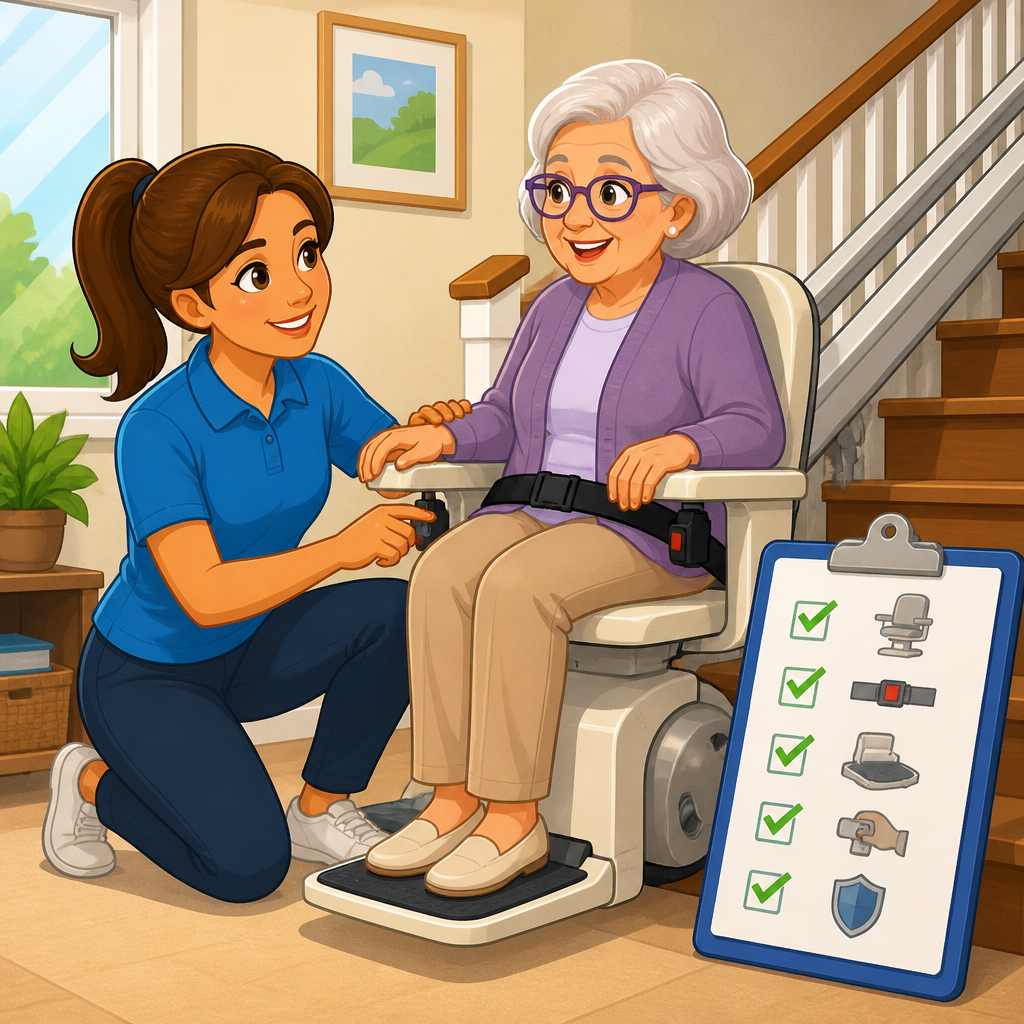
Chair lift safety training protects the person riding the lift, the caregiver assisting them, and the home itself. New home caregivers often inherit equipment with little orientation, yet a stair lift is not simply a seat on a rail. It is a powered mobility device with load limits, charging systems, safety sensors, folding parts, and emergency procedures that must be understood before daily use begins. In my experience training family caregivers and agency staff, the biggest risks come from assumptions: assuming every model works the same way, assuming the rider can transfer independently, or assuming a chair lift will stop every unsafe situation automatically. A practical checklist reduces those mistakes.
For this article, chair lift refers to a motorized seat that travels along a staircase rail, sometimes called a stair lift. Safety training means the structured process of teaching a caregiver how to inspect the lift, prepare the rider, operate controls, respond to faults, and document concerns. Home caregiver support resources include manufacturer manuals, installer orientation, occupational therapists, physical therapists, home care supervisors, durable medical equipment providers, and local aging or disability organizations. Together, these resources help caregivers move from basic operation to safe, consistent support.
This topic matters because falls on stairs remain one of the most serious home hazards for older adults and people with mobility limitations. A stair lift can lower risk, but only when it is correctly matched to the user and consistently used as intended. Poor positioning, skipped maintenance, dead batteries, cluttered stairs, or rushed transfers can quickly turn a helpful device into a dangerous one. New caregivers need a repeatable process that covers before, during, and after each ride, along with clear guidance on when to stop using the lift and call for help.
As the hub page for caregiver support resources within Accessibility & Mobility Solutions, this guide organizes the essential knowledge every new caregiver should master first. It explains the core safety checklist, the common mistakes to avoid, the support resources that answer real-world questions, and the routines that keep the lift dependable over time. If you are supporting a parent, spouse, client, or patient at home, use this article as your starting framework, then adapt it to the specific lift model, the rider’s physical abilities, and the care plan provided by clinicians or the installation company.
Start With a Device-Specific Chair Lift Orientation
The first item on any chair lift safety training checklist is model-specific orientation. I never train a new caregiver by saying, “They all work basically the same,” because they do not. Controls may be on the armrest, on a handheld remote, or mounted on the wall. Some lifts swivel manually at the landing; others use a powered swivel. Footrests may fold by hand or with linked mechanisms. Outdoor models add weather covers and more aggressive maintenance needs. Straight stair lifts are simpler than curved models, but both require the caregiver to know exactly how this unit behaves.
Begin by locating the owner’s manual and installation paperwork. Confirm the manufacturer and model, such as Bruno, Harmar, Handicare, or Stannah. Read the sections on weight capacity, charging points, seatbelt use, obstruction sensors, parking position, and emergency lowering or recovery procedures. If the paperwork is missing, request a digital manual from the manufacturer or dealer before unsupervised use. During orientation, physically identify the power switch, battery status indicator, key switch if present, charging contacts, send-call controls, seat swivel lever, folding points, and any audible or visual error indicators.
A competent orientation also includes a return demonstration. The caregiver should show they can power the lift on, unfold it safely, park it at the correct charging point, lock or unlock the swivel if applicable, and identify when the unit is not ready for use. If the caregiver cannot confidently explain what each control does, training is incomplete. This is also the best time to create quick-reference notes near the lift, including the dealer service number, model name, weight limit, and the exact steps for basic troubleshooting approved by the manufacturer.
Pre-Use Chair Lift Safety Checklist for Every Shift
Before each use, the caregiver should complete a brief visual and functional check. This is not excessive caution; it is standard risk control. Look at the staircase first. The steps, landings, and rail path must be free of shoes, laundry, pet toys, cords, oxygen tubing, and loose rugs near the boarding area. Good lighting matters because transfers are often compromised by poor depth perception and shadows. Then check the chair itself. Make sure the seat, armrests, and footrest are fully opened and stable. Inspect the seatbelt for twists, fraying, or a latch that does not click securely.
Next, verify that the lift is charged or parked correctly, depending on the model. Many stair lifts run on batteries that recharge only when the unit sits at designated charge points. I have seen caregivers assume the lift was plugged in and ready, only to discover a depleted battery during a transfer. Listen for unusual sounds when moving the chair a short distance without the rider, if your care plan permits that check. Grinding, jerking, or intermittent stopping should trigger a service call. Never continue regular use if the lift is showing fault lights, beeping repeatedly, or failing to stop smoothly at the landing.
The rider check is equally important. Confirm the person is wearing secure footwear, not slippery socks, and that clothing, blankets, catheter tubing, or bags will not catch in the mechanism. Assess whether the rider is alert enough to follow instructions. If they are dizzy, newly weak, short of breath, acutely confused, or refusing the transfer, pause and reassess rather than forcing the ride. A safe trip begins before anyone sits down.
| Checklist Item | What to Verify | Why It Matters |
|---|---|---|
| Stair path | No objects on steps, landings, or rail area | Prevents obstruction stops, trips, and falls |
| Seat and footrest | Fully opened, locked, and stable | Reduces transfer errors and foot drag |
| Seatbelt | Buckles correctly and is not damaged | Keeps rider positioned during travel |
| Battery or charging status | Lift is parked on charge point or indicates ready status | Avoids stalls mid-travel |
| Rider readiness | Proper footwear, alertness, and manageable symptoms | Supports a controlled transfer |
Safe Transfer Technique and Rider Positioning
Most chair lift incidents happen at the transfer, not in the middle of the ride. The caregiver’s job is to create a controlled sit, secure position, and controlled stand. At the boarding landing, position the chair exactly as the manufacturer instructs. If the seat swivels away from the staircase, lock it in the transfer position before asking the rider to sit. Cue the rider in short steps: back up until they feel the chair on the back of their legs, reach for the armrests if allowed by the design, and sit slowly. Avoid pulling on the person’s arms or clothing. If hands-on assist is needed, use body mechanics and the transfer method taught by therapy staff.
Once seated, center the rider in the chair. Hips should be back in the seat, feet placed fully on the footrest, and arms kept inside the armrests. Fasten the seatbelt every trip, even for very short rides. This is nonnegotiable. If the rider leans heavily to one side, slides forward, or cannot keep feet on the footrest, the care team should reassess whether this equipment still matches the person’s needs. An occupational therapist can recommend positioning strategies, while a physical therapist can assess transfer ability and lower-extremity strength. In progressive conditions such as Parkinson’s disease, multiple sclerosis, or advanced arthritis, transfer technique may need to change over time.
At the destination landing, rotate the seat only when the unit has fully stopped and the manual says it is safe to swivel. Lock the swivel before the rider stands. Give the rider time to orient, especially if orthostatic hypotension or balance impairment is a concern. I teach caregivers to pause for one full breath before standing, then cue “nose over toes” if that aligns with therapy guidance. Rushing the dismount creates more risk than the powered ride itself.
Operating Rules, Supervision, and Emergency Response
During travel, the caregiver should remain engaged, even if the rider is independent. Watch posture, hand placement, and the rider’s response to movement. Keep pets and children away from the staircase while the lift is in use. Use only one rider at a time unless the manufacturer explicitly states otherwise, which residential stair lifts generally do not. Never exceed the published weight capacity. Standard residential models often support roughly 250 to 350 pounds, while heavy-duty units may allow more; the exact limit must come from the model documentation, not guesswork.
Caregivers also need direct rules for common exceptions. Do not use the chair lift to move boxes, laundry baskets, oxygen cylinders, or assistive devices balanced on the rider’s lap unless the manufacturer permits a specific setup. Do not let the rider dangle feet off the footrest. Do not bypass sensors, tape controls down, or override stops because the lift “usually sticks there.” A repeated fault is not an inconvenience; it is a maintenance issue. If the unit stops unexpectedly, follow the manual’s instructions, keep the rider calm, and avoid risky improvised rescues on the stairs.
Emergency planning should be written and practiced. Every caregiver should know who to call for service, what symptoms require medical attention, and what to do if there is a power outage. Because many units are battery powered, they often continue to work temporarily during an outage, but that does not eliminate the need for a plan. If the rider becomes ill while seated, prioritize medical assessment over finishing the trip. If a transfer fails, protect the person from a fall and call for appropriate assistance rather than attempting a solo lift. Training should include location-specific details such as whether a second exit exists and how emergency responders can access the home quickly.
Maintenance, Documentation, and Caregiver Support Resources
Reliable chair lift safety depends on routine maintenance and accurate documentation. Most manufacturers recommend professional servicing at intervals based on use, environment, and model design. Homes with pets, high humidity, outdoor installations, or heavy daily traffic usually need closer attention. Caregivers should clean only as directed, typically keeping the rail clear of dust and debris and avoiding unapproved lubricants. I have seen well-meaning family members apply household oil to a rail, which can attract dirt and interfere with proper performance. Follow the manufacturer’s cleaning method exactly.
Documentation turns scattered observations into actionable safety information. Keep a simple log that records battery warnings, unusual noises, missed charge points, rider complaints, near-falls during transfers, and completed service visits. This helps agencies supervise quality, helps families spot patterns, and gives technicians useful evidence. If a rider starts pushing off unsafely, forgetting the seatbelt, or resisting the swivel routine, note the change and share it with the clinician or supervisor. Those behavioral shifts can signal pain, cognitive change, fear of movement, or equipment mismatch rather than simple noncompliance.
Strong caregiver support resources make ongoing safety realistic. Start with the installation dealer, who should provide operation training and service contacts. Add the manufacturer’s technical support line for manuals and troubleshooting guidance. Include the client’s home care agency, case manager, occupational therapist, physical therapist, and primary care team when transfer ability changes. Local Area Agencies on Aging, Centers for Independent Living, veterans’ programs, and disease-specific nonprofits often help families locate funding, respite, and caregiver education. If this article is your entry point into caregiver support resources, the next priorities are transfer training, fall prevention planning, home safety assessment, mobility device maintenance, and respite options for overwhelmed family caregivers.
A chair lift can make home access safer and preserve independence, but only when caregivers treat it as a clinical support device rather than a household convenience. The essentials are straightforward: learn the exact model, inspect the stairway and lift before use, perform deliberate transfers, secure the seatbelt every ride, monitor the rider throughout travel, and stop use when faults appear. These habits prevent the most common problems, including transfer falls, battery failures, obstruction stops, and misuse that gradually damages the equipment.
For new home caregivers, the bigger lesson is that safe chair lift use does not happen in isolation. It depends on a network of caregiver support resources that includes the manual, the installer, rehabilitation professionals, supervisors, maintenance technicians, and community organizations. When the rider’s strength, balance, cognition, or confidence changes, the checklist should trigger reassessment, not improvisation. Consistent documentation and timely service calls are just as important as hands-on assistance because they catch small issues before they become emergencies.
Use this chair lift safety training checklist as your hub reference, then build a home-specific routine around it. Post the key steps near the lift, schedule formal training for every new caregiver, and review the process after any near-miss or change in the rider’s condition. A few disciplined minutes before each trip can prevent injuries and keep the home mobility plan working as intended. Start today by locating the manual, confirming the model’s safety features, and creating a written checklist for everyone who provides care.
Frequently Asked Questions
What should be included in a chair lift safety training checklist before a new home caregiver uses the lift?
A complete chair lift safety training checklist should start with the basics and then move into hands-on operation. First, the caregiver should identify the exact lift model, locate the owner’s manual, and confirm who services the equipment. This matters because controls, diagnostic lights, folding features, and emergency functions can vary by manufacturer. Next, training should cover the lift’s weight capacity, proper seating position, seat belt use, armrest and footrest operation, swivel-seat locking at the top landing, and the location of the on/off switch or key. A caregiver should also learn how the lift charges, where the charging points are, and what low-battery alerts sound or look like.
The checklist should also include a full environmental safety review. That means checking the staircase for clutter, loose rugs, cords, pet toys, and anything else that could interfere with the rail or the user’s feet. Caregivers should be shown how to inspect folding components, test safety sensors, use call/send controls, and confirm the chair parks correctly without blocking normal stair use. Just as important, they need to practice common scenarios: helping a rider transfer on and off safely, stopping the lift mid-travel if needed, and responding to a stalled unit or power issue. Good training is not complete until the caregiver demonstrates the routine independently and knows when to stop use and call a technician.
Why is chair lift safety training so important for new home caregivers?
Chair lift safety training is important because a stair lift is a powered mobility device, not just a household convenience. When a new caregiver assumes responsibility without orientation, they may make dangerous assumptions about how the rider should sit, whether the chair can be overloaded, how the swivel seat locks, or what to do when the lift stops unexpectedly. These errors can lead to falls, pinched fingers, equipment damage, blocked stairways, or preventable stress for the person relying on the lift. In a home care setting, even small misunderstandings can create serious risks because transfers often involve older adults with balance problems, weakness, cognitive impairment, or fear of falling.
Training also protects the caregiver and the home itself. A caregiver who knows proper transfer technique is less likely to strain their back or try to physically support too much body weight on the stairs. A caregiver who understands folding procedures and parking positions is less likely to leave the lift in a way that creates a trip hazard for others in the household. In my experience, the biggest risks usually come from routine shortcuts: skipping the seat belt, failing to verify the seat has locked into position, ignoring strange noises, or continuing to use the lift after a sensor problem appears. Structured training helps replace guesswork with safe habits, which is exactly what new caregivers need before daily use begins.
What are the most common mistakes caregivers make when helping someone use a chair lift?
The most common mistakes are usually simple, but they can have major consequences. One frequent error is rushing the transfer and not making sure the rider is fully seated back in the chair before movement begins. Another is forgetting the seat belt or assuming the rider does not need it for a short trip. Caregivers also commonly fail to confirm that the footrest is positioned correctly, that loose clothing or blankets are clear of moving parts, and that the swivel seat has locked securely at the top landing before the rider stands. These may sound minor, but each one directly affects fall risk.
Other mistakes involve the equipment itself. Some caregivers overload the lift by assuming it can carry any adult safely, or they let a rider hold heavy items that affect balance during the trip. Others ignore beeping alarms, reduced speed, or intermittent stopping, even though those are often early signs of battery, charging, or sensor issues. A common environmental mistake is allowing clutter to build up along the staircase or rail path. Pets, laundry baskets, extension cords, and debris can all interfere with safe operation. Another major error is trying to troubleshoot beyond basic steps when the lift malfunctions. Caregivers should know the difference between routine user checks and service issues that require a qualified technician. If the lift behaves unusually, the safest response is to stop using it until the cause is identified.
How should a caregiver safely assist a person getting on and off a stair lift?
Safe assistance begins before the person even sits down. The caregiver should make sure the chair is parked in the correct position, the seat is fully lowered, the armrests and footrest are ready for use, and the rider has appropriate footwear. The transfer area should be dry, well lit, and free of clutter. When helping the person approach the chair, the caregiver should encourage a slow, controlled turn and backing up until the rider feels the seat behind their legs. The rider should sit fully back in the chair, with hips centered and posture supported. Once seated, the caregiver should secure the seat belt, check arm placement, ensure feet are properly on the footrest, and verify that clothing, blankets, tubing, or mobility aids are clear of the rail and moving parts.
At the upper landing, the process is just as important. After the lift stops, the caregiver should make sure the chair has fully reached its final position and, if applicable, swivel the seat only as instructed by the manufacturer. The seat must lock firmly before the rider stands. The caregiver should never encourage the person to stand while the seat is unsecured or angled incorrectly. Ideally, the rider pushes up from approved surfaces and stands only when balanced and ready. If the person needs physical help, the caregiver should use safe body mechanics and any transfer techniques recommended by a therapist or nurse, rather than pulling abruptly on the person’s arms. The key principle is consistency: every trip should follow the same careful steps so that neither the rider nor the caregiver relies on improvisation.
What should a new caregiver do if the chair lift stops working or there is an emergency during use?
If a chair lift stops working, the caregiver should stay calm and keep the rider calm first. Many situations become more dangerous when someone tries to rush a solution. The caregiver should tell the rider to remain seated with the seat belt on until the situation is assessed. Basic checks may include confirming the lift is switched on, checking whether the seat is fully locked in its travel position, making sure the armrests and footrest are positioned properly, and looking for an obstruction triggering a safety sensor. If household power is out, the caregiver should know that many lifts run temporarily on battery power, but they should still follow the manufacturer’s guidance. If the unit is beeping, flashing, or partially moving, that information should be noted for troubleshooting or for the service provider.
In a true emergency, such as chest pain, loss of consciousness, breathing distress, or a fall risk that cannot be safely managed on the lift, the caregiver should follow the home care emergency plan and call emergency services as appropriate. The caregiver should not attempt risky manual removal from the chair on the stairs unless they have been specifically trained for that situation and it can be done safely. For mechanical problems, the safest standard is to stop using the lift and contact the dealer or qualified technician rather than forcing movement or bypassing safety features. Every new caregiver should be trained on whom to call, where the manual and service number are kept, and how to document the problem. Emergency readiness is part of safe daily use, not a separate topic, because the right response in the first few minutes can prevent injury and further equipment damage.