Choosing a stair lift for bariatric users starts with one practical question: can the lift move the rider safely, comfortably, and consistently every day without straining the equipment or the home? In the stair lift industry, bariatric usually refers to products engineered for higher weight capacities than standard models, often beginning around 350 pounds and extending to 600 pounds or more depending on rail design, seat size, motor output, and installation conditions. Heavy-duty lifts are not simply standard stair lifts with a bigger chair. They are purpose-built systems with reinforced seats, stronger transmissions, wider arm spacing, upgraded footrests, and rails designed to manage higher loads while maintaining smooth travel.
This matters because fit and stability directly affect safety. I have seen buyers focus only on the published weight limit, then discover too late that the user’s hip width, transfer style, knee position, or staircase layout makes the model unsuitable. For bariatric users, successful selection depends on the interaction between rider dimensions, stair geometry, rail placement, seat height, swivel clearance, and power system design. This hub article explains heavy-duty lifts comprehensively, including capacity ratings, straight versus curved options, installation constraints, safety features, sizing, cost, and maintenance. If you are comparing chair lift types and designs, this is the foundational page for understanding how heavy-duty stair lifts differ from standard residential models and when they are the right solution.
What Makes a Heavy-Duty Stair Lift Different
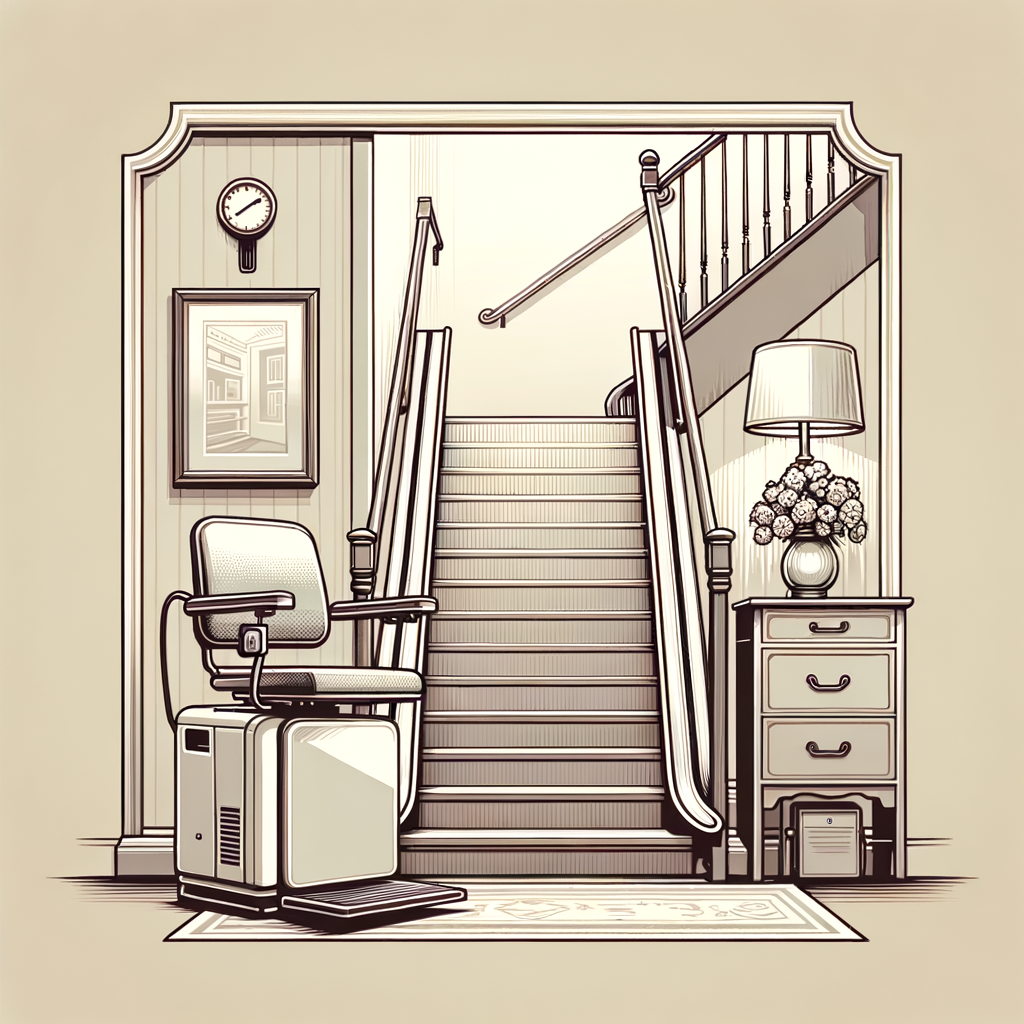
A heavy-duty stair lift is engineered around structural load management, not marketing language. The differences begin with the drivetrain. Manufacturers typically use higher-torque motors, more robust gearboxes, and reinforced carriage assemblies to control acceleration and braking under greater loads. The seat base is wider and stronger, the armrests are set farther apart, and the footrest often offers increased depth and weight-bearing support during transfer. The rail can also be physically larger or mounted in a way that distributes force more effectively into the stair treads. These changes improve durability, but they also affect the amount of staircase width the lift requires.
Most standard residential stair lifts carry about 250 to 350 pounds. Heavy-duty lifts commonly start around 350 pounds, with many respected models rated at 400, 500, or 600 pounds. Harmar’s Pinnacle Heavy Duty has long been known in the 350-pound range, while Bruno’s Elite models are frequently specified for users needing 400 pounds of capacity on straight staircases. Savaria and Handicare distributors may offer heavy-duty configurations depending on the rail and site requirements. Capacity, however, is only one part of the specification. A lift rated for 400 pounds may still be a poor choice if the seat width is insufficient or if the rider’s center of gravity during transfer shifts outside the designed seating position.
Another defining difference is ride quality under load. A well-designed bariatric stair lift should start smoothly, stop predictably, and remain stable without noticeable deflection, vibration, or seat flex. Battery-powered systems dominate the market because they continue to operate during power outages and deliver controlled DC motor performance. In homes where reliability is critical, I recommend asking how many trips the unit can complete on battery backup at the user’s typical weight, not just at a laboratory test load. That question often separates a product that looks good in a brochure from one that performs dependably in real life.
Who Needs a Bariatric Stair Lift and When
A bariatric stair lift is appropriate when a standard lift fails in one of three areas: weight capacity, body fit, or transfer safety. Some users exceed the listed safe working load of standard models. Others fall within the nominal limit but need a wider seat, more arm spacing, or a higher seat position to stand and sit without assistance. I have also worked with clients whose body dimensions caused knee crowding on narrow staircases, making a standard chair technically installable but practically unusable. In these cases, the heavy-duty category is not optional; it is the correct clinical and mechanical match.
Medical conditions often influence selection. Users with severe osteoarthritis, spinal stenosis, chronic heart failure, lymphedema, or reduced endurance may need a larger seat and steadier transfer platform even if their body weight alone does not seem extreme. Post-surgical patients and individuals with deconditioning after hospitalization may also benefit temporarily from a more supportive lift. Households should think beyond today’s need. If a user is already close to a standard lift’s limit or has progressive mobility loss, installing a properly sized heavy-duty unit now can prevent a second purchase later.
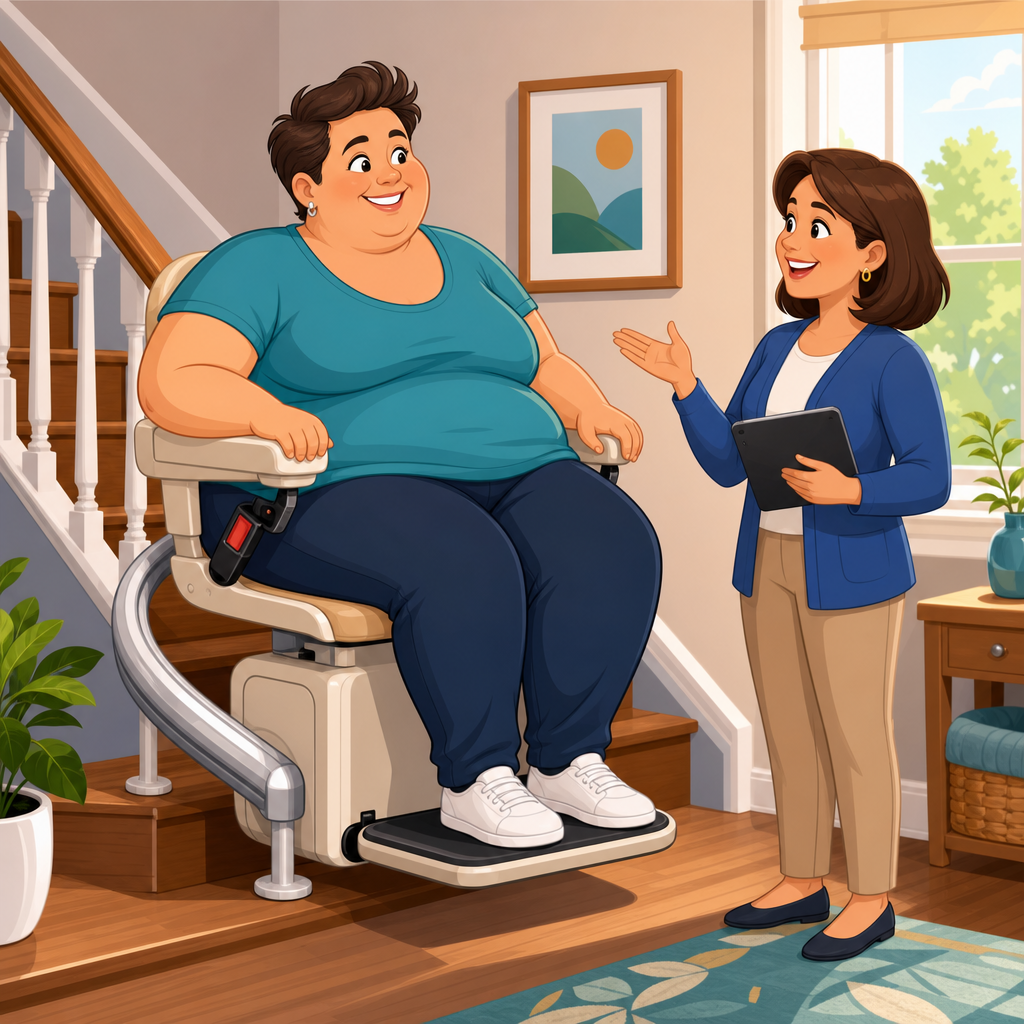
Caregiver involvement is another trigger. If a spouse or aide must assist with transfers, the chair needs enough room for the user to settle safely without awkward twisting. Features such as powered swivel seats, retractable seat belts, and larger footrests reduce caregiver strain. For multigenerational households, call-send controls at both landings let different users share the staircase without leaving the lift parked in the way. The best heavy-duty lift is the one that matches the rider, the caregivers, and the staircase as a system.
Straight vs. Curved Heavy-Duty Lifts
The staircase shape determines the broad product category first. Straight heavy-duty stair lifts serve staircases without turns, landings, or changes in angle. They are generally faster to source, easier to install, and less expensive because the rail is modular or cut to length on site. Curved heavy-duty lifts are built for staircases with bends, intermediate landings, spiral sections, or nonuniform geometry. Their rails are custom fabricated from measurements or digital scans, and lead times are longer. For bariatric users, curved installations require especially careful planning because larger seats and wider carriages need more clearance at turns.
In practice, straight heavy-duty lifts are the most common and the most forgiving. They can often be mounted to the stair treads in a single day, and reputable dealers can verify suitability with straightforward measurements of width, rise, run, and landing space. Curved heavy-duty models are possible, but they are less common and usually more expensive than comparable standard curved lifts due to the demands of custom engineering. In narrow or complex stairs, a vertical platform lift or home elevator may be safer and ultimately more economical than forcing a bariatric stair lift into a marginal layout.
| Type | Best for | Typical capacity range | Main advantage | Main limitation |
|---|---|---|---|---|
| Straight heavy-duty lift | Single-flight stairs with no turns | 350 to 600 pounds | Lower cost and faster installation | Cannot navigate bends or landings |
| Curved heavy-duty lift | Stairs with turns or intermediate landings | Usually 350 to 400+ pounds, model dependent | Custom fit to complex staircases | Higher price and longer lead time |
| Vertical platform lift | Wheelchair users or difficult stair geometry | Often 600 pounds or more | No seated transfer required | Needs more space and code review |
Measurements, Fit, and Clearance Requirements
The most important buying step is the in-home assessment. Dealers should measure staircase width, tread depth, nosing profile, total travel length, top and bottom landing clearance, and any door swings or obstructions. For bariatric users, body measurements matter just as much: hip width when seated, shoulder width, knee-to-toe length, seated height, and transfer style. A user who pushes off strongly from the armrests needs seat and arm geometry that can tolerate repeated side loading. Someone who pivots slowly may need a larger top landing and a powered swivel to exit away from the stairs.
Many heavy-duty lifts require more clear staircase width than standard units. A common benchmark is at least 36 inches of clear stair width, though some models and user profiles need more. This is not a universal rule, and published minimums can be misleading if the rider has broad shoulders or limited trunk control. What matters is remaining passable width, knee clearance during travel, and safe mounting and dismounting at both landings. Dealers should verify whether the folded seat, arms, and footrest still allow others to use the stairs, especially in homes with emergency egress concerns.
Seat height is often underestimated. If the seat is too low, a bariatric user may struggle to stand, increasing fall risk. If it is too high, the rider may feel unstable or unable to place both feet securely on the footrest. Good installers adjust seat position based on the user’s lower-leg length, footwear, and preferred transfer method. They also check whether the top overrun moves the chair onto the landing so the user dismounts away from the stair edge. In my experience, proper fit work prevents more service calls and safety complaints than any other installation step.
Safety Features That Matter Most
All modern stair lifts include basic safety systems, but bariatric applications demand closer scrutiny. Essential features include a seat belt, obstruction sensors on the carriage and footrest, overspeed protection, limit switches, battery backup, and a secure swivel seat lock at the upper landing. Heavy-duty lifts should also offer stable armrests for push-off support and a footrest large enough to keep both feet planted throughout travel. If the user has poor balance or cognitive impairment, consider powered swivel and powered footrest functions to reduce the need for reaching and bending.
Ask how the manufacturer tests the lift. Reputable companies validate capacity, braking, and rail performance under repeated cycles, not just one-time static loads. Standards and code requirements vary by product type and jurisdiction, but stair lift dealers should be familiar with applicable residential accessibility guidance, electrical requirements, and manufacturer installation instructions. They should also explain emergency lowering procedures, charger placement, and what happens if the lift stops between floors. A clear answer builds trust. Vague assurances do not.
Safety also includes transfer technique. The rider should approach the seat with room for mobility aids, sit fully back, secure the belt, place both feet on the footrest, and keep arms within the chair during travel. At the top landing, the chair should swivel and lock before standing. Many incidents happen not while the lift is moving, but during hurried transfers. That is why dealer training and caregiver instruction are part of the safety package, not optional extras.
Cost, Installation, and Long-Term Ownership
Heavy-duty stair lift pricing varies widely by staircase shape, capacity, seat configuration, and local labor rates. Straight heavy-duty lifts commonly cost several thousand dollars installed, while curved heavy-duty lifts can rise sharply because of custom rail fabrication. In many U.S. markets, a straight bariatric model may land roughly in the mid-thousands, while a curved system can move into five figures. Additional charges may include power swivel seats, folding rails, call stations, extended warranties, service plans, and electrical work if a dedicated outlet is needed near the charging point.
Installation quality matters as much as product quality. A proper job includes stair tread assessment, secure bracket spacing, charger verification, ride testing at rated conditions, and user instruction. Dealers should review the home’s power reliability, discuss where the chair will park and charge, and confirm that the rail does not create an unacceptable trip hazard at the lower landing. If the home may be sold or remodeled later, ask about rail removal, stair repair, and transferability of warranties. Those details affect long-term value.
Maintenance is straightforward but important. Battery replacement is a recurring cost, typically every few years depending on usage, charging habits, and temperature conditions. Annual service should include gear inspection, rail cleaning, fastener checks, safety sensor testing, and seat hardware review. For high-use households, preventive maintenance is cheaper than emergency repair. If you are building out your understanding of chair lift types and designs, keep this rule in mind: the correct heavy-duty lift is not the highest capacity on paper, but the model that fits the user, the staircase, and the service support available in your area.
How to Choose the Right Dealer and Next Steps
The dealer often determines whether the outcome is excellent or frustrating. Choose a company that regularly installs heavy-duty lifts, not one that only handles standard models and treats bariatric work as an exception. Ask which brands they represent, what capacities they have installed recently, whether they perform in-home assessments themselves, and how they handle service after installation. A strong dealer will measure carefully, discuss limitations honestly, and tell you when a stair lift is the wrong solution. That honesty can save thousands of dollars and prevent an unsafe installation.
Request a written proposal listing model name, weight capacity, seat dimensions, required stair width, warranty terms, lead time, and all included features. If the staircase is narrow or curved, ask the dealer to explain why the recommended unit will still provide safe clearances at the user’s shoulders, knees, and feet. If more than one person may use the lift, discuss programmability, remote controls, and seat ergonomics for different body types. Compare service response times too. A lower purchase price loses its appeal quickly if repairs take weeks.
Choosing a stair lift for bariatric users is ultimately about preserving safe access to the whole home. Start with a professional assessment, prioritize fit over brochure claims, and verify that the dealer can support the lift for years. Heavy-duty lifts can be life-changing when matched correctly, giving users confidence, reducing caregiver strain, and making daily movement predictable again. If you are researching heavy-duty lifts within the broader chair lift types and designs category, use this page as your hub, then move to detailed comparisons of straight models, curved systems, sizing guides, and installation planning before requesting quotes.
Frequently Asked Questions
What weight capacity should I look for in a stair lift for a bariatric user?
The first thing to confirm is the lift’s rated weight capacity, but that number should never be viewed in isolation. In the stair lift market, bariatric or heavy-duty models are typically designed for users above the range supported by standard lifts, often starting around 350 pounds and extending to 600 pounds or more. The right choice depends on the rider’s current weight, whether a caregiver may occasionally assist during transfers, and whether the user needs extra room for comfort, positioning, or winter clothing. It is usually wise to choose a model that provides a reasonable margin above the user’s present weight rather than selecting a unit that operates near its maximum limit every day.
Capacity is tied to the entire system, not just the motor. A lift may advertise a high weight limit, but that rating depends on the rail design, seat construction, transmission, carriage, and the stairway conditions it will be installed on. For example, a straight stair lift on a simple staircase may support more weight than a curved model customized for tight turns or landings. The safest approach is to have the staircase measured by a qualified dealer or installer who can verify the real-world capacity for that specific home. This helps ensure the lift will move the rider safely, comfortably, and consistently without overloading the equipment.
How is a bariatric stair lift different from a standard stair lift?
A bariatric stair lift is engineered specifically for higher-demand use. Compared with standard models, it usually has a stronger drive system, a more robust rail, a wider and deeper seat, reinforced footrest and armrests, and a frame built to manage greater loads over time. These differences matter because the goal is not simply to “hold more weight” one time, but to perform reliably through repeated daily use. A properly selected heavy-duty lift should allow the rider to feel secure during the trip, with stable starts and stops, minimal sway, and enough room to sit naturally rather than feeling squeezed into a seat that is too narrow.
There are also important practical differences in fit and installation. Heavy-duty stair lifts often require more clearance on the staircase because the seat and carriage are larger. The staircase may need to meet minimum width requirements, especially if others still need to walk past the lift. Some homes can accommodate a bariatric straight lift but not a bariatric curved lift, while others may need a different accessibility solution altogether. That is why an on-site assessment is so important. The best unit is the one that fits both the rider and the physical limitations of the home, not just the one with the highest advertised capacity.
Will my staircase and home support a heavy-duty stair lift?
In many cases, yes, but that should always be verified by a professional evaluation rather than assumed. Stair lifts are typically mounted to the stair treads rather than the wall, so the installer needs to assess the staircase itself, including tread condition, width, angle, landings, and any turns or obstructions. A bariatric stair lift places greater demands on the rail and mounting points than a standard model, so the installer must confirm the stairs can support the system safely and that there is enough room for the user to get on and off the chair without crowding a doorway or landing.
The layout of the home matters just as much as the stair structure. Narrow staircases, low overhangs, sharp curves, and limited landing space can affect whether a heavy-duty lift is practical. The seat size, footrest depth, swivel function, and parked position all need to be considered. In some homes, a straight heavy-duty lift is straightforward to install. In others, the stair configuration may limit capacity options or require a custom solution. A reputable dealer should measure carefully, explain any limitations clearly, and tell you upfront if a stair lift is not the safest choice for that environment. That honesty is a sign of a good provider.
What comfort and safety features matter most for bariatric users?
For bariatric users, comfort and safety are closely connected. A seat that is wide enough, supportive, and correctly positioned reduces the effort required to sit down, stay balanced during travel, and stand up at the top or bottom of the stairs. Look for a model with a generous seat base, sturdy armrests for leverage, a solid footrest, and a seat height that supports safe transfers. A swivel seat at the landing can be especially valuable because it allows the rider to dismount onto the floor rather than toward the staircase. Seat belts, obstruction sensors, soft-start and soft-stop operation, and easy-to-use controls are also essential features.
Beyond the chair itself, usability matters every day. The rider should be able to operate the controls without strain, and the parked position should not create a hazard for others in the home. If the user has arthritis, limited mobility, respiratory concerns, or poor balance, those issues should be discussed during the assessment so the lift can be matched appropriately. Some users benefit from powered swivel or folding components, while others need a more upright seat posture or extra room between armrests. The safest lift is one that supports the user’s body mechanics and routine, not just one that meets a weight rating on paper.
How can I make sure a bariatric stair lift will be reliable over the long term?
Long-term reliability starts with choosing the correct model for the user, the staircase, and the expected frequency of use. A lift that is undersized or pushed close to its maximum capacity day after day is more likely to wear prematurely and perform inconsistently. That is why it is important to work with an experienced stair lift provider who installs heavy-duty models regularly, not one who mainly sells standard units and treats bariatric needs as an afterthought. Ask about manufacturer specifications, service history, warranty coverage, parts availability, and the installer’s experience with higher-capacity systems in real homes.
Maintenance and support also play a major role. Even a well-built stair lift should be serviced according to the manufacturer’s recommendations, and batteries should be monitored and replaced when needed. It is helpful to know how quickly service calls are handled, whether local technicians carry common parts, and what kind of follow-up support is available after installation. A dependable bariatric stair lift should feel steady and predictable every day, not strained, hesitant, or noisy. Investing in the right equipment from the beginning, with proper installation and ongoing service, is the best way to protect both the user and the home while maintaining safe access between floors.