Using a stair lift safely while carrying a cane or walker starts with understanding one rule: the mobility aid must never interfere with seating, armrests, the footrest, the track, or safe transfer on and off the chair. I have worked with stair lift users, caregivers, and installers long enough to see that most problems do not come from the lift motor or rail. They happen during transfers, when a user rushes, twists awkwardly, or tries to manage a cane or walker with one hand while sitting down. This matters because stairways concentrate fall risk in one narrow space, and even a small mistake can lead to a serious injury. A stair lift is a motorized chair that travels along a rail fixed to the stairs, while a cane is a single-point or multi-point walking aid and a walker is a frame that provides broader support. When these tools are used together, safety depends on planning, setup, and repeatable habits. This guide explains the core user safety best practices, when to use a cane versus a walker during boarding, how to position the aid at the top and bottom landings, what caregivers should watch for, and when to ask your dealer, installer, or clinician for changes. If your site also covers transfer techniques, stair lift maintenance checklists, obstruction troubleshooting, battery care, or troubleshooting common stair lift beeps, this page should anchor those topics because safe use is the thread connecting all of them.
Start with the right setup before every ride
The safest stair lift ride begins before the chair moves. First, make sure the landing area is dry, bright, and clear of shoes, cords, pet toys, oxygen tubing, or loose rugs. The user should approach the chair with the mobility aid positioned for balance, not dragged behind. On most models from Bruno, Harmar, Stannah, Acorn, and Handicare, the seat, armrests, and footrest should be fully down and locked before sitting. If the lift has a powered swivel or powered footrest, confirm it has completed its cycle. If it has a manual swivel seat, lock it in the loading position before transfer. I tell users to pause and do a quick three-point check: chair locked, footrest ready, path clear. That simple routine prevents rushed boarding.
Fit and configuration matter too. The stair lift should match the user’s body size, range of motion, and dominant side. Seat height influences whether the user can stand up without pulling on the armrests in an unsafe way. Armrest spacing affects trunk stability. The presence of a folding rail at the bottom can reduce a trip hazard, but only if the user understands when it is moving and where it stops. If a user carries a walker, overrun sections at the top or bottom landing often make transfers safer because they move the chair away from the open staircase. Many dealers can also adjust seat height, armrest position, or add a larger footrest. Those details are not cosmetic; they directly reduce fall exposure.
How to board with a cane safely
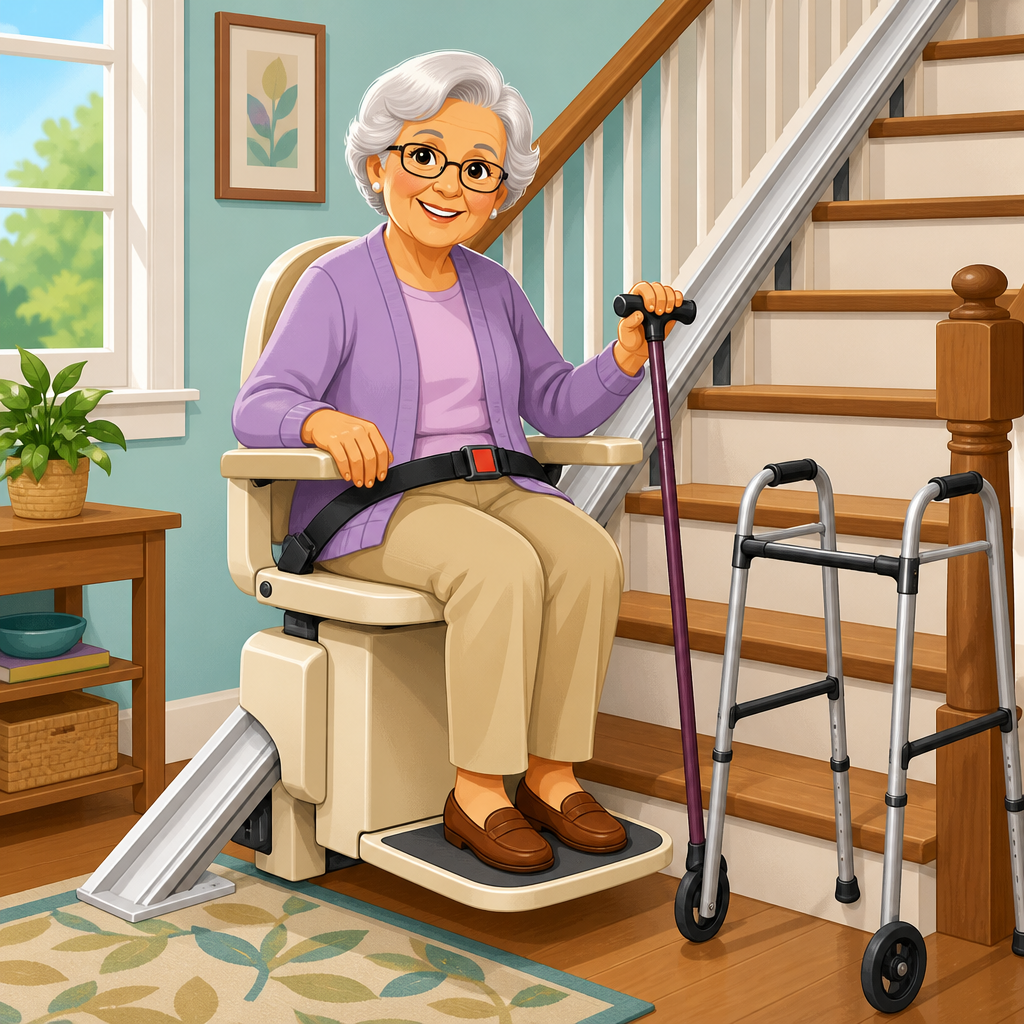
A cane is usually easier to manage than a walker because it takes less space and can often be held in one hand while the other hand reaches the stair lift armrest. Even so, the user should not sit while the cane is trapped underfoot or angled across the transfer path. The safest method is to walk up to the seat until the backs of the legs touch it, hold the cane on the stronger side unless a therapist has instructed otherwise, reach back for the nearest armrest, and lower into the chair slowly. Once seated, bring the cane onto the lap or secure it in an approved cane holder if the manufacturer offers one. The cane should never extend beyond the footrest where it could strike the stairs, wall, or track supports during travel.
At the destination landing, reverse the process in a controlled order. Stop fully, swivel the seat if the model allows it, raise the footrest if needed, plant both feet securely, stand using the armrests, regain balance, and then take hold of the cane. The mistake I see most often is grabbing the cane too early and standing before the user’s center of gravity is over the feet. That creates a sideways lean and increases the chance of slipping. If the user has a quad cane, check that all four tips contact the floor evenly. Worn cane tips are a quiet hazard; once the rubber hardens or smooths out, traction drops sharply on hardwood, tile, or polished landings.
How to board with a walker safely
A walker introduces a different challenge because the user cannot ride while holding it around the body. Standard practice is to keep one walker at the top landing and another at the bottom landing, or to store a single walker securely at one end if the user has caregiver assistance. For independent use, two walkers are usually the safest solution. During boarding, the walker should be placed directly in front of the user for support while approaching the seat, then positioned so it remains stable and accessible after dismount, without blocking the chair, the swivel path, or the staircase. The user should never try to carry a walker on the stair lift unless the manufacturer specifically allows it and the aid can be stowed without obstructing movement.
Transfer mechanics are especially important for walker users. Back up until the legs touch the seat, reach for the armrests one hand at a time, and sit down under control. Do not keep both hands on the walker while lowering because walkers can slide, especially on smooth floors. At the upper landing, the walker should already be set where the user will stand and grasp it after rising, ideally within a half-step and square to the body. If the user must pivot or take multiple unsupported steps to reach the walker, the setup is wrong. In homes with narrow landings, an occupational therapist may recommend a different walker style, such as a front-wheeled walker, or a revised chair orientation to reduce awkward turning.
Safe positioning of mobility aids at the top and bottom
Positioning is the hidden part of stair lift safety. A cane can usually rest against a wall corner, in a dedicated holder, or on the user’s lap if it stays entirely within the chair footprint. A walker should sit on level flooring, not on stair nosings, not against a spring-loaded door, and not where it narrows the egress path. The key is that the mobility aid must be available immediately after transfer without becoming a trip obstacle for others. This is particularly important in shared homes where family members pass through the same landing several times a day.
| Situation | Safer positioning | Why it works |
|---|---|---|
| Cane at bottom landing | Lean it in a corner beside the chair exit or use an approved holder | Keeps the transfer zone open while leaving the cane within arm’s reach after standing |
| Walker at top landing | Place it squarely on the landing, centered in front of the final standing position | Allows the user to stand, stabilize, and grasp the walker without twisting |
| Narrow hallway near rail | Store the walker just beyond the swivel arc, not beside the moving carriage | Prevents contact with the chair, footrest, or charge points |
| Shared family traffic area | Mark a consistent storage spot with tape or a small furniture stop | Reduces clutter and keeps the aid from drifting into the path |
If there is no obvious safe place for a walker at one or both landings, treat that as a warning sign rather than an inconvenience. It often means the overall transfer plan needs redesign. In several homes I have assessed, a small console table, shoe rack, or decorative bench was the real barrier. Removing it created enough landing space to place the walker properly and eliminated the user’s need to sidestep unsupported. A home safety review should look at furniture, lighting, outlet cords, threshold height, and door swing direction around the lift, not only the lift itself.
During the ride: restraint, posture, and hazard awareness
Once seated, the user should buckle the seat belt every time. That advice is not optional. The belt helps maintain position if the user shifts unexpectedly or if clothing slides on a smooth seat surface. Feet belong flat on the footrest, never dangling, tucked back, or resting on stair edges. Hands should stay on the armrests or in the lap, and loose items such as shopping bags, blankets, or purses should not hang outside the chair. If the mobility aid is on the lap, it must remain fully inside the chair profile. A dangling cane tip can hit a tread or baluster and create a jolt.
Most modern stair lifts have obstruction sensors on the footrest and carriage, plus overspeed governors, final limit switches, and battery backup systems. Those features improve safety, but they do not replace safe user behavior. If the lift stops because it detects an obstruction, the user should not force movement or lean out to investigate over the stairs. Use the armrest control or call-send remote only according to the manual, and contact a caregiver or service provider if the reason is unclear. If the unit beeps, many brands are signaling low battery, charging contact issues, or a seat not locked in position. Knowing those signals belongs in every household safety routine.
Caregiver best practices and training routines
Caregivers play a major role even when the user rides independently. Their job is to make the environment predictable, not to rush the person through it. A good caregiver routine includes checking that the rail is clear, the seat swivels and locks, the footrest is down, the battery is charging at the park position, and both landings are free of clutter. For walker users, caregivers should verify that the second walker is exactly where the user expects it to be. Consistency matters because many older adults rely on procedural memory; changing the setup without telling them can cause hesitation and loss of balance.
Training should be simple and repeated. I recommend practicing the entire sequence several times when the lift is first installed and again after any hospitalization, medication change, or decline in strength. The sequence is approach, pause, position aid, sit, belt, ride, stop, swivel, stand, regain balance, then reach for the cane or walker. Family members often try to help by handing the walker too soon or steadying the user from the wrong side. Better technique is to guard from the side and slightly behind, near the gait belt if one is used, while allowing the user to complete the transfer deliberately. If the user shows retropulsion, poor judgment, freezing, or difficulty with hand placement, ask a physical or occupational therapist to reassess the method.
When to modify the plan or stop independent use
Not every stair lift user can safely manage a cane or walker alone forever. The decision depends on strength, balance, cognition, vision, sensation, and endurance, not just on owning the equipment. Warning signs include repeated near falls during transfer, forgetting the seat belt, leaving the seat unswiveled, parking the walker out of reach, bruises on the shins from poor foot placement, or anxiety that causes hurried movement. Medical changes matter too. Sedating medications, orthostatic hypotension, neuropathy, recent joint surgery, stroke, Parkinsonian freezing, and moderate dementia all raise transfer risk.
When those issues appear, modify the setup early. That may mean adding a second walker, improving lighting to at least typical hallway levels, installing contrasting edge strips on flooring transitions, adjusting the seat height, or scheduling supervised use only. In some cases, the safer answer is no longer a stair lift but a first-floor sleeping arrangement, a vertical platform lift, or home modifications that remove the need for stairs entirely. The main benefit of following these user safety best practices is not simply avoiding mechanical problems. It is preserving confidence and independence while reducing preventable falls. Review your current setup today, test each transfer step, and correct any weak point before it becomes an emergency.
Frequently Asked Questions
Can I hold my cane or walker while riding on a stair lift?
In most cases, you should not hold a cane or walker in a way that affects your balance, blocks the armrests, or interferes with the footrest, chair, or rail during travel. The safest approach is to get fully seated first, with your hips all the way back in the chair, your feet placed securely on the footrest, and the seat belt fastened before you deal with the mobility aid. A cane is often easier to manage because it is smaller, but even then it should be kept stable and out of the path of the lift. It should never dangle near the stairs, the side of the chair, or the track where it could catch or distract you mid-ride.
A walker requires even more caution because it is bulkier and much more likely to block transfers or create a tipping hazard. It should not be balanced on your lap if it makes it harder to sit upright, use the armrests, or exit safely at the top or bottom landing. Many users do better when a caregiver moves the walker separately, or when a second walker is kept on the opposite level so there is always one waiting where the user gets off. The main safety principle is simple: if carrying the cane or walker changes the way you sit, fasten the belt, use the controls, or get on and off the lift, it is not being handled safely.
What is the safest way to get on and off a stair lift when I use a cane or walker?
The safest transfer starts before you even sit down. Position yourself so you can approach the chair without twisting or reaching. Make sure the stair lift is parked correctly, the seat is locked in its riding position unless your model uses a swivel for boarding, and the footrest is down and clear. If you use a cane, keep it within easy reach but not underfoot. If you use a walker, place it on the landing where it will support you immediately before sitting and immediately after standing, without forcing you to turn awkwardly on the stairs.
When sitting, use the armrests or any approved handhold recommended by the manufacturer, not the cane or walker, to lower yourself into the chair. Do not try to back up blindly while also moving the mobility aid. Once seated, scoot back fully, center your body, place both feet on the footrest, and fasten the seat belt. When you reach the top or bottom, do not stand until the lift has stopped completely and the seat is in the proper position. If your lift has a swivel seat at the upper landing, lock it before you stand. Then stand using the armrests and transfer carefully to your cane or walker once you are stable. Most transfer-related incidents happen because someone rushes the last few seconds, stands before they are balanced, or tries to grab the walker too early.
Where should I put my walker when using a stair lift?
The best place for a walker is on the landing where you need it next, positioned so it is ready the moment you step off the stair lift. That usually means having someone move it for you, using a second walker on the other floor, or arranging your routine so you are never trying to drag or balance the walker while seated on the lift. A walker should not block the chair’s path, the footrest, or your transfer area. It also should not be left where it can create a tripping hazard for you or anyone else using the stairs.
If you are tempted to fold the walker and carry it with you, stop and evaluate whether that changes your posture, reduces your grip on the armrest, or makes it harder to keep your feet correctly placed. Those are all warning signs that the setup is unsafe. Many users assume the ride itself is the difficult part, but in practice the bigger risk is arriving at the landing without stable support waiting nearby. That is why professionals often recommend a walker at both levels or caregiver assistance, especially for anyone with limited balance, weakness, dizziness, or recent surgery. Safe placement is less about convenience and more about making sure your first step on and off the lift is controlled and supported.
Are there specific mistakes people make with canes or walkers on stair lifts that I should avoid?
Yes, and the most common mistakes are very predictable. One is trying to manage too many tasks at once: turning toward the chair, holding a cane or walker, reaching for the controls, and lowering into the seat all in one hurried motion. Another is placing the cane against the lift where it can slide, fall, or get caught, or positioning the walker too far away so the user has to reach for it after standing. People also get into trouble when they let the mobility aid interfere with the seat belt, armrests, or foot placement. If your cane or walker causes you to sit crooked, lean to one side, or keep one foot off the footrest, that is a serious safety issue.
Another frequent mistake is underestimating how much safer a simple routine can be. Safe users tend to do the same steps every time: park the lift properly, place the aid within reach but out of the way, sit fully, buckle up, ride without shifting around, stop completely, swivel if needed, stand carefully, and only then take hold of the cane or walker. Unsafe use usually involves improvising. That may look like holding onto a walker for support while sitting, carrying a walker across the lap, or trying to step away before the seat is locked. Avoid anything that introduces twisting, rushing, one-handed transfers, or clutter at the landing. Those are the exact conditions that lead to preventable falls.
Do I need help from a caregiver or installer to use a stair lift safely with a cane or walker?
Many people can use a stair lift independently, but that depends on balance, hand strength, coordination, judgment, and the type of mobility aid involved. If you use a cane and can transfer steadily with both hands available for the chair armrests, you may be able to manage safely once you have been trained on the correct routine. If you use a walker, have difficulty turning, tire easily, or need help standing from a chair, caregiver assistance may be the safer choice. The key question is not whether you can ride the lift; it is whether you can get on and off without twisting, losing balance, or mishandling the mobility aid.
An experienced installer, therapist, or caregiver can often spot problems you may not notice yourself, such as poor walker placement, awkward seat height, unsafe body mechanics, or a landing that does not leave enough room for a clean transfer. They can help you practice where to place the cane, whether a second walker would help, how to use a swivel seat correctly, and whether your current setup supports safe transfers at both levels. If there is any doubt, ask for a supervised demonstration and practice session. That small step can prevent the most common stair lift accidents, which usually happen not because the machine fails, but because the transfer process was not matched to the user’s real mobility needs.