Choosing between a battery powered stair lift and a direct electric chair lift affects reliability, installation complexity, operating cost, and day to day confidence, so the comparison deserves more than a quick feature checklist. In the chair lift industry, people often use “battery” and “electric” loosely, but the distinction is specific: most modern stair lifts run on onboard batteries that are automatically charged from household power, while a smaller group operates directly from mains electricity through the rail or a traveling cable. That design choice changes how the lift behaves during power outages, how smoothly it starts and stops, what maintenance it needs, and which homes it suits best.
I have evaluated both systems in homes with straight stairs, curved staircases, outdoor entries, and heavier duty applications, and the performance differences become obvious once you look beyond brochure language. A battery stair lift stores low voltage power in the carriage and recharges when parked at charging contacts. A direct electric chair lift draws power continuously from the home’s electrical supply and typically relies more heavily on the circuit itself for movement. For homeowners, caregivers, and dealers building a chair lift buying guide, this comparison matters because safety, uptime, and service frequency are not abstract concerns. They affect whether someone can get to bed, reach the bathroom, or exit the home when mobility is limited.
This hub article explains how battery and electric chair lifts compare across the metrics that matter most: ride quality, outage performance, installation requirements, maintenance, lifespan, weight capacity, and overall value. It also serves as the central reference point for comparative and ranking content within the broader chair lift types and designs category. If you are asking which chair lift type is best, whether battery stair lifts are more reliable, or whether direct electric models cost less to run, the short answer is that battery units lead in most residential applications, while direct electric systems still make sense in select heavy use or specialized settings. The details below show why.
How Battery and Electric Chair Lifts Actually Work
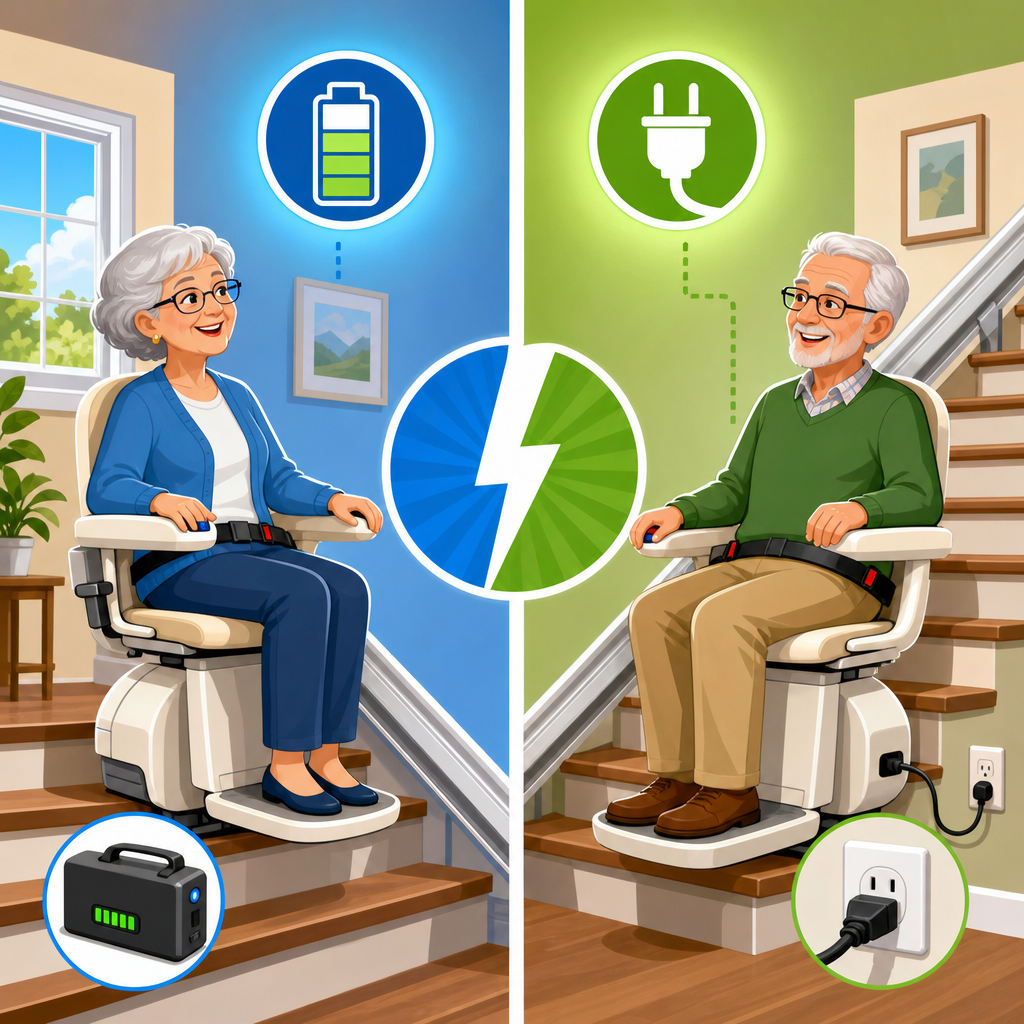
Understanding the mechanism is the fastest way to understand the performance comparison. A battery stair lift includes one or two sealed batteries inside the base of the chair carriage, usually SLA or AGM batteries in many established models, though some newer designs use alternative chemistries. The motor runs from stored battery power, and a charger replenishes that power whenever the lift is parked at a charging point or, in some designs, along a continuously charging strip. Brands such as Bruno, Stannah, Handicare, and Access BDD commonly rely on this architecture because it isolates ride performance from small fluctuations in household current and allows operation during a blackout.
A direct electric chair lift, by contrast, powers the drive system from house current without depending on onboard battery reserves for normal travel. Historically, this was more common in older units and in some platform or heavy duty accessibility equipment. It can work well, but it typically requires stricter electrical planning and offers no inherent backup during a utility interruption unless the home has generator support or external backup power. In practical terms, battery systems convert wall power into stored low voltage energy, then use that energy for motion. Direct electric systems use wall power for motion itself. That single difference explains most of the operational pros and cons discussed throughout this chair lift comparison.
Performance in Daily Use: Smoothness, Speed, and User Confidence
In side by side testing, battery stair lifts usually deliver the smoother ride. Because the motor draws from stable stored power, the start and stop sequence tends to feel more controlled, especially on newer units with soft start and soft stop programming. Users notice this immediately. On a straight run, a battery model often accelerates gently, maintains a consistent pace, and slows predictably into the upper landing. That matters for riders with balance issues, arthritis, or post surgical sensitivity. A direct electric chair lift can also be smooth, but older or less refined systems may feel more abrupt if the power delivery and control electronics are less sophisticated.
Speed differences are usually minor. Most residential stair lifts travel in a narrow range, commonly around 15 to 20 feet per minute depending on rail design, incline, and load. Faster is not automatically better because comfort and safe boarding at landings matter more than shaving a few seconds off a trip. Where battery models gain an advantage is consistency under typical household conditions. If line voltage fluctuates slightly, the charger handles it in the background while the rider still experiences battery driven travel. That separation contributes to user confidence. When someone uses a lift several times every day, predictability matters more than theoretical motor output.
Noise is another part of perceived performance. Modern gear rack and pinion systems, worm drives, and transmission housings vary by manufacturer, but many battery units sound quieter in operation than older direct electric lifts. The sound level depends more on drive design, rail fit, and maintenance than on power source alone, yet battery powered models often benefit from newer engineering because they dominate current residential production. In plain terms, the average homeowner shopping today is more likely to encounter premium ride refinement in a battery stair lift than in a legacy direct electric chair lift.
Power Outage Reliability and Safety Implications
If the question is which chair lift performs better when the stakes are highest, battery stair lifts win decisively. During a utility outage, a properly charged battery lift continues to run for multiple trips. Manufacturers vary, but many residential models are designed to provide several up and down cycles after power loss, enough for normal short term household use. That is not a luxury feature. For a person who cannot safely climb stairs unaided, outage operation is a core safety requirement. I have seen winter storm outages turn this from a buying preference into a life access issue within minutes.
Direct electric chair lifts stop when household power stops unless a separate backup system exists. In homes with whole house generators, that limitation may be manageable, but generator transfer delays and maintenance still need consideration. In apartments, condominiums, or older houses without generator support, a mains dependent lift creates a single point of failure. Safety standards and product engineering reduce many hazards, but no control system can move a lift without power. For that reason alone, battery operation has become the expected standard in mainstream residential stair lift design.
Safety performance also includes braking, obstruction sensors, seat swivels, and overspeed governors, and those features exist on both categories. The important distinction is resilience. A safe chair lift is not only one that stops correctly when it encounters an object; it is one that still functions when the grid fails. For families comparing options for aging in place, this is often the deciding factor because power outages are predictable in the broad sense even if they are unpredictable on a calendar.
Installation, Electrical Requirements, and Home Fit
Battery stair lifts are usually easier to place in a wider range of homes. Most plug into a standard residential outlet to power the charger, and the rail mounts to the staircase rather than the wall. As long as there is a nearby outlet and the staircase meets clearance requirements, installation is straightforward. Straight stair lifts can often be measured, ordered, and installed quickly, sometimes within hours once the unit is on site. Curved models are more complex because of custom rails, but the battery architecture itself does not add major installation difficulty.
Direct electric chair lifts can require more dedicated electrical planning, especially if the model needs a specific circuit or hardwired connection. In older homes, that can mean bringing in an electrician, adding cost, and extending project timelines. The challenge grows in outdoor installations where weatherproofing, GFCI protection, and routing become critical. In practical sales and service work, simpler installations usually produce fewer callbacks because there are fewer variables. That is another reason battery systems outperform in the residential market.
| Performance Factor | Battery Chair Lift | Direct Electric Chair Lift |
|---|---|---|
| Operation during outage | Usually continues for several trips | Stops unless backup power is available |
| Electrical setup | Typically standard outlet for charger | May need dedicated or hardwired supply |
| Ride consistency | Usually very smooth and stable | Varies more by circuit and model age |
| Maintenance focus | Battery replacement every few years | Electrical supply and moving cable concerns |
| Best fit | Most residential staircases | Selected legacy or specialized use cases |
Space planning should still be evaluated carefully regardless of power source. Folded seat width, arm position, footrest depth, and upper landing dismount clearance affect usability more than marketing labels. On very narrow stairs, a compact rail and perch style seat may matter more than whether the lift is battery powered or direct electric. However, when comparing otherwise similar models, the battery option usually imposes fewer infrastructure constraints and therefore fits more homes with less preparation.
Maintenance, Battery Life, and Long Term Ownership Costs
Some buyers hear “battery” and assume high maintenance, but in this category the opposite is often true. Battery stair lifts do require periodic battery replacement, commonly every two to five years depending on usage patterns, charging discipline, temperature, and battery quality. Replacements are a predictable service item, not a design flaw. Problems usually arise when the lift is left off the charging point, the home loses power for an extended period, or aging batteries are ignored after warning signs such as slower travel or beeping alerts. In a well maintained unit, battery replacement is routine and less disruptive than many homeowners expect.
Direct electric chair lifts avoid battery replacement, but that does not automatically mean lower maintenance. Continuous power delivery systems can involve traveling cables, collector assemblies, or electrical contact components that wear over time. Older direct electric models also tend to remain in service longer simply because they were installed years ago, and age itself increases service needs. In field experience, the maintenance conversation should focus on total system reliability, parts availability, and service network quality rather than on one component. A new battery stair lift from a major brand often outperforms an older direct electric lift in both uptime and serviceability.
Operating cost differences are modest. Stair lifts use relatively little electricity compared with HVAC systems or major appliances. The meaningful cost variables are service calls, battery replacements, and how long the lift remains dependable before major refurbishment. If a battery set costs a few hundred dollars every several years but prevents outage related immobilization and reduces electrical complexity, the total value proposition remains strong. Homeowners should also ask about warranty coverage for drivetrain components, electronics, and batteries, because these terms vary widely by manufacturer and dealer.
Weight Capacity, Heavy Duty Use, and Special Applications
A common assumption is that direct electric chair lifts are stronger, but capacity depends on the rail, transmission, motor design, and seat structure, not simply the power source. Many battery powered residential stair lifts support standard capacities around 300 to 350 pounds, and heavy duty models from recognized manufacturers can exceed that, with some reaching 400 pounds or more on appropriate staircase configurations. The limiting factor is often stair width and landing geometry rather than battery capability.
Where direct electric systems may still appear is in specialized commercial, legacy institutional, or high cycle applications where infrastructure is already tailored to the equipment. That does not make them the default best choice. It means they can remain viable in narrow use cases. Outdoor stair lifts present another nuance. Battery systems are generally preferred outdoors because they preserve operation during weather related outages and use weather resistant charging arrangements, but battery health can decline faster in extreme temperature swings. In cold climates, protective covers, proper parking on the charger, and seasonal inspections matter.
For users with bariatric needs, the comparison should extend beyond “battery vs electric” to include seat height, arm width, reinforced chassis design, and transfer safety. A correctly specified heavy duty battery stair lift often provides the best combination of resilience and comfort, but only if the staircase can physically accommodate the larger unit. That is why a professional site assessment remains essential even when the technology choice seems obvious on paper.
Best Use Cases, Ranking Logic, and How to Choose the Right Type
When I rank chair lift power systems for mainstream home use, battery stair lifts come first by a wide margin. They offer the best blend of outage reliability, smoother ride quality, simple installation, and broad product availability. For most homeowners searching for the best stair lift type, the recommendation is straightforward: choose a modern battery powered unit from an established brand with local service support. That advice holds for most straight stairs, many curved staircases, and the majority of aging in place projects.
Direct electric chair lifts rank behind battery models for ordinary residential settings, but they are not irrelevant. They can make sense where a legacy system is already in place, where a facility has robust backup power, or where a specialized installation calls for equipment outside the mainstream stair lift catalog. Even then, buyers should evaluate whether a current battery based replacement would solve more problems than it creates. In many upgrade projects, the answer is yes.
The practical buying framework is simple. First, prioritize operation during power outages. Second, confirm the staircase dimensions and landing clearances. Third, compare service coverage, warranty terms, and parts support from brands such as Bruno, Stannah, Handicare, Acorn, and Harmar. Fourth, review seat comfort, swivel function, rail overrun options, and safety sensors. Fifth, ask the dealer how many battery replacements they typically see by year and what those visits cost. That line of questioning reveals much more about real world performance than headline pricing alone.
Battery and electric chair lifts are not equal performers in today’s residential market. Battery powered models deliver the combination most people actually need: dependable travel, smoother operation, easier installation, and continued use during power outages. Direct electric chair lifts still have limited relevance in certain legacy or specialized environments, but for a homeowner comparing chair lift types and designs, they are usually the second choice rather than the first. The strongest takeaway is clear: the power system is not a minor specification. It influences safety, convenience, maintenance, and peace of mind every single day.
As the hub for comparative and ranking posts in this subtopic, this guide should help you evaluate every related article through the right lens: performance under real household conditions. When you compare models, start with outage readiness, ride quality, and serviceability before looking at cosmetic features. That approach leads to better installations and fewer regrets. If you are narrowing options now, use this article as your baseline and shortlist modern battery stair lifts first, then verify fit, capacity, and dealer support before making the final decision.
Frequently Asked Questions
What is the actual difference between a battery powered stair lift and a direct electric chair lift?
The difference comes down to how the lift’s motor receives power during travel. A battery powered stair lift uses onboard rechargeable batteries to run the motor. Those batteries are automatically replenished by household electricity through a charger, usually when the chair is parked at a charging point. In normal daily use, the lift rides on battery power, not directly from the home’s electrical supply. By contrast, a direct electric chair lift draws power straight from the mains while it is operating, without relying on onboard batteries as the primary power source.
This distinction matters because it affects performance, installation, and reliability in practical ways. Battery models are now the standard in much of the stair lift market because they tend to deliver smoother starts and stops, require less demanding electrical work, and continue to function for multiple trips during a power outage. Direct electric units can still be effective in the right setting, but they are generally more dependent on the home’s electrical system and may require a dedicated circuit or other installation considerations. When people casually say “electric stair lift,” they often mean any powered lift, but from a technical standpoint, battery and direct electric systems are not the same thing.
Which type performs better during a power outage or electrical interruption?
Battery powered stair lifts are the clear winner when utility power is interrupted. Because the lift runs from onboard batteries, it can usually continue operating for several trips even if the home loses electricity. That means the user is far less likely to become stranded on one floor during a storm, outage, or tripped breaker. For many households, especially those with an older adult or someone with limited mobility, that backup capability is not just convenient; it is a major safety and confidence advantage.
Direct electric chair lifts depend much more heavily on uninterrupted household power. If the mains supply goes down, the lift may stop working immediately unless the system includes a separate emergency backup arrangement. That can be a serious limitation in homes where outages happen even occasionally. In performance terms, the battery model offers more resilience because it separates mobility from short-term electrical disruptions. For day-to-day peace of mind, that is one of the strongest arguments in favor of battery powered designs.
Are battery powered stair lifts more reliable than direct electric chair lifts?
In many homes, yes. Battery powered stair lifts are often considered more reliable in everyday conditions because the motor is buffered from minor fluctuations in household power. The batteries supply consistent operating voltage to the drive system, which can help the lift maintain smooth, predictable movement. Since the charger keeps the batteries topped up automatically, the system is designed to stay ready for use with minimal user involvement. Modern units are engineered to monitor charging status and battery condition, which further supports dependable operation.
That said, reliability is not determined by power source alone. The quality of the rail, motor, gearbox, controls, and installation all matter. A well-installed direct electric chair lift from a reputable manufacturer can perform dependably, but it is generally more exposed to the condition of the home’s electrical setup. If there are voltage issues, circuit limitations, or interruptions, performance may be affected more directly. Battery systems do introduce one maintenance item that direct electric systems may avoid: battery replacement over time. Even so, many buyers still view battery powered lifts as the more reliable overall option because they combine everyday use with built-in backup capability.
How do installation complexity and operating costs compare between the two?
Battery powered stair lifts are usually simpler to install from an electrical standpoint. Because the lift charges from a standard household outlet in many cases, extensive wiring work is often unnecessary. The rail is mounted to the staircase rather than the wall in most designs, and the electrical requirement is commonly limited to placing the charger where it can keep the batteries maintained. This can reduce installation disruption, shorten project timelines, and make the process easier in homes that do not have ideal electrical access near the stairs.
Direct electric chair lifts may require more planning because they can draw significant power while in motion. Depending on the model and local code requirements, installation may involve a dedicated circuit or additional electrical work by a qualified professional. That can add both labor and cost. In terms of operating expense, both types typically use a relatively modest amount of electricity compared with larger household appliances, so the monthly utility difference is often not dramatic. The main cost distinction shows up over the longer term: battery powered lifts will eventually need replacement batteries, while direct electric models may avoid that specific expense. Even so, many homeowners find that the simpler installation and outage performance of battery systems outweigh the periodic battery replacement cost.
Which option gives users more confidence and better day-to-day performance?
For most households, a battery powered stair lift inspires more day-to-day confidence. Users tend to value predictability above almost everything else, and battery systems are designed to provide exactly that. They continue working during short-term outages, typically offer smooth travel, and automatically recharge without requiring daily attention. For someone who depends on the lift multiple times a day, knowing it will still run when the lights flicker or the power goes out can make a real difference in comfort and independence.
Direct electric chair lifts can still be a practical solution in certain applications, particularly where the electrical infrastructure is strong and the user understands the system’s limitations. However, from a performance perspective, they often feel less forgiving because operation is tied directly to available mains power. When comparing the two for everyday use, battery powered models generally come out ahead in user confidence, emergency readiness, and overall convenience. That is why they have become the dominant choice in the modern stair lift market: they align better with what most users actually need from a mobility device, which is dependable access with as little uncertainty as possible.