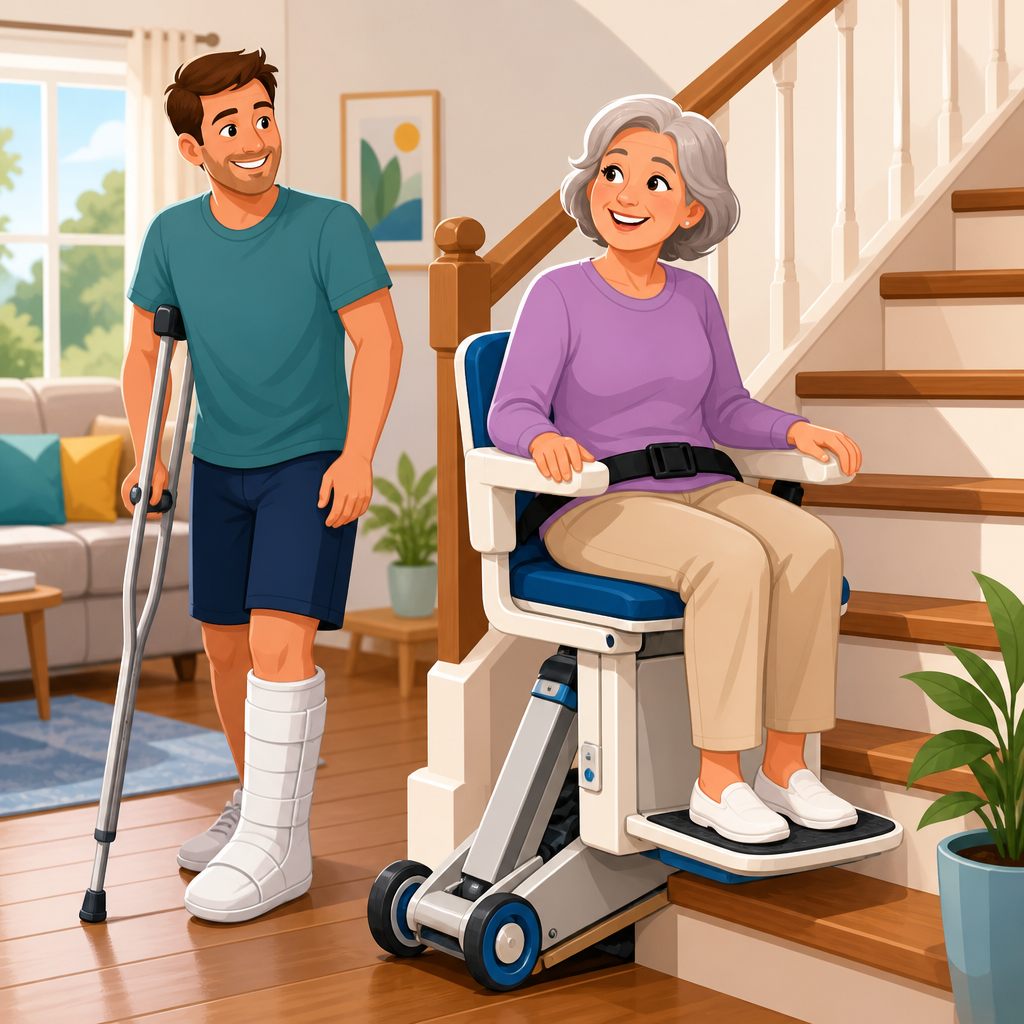
Portable stair lifts for temporary disabilities and short-term recovery solve a specific mobility problem: how to move safely between floors for a few weeks or months without committing to a permanent home modification. In practice, people usually start searching after a surgery date is scheduled, after a fall, or when a family member is discharged from hospital with strict weight-bearing limits. I have helped families compare these options in exactly those situations, and the same questions always come up first: what counts as portable, who is it for, how safe is it, and when is it a smarter choice than a standard stair lift or a bedroom move downstairs?
A portable stair lift is a mobility device designed to help a person navigate stairs temporarily, typically without the extensive installation associated with a fixed rail stair lift. The term covers more than one product type. Some devices are tracked stair climbers operated by a caregiver, some are mobile lifting chairs used for transfer support near stairways, and some are compact, rental-friendly stair access solutions intended for recovery periods rather than lifelong use. What they share is short-term utility, faster deployment, and less structural change to the home. That distinction matters because buyers often assume every “stair lift” means a motorized chair bolted to a rail. For temporary disabilities, that is frequently not the best fit.
Temporary disability refers to a limited period of reduced mobility caused by surgery, injury, illness, pregnancy complications, or neurological flare-ups expected to improve. Short-term recovery usually means a defined rehabilitation window, often two to sixteen weeks, although some recoveries run longer. During that period, stairs become a major hazard. The Centers for Disease Control and Prevention consistently identifies falls as a leading source of injury among older adults, and post-operative patients face added risks from pain medication, muscle weakness, balance disruption, and fatigue. Even healthy adults recovering from ACL reconstruction, hip replacement, spinal surgery, or ankle fractures can misjudge a single step. If the bathroom or bedroom is upstairs, the risk multiplies quickly.
Choosing the right portable lift matters because the wrong solution creates both safety and financial problems. A full rail stair lift may be excellent for chronic mobility limitations, but it can be expensive, slower to arrange, and unnecessary if the need lasts only six weeks. On the other hand, a cheap stair-climbing device is a poor substitute when the user cannot sit upright, has poor trunk control, or lacks a trained helper. Good decision-making starts with the user’s medical restrictions, the staircase layout, and the expected recovery timeline. This hub article explains the main portable lift categories, ideal use cases, costs, safety criteria, and practical buying considerations so you can move into product-specific guides with a clear framework.
What Portable Stair Lifts Include and How They Differ From Fixed Stair Lifts
The first point to clarify is that portable stair lifts are a category, not one universal device. In the market, the most common short-term solutions are powered stair climbers with tracks or rotating belts, evacuation-style stair chairs adapted for controlled ascent or descent, and temporary-access mobility aids offered through rental providers. A fixed stair lift, by contrast, uses a rail permanently mounted to the staircase, a powered seat, call/send controls, charging points, and safety sensors. Brands such as Bruno, Stannah, Harmar, and Acorn dominate the fixed category because those systems are built for daily, long-term household use.
Portable units trade convenience of setup for dependence on caregiver technique and user compatibility. In homes where recovery will be short and a helper is consistently available, that tradeoff often makes sense. I have seen tracked stair climbers work very well after knee replacement when the patient could transfer into a seated position and the spouse was trained properly. I have also seen the opposite: a family bought a portable unit online, only to discover their narrow landing did not allow safe turning at the top. Unlike fixed lifts, portable models do not automatically solve space constraints. They must be matched to tread depth, stair width, landing clearance, user size, and transfer ability.
Another difference is code and property impact. Portable devices usually avoid drilling rails into the staircase, which makes them attractive for renters, historic homes, and families waiting to see whether mobility returns. They can also be moved between locations more easily than a fixed lift. However, “no installation” should never be confused with “no assessment.” The best suppliers still ask for staircase measurements, user weight, diagnosis-related restrictions, and a demonstration or training session. That assessment stage is where many accidents are prevented.
Who Benefits Most During Temporary Disability and Recovery
Portable lifts are most useful when mobility loss is real but expected to improve. Common examples include recovery after total knee replacement, total hip replacement, foot and ankle surgery, ligament repair, spine procedures, stroke with early-stage rehabilitation, severe vertigo episodes, and fractures that require non-weight-bearing or partial-weight-bearing precautions. They can also help people undergoing cancer treatment who experience sudden weakness but may recover function after therapy. The key is that stair use is unsafe now, but independent walking on stairs may return.
Short-term users usually fall into three practical groups. The first group can sit securely and tolerate brief transfers but should not climb steps because of pain, weakness, or surgeon restrictions. The second group can climb a few steps with help, yet doing a full flight is too risky or exhausting. The third group includes users who could relocate downstairs but cannot because the only bathing facilities or medically necessary bedroom setup are upstairs. In all three cases, a portable stair lift can reduce fall exposure while preserving use of the home.
There are clear cases where portable options are a poor fit. If the user has uncontrolled seizures, severe agitation, profound trunk instability, very high transfer needs, or body size beyond the equipment rating, alternatives should be explored. For some families, setting up a temporary first-floor bedroom and bedside commode is safer than any stair device. For others, a fixed stair lift rental, if available locally, is better because it reduces caregiver handling. Clinical restrictions from the surgeon, physical therapist, or occupational therapist should guide the final choice. Mobility equipment should support the care plan, not work around it.
Main Portable Lift Types, Strengths, and Limitations
Most shoppers compare options more effectively when they see the category strengths side by side. The table below summarizes the main portable lift types used for temporary disability and short-term recovery.
| Type | Best For | Key Strength | Main Limitation |
|---|---|---|---|
| Tracked stair climber | Seated users with caregiver assistance | Controlled movement on straight stairs | Requires training, turning space, and a helper |
| Powered evacuation chair | Emergency descent or occasional assisted use | Compact storage and transport | Often optimized for descent, not daily comfort |
| Portable transfer lift near stair zone | Transfers before or after stair negotiation | Reduces lifting strain during seating and standing | Does not independently carry user up the stairs |
| Rental fixed stair lift marketed for temporary use | Recovery lasting several months | Greater user comfort and less caregiver effort | Needs installation and may not suit curved stairs economically |
Tracked stair climbers are the category most people mean when they search portable stair lifts. These devices support a seated passenger while a caregiver guides the machine on the staircase. Better models have braking systems, adjustable handles, battery indicators, head support options, and secure harnessing. They work best on straight staircases with adequate landing room. They are less suitable on winding stairs, steep turns, or homes with deep carpet lips that interfere with tracking.
Evacuation chairs come from emergency egress settings such as hospitals, schools, and commercial buildings. Some families use them at home because they are compact and comparatively affordable, but they are not always comfortable enough for repeated daily trips during recovery. Transfer lifts, meanwhile, matter because stair access is not only about the stair itself. Many post-surgical patients struggle most with standing up, pivoting, and sitting down before and after the staircase. Combining a transfer aid with a stair solution can be safer than focusing on stair movement alone.
Safety Standards, Training, and Home Assessment Requirements
Safety should be the deciding factor, not marketing language. Reputable mobility suppliers review maximum weight capacity, center of gravity, anti-tip design, restraint systems, battery reliability, and maneuvering requirements on landings. In the United States, many related accessibility principles draw from the Americans with Disabilities Act for dimensional awareness, though private homes are not governed the same way commercial spaces are. Manufacturers may also reference testing frameworks or quality systems, but the most meaningful protection is still competent assessment and supervised training.
In real homes, the critical safety questions are simple. Can the user transfer into the device without twisting against surgical precautions? Can the caregiver control the unit without excessive force? Is there enough space at the top and bottom to load, unload, and turn safely? Are the stairs dry, well lit, and free of loose runners? Can the user tolerate the seated angle and movement without dizziness or pain spikes? If any answer is no, the device may be unsuitable even if the brochure says it fits.
Training is nonnegotiable. I advise families to insist on a live demonstration using the actual staircase whenever possible. The caregiver should practice empty runs first, then assisted runs, and learn charging routines, emergency stop use, harness placement, and what to do if the battery depletes mid-cycle. Written instructions alone are not enough. Most home accidents with portable stair devices do not happen because the machine suddenly fails; they happen because the helper misjudges positioning, speed, or turning clearance. Proper training dramatically lowers that risk.
Cost, Rental Options, and Insurance Reality
Portable stair lifts are often chosen to save money, but the economics depend on duration. Purchase prices for portable climbing devices commonly range from the low thousands upward depending on weight capacity, power system, and accessories. Rental availability varies sharply by region. Some dealers rent portable stair climbers weekly or monthly, while others focus on fixed stair lift rentals for straight staircases. Delivery, setup, caregiver training, damage waivers, and pickup fees can materially change the total cost.
Insurance coverage is inconsistent. Original Medicare generally does not cover most stair lifts because they are usually categorized as home modifications or convenience equipment rather than durable medical equipment under standard rules. Medicare Advantage plans may offer supplemental benefits in some cases, but this is plan-specific. Medicaid waiver programs, workers’ compensation, Veterans Affairs benefits, state assistive technology programs, or nonprofit equipment loan closets can sometimes help. Hospital discharge planners and occupational therapists often know which local programs actually move quickly enough for post-discharge needs.
When comparing cost, include the value of caregiver strain and avoidable setbacks. If a spouse injures a back while helping someone hop up stairs, the cheapest option was not cheap. Likewise, if repeated stair climbing increases swelling after orthopedic surgery, recovery can slow. For a six- to twelve-week recovery, a rental or used-reconditioned solution from a reputable dealer is often financially sensible. For anything trending beyond several months, revisit whether a standard stair lift becomes the better long-term investment.
How to Choose the Right Portable Lift for Your Home
The best choice comes from a structured screening process. Start with the medical plan: weight-bearing status, hip precautions, brace requirements, dizziness, upper-body strength, and whether one or two helpers are recommended. Next, measure the home: staircase width, number of steps, tread depth, handrail position, top and bottom landing dimensions, and any turns. Then define usage frequency. A device used twice a week has different demands than one used six times a day for toileting and sleep.
Ask suppliers direct questions. What is the exact safe working load? Can the device manage your stair angle? How long does the battery last under realistic use? What training is included? What maintenance support exists during a rental? Can replacement batteries or parts be delivered quickly? Does the provider have experience with post-operative cases, not just general elder care? The strongest suppliers answer these questions precisely and ask equally detailed questions back.
This hub sits within the broader chair lift types and designs topic because portable stair lifts should be understood in context. They are one branch of the larger decision tree that includes straight stair lifts, curved stair lifts, standing stair lifts, outdoor models, and heavy-duty chairs. If your recovery timeline changes, your best option may move from portable to fixed. Use this page as the starting framework, then compare specific device categories, staircase compatibility, and rental-versus-purchase scenarios before committing.
Portable stair lifts for temporary disabilities and short-term recovery are most effective when they are treated as clinical mobility tools, not impulse purchases. The right device can bridge the gap between hospital discharge and regained independence, protect healing joints, reduce fall risk, and keep a household functioning with less physical strain. The wrong device can create false confidence, awkward transfers, and preventable danger. That is why successful outcomes depend on matching the equipment to the person, the staircase, and the recovery plan.
The essential takeaways are straightforward. Portable does not mean one-size-fits-all. Tracked stair climbers, evacuation chairs, transfer aids, and short-term rental solutions each serve different needs. Medical restrictions, stair geometry, caregiver availability, and landing space matter more than brand slogans. Costs vary, rentals are not universally available, and insurance support is limited, so planning early is important. A proper demonstration, supervised training, and realistic discussion with a therapist or mobility dealer are the fastest ways to avoid expensive mistakes.
If you are evaluating portable lifts as part of the chair lift types and designs landscape, use this hub to narrow the field before moving deeper into product-specific guides. Measure your stairs, confirm the user’s recovery restrictions, and speak with a qualified mobility provider who can assess the home directly. A short-term solution works best when it is chosen with long-term clarity.
Frequently Asked Questions
Are portable stair lifts a good option for temporary disabilities and short-term recovery?
Yes, in the right situation, portable stair lifts can be an excellent short-term mobility solution. They are especially useful when someone needs safe access between floors for a limited period after surgery, during recovery from a fall, or while following temporary weight-bearing restrictions. Instead of committing to a permanent stair lift installation or rushing into a major home modification, families can use a portable option to bridge the gap during the recovery window.
The biggest advantage is flexibility. Temporary mobility needs often come with uncertainty. A doctor may estimate recovery at six weeks, but real-world healing can take longer or shorter depending on the procedure, age, strength, pain levels, and physical therapy progress. Portable stair lifts help families respond to that uncertainty without making a long-term structural decision too early. For households that expect mobility to improve, this can be a very practical middle-ground solution.
That said, “portable stair lift” is a broad term, and not every product is appropriate for every user or staircase. The person’s balance, upper-body strength, transfer ability, pain level, and cognitive status all matter. So do the stair dimensions, landings, handrail locations, and whether a caregiver will be helping. In many cases, the best results come when a family compares portable lifting devices, stair-climbing chairs, and short-term rental or temporary-use stair lift options with input from a medical provider or accessibility specialist. The goal is not simply getting someone upstairs once, but doing it safely, repeatedly, and with as little strain on the user and caregiver as possible.
How do portable stair lifts differ from permanent stair lifts?
The main difference is commitment. A permanent stair lift is installed directly onto the staircase using a rail system designed for ongoing daily use over the long term. It is ideal when mobility challenges are expected to be chronic, progressive, or permanent. A portable stair lift, by contrast, is generally intended for short-term use, travel between locations, or temporary recovery periods when the need may disappear after a few weeks or months.
Portable options also differ in setup and storage. Many are not fixed to the stairs in the same way a traditional stair lift is. Some are caregiver-operated stair-climbing devices, while others are transport-based mobility products designed to help move a person over stairs under supervision. Because they are often used in temporary situations, families tend to prioritize fast availability, ease of use, and minimal home disruption. That can be very appealing when a surgery date is close or when someone is unexpectedly discharged from the hospital.
However, permanent stair lifts usually offer the most independent and comfortable experience for users who can safely transfer in and out of the seat. They often have smoother travel, secure seating, and features such as swivel seats, seat belts, folding components, and call/send controls. Portable systems may require more caregiver involvement and may not be as suitable for independent use. In short, if the need is temporary and speed matters, portable solutions can make sense. If the need is likely to last, a standard installed stair lift may provide greater safety, convenience, and long-term value.
What should families evaluate before choosing a portable stair lift for recovery at home?
Start with the person, not the product. The first question is whether the individual can safely use the device being considered. Important factors include body weight, ability to sit upright, pain with movement, transfer ability, hand strength, balance, endurance, and whether the person becomes dizzy or fatigued. If the user has strict post-surgical restrictions, such as limited hip flexion, no twisting, or non-weight-bearing instructions, those limitations should directly guide the choice. What works well for a person recovering from a foot fracture may be completely wrong for someone recovering from spinal surgery.
Next, assess the staircase itself. Measure the width, number of steps, shape of the staircase, and size of the top and bottom landings. Note whether the stairs are straight or curved, whether they are carpeted or slippery, and whether there are tight turns or obstructions nearby. Some portable solutions work best on straight, predictable staircases with adequate landing space, while others are more limited in narrow or awkward layouts. A device that looks ideal online may not actually be compatible with the home.
Caregiver demands are another critical piece. Many portable stair mobility devices are not truly independent-use products. They may require a strong, trained caregiver who is comfortable guiding the equipment and supporting the user. Families often underestimate how physically and emotionally demanding this can be, especially if the stair use will happen multiple times a day. If the caregiver is older, has back issues, or cannot be present consistently, that should influence the decision.
Finally, look at timeline, cost, and support. Temporary disability often creates urgent timelines, so availability matters. Ask whether the device can be obtained quickly, whether training is included, and what happens if the recovery lasts longer than expected. Clarify return policies, rental terms if available, maintenance expectations, and weight capacity. The safest purchase is usually the one that fits the user’s medical needs, the home’s layout, and the family’s actual ability to operate it day after day.
Can someone use a portable stair lift independently, or is caregiver assistance usually required?
In many short-term recovery situations, caregiver assistance is usually required, though this depends on the type of device and the user’s physical condition. Portable stair mobility products often involve more hands-on operation than a traditional installed stair lift. For someone recovering from surgery, dealing with pain medication, weakness, or partial weight-bearing restrictions, independent use may not be realistic even if the device itself appears simple.
Independence depends on several factors working together. The user must be able to transfer onto the device safely, remain stable during movement, and get off at the top or bottom without violating recovery precautions. They also need sufficient alertness, coordination, and confidence. Even a small amount of weakness or poor balance can increase risk on stairs. In real recovery scenarios, families often find that what seemed manageable in theory becomes much harder when the person is tired, sore, or anxious.
That is why caregiver planning is so important. If a product requires an assistant, make sure that person receives proper instruction and understands how to operate it consistently. The caregiver should also know when not to use it, such as if the user is too sedated, in severe pain, or unable to transfer safely that day. The safest approach is to assume supervision will be needed unless a qualified professional has confirmed that the user can operate the device independently in the home environment. For many families, that realistic expectation prevents accidents and reduces stress during the recovery period.
Is renting or buying better when the stair lift is only needed for a few weeks or months?
It depends on the type of product, the expected recovery timeline, and local availability, but for truly short-term needs, renting is often the first option worth exploring. If the mobility problem is expected to last only a few weeks or a few months, renting can lower upfront cost and avoid the hassle of owning equipment that may no longer be needed after recovery. This is particularly appealing after planned surgeries such as joint replacements or after hospital discharge when the duration of need is temporary but immediate.
Buying can still make sense in some situations. If rental inventory is limited, if the product is needed urgently, or if the recovery period is uncertain and may extend longer than expected, purchasing may be more practical. Some families also prefer to buy because they want immediate control over the equipment, the ability to reuse it, or the option to resell it later. In other cases, the only products available for temporary use are purchase-only portable devices rather than formal rental stair lift programs.
The best way to decide is to compare total cost, not just monthly price. Ask about delivery, setup, training, service support, pickup, cleaning fees, and extension terms. Also ask what happens if the user improves faster than expected or, conversely, if recovery becomes more complicated and the equipment is needed longer. In short-term recovery planning, the smartest financial choice is usually the one that stays flexible while still meeting safety requirements. Saving money matters, but not more than getting the person safely between floors during a vulnerable period.