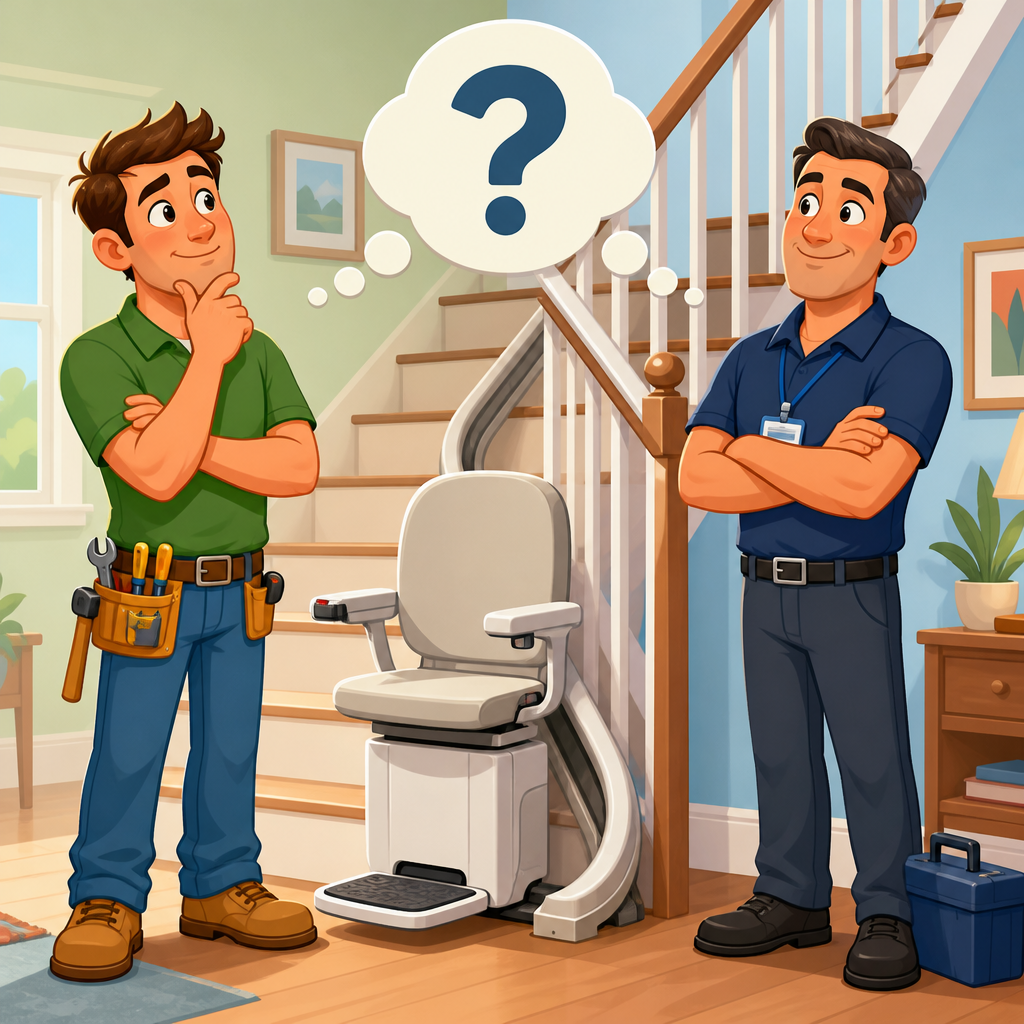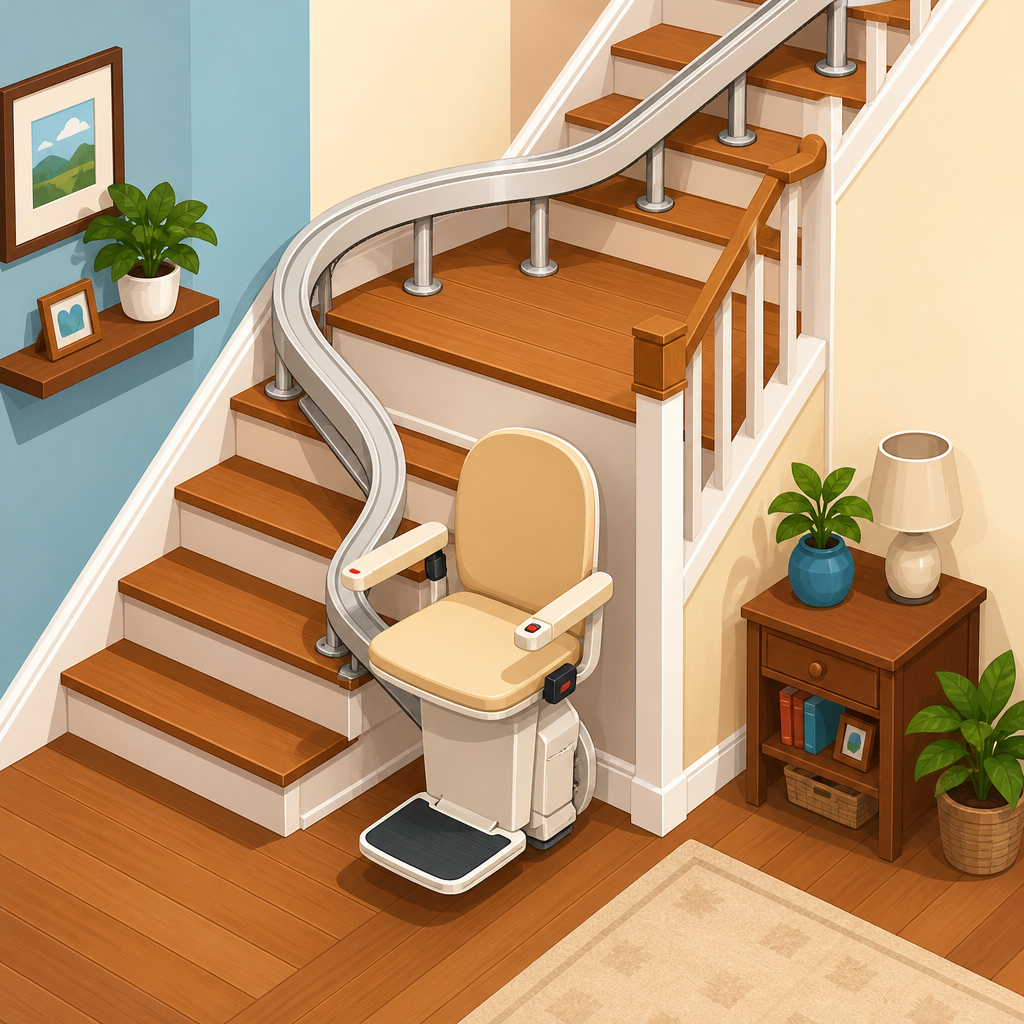
Installing a stair lift on stairs with a 90-degree turn is absolutely possible, but it requires more planning, tighter measurement standards, and a clearer understanding of staircase requirements than a straight-run installation. In my experience surveying homes for lift fitment, quarter-turn staircases are among the most common layouts because they appear in split-level houses, older colonials, townhomes, and compact new builds where architects use landings to save floor space. A 90-degree turn usually means the stairs change direction at a landing, although some designs use winders instead of a full platform. For stair lift installation, that distinction matters because the rail design, bracket placement, rider comfort, and safety clearances all depend on how the turn is built. Homeowners often ask one simple question: can a lift go around the corner? The direct answer is yes, if the staircase has enough usable width, stable mounting points, code-compliant power access, and clear start and stop areas at both levels.
A stair lift is a motorized chair or perch mounted to a rail that is fixed to the stair treads, not usually to the wall. On a staircase with a 90-degree turn, the system is typically called a curved stair lift, even when only one corner is involved. The rail is custom manufactured after a detailed site survey captures tread dimensions, rise and run, landing depth, headroom, obstruction locations, and seat parking preferences. Staircase requirements are the practical conditions that determine whether the lift can be installed safely and used comfortably every day. They include minimum stair width, adequate landing space, structural soundness of the stairs, uninterrupted travel path, electrical readiness, and safe transfer zones at the top and bottom. This article matters because a stair lift is not just a product purchase; it is an accessibility system that must match the staircase precisely. A poor fit can block egress, create transfer risk, or lead to expensive redesigns after manufacturing begins.
What makes a 90-degree staircase different for stair lift installation
A straight stair lift uses a standard rail and can often be installed quickly because there are few variables. A 90-degree turn changes that completely. The rail must bend or transition at the landing while maintaining smooth travel speed, proper gear engagement, and stable support across the change in direction. If the staircase includes a square landing, the chair may pause slightly as it moves through the corner, depending on the rail geometry and drive system. If the stairs use winders, where triangular treads turn the flight without a full landing, the engineering becomes more complex because bracket positions and seat overhang must account for varying tread depth. In field measurements, this is where small errors become major problems. Being off by even a few millimeters at the turn can affect final rail alignment and parking position.
The other major difference is user transfer. On a straight run, top and bottom dismount areas are easier to predict. On quarter-turn stairs, homeowners often want the seat to park away from the main traffic path, which may require a powered swivel seat, folding rail section, or overrun into the landing. A top overrun extends the rail beyond the last stair so the user gets on and off in a safer, flatter area. A bottom overrun does the same at the lower level. These options are especially valuable when arthritis, poor balance, or reduced trunk control make angled transfers unsafe. Brands such as Handicare, Bruno, Stannah, Harmar, and Access BDD all offer curved models, but their rail profiles, seat dimensions, and parking capabilities differ. That is why the staircase survey comes before brand recommendation, not after.
Core staircase requirements that determine fit and safety
The first requirement is usable width. Many manufacturers can work on stairs as narrow as about 26 to 30 inches, but practical comfort often improves when there is more space, especially at the turn. Usable width is not just wall-to-banister measurement. It includes protruding handrails, trim, newel posts, radiators, window ledges, and door casing that may interfere with knees, elbows, or the folded seat. On occupied homes, I measure the narrowest point, not the average. A rail can be technically installable and still leave the staircase too tight for other household members unless careful parking and fold-up dimensions are reviewed.
The second requirement is landing space. A 90-degree staircase needs enough room at the corner and at both ends for the chair to travel, swivel, and permit safe boarding. A shallow upper landing can be more limiting than the stair width because the user must be able to sit, secure the seat belt, and dismount without standing close to the stair edge. The third requirement is structural integrity. Stair lifts are mounted to the treads or, in some proprietary systems, to posts anchored through the treads. Loose stair noses, water-damaged wood, cracked masonry, or flexing landings must be repaired first. Installers look for solid substrate because the lift carries live load repeatedly in the same points over many years.
The fourth requirement is obstruction management. Doors opening onto the stairs, baseboard heaters, low windows, protruding spindles, and deep carpet pile can all affect the rail path. The fifth is headroom and body clearance. Building headroom standards vary, but for lift planning the important issue is whether the rider’s shoulders, knees, and head remain clear throughout the turn, particularly on inside bends where the body swings differently. Finally, electrical readiness matters. Most modern lifts use battery-powered drive units that charge at stations along the rail, often at the ends. That means a nearby standard outlet is typically sufficient, but the outlet must be correctly located and reliable. Extension cords are not an acceptable permanent solution.
How professionals measure a quarter-turn staircase
Accurate survey work is the backbone of curved stair lift installation. In the homes I have assessed, the best results come from a repeatable method rather than rough tape estimates. Installers record total rise, individual tread depth, number of risers, nosing projection, staircase width, handrail projection, landing depth, and all obstacles within the travel envelope. They also document whether the lift will run on the inside or outside of the turn. Inside rails are shorter and often less expensive, but they create tighter turning geometry. Outside rails are longer and usually smoother for the rider, yet they consume more open space and may require longer overruns.
| Measurement area | What is checked | Why it matters |
|---|---|---|
| Stair width | Narrowest clear distance between wall, railings, and trim | Determines chair fit and remaining walking space |
| Landing depth | Usable flat area at top, bottom, and corner | Supports safe transfer and parking positions |
| Tread condition | Material, rigidity, levelness, and damage | Confirms secure bracket anchoring |
| Obstructions | Doors, newels, radiators, windows, handrails | Prevents collisions during travel and swivel |
| Power location | Outlet placement near charge points | Ensures reliable charging without unsafe wiring |
Many manufacturers now use photo measurement systems or digital mapping tools to create highly accurate rail templates. These systems reduce fabrication error, but they do not replace experienced judgment. For example, software may capture the geometry of a landing perfectly and still miss that a user with limited hip mobility needs a larger dismount zone on the upper floor. A good survey combines dimensions with human factors: which side is easier to approach with a walker, whether the user transfers better facing left or right, and how often other residents need to pass on the stairs. Those observations influence rail side selection, seat type, and parking location as much as raw measurements do.
Landings, winders, and overrun options
Not every 90-degree staircase turns the same way. A full landing creates the cleanest installation path because the lift can transition through the bend with predictable support spacing. Winder stairs can still work, but the variable tread shapes complicate bracket placement and may narrow the usable path on the inside corner. When winders are involved, I pay extra attention to knee clearance and the folded width of the seat, footrest, and armrests. Some homes that look suitable at first glance become poor candidates once the rider’s body position in the turn is considered.
Overruns solve many transfer problems. A top overrun can move the seat farther onto the landing so the user does not stand up directly above the stair edge. A bottom overrun can shift boarding away from a doorway or hallway pinch point. Hinged or folding rail sections are useful when the lower rail would otherwise block a door, but they add moving parts and maintenance considerations. Powered swivels also improve safety for users who cannot rotate comfortably by hand. None of these features are cosmetic upgrades. On quarter-turn stairs, they are often the difference between a lift that merely fits and one that is genuinely safe to use every day.
Code, safety, and household traffic considerations
Stair lifts in private homes are not governed exactly like commercial platform lifts, but reputable installers still align their work with recognized safety standards, manufacturer instructions, and local electrical rules. In the United States, products are commonly designed to ASME A18.1 and certified through recognized testing programs, while electrical work must meet local code based on the National Electrical Code. In the United Kingdom and Europe, different conformity standards apply, but the principle is the same: use approved equipment, install it to specification, and preserve safe stair access.
One frequent concern is whether a stair lift blocks the staircase for others. On a 90-degree turn, that depends on the folded dimensions and where the rail sits. Most seats, armrests, and footrests fold up to reduce projection when not in use. However, folded clearance must still be checked with real household behavior in mind. Can another resident carry laundry past the parked chair? Can emergency egress still happen without confusion? If the home has children, pets, or caregivers moving through the same stairwell, parking the chair at a landing instead of mid-flight often works better. Safety sensors on the carriage and footrest stop the lift if it contacts an obstacle, but those sensors are a backup, not a design strategy.
Installation process, timeline, and common obstacles
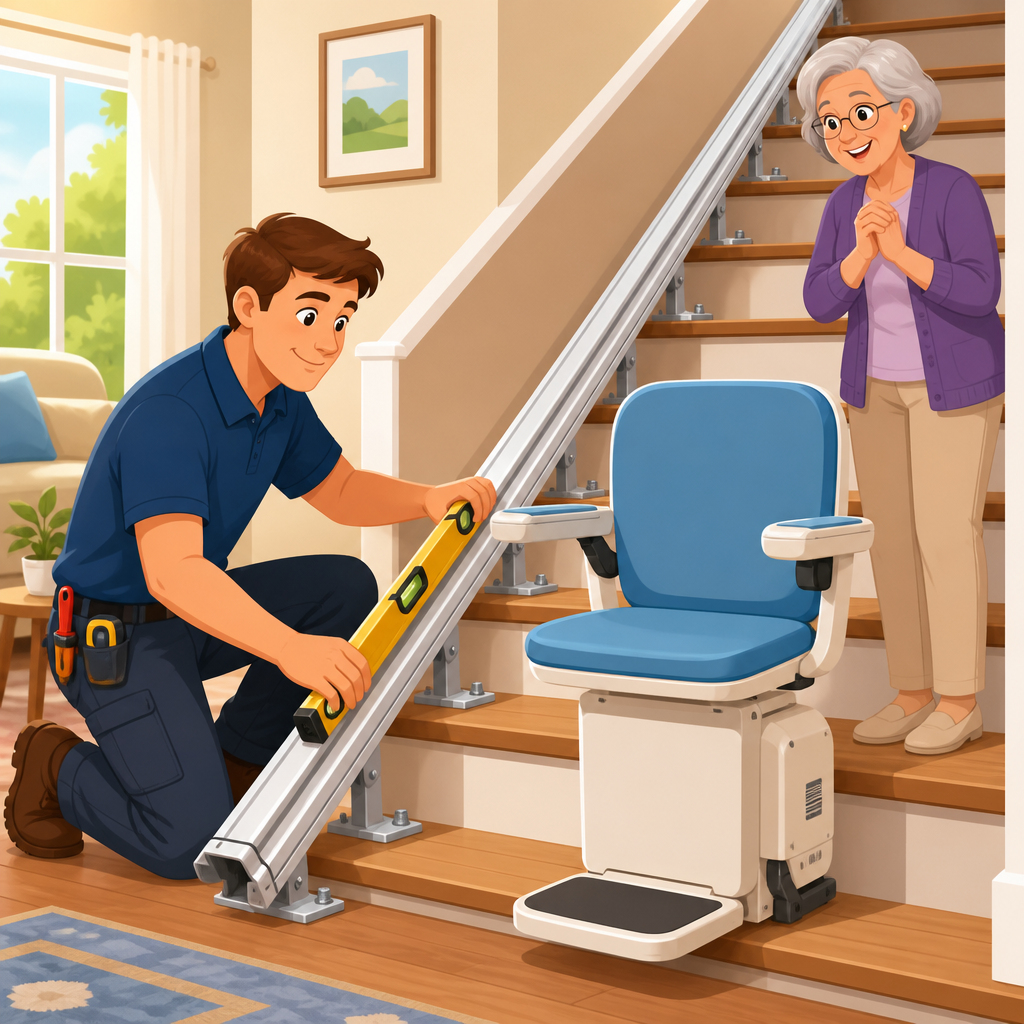
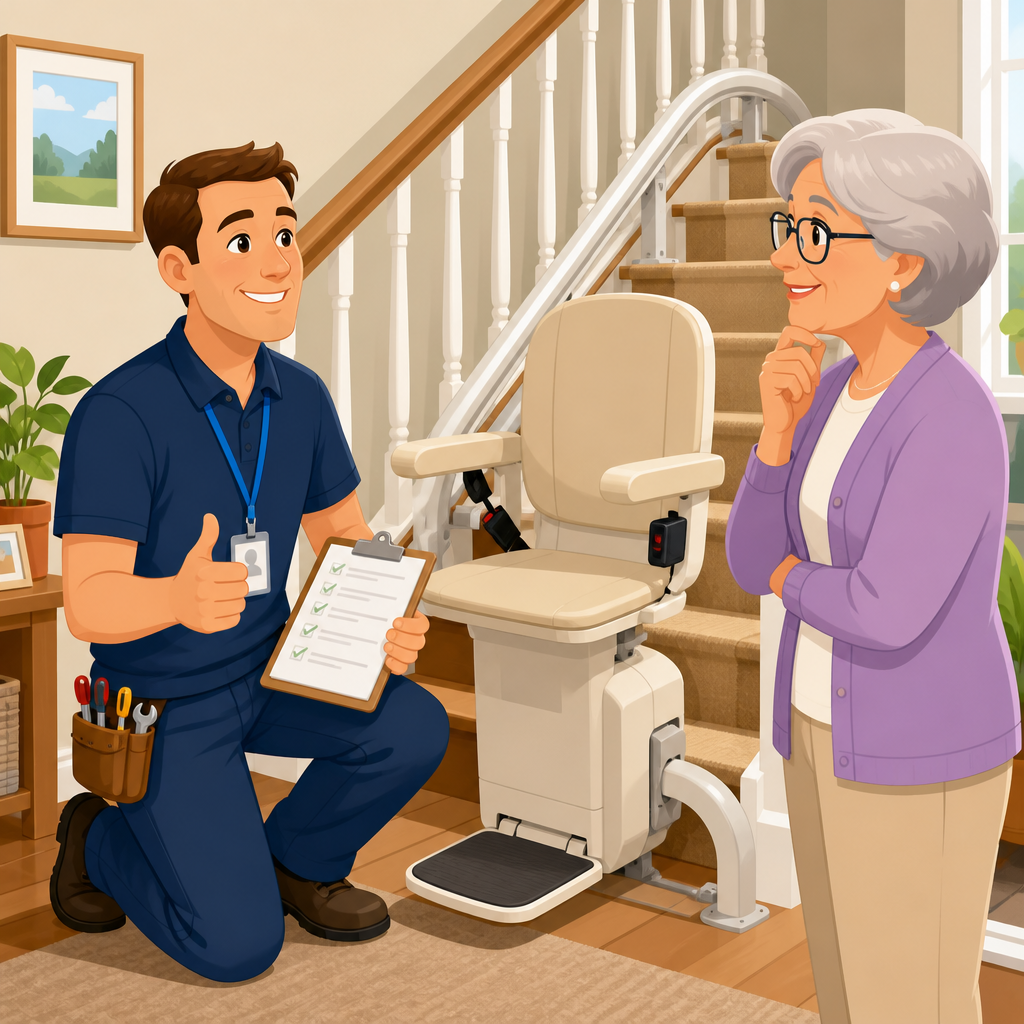
Once measurements are approved, the curved rail is manufactured to order. Lead times vary by brand and region, but custom quarter-turn lifts commonly take several weeks from survey to installation. The actual installation in the home is usually completed in less than a day, although difficult access, electrical updates, or stair repairs can extend the schedule. Installers mount brackets to the treads, assemble rail sections, test charging contacts, verify limit positions, and run multiple loaded and unloaded cycles. They then set the seat height where adjustable, teach the user the controls, explain the seat belt and swivel function, and review manual lowering or emergency procedures.
Common obstacles include loose balusters, inconsistent stair geometry in older homes, and last-minute furniture placement conflicts near the top landing. I have also seen beautiful staircases with decorative newel posts that force a redesign because the seat cannot swivel where expected. This is why final signoff should always include a live transfer test, ideally with the actual user rather than only a family member. Technical fit is not enough. The user must feel stable approaching the seat, operating the call-send controls, and stepping away at both ends.
When a stair lift is the right choice, and when it is not
A curved stair lift is the right choice when the user can safely transfer on and off the seat, remain seated upright during travel, and benefit from preserving access to an upper floor without major remodeling. It is often faster and less disruptive than moving bedrooms downstairs or installing a residential elevator. It also preserves independence for many people recovering from joint replacement, living with multiple sclerosis, or managing age-related mobility loss. For caregivers, it reduces manual assistance on stairs, one of the highest-risk tasks in the home.
It is not always the best solution. If the user cannot sit safely, has severe involuntary movement, or depends on a wheelchair continuously, a vertical platform lift, limited-use elevator, or first-floor living redesign may be more appropriate. Very narrow winding stairs can also defeat even well-designed curved systems. Cost is another real consideration. Curved lifts are significantly more expensive than straight models because the rail is custom built. Still, for a well-suited home and user, the long-term value is clear: safe daily access to the full house without repeated strain or dangerous stair climbing.
Stair lift installation on stairs with a 90-degree turn succeeds when the staircase requirements are evaluated with precision rather than assumptions. Width, landing depth, structural strength, obstructions, rider clearance, and charging access all shape whether a curved lift will fit and how safely it will perform. The most important lesson is that quarter-turn stairs are not automatically difficult; they are simply less forgiving of poor measurement and generic planning. When the survey is thorough and the design accounts for the user’s transfer needs, a curved stair lift can feel smooth, secure, and unobtrusive.
As the hub for staircase requirements within installation and setup, this topic connects directly to deeper questions about minimum stair width, landing clearance, rail side selection, power supply, code issues, and user transfer safety. Those subtopics deserve their own detailed guidance, but the decision framework starts here. Treat the staircase as a system, not just a set of dimensions. If you are evaluating a stair lift for a 90-degree turn, schedule a professional site survey, ask for a transfer-focused fit assessment, and compare rail layouts before choosing a model. That approach leads to safer installations, fewer surprises, and better long-term mobility at home.
Frequently Asked Questions
Can a stair lift really be installed on stairs with a 90-degree turn?
Yes — a stair lift can absolutely be installed on a staircase with a 90-degree turn, and this is one of the most common curved-stair applications. Unlike a straight stair lift, which uses a simple linear rail, a lift for a quarter-turn staircase uses a custom-built curved rail designed to follow the exact shape of the stairs and landing. In practical terms, that means the lift can travel up one flight, go around the 90-degree bend, and continue smoothly to the next section of the staircase.
The key difference is that curved installations require far more precise planning. The rail must be engineered to match the width of the stairs, the depth and height of each tread, the size of the landing, the inside and outside turning radius, and the available clearance at both the top and bottom of the run. Even small measurement errors can affect ride quality, parking position, or safe passage on the staircase. That is why professional surveying is especially important on quarter-turn staircases.
Most homeowners are surprised to learn that the lift is typically mounted to the stair treads rather than the wall. This is important because a 90-degree turn does not automatically make a staircase unsuitable just because there is a tight wall, a handrail, or an open balustrade. What matters more is whether the staircase provides enough usable space for the chair, the rider, and anyone else who needs to walk the stairs safely when the lift is parked or folded.
In short, a 90-degree turn does not prevent installation — it simply moves the project from a standard straight model to a custom curved solution. With proper measurements and the right rail design, these staircases are very often excellent candidates for a safe, reliable lift.
What measurements and staircase conditions matter most for a 90-degree turn stair lift?
For a quarter-turn stair lift, the most important factor is accurate measurement of the entire staircase geometry, not just the length of the stairs. Installers need to assess stair width, tread depth, riser height, the exact point where the staircase changes direction, landing dimensions, headroom, obstructions, and the amount of clearance available along both the inside and outside of the turn. These details determine whether the rail should hug the inside of the staircase, travel along the outside edge, or use a parking arrangement at the top or bottom to improve access.
Stair width is especially important because a curved rail and chair take up more functional space than many homeowners expect. The staircase does not need to be unusually large, but there does need to be enough room for the seat, footrest, and rider to move through the bend without creating an unsafe pinch point. In many cases, a folded seat and footrest allow the lift to leave reasonable walking space, but that needs to be verified during the survey rather than assumed.
The landing at the 90-degree turn is another major consideration. Some quarter-turn staircases have a flat square landing, while others use winders, where the steps themselves narrow and turn. Both layouts can potentially accept a stair lift, but they require different rail strategies. Winders often demand even tighter tolerances because the lift must pass through a more complex path while maintaining smooth travel and proper seat position.
Installers also look closely at obstructions such as radiators, trim details, door swings, baseboard heaters, low newel posts, window sills, and nearby hallway traffic patterns. The best installation is not just one that technically fits, but one that provides safe transfer on and off the seat at the top and bottom. That often matters more than the turn itself. A detailed site assessment answers these questions before equipment is ordered, which is critical because curved rails are typically custom manufactured for a specific staircase and are not easily modified after production.
Is a curved stair lift for a 90-degree turn more expensive than a straight stair lift?
Yes, in most cases it is significantly more expensive than a straight stair lift. The reason is straightforward: a straight stair lift uses a standard rail that can often be cut to length and installed relatively quickly, while a 90-degree turn requires a custom curved rail built specifically for that staircase. The rail must be designed from precise measurements, manufactured to match the stair layout, and installed with careful attention to travel path, seat clearance, and parking positions.
The price difference is driven by customization, engineering, and production time rather than just by the presence of a bend. Every quarter-turn staircase is a little different. The exact shape of the turn, whether the rail mounts on the inside or outside of the staircase, whether there is a landing overrun, and how the chair needs to park at the top or bottom all affect the final cost. Additional powered features — such as a power swivel seat, powered footrest, folding rail section, or automatic hinge to avoid blocking a doorway — can also increase the total investment.
Installation labor can be more involved as well. On a straight staircase, the rail path is simple and predictable. On a 90-degree staircase, the installer has to fit and align a more complex rail system, test ride performance through the bend, verify charging points, and ensure that transfer areas are safe and comfortable. This added complexity contributes to both cost and lead time.
That said, the higher cost often reflects a much better usability outcome than trying to force a mobility solution that does not truly fit the staircase. For homeowners who need to remain in a split-level, townhouse, or older two-story home, a properly designed curved stair lift can be far more affordable than moving, undertaking major remodeling, or relying on unsafe workarounds. The best approach is to get a professional assessment and written quote based on the actual staircase, because pricing on curved lifts varies substantially from one home layout to another.
How long does installation take, and what is the process for a 90-degree turn stair lift?
The overall process usually takes longer than a straight stair lift because of the custom manufacturing involved, but the on-site installation itself is often completed within a day once the rail is ready. The project generally begins with an in-home survey, where the staircase is measured in detail and the installer or surveyor identifies any challenges related to the 90-degree turn, landings, transfer space, and obstructions. In many cases, photos and digital measurement tools are used so the rail can be accurately designed.
After that survey, the lift manufacturer or supplier creates a rail layout specific to the home. Because this is not an off-the-shelf straight rail, there is typically a production period while the custom curved track is fabricated. Depending on the brand, model, and region, that phase can take anywhere from a couple of weeks to longer. The more complex the staircase, the more important it is to allow time for correct design and manufacturing rather than rushing the process.
Once the equipment arrives, installation typically involves securing the rail to the stair treads, assembling the chair and carriage, connecting charging points, testing safety features, and making sure the unit travels smoothly through the quarter-turn. The technician should also check seat swivel function, footrest clearance, remote controls, obstruction sensors, and final parking positions. A well-done installation includes a full user demonstration so the homeowner knows how to operate, fold, charge, and safely transfer on and off the lift.
One important point is that installation usually causes less disruption than people expect. Stair lifts do not normally require major structural remodeling because they are mounted to the stairs, not built into the framing of the house. In most cases, homeowners can remain in the home during installation. The time-consuming part is typically the custom rail production, not the physical fitting of the lift on installation day.
Will a stair lift on a 90-degree staircase still leave enough room to use the stairs normally?
Often yes, but this depends on the width and configuration of the staircase, which is why a site-specific evaluation is so important. On many quarter-turn staircases, the chair, armrests, and footrest can be folded when the lift is not in use, which helps preserve walking space. However, the actual amount of remaining clearance varies based on whether the rail runs along the inside or outside of the turn, how tight the staircase is, and whether the landing area narrows at the bend.
In tighter homes, preserving access for other household members is a major design goal. Installers may choose a rail path that minimizes intrusion, or they may incorporate parking positions that move the chair away from the main walkway when it is not needed. In some cases, the lift can be parked at the top landing, bottom landing, or around the bend so it is less visually obtrusive and less likely to interfere with foot traffic. Call/send controls also help by allowing the chair to be moved to a preferred parked position after use.
What matters most is not just whether someone can physically squeeze past the folded lift, but whether they can do so safely and comfortably. A staircase used by multiple family members, caregivers, or visitors needs practical day-to-day usability. During a professional survey, the installer should evaluate how people enter the staircase, whether doors open into the stair area, and whether the folded lift still allows a secure handhold and normal walking pattern.
If the staircase is especially narrow, there may still be workable options, but those options need to be