Is ADA compliance required for in-home care facilities? The short answer is: often yes in part, sometimes no in part, and the correct answer depends on how the home is used, funded, staffed, and open to the public. That distinction matters because “in-home care facility” can describe very different settings, from a private residence where a family hires a caregiver, to a licensed group home, to an adult family home, to a home-based agency office where clients visit for assessments. In practice, I have seen owners assume a residential address automatically exempts them from accessibility rules, only to learn later that civil rights law, state licensing standards, fair housing rules, Medicaid participation terms, and local building codes may still impose accessibility obligations.
To understand the issue, define the terms clearly. The Americans with Disabilities Act is a federal civil rights law that prohibits disability discrimination. It is divided into titles that apply to different entities and activities. Title I covers employment. Title II covers state and local government programs and services. Title III covers places of public accommodation and commercial facilities operated by private entities. Another law, the Fair Housing Act, can apply to housing providers and certain residential settings. Section 504 of the Rehabilitation Act can apply when federal financial assistance is involved. For in-home care operators, the legal question is rarely “Does one law control everything?” It is “Which laws apply to this specific operation, and what do they require?”
This matters because accessibility failures create real harm. A resident may be unable to enter a bathroom safely, a deaf client may miss medication instructions because no effective communication method was provided, or a wheelchair user may be excluded from intake services offered in a converted home office. The consequences are also operational and financial: complaints to the Department of Justice, licensing citations, denied occupancy approvals, renovation delays, workers’ compensation exposure from unsafe transfers, and reputational damage. For a hub page on ADA compliance and guidelines, the most useful approach is practical: identify the setting, classify the services, then map the applicable standards before construction, licensing, or policy decisions are made.
When ADA compliance applies to in-home care facilities
ADA compliance applies when the operation fits one of the law’s covered categories. If the business is a private care agency serving clients in their homes, Title III may apply to the agency’s office if clients or applicants come there, even if the office is in a house. If a city or county operates the program, Title II applies to the government service regardless of whether it is delivered in a residential structure. If the organization has employees, Title I governs employment practices and reasonable accommodation for qualified workers with disabilities. In other words, the street address does not decide coverage; the nature of the entity and the service does.
Some residential care settings are not classic “public accommodations,” but that does not mean accessibility is optional. Group homes, adult foster homes, assisted living residences, and similar programs may trigger state accessibility rules, licensing design standards, building code requirements, and fair housing obligations. I have worked on projects where an operator focused only on ADA door widths and missed a state rule on roll-in showers for a certain resident population. Others assumed that because a setting was licensed as residential, they had no duty to modify policies, yet they still had to provide reasonable accommodations and effective communication for residents, visitors, employees, or applicants.
The Department of Justice ADA Standards for Accessible Design are central when Title II or Title III construction requirements apply. For housing-related settings, the Fair Housing Act design-and-construction rules may be more important for covered multifamily dwellings. Health care functions can add more layers. If a nurse performs evaluations in a home-based clinic room used by the public, exam-room accessibility and accessible routes become significant. If services are provided only inside a private dwelling occupied by one client, the legal focus often shifts toward nondiscrimination in service delivery, communication access, staff accommodations, and safe transfer practices rather than public-facing architectural features.
Private homes, group homes, and agency offices are treated differently
A private home where a family employs a caregiver is usually not a place of public accommodation. The ADA generally does not require a homeowner to remodel a personal residence for every possible visitor or worker. However, if the family receives services through a government program or a federally funded provider, program access and nondiscrimination rules can still influence how services are delivered. Separate from federal law, state home care rules, Medicaid waiver requirements, and insurer expectations may affect equipment, transfers, communication supports, and emergency planning.
Licensed group homes and adult family homes sit in a more complex category. They function as residences, but they also deliver organized care services under regulatory oversight. Courts and agencies look closely at whether the setting is residential, whether the operator is open to the public, and whether parts of the property are used for commercial service delivery. In my experience, entrances, parking, common bathrooms, staff offices, and intake areas create the most confusion. A provider may not need to make every bedroom identical, but it may need an accessible route to shared spaces, reasonable policy modifications, and communication accommodations for residents and family members.
Agency offices inside homes are the clearest example of ADA exposure. If clients visit for assessments, paperwork, caregiver interviews, or training, those areas can be treated like any other customer-facing business space. A converted porch office with steps and no ramp is a common problem. So is a narrow restroom used by applicants with mobility impairments. Even when full structural compliance is not readily achievable in an older building, Title III still requires removal of architectural barriers when readily achievable, meaning easily accomplishable without much difficulty or expense, judged in light of the business’s size, resources, and operations.
What ADA compliance usually requires in practice
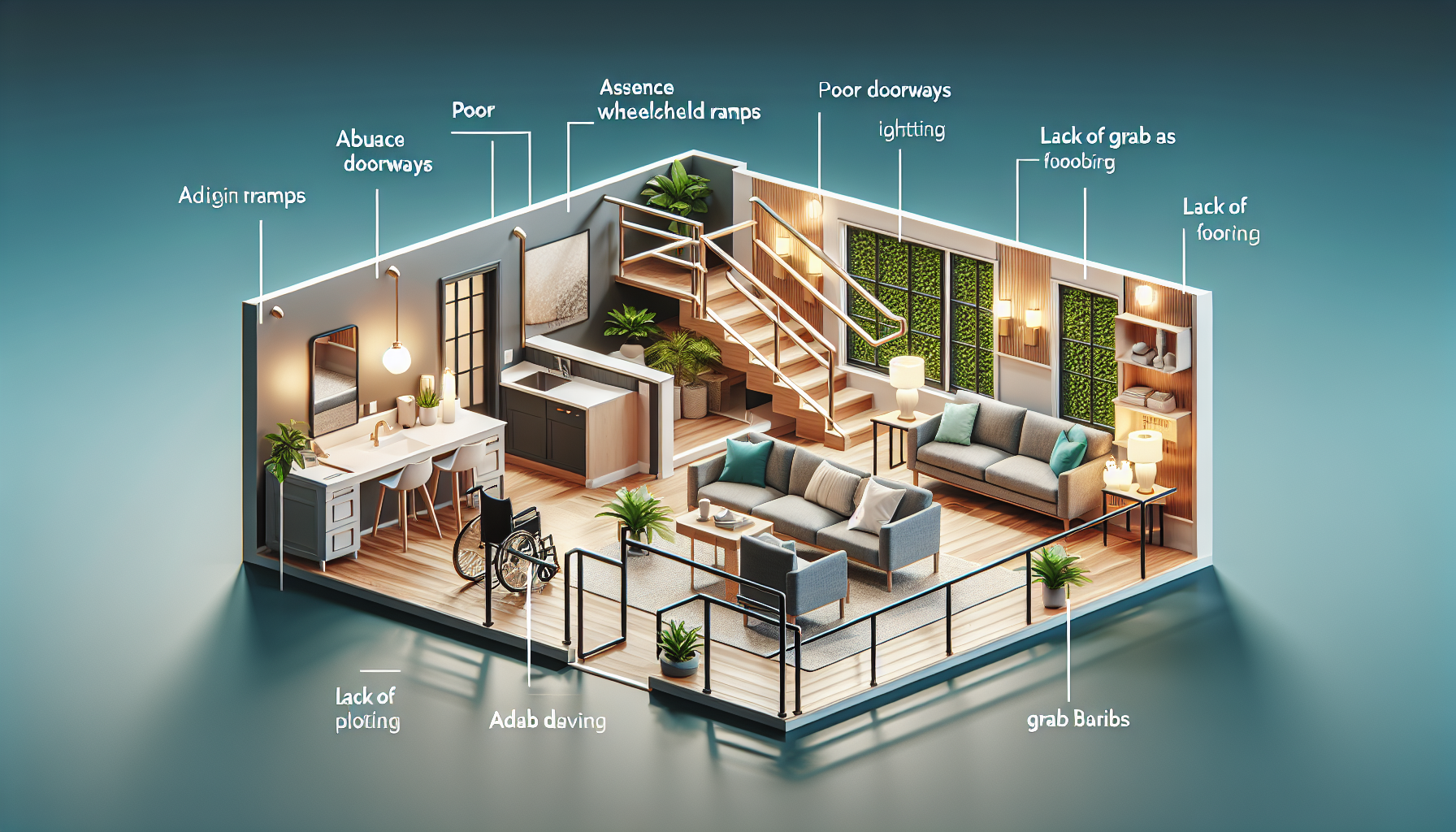
Compliance is not one thing. It includes physical access, communication access, policy access, and employment access. Physical access means features such as parking, routes, entrances, doors, turning space, bathroom layout, grab bars, thresholds, ramps, handrails, signage, and alarms. Communication access means providing auxiliary aids and services when needed for effective communication, such as qualified sign language interpreters, captioning, relay services, large print, or accessible digital forms. Policy access means modifying rules when necessary unless doing so would fundamentally alter the service. Employment access means engaging in an interactive process with employees and applicants who need accommodations.
Older facilities should understand the difference between new construction, alterations, and existing buildings. New construction and altered elements must meet applicable accessibility standards much more strictly. Existing facilities under Title III have an ongoing duty to remove barriers when readily achievable. Under Title II, public entities must ensure program access, which can sometimes be achieved without making every old building fully compliant, but the service as a whole must be accessible. This is a nuanced area. A provider might relocate assessments to an accessible room while planning future renovations, but that does not excuse avoidable barriers where affordable corrections are available now.
| Setting | Common legal framework | Typical accessibility focus | Example issue |
|---|---|---|---|
| Private client home | Service nondiscrimination, funding rules, employment law | Communication, safe care delivery, staff accommodation | Providing printed instructions in large print for a low-vision client |
| Licensed group home | State licensing, building code, fair housing, sometimes ADA-related obligations | Shared-space access, policies, resident accommodations | Accessible route from parking to common dining area |
| Home-based agency office | ADA Title III, building code, employment law | Entrances, restrooms, service counters, forms | Step-free entrance for client intake visits |
| Government-operated home care program | ADA Title II, Section 504, program access | Accessible services, effective communication, digital access | Video remote interpreting for benefits counseling |
Technology also belongs in the compliance discussion. Intake websites, consent forms, patient portals, telehealth systems, and training modules should be usable by people with disabilities. While the ADA does not contain one web regulation for every private health-related provider, courts and enforcement actions increasingly treat inaccessible digital services as barriers to equal access. Practical benchmarks often come from WCAG 2.1 AA. For in-home care organizations, that means online scheduling should work with screen readers, videos should have captions, and PDFs should be tagged properly. An inaccessible digital form can block access just as effectively as a step at the front door.
Key standards, codes, and guidance sources operators should review
No operator should rely on a single checklist. Start with the 2010 ADA Standards for Accessible Design and the Department of Justice regulations for Titles II and III. Then review the Fair Housing Act if the setting is residential, especially for multifamily development or reasonable accommodation issues. Next, examine your state licensing rules for adult care homes, assisted living, home health agencies, hospice providers, or adult foster care. State codes often specify bathroom fixture placement, bedroom clearances, sprinkler systems, evacuation methods, and staffing requirements that interact with accessibility. Local building and fire officials also matter because occupancy classification can change what construction is allowed.
For health-related services, I often cross-check guidance from the U.S. Access Board, the Centers for Medicare & Medicaid Services, and state Medicaid waiver manuals. CMS requirements may not replace the ADA, but they can shape expectations around person-centered planning, community integration, and safe service delivery. If transportation is offered, vehicle access rules may come into play. If durable medical equipment is stored or demonstrated on site, circulation space and transfer access become more important. The point is simple: compliance is layered, and operators who coordinate legal counsel, architects, and licensing consultants early spend less money fixing avoidable mistakes later.
Documentation is another standard in practice, even when it is not called out in a single statute. Keep records of accessibility assessments, barrier-removal decisions, requests for accommodation, maintenance logs, staff training, and digital remediation efforts. If a ramp slope cannot be corrected immediately due to structural limits, document the interim measures and the budgeted plan for remediation. If an interpreter request arises, document how it was evaluated and fulfilled. Good records show that the organization made reasoned, timely decisions rather than ignoring obligations. That can matter in enforcement, insurance review, and licensure renewal.
Common mistakes and how to avoid them
The most common mistake is assuming a residential appearance means residential treatment under every law. A second mistake is focusing only on wheelchair access. ADA compliance also covers vision, hearing, speech, cognitive, and psychiatric disabilities. A third mistake is treating accessibility as a renovation issue instead of an operations issue. I routinely see providers buy grab bars and portable ramps but never train staff on communication aids, service animal policies, accommodation requests, or emergency evacuation procedures. Physical changes help, but without policy and training, compliance remains incomplete.
Another frequent error is using “grandfathered” as a blanket defense. Older buildings may have limited retrofit obligations compared with new construction, but age alone does not erase duties under Title II, Title III, licensing law, or fair housing requirements. Operators also underestimate bathroom design. A room may look spacious yet fail because clear floor space overlaps poorly, door swings block transfer areas, or grab bars are mounted incorrectly. Finally, many organizations wait until a complaint arrives. A better approach is an annual accessibility audit covering the property, digital tools, employee procedures, forms, vendor contracts, and emergency plans.
For operators deciding what to do next, the best sequence is straightforward: classify the setting, identify the governing laws, perform a site and policy audit, prioritize high-impact fixes, and create a written implementation plan. If your home-based office serves the public, start with the route, entrance, restroom, and communication methods. If your group home is residential, review licensing standards, common-area access, and accommodation procedures. If you are a family hiring one aide in a private home, focus on safe care, communication, and program requirements tied to funding. Accessibility is not a one-time project. It is an operating standard that protects residents, clients, visitors, and staff while reducing legal and clinical risk.
ADA compliance for in-home care facilities is therefore not a yes-or-no question answered by the word “home.” It depends on the entity, the service, the funding, the building use, and whether the public, employees, residents, or applicants need equal access. Private residences used only as homes are treated differently from licensed care homes and very differently from home-based agency offices that serve the public. Beyond the ADA, fair housing law, Section 504, state licensing rules, Medicaid conditions, building codes, and digital accessibility expectations often shape the real compliance picture.
The practical lesson is clear. Start by identifying exactly what your operation is, then match it to the right legal framework and technical standards. Review physical access, communication access, policies, websites, and employment practices together rather than in isolation. Use recognized references such as the 2010 ADA Standards, state licensing regulations, local code requirements, and WCAG-based digital accessibility practices. Document decisions, train staff, and reassess regularly, especially after renovations, changes in resident needs, or new service lines. Organizations that take this structured approach avoid costly retrofits and provide safer, more dignified care.
If you manage, own, design, or advise an in-home care facility, treat accessibility review as an early planning step, not a last-minute correction. Build a compliance checklist for each property, consult qualified legal and design professionals where needed, and use this hub as your starting point for every ADA compliance and guidelines question in the accessibility and mobility solutions category.
Frequently Asked Questions
Is ADA compliance always required for an in-home care facility?
No. Whether ADA compliance is required depends on what “in-home care facility” actually is in practice. If the setting is a purely private residence where a family hires a caregiver directly and the home is not operating as a business open to the public, the ADA often does not apply in the same way it would to a commercial facility. On the other hand, if the home is being used as a licensed care setting, a group home, an adult family home, or a place where clients come for evaluations, intake meetings, or other services, ADA obligations may apply in whole or in part. The answer can also change based on whether the operator is a private business, a nonprofit, or a public entity.
It is also important to understand that “ADA compliance” is not one single rule. Different parts of the ADA cover different situations. Title I addresses employment, Title II applies to state and local government programs, and Title III covers private businesses and nonprofit organizations that serve the public. That means a home-based care operation could have obligations related to employees even if the residence itself is not treated like a public accommodation in every respect. Likewise, a provider that receives government funding may also have accessibility duties under other laws, such as Section 504 of the Rehabilitation Act or the Fair Housing Act, depending on the facts.
In real-world terms, owners and operators should avoid assuming that a residential setting is automatically exempt just because it looks like a house. Regulators and courts typically look at the actual use of the property: who lives there, who visits there, what services are offered there, whether the public comes in, how many staff work there, and whether the program is licensed or publicly funded. That functional analysis is what usually determines whether and how accessibility rules apply.
How does the ADA apply differently to a private home, a group home, and a home-based care business?
The ADA treats these situations differently because they are not the same legally, even if all of them involve care provided in a residential environment. A private home where an individual simply receives care from a hired aide is usually not considered a public-facing business location. In that case, the home itself may not be subject to the same public-access requirements that apply to clinics, offices, or service establishments. However, the employer may still have responsibilities toward employees, and other disability laws may still be relevant in certain situations.
A group home, adult family home, or licensed residential care setting is more likely to trigger accessibility obligations because it is being operated as an organized service environment rather than solely as a private household. Even then, the analysis is not always simple. Some requirements may relate to policies, equal access to services, and reasonable modifications rather than extensive structural changes. In some cases, the Fair Housing Act may be just as important as the ADA, particularly where the residents are living there as their home and discrimination in housing-related services is at issue.
A home-based care business creates yet another layer. If part of the residence is used as an office where clients, family members, or members of the public come for assessments, intake, billing, counseling, or consultations, that portion of the property may be treated more like a place of business. That can raise issues such as accessible routes, entrances, communication accommodations, service-animal access, and nondiscriminatory policies. In short, the more the home functions like a business location open to clients or the public, the more likely ADA standards become relevant.
If clients never visit the home, can an in-home care provider still have ADA obligations?
Yes. Even when clients do not come to the home or office, an in-home care provider can still have ADA-related responsibilities. Accessibility is not limited to wheelchair ramps and door widths. The ADA also addresses how services are provided, how communication is handled, and whether individuals with disabilities have equal access to programs and benefits. A care agency that sends staff into clients’ homes may need to provide effective communication, make reasonable modifications to policies, and avoid practices that screen out or disadvantage people with disabilities unless there is a legitimate, legally recognized reason.
Employment obligations may also exist. If the provider has enough employees to be covered under ADA employment rules, it may need to provide reasonable accommodations to qualified employees or applicants with disabilities, unless doing so would create an undue hardship. That can include accommodations in scheduling, job duties, assistive technology, or workplace policies. These obligations can apply even if the business is run from a residence and even if no clients ever step onto the property.
There may also be overlapping state and local accessibility laws that apply more broadly than federal ADA rules. Some states impose disability access requirements on smaller employers, licensed care providers, or entities serving vulnerable populations. For that reason, providers should not assume that “no client visits” means “no compliance duties.” The better approach is to review operations comprehensively, including hiring practices, service policies, communications, online forms, intake procedures, and licensing requirements.
What accessibility features or accommodations are most commonly required in residential care settings?
The most common requirements depend on the type of operation, but they often fall into two categories: physical access and programmatic access. Physical access may include an accessible entrance, a usable path of travel, adequate door clearance, accessible parking where applicable, and bathrooms that can be used by people with mobility disabilities. If clients or members of the public are expected to visit the property, these issues become especially important. However, not every residential care setting will be required to meet the same construction standards, particularly in older homes or where the law focuses more on reasonable modifications than full-scale retrofitting.
Programmatic access is often just as important and is frequently overlooked. This can include allowing service animals, providing auxiliary aids and services for effective communication, modifying policies when necessary to avoid disability-based exclusion, and ensuring that intake, assessments, and daily services can be delivered in ways that are accessible. For example, a provider may need to communicate with a deaf client through appropriate aids, adjust a rigid policy that unintentionally excludes someone with a disability, or make reasonable changes to how appointments are scheduled or conducted.
In residential care environments, accessibility can also involve the lived experience of residents. That may include safe movement through common areas, access to meals and activities, usable bathrooms and sleeping areas where required, and staff practices that do not isolate or segregate residents with disabilities. The key point is that compliance is rarely just a checklist of building features. It usually involves a broader review of whether people with disabilities can actually access the same services, benefits, and opportunities offered to others.
How can owners or operators of in-home care facilities determine what laws apply to them?
The most reliable way is to evaluate the operation based on function, not just label. Start by asking practical questions: Is this a private residence or a licensed care setting? Do clients or members of the public visit the property? Is part of the home used as a business office? How many employees are there? Is the provider privately operated, government-operated, or receiving public funding? Are residents living there as tenants, patients, or program participants? The answers to those questions help identify whether the ADA, the Fair Housing Act, Section 504, state accessibility codes, or local licensing rules may apply.
Next, review the property and operations separately. The property review should look at entrances, routes, bathrooms, parking, signage, and any area used by clients, staff, or the public. The operational review should look at admissions criteria, service-animal rules, communication methods, websites and forms, staff training, emergency procedures, and employment practices. Many compliance problems arise not because a provider intended to exclude anyone, but because policies were written without considering disability access. A structured review can uncover those issues before they become complaints, enforcement actions, or lawsuits.
Because this area often involves overlapping legal frameworks, many operators benefit from consulting an attorney familiar with disability access and housing law, along with an accessibility specialist or design professional where physical access is at issue. That is especially true for group homes, adult family homes, assisted living models in residential buildings, and hybrid home-office setups. The takeaway is simple: there is no universal yes-or-no answer for every “in-home care facility.” The safest path is a fact-specific compliance assessment based on how the home is actually used.