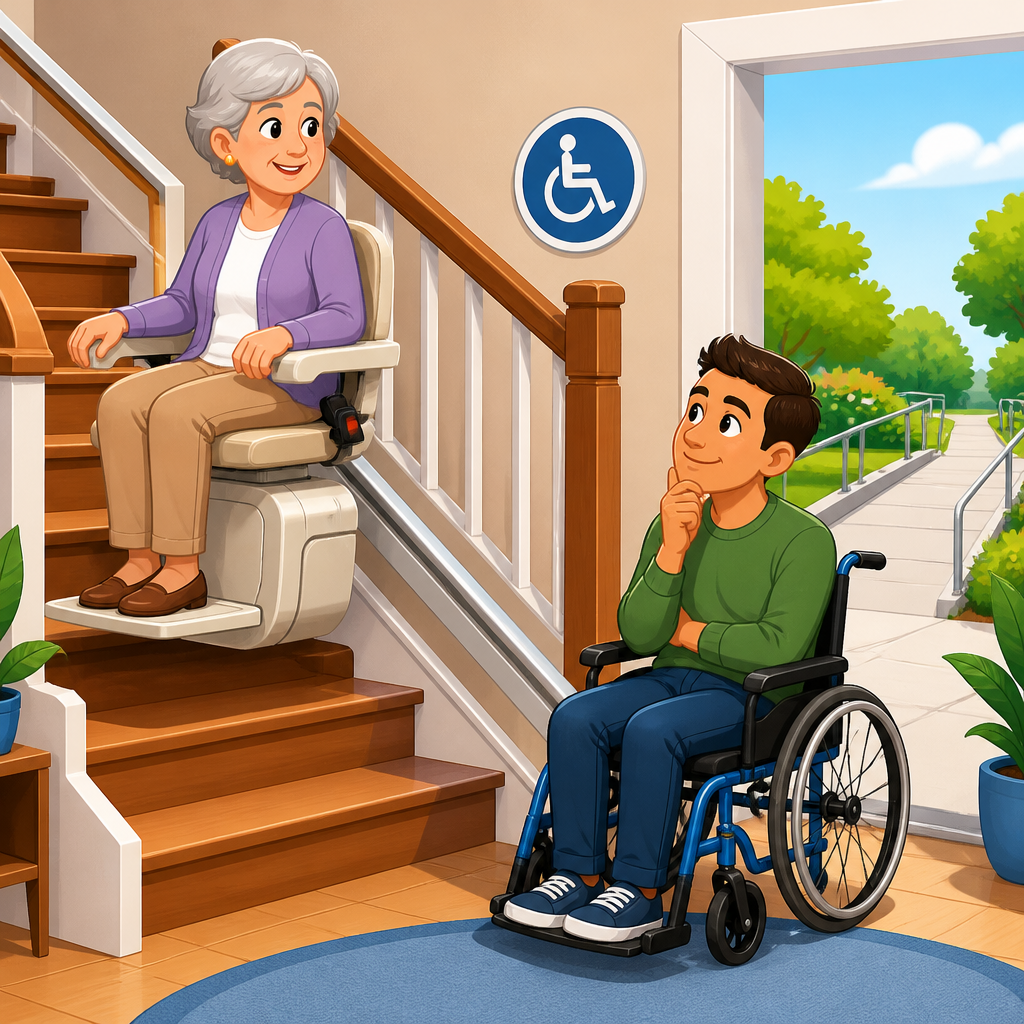
Whether a stair chair lift is allowed as an ADA accessible route depends on the building type, the location, and which accessibility standard applies, but in most public and commercial settings a stair chair lift does not qualify as the required accessible route. That distinction matters because owners, architects, facility managers, and families often use the phrase “ADA compliant” loosely, even though the Americans with Disabilities Act and the 2010 ADA Standards for Accessible Design use the term accessible route in a very specific way. An accessible route is a continuous, unobstructed path connecting all accessible elements and spaces in a building or site. It must meet technical requirements for width, slope, maneuvering clearances, changes in level, door access, and vertical circulation. In practice, that usually means walking surfaces, ramps, elevators, platform lifts in limited permitted situations, and in some cases lifts allowed by code exceptions. Stair chair lifts, by contrast, move a seated user along an existing stair on a rail and are typically designed for one person at a time.
I have worked with property owners comparing stair lifts, vertical platform lifts, limited-use limited-application elevators, and full passenger elevators during renovations, and the same misconception appears repeatedly: if a device helps someone get upstairs, people assume it automatically satisfies accessibility law. It does not. The ADA is concerned not only with movement between floors, but with equal, reliable, dignified access for people with different disabilities, including wheelchair users, people using scooters, walkers, canes, service animals, and people who cannot safely transfer into a stair chair. That broader view is why understanding whether stair chair lifts are allowed as an ADA accessible route is essential before spending money on the wrong equipment, filing permits, or making promises to tenants and customers.
What the ADA means by an accessible route
An accessible route under the 2010 ADA Standards is the path that connects arrival points, entrances, rooms, amenities, restrooms, and vertical circulation in a way that can be used by individuals with disabilities. The route must be stable, firm, and slip resistant where applicable, with compliant widths and clearances. For vertical access, the baseline expectation in many public accommodations and commercial facilities is an elevator when stories or occupiable levels must be connected. Ramps may serve changes in level within their allowable geometry, and platform lifts may be used only in specific circumstances listed by the standards. A stairway by itself is never an accessible route. A device installed on a stair does not automatically convert that stair into one.
The key legal point is that the ADA standards distinguish between elevators, platform lifts, and other equipment. Stair chair lifts are generally not named as an acceptable component of a required accessible route in public accommodations and commercial buildings. If a person must transfer from a wheelchair into a chair mounted on a stair rail, the route excludes many users by design. It also introduces operational variables such as staff assistance, charging status, folded seat position, emergency evacuation issues, and weight limitations. Those characteristics conflict with the ADA’s goal of independent access wherever readily achievable or required by new construction and alterations provisions.
Are stair chair lifts ADA compliant in public and commercial buildings?
In most cases, no. A stair chair lift is not accepted as the required accessible route in new construction or alterations covered by the ADA when an elevator or another compliant accessible route is required. This is the clearest answer for offices, restaurants, retail stores, medical practices, schools covered under parallel standards, multifamily common areas subject to overlapping laws, hotels, and other public-facing spaces. If a facility has multiple levels that must be accessible, relying on a stair chair lift typically falls short because it serves only people able to transfer into the seat and tolerate the ride. A wheelchair user who cannot transfer remains excluded, which defeats the core function of an accessible route.
There are narrow scenarios in accessibility planning where building owners discuss alternative methods because of structural constraints, historic preservation issues, or very limited alterations. Even then, the analysis usually centers on whether a platform lift is permitted, whether equivalent facilitation can be justified, or whether a barrier removal measure is readily achievable under Title III. A stair chair lift may still be useful as an accommodation for a specific individual in a residential setting or employee-specific context, but that is different from establishing the legally required accessible route for the public. It is important not to confuse an accommodation device with a standards-compliant path of travel.
What equipment can count toward an accessible route instead
When vertical access is required, the common compliant solutions are elevators, limited-use limited-application elevators where permitted by local code, ramps for smaller level changes, and platform lifts in the limited situations explicitly allowed by the ADA Standards. The standards permit platform lifts, also called wheelchair lifts, in places such as performance areas, wheelchair spaces in assembly seating, incidental spaces not open to the public, certain existing site constraints, and some dwelling unit entrances or altered historic facilities, depending on the exact section and occupancy context. The difference matters because a platform lift carries the wheelchair user on a platform without requiring transfer, preserving usability for a wider range of people.
| Vertical access option | Can it usually serve as an ADA accessible route? | Main limitation |
|---|---|---|
| Passenger elevator | Yes | Highest cost and space demand |
| LULA elevator | Often, where permitted by code and project type | Travel, size, and code constraints |
| Platform lift | Only in specific ADA-permitted situations | Not a universal substitute for elevators |
| Ramp | Yes, for compliant rise and run conditions | Requires substantial floor area |
| Stair chair lift | No, not as the required route in most public settings | Requires transfer and excludes many users |
From a planning standpoint, choosing among these options requires coordination between ADA requirements, the International Building Code, NFPA 101 Life Safety Code, state accessibility codes, fire department access rules, and manufacturer specifications. In my experience, the project fails when teams shop equipment first and analyze compliance second. The right sequence is the opposite: define the required accessible route, identify the governing standard, confirm local code interpretation, then size the equipment and structural work accordingly. That approach prevents expensive redesigns and avoids installing a device that inspectors, lenders, or counsel later reject.
Why stair chair lifts fail the accessible route test
Stair chair lifts are valuable mobility devices, but they are limited in ways that conflict with public accessibility requirements. First, they generally require a transfer from wheelchair or scooter to the lift seat. Transfer may be impossible for some users because of paralysis, balance impairments, chronic pain, or body support needs. Second, the user must sit upright and often operate controls during travel, which excludes some individuals with limited trunk stability or dexterity. Third, the equipment typically serves one person at a time and can create bottlenecks in buildings expecting independent circulation. Fourth, folded rails, parked seats, and call stations can create operational issues, especially when staff are unavailable or untrained.
There are also emergency and maintenance considerations. During power failure, battery backup may provide limited travel, but accessibility law is not satisfied by equipment that works only under ideal conditions. If the chair is out of service, the accessible route effectively disappears. Elevators and platform lifts also require maintenance, of course, but they are designed around wheelchair carriage and recognized within the standards framework. Stair chair lifts are mainly intended for private homes or narrow retrofit situations for individual use. That is why manufacturers market them for aging in place far more often than for code-required public access.
Existing buildings, barrier removal, and common gray areas
Existing buildings create the hardest questions because ADA obligations differ between new construction, alterations, and ongoing barrier removal. Under Title III, businesses in existing facilities must remove architectural barriers when removal is readily achievable, meaning easily accomplishable without much difficulty or expense. That standard is flexible and fact specific. A small shop in an old two-story building may argue that installing an elevator is not readily achievable today. But that does not mean a stair chair lift automatically becomes an ADA accessible route. It may be one interim measure among several, yet the business may still face limits on which services it can offer upstairs and may need to relocate key functions to an accessible floor.
Historic buildings add further nuance. Preservation constraints can affect shaft construction, machine room placement, pit depth, overhead clearance, and facade changes. In those cases, teams often evaluate compact elevators, inclined platform lifts, or carefully designed route reconfiguration. A stair chair lift may appear less intrusive, but appearance alone does not solve the legal access problem. The correct analysis asks whether the program, goods, or services can be made accessible through compliant route modifications, alternative service delivery, or permitted lift types. Owners should document this analysis carefully because complaints, lease disputes, and due diligence reviews often focus on whether decisions were reasoned and supported.
Residential use versus public ADA obligations
Many people encounter stair chair lifts first in private homes, where the compliance conversation is completely different. The ADA generally does not regulate owner-occupied single-family homes in the same way it regulates public accommodations or commercial facilities. A residential stair lift can be an excellent solution for an older adult who can transfer safely and wants to remain at home. It may cost far less than a residential elevator and can often be installed with minimal structural work. In that context, the question is usability, safety, and future needs, not whether the device creates a public accessible route.
Confusion arises when people carry home mobility logic into public projects. A condominium common area, church fellowship hall, independent retail tenant, or professional office may all feel informal, but accessibility obligations can still apply through the ADA, the Fair Housing Act, state law, or local building code. I have seen owners assume a stair chair lift would satisfy everyone because it worked for a relative at home. Once plans reached review, they learned the public route still required a different solution. Separating residential convenience from public compliance is one of the most important risk controls in accessibility planning.
How to evaluate compliance before buying equipment
Start with four questions. What law applies: ADA Title II, ADA Title III, FHA design requirements, state accessibility code, or a combination? Is the project new construction, an alteration, or an existing facility barrier removal issue? Which spaces must be connected by an accessible route? And is vertical access required by the adopted building code, not just accessibility standards? Once those answers are clear, review the 2010 ADA Standards sections on accessible routes, elevators, and platform lifts, then confirm interpretation with the authority having jurisdiction, design counsel, or a certified accessibility specialist where available. Equipment vendors can provide useful dimensions and product limitations, but they should not be your sole source of legal compliance advice.
Then assess user needs realistically. If the route must serve wheelchair users independently, a stair chair lift is the wrong starting point. Compare lifecycle factors such as downtime response, service contracts, battery replacement, load rating, turning clearances at landings, door maneuvering space, and emergency communication requirements. Document the business rationale for the chosen solution, especially in existing buildings where readily achievable barrier removal is the standard. Good documentation supports capital planning, reduces procurement mistakes, and shows that accessibility decisions were made methodically rather than casually. That discipline is what turns compliance from a reactive expense into a durable mobility strategy.
The practical takeaway is straightforward: stair chair lifts are generally not allowed as an ADA accessible route in public and commercial environments, even though they can be helpful mobility devices in homes or as limited individual accommodations. The ADA’s concept of an accessible route is broader and more demanding than simply moving one seated passenger up a stair. It requires a continuous, usable path for people with a wide range of disabilities, especially wheelchair users who cannot transfer. That is why elevators, ramps, and platform lifts in specific permitted situations remain the recognized solutions when vertical access is required.
For owners and managers, the safest path is to treat “ADA compliant” as a technical conclusion, not a sales label. Review the applicable standard, identify whether the project is new construction, alteration, or barrier removal, and verify how local code interacts with federal requirements. If your building has a level change and you are considering a stair chair lift, pause before purchase and get a code-based accessibility review. The right analysis early will save money, avoid failed inspections, and produce access that is usable, lawful, and respectful. If you are building out your accessibility and mobility plan, make this page your starting point and map every vertical access decision back to the required route.
Frequently Asked Questions
Are stair chair lifts considered an ADA accessible route?
Usually, no. In most public and commercial settings, a stair chair lift does not count as the required ADA accessible route. The key issue is that the ADA and the 2010 ADA Standards for Accessible Design use very specific definitions for terms like “accessible route,” and those definitions generally point to features such as ramps, elevators, and platform lifts in limited situations—not typical stair-mounted chair lifts. A stair chair lift is designed for a seated user who can transfer onto the chair, operate it, and ride individually along the stairs. That means it does not provide equivalent access for many wheelchair users or others who need a route that accommodates a broader range of mobility devices and abilities.
This is where confusion often happens. People regularly use phrases like “ADA compliant” or “ADA accessible” in a casual way, especially in marketing, real estate listings, and renovation discussions. But under the actual accessibility standards, compliance depends on the building type, whether the space is new construction or an alteration, the number of stories, the available exceptions, and the specific element being evaluated. So while a stair chair lift may improve access for some individuals, it usually does not satisfy the legal requirement for an accessible route in places like offices, retail stores, medical spaces, restaurants, schools, and other public-facing or commercial properties.
Why doesn’t a stair chair lift usually qualify as the required accessible route?
The main reason is that an accessible route must be usable by people with a wide variety of disabilities, including many wheelchair and scooter users, not just people who can safely transfer to a seat. A stair chair lift is inherently limited because it serves one person at a time, requires a transfer in most cases, and may not be usable independently by someone with limited balance, strength, trunk control, or dexterity. It also may not work for a person using a wheelchair who cannot leave that mobility device to sit in the lift chair. In contrast, the ADA standards are built around more universal access.
There are also practical and safety considerations. Accessible routes are expected to be reliable, reasonably independent, and integrated into the normal path of travel. A stair chair lift can create operational barriers if the user needs staff assistance, if the lift is folded up or parked elsewhere, if battery charging fails, or if the stair remains the only means of movement for everyone else during an emergency or heavy traffic period. In many settings, the law is not looking for a partial workaround for some users; it is looking for a compliant route that allows people with disabilities to enter, move through, and use the space in a way that is comparable to others. That is why elevators, ramps, and in some cases platform lifts are treated differently under accessibility rules.
Are there any situations where a lift on or near stairs can be used under ADA rules?
Yes, but this is where terminology matters. A stair chair lift and a platform lift are not the same thing. A platform lift carries a person on a platform, often while remaining in a wheelchair, and the ADA standards allow platform lifts only in certain limited applications. Depending on the circumstances, a platform lift may be permitted for things like access to a stage, a wheelchair space in an assembly area, certain existing site constraints, or limited story-to-story connections where the standards specifically allow it. Even then, it must meet technical requirements and be appropriate for the location.
By contrast, a standard stair chair lift is generally not the device the ADA recognizes as the required accessible route in public accommodations and commercial facilities. In some residential or private settings, however, the analysis is different because the ADA may not apply in the same way, or a different code or standard may govern. That is why it is important not to rely on generic statements like “lifts are ADA approved.” The answer depends on what kind of lift is being installed, where it is being installed, what code or federal standard applies, and whether the project is existing construction, an alteration, or new construction. A local building official, accessibility consultant, architect, or ADA attorney can help confirm what is allowed in a specific project.
How do building type and location affect whether a stair chair lift is allowed?
They affect it significantly. A single-family home, a private residence, a house of worship, a small business tenant space, a state or local government building, and a place of public accommodation can all be subject to different rules or enforcement frameworks. The ADA itself has multiple titles, and the design standards interact with local building codes, state accessibility laws, and in some cases federal funding requirements. On top of that, some jurisdictions enforce accessibility requirements more strictly than the federal baseline, so what may seem acceptable in one context may not be acceptable in another.
For example, in a private home, a stair chair lift may be an entirely reasonable and beneficial accessibility solution because the goal is often to help a specific resident use the stairs safely. In a commercial building open to the public, however, the question is not simply whether the equipment helps someone; the question is whether the route satisfies the applicable accessibility standard for the full range of users the law is intended to protect. Historic buildings can add another layer, because certain constraints and exceptions may apply, but those exceptions do not automatically make a stair chair lift compliant. In short, location and occupancy matter because accessibility is regulated differently depending on who uses the building, how it is used, and what law or code controls the project.
What should owners, architects, and families do before installing a stair chair lift for accessibility?
They should first identify the exact goal and the exact legal standard that applies. If the project is in a public, commercial, or government setting, the first question should be whether the space is required to have an ADA-compliant accessible route and, if so, what elements are permitted to provide it. That usually means reviewing the 2010 ADA Standards for Accessible Design along with the applicable state and local building code, and often consulting with a design professional or accessibility specialist. It is much easier and less expensive to verify compliance before equipment is purchased than to discover later that the installation does not satisfy the law.
Families and homeowners should also be clear about the difference between a practical mobility solution and a legally recognized accessible route. A stair chair lift may be an excellent choice for aging in place or for helping one specific person navigate stairs at home. But if the discussion involves a clinic, office, store, restaurant, school, multifamily common area, or other nonresidential environment, assumptions can be costly. Before moving forward, it is wise to ask: Is this new construction or an existing building? Is this an alteration? Is a ramp, elevator, or platform lift required instead? Are there historic constraints? Does the user need to remain in a wheelchair? A careful review at the start helps ensure the chosen solution is safe, functional, and actually compliant rather than just described that way informally.