Extended warranty options for chair lifts matter because the warranty often determines whether a lift remains affordable to own after installation. A chair lift is a motorized mobility device mounted to a staircase that carries a seated rider between floors, and it is typically purchased by older adults, people recovering from injury, or households planning for long-term accessibility. A standard manufacturer warranty usually covers major components for a limited period, while an extended warranty adds protection beyond the original term for parts, labor, service visits, or selected wear items. Return policies are separate rules that govern cancellations, refunds, restocking charges, and what happens if a custom rail has already been built. Buyers frequently focus on seat comfort, track design, and price, yet in practice, warranty and return terms often create the biggest difference in total ownership cost.
After reviewing chair lift quotes, installer agreements, and service records, I have seen the same pattern repeatedly: the least expensive proposal on day one can become the most expensive option by year three if labor is excluded, batteries are treated as consumables, or travel fees are billed separately. This is why an extended warranty is not just an add-on. It is a risk-management decision tied to product reliability, installer capability, and how urgently a household needs uninterrupted stair access. In the buying process, this page serves as a hub for warranty and return policy questions, helping you compare coverage terms, spot exclusions, and understand when extra protection is worth buying. If you are evaluating Bruno, Harmar, Stannah, Acorn, or another brand, the principles are the same: read the written warranty, match it to expected usage, and clarify return rights before signing.
What an extended chair lift warranty usually covers
An extended chair lift warranty extends protection after the base warranty expires, but coverage varies widely. Most plans focus on core mechanical and electrical components such as the motor, transmission, circuit board, charger, seat swivel mechanism, footrest switch, and call-send controls. Better plans also include labor for diagnosis and replacement, which is important because labor commonly costs more than small parts. Some dealers include annual preventive maintenance during the extended term, while others sell it separately as a service agreement. The practical question is simple: if the lift stops working two years from now, who pays for the technician, who pays for the part, and who pays for the trip to your home?
Coverage details must be read line by line. Batteries are the most common gray area. Because most chair lifts run on battery power with constant charging at park points, batteries degrade over time and are often excluded from extended warranties or covered for only one year. Upholstery, arm pads, remote controls, and cosmetic trim may be excluded as wear items. Outdoor chair lifts usually have more restrictive terms because weather exposure increases corrosion risk. I advise buyers to ask for the exact written list of inclusions and exclusions, not a sales summary. A statement like “full coverage” is meaningless unless the contract defines parts, labor, travel, emergency calls, and transferability in writing.
How manufacturer warranties differ from dealer service contracts
Many buyers assume the company that makes the chair lift also handles every repair. In reality, the manufacturer warranty and the dealer’s service contract are often separate obligations. The manufacturer may cover a component under its factory warranty, but the local dealer may charge labor or mileage unless your agreement says otherwise. This distinction matters because most service experiences are delivered locally. If the installer has limited staff, slow scheduling, or a small service area, a strong factory warranty still may not produce fast repairs. Evaluating warranty value therefore requires evaluating the dealer, not just the brand badge on the lift.
Manufacturer warranties usually follow a standard structure: lifetime or multi-year coverage on the rail and drivetrain, shorter coverage on electrical components, and limited terms on batteries and accessories. Dealer-issued extended warranties can add labor, annual tune-ups, priority response, loaner equipment policies, or reduced emergency call fees. Some are backed by the manufacturer; others are only as reliable as the local business selling them. I always tell shoppers to verify who administers claims, whether authorization is needed before repairs, and what happens if the dealer closes. If a contract is not transferable to another authorized service provider, the practical value of the warranty can drop sharply.
Key warranty and return policy terms every buyer should compare
The easiest way to compare chair lift warranty options is to place the critical terms side by side before you review price. A quote with broad parts coverage but no labor can be weaker than a slightly more expensive plan that includes in-home service. Return policy terms also deserve equal attention because many stair lift systems are custom-fitted to a staircase, making returns difficult after manufacturing begins. Straight stair lifts are sometimes easier to cancel or reinstall elsewhere than curved models, which usually use made-to-order rails.
| Term | What to look for | Why it matters |
|---|---|---|
| Parts coverage | Specific list of covered components and term length | Prevents disputes over motors, boards, chargers, or remotes |
| Labor coverage | Included years, hourly limits, and diagnostic charges | Labor often exceeds the cost of common replacement parts |
| Travel or mileage fees | Whether in-home trips are included or billed separately | Rural households can face significant service surcharges |
| Battery terms | Covered duration and replacement conditions | Batteries are routine failure points and frequent exclusions |
| Maintenance requirements | Required annual service to keep warranty valid | Missing a tune-up can void coverage under some contracts |
| Cancellation window | Days allowed before fabrication or installation begins | Determines refund eligibility if circumstances change quickly |
| Restocking fees | Percentage charged on returned standard equipment | Affects true refund value after a canceled installation |
| Transferability | Whether the warranty transfers to a new homeowner | Can improve resale appeal and preserve contract value |
When I compare proposals, I also look for plain-language definitions. “Lifetime” may mean the lifetime of the original purchaser, the lifetime of the product, or the period during which the model remains in production. “Limited” usually means major restrictions apply. “Service included” may exclude after-hours calls. Strong contracts define these terms directly. Weak contracts leave room for interpretation when a claim is filed.
When an extended warranty is worth the cost
An extended warranty is usually worth considering when the chair lift will be used daily, when the home has only one practical route between floors, or when the rider cannot safely manage stairs during downtime. Reliability risk is not just about product quality; it is about consequences. If a breakdown leaves a user unable to reach a bedroom or bathroom, the value of rapid covered service is much higher than the value of the replacement part itself. Homes in remote areas also benefit more from broader coverage because trip charges and service delays are more common.
There are, however, cases where paying extra is unnecessary. If the buyer expects short-term use after surgery, plans to move soon, or is purchasing a refurbished straight stair lift for temporary access, a long extended warranty may deliver limited return. Likewise, if a dealer has a strong reputation for low-cost service and keeps common parts in stock, paying for premium protection may not be essential. I recommend estimating likely ownership length, expected daily cycles, and local service availability. Then compare the extension price with the probable cost of one battery replacement, one service call, and one electronic repair. That simple exercise often clarifies whether the contract is fairly priced.
Return policies, trial periods, and refund limitations
Return policies for chair lifts are much stricter than return policies for consumer electronics because installation changes the home and many systems are built to order. Some companies offer a short cancellation period before fabrication or installation scheduling. After that point, deposits may become nonrefundable, especially for curved stair lifts where the rail is manufactured from staircase measurements. Straight rail units may offer more flexibility because the rail is standardized and can sometimes be resized or reused, but buyers should never assume this. Every quote should state deposit terms, restocking fees, and whether removal costs are deducted from any refund.
Trial periods are uncommon, and when they exist, the details matter. A “30-day guarantee” may still exclude installation charges, custom rails, permit costs, and damage repair. I have reviewed agreements where the advertised return promise sounded generous, yet the actual refund after deductions was small. Buyers should also ask whether the seller will remove mounting brackets, patch stair treads, and dispose of the equipment if a return is approved. For households comparing rental versus purchase, return policy flexibility can be the deciding factor. If future mobility needs are uncertain, a rental plan with clear pickup terms can reduce financial risk more effectively than buying with a restrictive refund policy.
Brand, model, and installation factors that change warranty value
Warranty value changes depending on the type of chair lift and the installation environment. Straight indoor lifts generally have fewer custom components and lower service complexity than curved or outdoor models. Curved lifts use rail sections engineered to match exact turns, landings, and parking positions, which means repairs may involve specialized parts with longer lead times. Outdoor lifts face moisture, temperature swings, ultraviolet exposure, and debris accumulation, all of which increase maintenance needs. In these cases, extended coverage can carry more practical value, particularly if it includes weather-related component failures that are not caused by neglect.
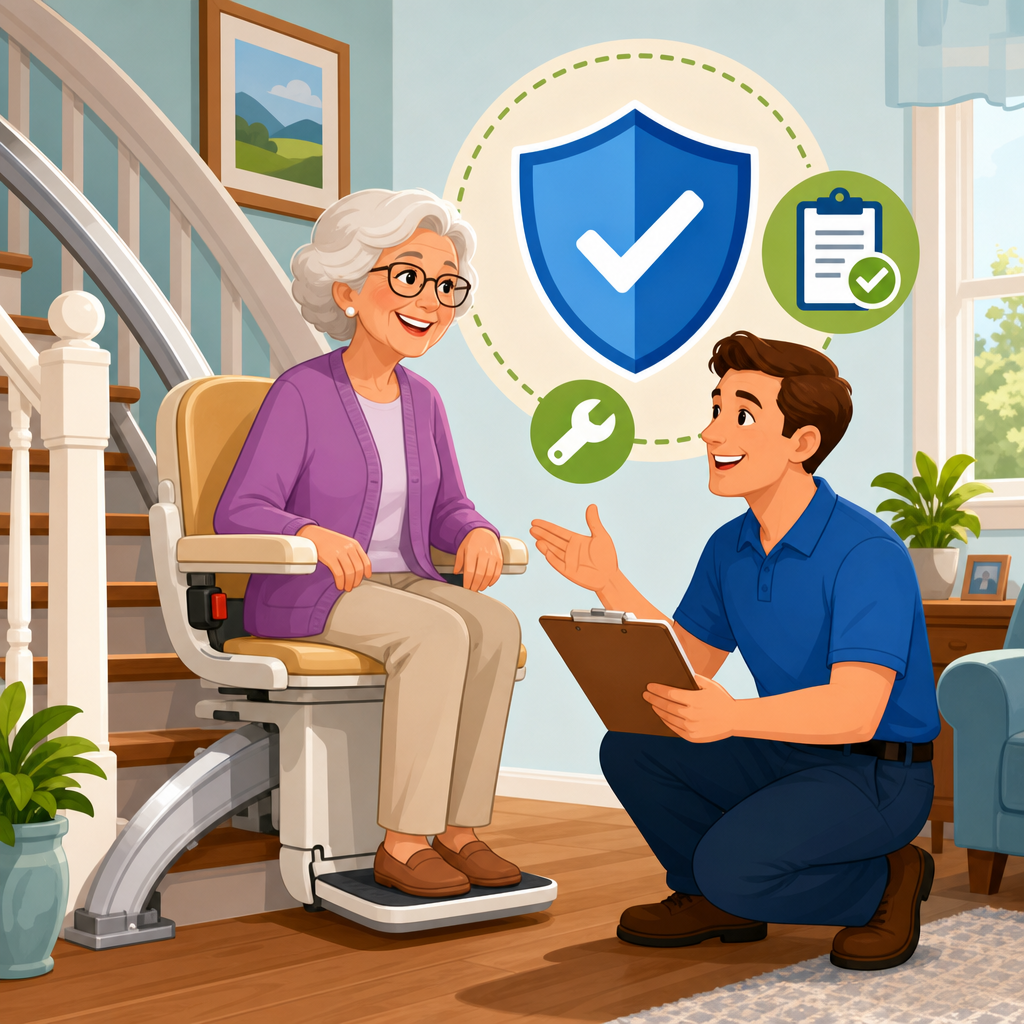
Installation quality also affects whether a warranty pays off. A well-built lift can still fail early if the track is misaligned, charge points are not positioned correctly, or power supply work is rushed. Good dealers perform a final ride test, verify seat swivel locks, confirm obstruction sensors, and explain charging behavior to the owner. They also document serial numbers and registration. I place significant weight on whether the installer is factory-trained and whether the dealer stocks batteries, hinges, remotes, and carriage electronics locally. A moderate warranty backed by a responsive service department is often better than a longer warranty sold by a dealer with slow support and outsourced repairs.
Questions to ask before you sign a chair lift agreement
Before signing, ask direct questions and insist on written answers. Who provides service after installation? What is the typical response time for a nonworking lift? Is labor included for the full extended term? Are batteries, remotes, and call-send stations covered? Does the contract require annual maintenance to remain valid? If the home is sold, can the warranty transfer to the new owner? What happens if the original dealer stops operating? For return terms, ask when the deposit becomes nonrefundable, what fees apply if you cancel, and whether a curved rail can ever be returned.
I also recommend requesting the owner’s manual and warranty sample before purchase. Reputable dealers provide both. Review the troubleshooting section to see whether common issues, such as a swivel seat not locked into travel position or a footrest obstruction switch being triggered, are easy to resolve without service. This reduces unnecessary callouts and helps you judge how user-friendly the model is. Finally, document every promise in the sales agreement. If a representative says “we cover everything for five years,” that sentence should appear in the signed paperwork with definitions. Verbal assurances do not help when there is a billing dispute later.
Extended warranty options for chair lifts are best understood as part of the full buying decision, not as an afterthought added at checkout. The right contract protects mobility, controls repair costs, and reduces stress when a household depends on the lift every day. The wrong contract leaves gaps around labor, batteries, travel fees, or cancellation rights that only become visible when something goes wrong. As the central guide for warranty and return policies, this page should help you compare coverage terms, identify hidden exclusions, and understand how manufacturer promises interact with dealer service obligations. Straight, curved, indoor, and outdoor models all carry different risk profiles, so the best warranty is the one matched to your actual use, home layout, and local service network.
The most important takeaway is simple: read every warranty and return document before you commit money, and compare them with the same care you use when comparing price and features. Look for clear parts and labor coverage, realistic response times, written cancellation rules, and a dealer with proven service capacity. If you are continuing your research, use this hub to explore related guides on manufacturer warranties, return windows, service contracts, rental agreements, and refurbished chair lift protections. Then request written terms from at least two providers and review them line by line before signing.
Frequently Asked Questions
What does an extended warranty for a chair lift usually cover?
An extended warranty for a chair lift typically expands protection beyond the standard manufacturer warranty, which often covers major parts for a limited period after installation. Depending on the provider and plan, extended coverage may include key mechanical and electrical components such as the motor, transmission, circuit boards, charger, batteries, seat swivel mechanism, footrest sensors, and call/send controls. Some plans also help cover labor charges for diagnosis and repair, which can be just as important as parts coverage because service visits can become expensive over time.
That said, not all extended warranties are equally comprehensive. Some only protect specific high-cost components, while others offer broader bumper-to-bumper style coverage for most failures caused by normal use. It is also common for plans to exclude cosmetic wear, damage caused by accidents, misuse, improper installation, power surges, unauthorized repairs, or lack of recommended maintenance. For homeowners comparing options, the most important step is to read the service agreement closely and confirm exactly what is included, what is excluded, whether labor is covered, and whether there are deductibles, trip fees, or annual service limits.
Is an extended warranty for a chair lift worth the cost?
For many buyers, an extended warranty can be worth the cost because a chair lift is not just a convenience item; it is a daily accessibility device that may be essential for safety and independence. Repair costs can add up quickly once the original warranty ends, especially if a lift requires replacement electronic parts, battery service, or multiple technician visits. An extended warranty can make ownership more predictable by reducing the risk of large out-of-pocket expenses and helping ensure that service is available when the lift is needed most.
Whether it is truly worth it depends on several practical factors. Consider the age of the user, how often the lift will be used, whether the staircase is a straight or curved design, the reputation of the manufacturer, and how long the household expects to stay in the home. Curved stair lifts and heavily used units generally involve more complex systems and higher repair costs, which can make extended coverage more attractive. If the plan includes both parts and labor, comes from a reputable company, and has clear terms with minimal exclusions, it often delivers meaningful value. On the other hand, a costly warranty with limited coverage or high service fees may offer less benefit than it first appears.
How long can extended warranty coverage last on a chair lift?
Extended warranty coverage for a chair lift can vary widely, but many providers offer plans that add one to five years beyond the original manufacturer warranty. In some cases, homeowners may be able to purchase renewable annual service protection plans after the initial warranty period ends. The total available coverage period often depends on the lift brand, model, installation type, and whether the warranty is offered directly by the manufacturer or through a local dealer or third-party service company.
It is important to understand when the extended warranty begins. Some plans start on the installation date and run alongside the manufacturer warranty, while others begin only after the standard coverage expires. This difference affects the real value of the contract. Buyers should also ask whether coverage can be renewed, whether the price increases as the lift ages, and whether there is an age limit after which a unit no longer qualifies. If long-term affordability is the goal, the best option is usually a plan that provides clear, uninterrupted protection and makes it easy to continue coverage as the chair lift gets older.
What should you look for before buying a chair lift extended warranty?
Before buying a chair lift extended warranty, focus on the details that directly affect real-world service and repair costs. Start by verifying whether the plan covers both parts and labor, since a warranty that only pays for replacement components may still leave you responsible for substantial technician fees. Next, review the list of covered components, exclusions, deductibles, emergency service terms, response times, and any limits on the number of claims. You should also confirm whether annual maintenance is required to keep the warranty valid and whether that maintenance is included or billed separately.
It is equally important to evaluate the company behind the warranty. Ask who actually performs repairs, whether service is handled by factory-trained technicians, and how quickly appointments are typically scheduled. A low-cost plan is less valuable if repairs are delayed for days when a user relies on the lift every day. Also check whether the warranty is transferable if the home is sold, whether it applies to indoor or outdoor lifts specifically, and whether batteries are treated as consumable items or covered parts. The strongest extended warranty is one that combines broad protection, dependable local service, transparent terms, and a support network that can respond quickly when mobility equipment fails.
Are extended warranties different for straight stair lifts, curved stair lifts, and outdoor chair lifts?
Yes, extended warranties can differ significantly depending on the type of chair lift. Straight stair lifts are generally simpler and use standardized rails and components, so warranty plans for these models may be more affordable and easier to understand. Curved stair lifts, by contrast, are custom-built for a specific staircase and often involve more specialized engineering, custom rails, and higher replacement part costs. Because of that, extended coverage for curved models may be more expensive, but it can also be more valuable if a major component fails after the standard warranty expires.
Outdoor chair lifts also deserve special attention because they operate in harsher conditions. Exposure to moisture, temperature swings, dirt, and UV radiation can increase wear on electrical and mechanical parts, and many warranties have special exclusions related to weather damage or improper storage. If you are considering an outdoor model, make sure the extended warranty clearly states what environmental exposure is covered and what owner responsibilities apply, such as using a protective cover or following seasonal maintenance recommendations. Matching the warranty to the exact lift type is important because the risks, repair costs, and long-term service needs can vary considerably from one installation to another.