
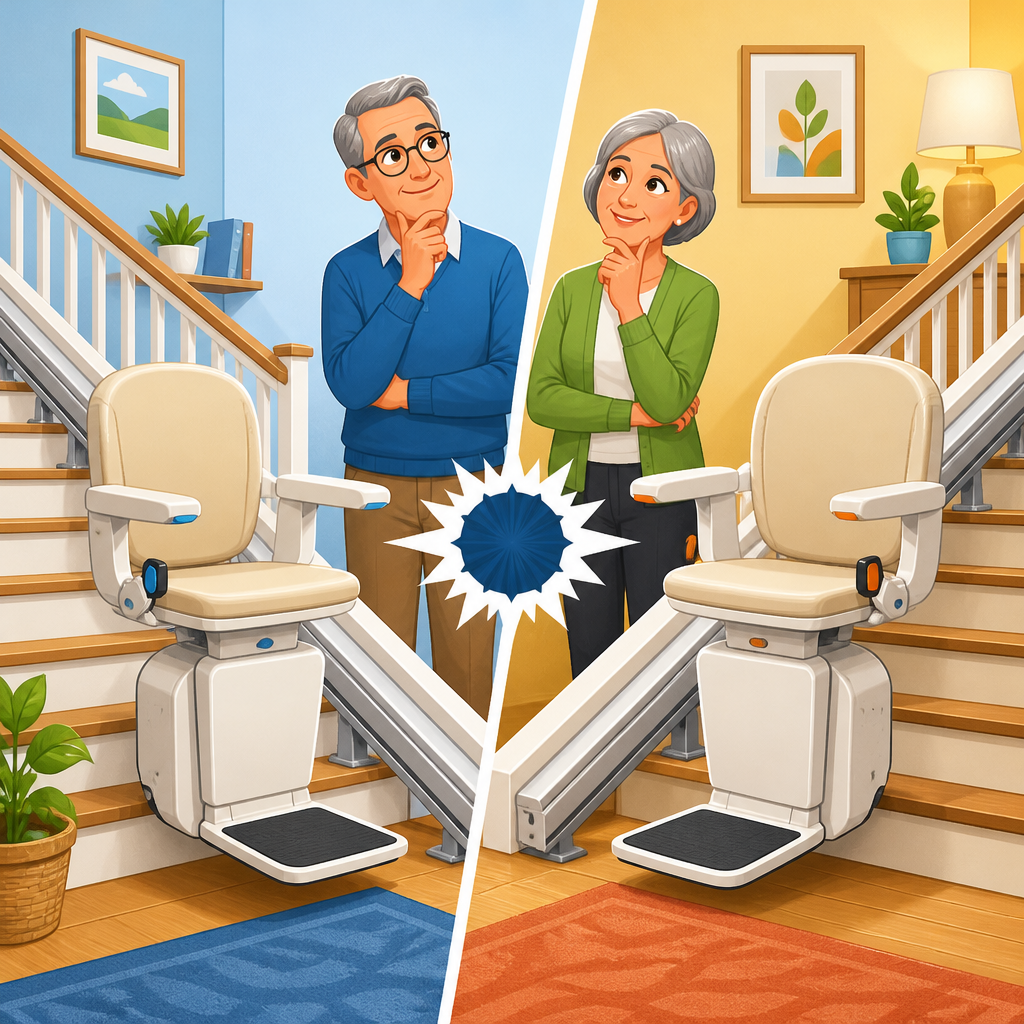
Choosing between the Handicare 1000 and Handicare 1100 comes down to more than price, because track design, ride quality, maintenance needs, and fit on narrow stairs all affect long-term satisfaction. In the straight stair lift category, both models come from a well-known manufacturer with broad dealer support, but they solve the same problem in meaningfully different ways. A straight stair lift is a powered chair that travels on a rail fixed to a straight staircase, helping users move safely between floors without climbing steps. For buyers comparing top stair lift brands, this matchup matters because Handicare positions the 1000 as its established, gear-driven workhorse, while the 1100 is the newer friction-drive option designed for tighter staircases and lower maintenance.
I have worked through many stair lift comparisons with families balancing mobility, safety, and budget, and this is exactly the kind of decision that benefits from specifics rather than marketing claims. People usually ask the same practical questions: Which model fits a narrow staircase better? Which is quieter? Which needs less service? Which feels more stable? Which gives the best value over years of daily use? The answer is not that one unit is universally better. The better choice depends on the staircase, the user’s transfer ability, household traffic, and how important features like a folding rail footprint or power swivel seat are in everyday life.
This guide compares the Handicare 1000 and Handicare 1100 in plain terms and also places them in the wider context of top stair lift brands, including Bruno, Stannah, Harmar, and Acorn. That broader view matters because a hub article should help you understand whether Handicare belongs on your shortlist at all. By the end, you will know where each Handicare model excels, where each has limitations, and which buyers are most likely to be happy with each system.
How the Handicare 1000 and 1100 differ at a basic engineering level
The biggest technical difference is the drive system. The Handicare 1000 uses a traditional rack-and-pinion style arrangement with a geared transmission moving the chair along the rail. That design has been common across the stair lift industry for years because it is proven, durable, and familiar to service technicians. The Handicare 1100 uses a patented friction-drive system rather than exposed gear teeth. In practical terms, that means the 1100 has fewer grease-related issues on the rail, tends to run more cleanly, and often appeals to buyers who want a sleeker installation.
The rail format also matters. The 1100 is known for an especially slim rail, which is one reason it is frequently recommended for narrow straight staircases. A narrower rail can preserve more walking space for other household members. On paper, a few inches may not sound significant, but on a staircase that already feels tight, the difference is noticeable. The 1000 rail is still compact by industry standards, yet it does not usually win the narrow-stair argument against the 1100.
Both lifts run on battery power and charge at stations, which means they can usually continue working during a household power outage if the batteries are in good condition. That is standard among leading stair lifts today and an important safety point. A direct-powered unit that stops when electricity fails would be a poor fit for most homes. In real installations, reliable battery backup is one of the first items I verify because outages are exactly when some users feel most vulnerable.
Installation footprint, staircase fit, and user comfort
If your staircase is the constraint, the Handicare 1100 usually starts with an advantage. Its compact rail and folded profile make it a strong candidate for homes where preserving stair width is essential. This is particularly relevant in older houses, townhomes, and split-level properties where the staircase was never designed with accessibility equipment in mind. Installers still need to measure carefully for code clearance, seat projection, and safe parking positions, but the 1100 is often the easier straight-lift fit.
The Handicare 1000 remains a solid option for standard-width stairs and can work very well where space is less restrictive. Some buyers prefer it because it has been in the market longer and many dealers know the platform inside out. That matters more than shoppers sometimes realize. A stair lift is not just a product; it is a measured, customized installation backed by local service. A well-installed unit with good dealer support typically outperforms a theoretically better model installed poorly or supported weakly.
Comfort is more subjective, but several factors are worth checking in person: seat width, armrest shape, footrest size, start-and-stop smoothness, and ease of swivel at the landing. Both models offer core safety and usability features expected in premium straight stair lifts, such as seatbelts, obstruction sensors, fold-up components, and call/send controls. Depending on configuration and dealer availability, buyers may also see powered options that reduce the effort needed to swivel the seat or fold the footrest. For users with limited hand strength or reduced trunk rotation, those details can make the difference between a lift that is technically usable and one that is comfortably usable every day.
Maintenance, noise, and long-term ownership costs
When buyers ask which lift is “better,” they often mean which one will be easier to live with for five to ten years. Here the Handicare 1100 has a persuasive case. Because its friction-drive rail does not rely on a greased toothed rack in the same way many traditional systems do, it tends to stay cleaner. That can matter in busy homes where dust, pet hair, or contact with clothing are concerns. In my experience, families often appreciate the lower-mess design as much as the engineering concept behind it.
The 1000’s more conventional mechanism is not a flaw. It is a mature design with a long service history, and experienced dealers generally know how to maintain it efficiently. Replacement parts familiarity can also be an advantage in some markets. However, traditional geared systems may involve more visible lubrication and can sound more mechanical during travel. Noise perception varies by staircase construction, wall resonance, and rail length, but many shoppers report that the 1100 feels smoother and quieter.
Battery replacement is an ownership cost for both models. Most stair lift batteries last several years, often around three to five depending on usage patterns, charging consistency, and environmental conditions. Annual service plans are also common. Before buying, ask the dealer for a written breakdown covering installation, warranty coverage, battery costs, labor terms, and service response times. A lower upfront quote is not automatically the better value if labor coverage is short or emergency service is expensive.
| Factor | Handicare 1000 | Handicare 1100 |
|---|---|---|
| Drive system | Traditional geared/rack style | Patented friction drive |
| Best for narrow stairs | Good | Excellent |
| Rail cleanliness | More conventional, may involve visible lubrication | Cleaner rail design |
| Noise profile | Can sound more mechanical | Often quieter and smoother |
| Dealer familiarity | Very strong due to long market presence | Strong and growing |
| Value case | Proven platform, often competitive pricing | Premium fit for tight spaces and lower-maintenance appeal |
Safety features, usability, and who should choose each model
Both the Handicare 1000 and 1100 meet the baseline expectations buyers should have for a modern straight stair lift: seatbelt restraint, pressure-sensitive safety edges, battery backup, lockable controls, and swivel seating for safer exits at the top landing. That means the decision is less about whether one is safe and more about which one supports safer daily use for a specific person. For example, if a user struggles to bend and unfold a footrest, an available powered footrest becomes more important than the rail technology itself.
The Handicare 1100 is usually the better choice for buyers with narrow stairs, those sensitive to noise, and households that want the cleanest-looking installation. It is also a strong fit for people who value a modern, low-profile appearance. If the staircase is the bottleneck, the 1100 often wins before other factors are even considered. By contrast, the Handicare 1000 is a sensible choice for standard staircases, value-focused shoppers, and buyers who prefer an established platform with a long track record in the field.
Weight capacity, seat dimensions, and transfer ergonomics should always be confirmed with the local dealer because available configurations can vary by market and update over time. This is where comparison shopping across top stair lift brands becomes useful. Bruno is widely respected for build quality and dealer support, especially in North America. Stannah has an excellent reputation for ride quality and custom solutions. Harmar offers broad product coverage and practical options at different price tiers. Acorn is highly visible and often considered by shoppers wanting quick quoting. Handicare belongs in that top-brand conversation because its straight-lift lineup addresses both the proven-traditional and newer-space-saving sides of the market.
How Handicare compares with other top stair lift brands
As the hub for this subtopic, this guide should help you place the 1000 and 1100 in the wider market rather than viewing them in isolation. Among top stair lift brands, no single manufacturer dominates every category. Bruno often leads discussions around premium durability and strong domestic dealer networks. Stannah is frequently praised for polished engineering and refined ride quality. Harmar is known for practical breadth, including straight and curved options with wide availability. Acorn stands out for brand recognition and broad consumer visibility. Handicare’s identity is different: it tends to compete by offering reliable straight-lift choices with thoughtful design distinctions, especially the ultra-slim 1100 rail concept.
In real buying decisions, brand matters less than fit, installation quality, and support after the sale. I have seen premium brands disappoint when the local dealer was slow or the home was not measured carefully. I have also seen mid-priced installations perform beautifully for years because the provider handled assessment, mounting, charging points, and user training correctly. That is why any brand comparison should include questions about service territory, technician availability, parts access, and what happens if the lift stops working on a weekend.
If you are building a shortlist under a buying guides and product reviews journey, use this page as your starting point, then compare straight stair lift reviews by brand, pricing guides, rental versus purchase options, and installation checklists. Handicare deserves attention because both the 1000 and 1100 answer legitimate buyer needs. The 1000 offers familiarity and proven dependability. The 1100 offers a better narrow-stair solution and a cleaner ownership experience. Neither should be judged only by brochure language.
Verdict: which straight stair lift is better?
The Handicare 1100 is better for most buyers who need to maximize stair width, want a quieter and cleaner-running system, or simply prefer the advantages of a newer slim-rail design. If your staircase is narrow, this is usually the stronger recommendation. It solves the problem that most often disqualifies otherwise good stair lifts: lack of usable space on the stairs after installation. For many homes, that practical advantage outweighs everything else.
The Handicare 1000 is better for buyers who have a more typical straight staircase, want a dependable traditional platform, and may find a stronger value proposition through local pricing or dealer familiarity. It remains a credible, capable stair lift from a respected brand, not a second-rate alternative. In markets where a dealer has extensive experience with the 1000 and excellent service capacity, that support can narrow the gap considerably.
The key takeaway is simple: choose the Handicare 1100 for tight spaces and lower-maintenance appeal; choose the Handicare 1000 for proven conventional performance and potentially better value on standard stairs. Before you buy, schedule an in-home assessment, sit in both models if possible, and compare Handicare with other top stair lift brands on fit, comfort, warranty, and service response. That step will give you the confidence to pick the straight stair lift that works best in your home, not just the one that looks best on paper.
Frequently Asked Questions
What is the biggest difference between the Handicare 1000 and the Handicare 1100?
The biggest difference is the rail and drive design. The Handicare 1000 uses a traditional straight stair lift track with a geared system, while the Handicare 1100 is known for its slimmer, more modern rail with a friction-drive setup. In practical terms, that affects how much space the lift takes up on the staircase, how smooth it feels during travel, and how much cleaning or maintenance may be needed over time.
For many buyers, the Handicare 1100 stands out because its rail is very compact and designed specifically to work well on narrow staircases. That can make a noticeable difference in homes where every inch of walking space matters. The Handicare 1000, on the other hand, has been a widely installed straight stair lift for years and has a strong reputation for reliability, making it a familiar choice through many dealers. So if you are comparing the two, think of the 1000 as the more traditional platform and the 1100 as the more space-conscious, newer-style option.
The “better” choice depends on your staircase and priorities. If your main concern is preserving stair width and getting a lift that looks sleek and compact, the 1100 often has the advantage. If you are focused on a proven design with broad parts familiarity and long-standing dealer experience, the 1000 may still be very appealing. Both are designed to solve the same mobility challenge, but they do it in different ways that matter in daily use.
Which stair lift is better for narrow stairs: the Handicare 1000 or the Handicare 1100?
In most cases, the Handicare 1100 is considered the better fit for narrow stairs. Its rail is one of its main selling points because it is especially slim and unobtrusive, which helps leave more open stair space for other household members. That matters in tighter homes, older houses with limited stair width, or any setup where maintaining a comfortable walking path is important.
The Handicare 1000 can still work well on many straight staircases, but it is generally not the first model people point to when space is the top concern. Because straight stair lifts mount to the stair treads rather than the wall, the rail design has a direct impact on how much room is left on the staircase. A narrower rail profile can improve both the visual openness of the stairs and the practical ease of passing by the folded lift.
That said, stair width alone does not decide the outcome. Seat size, armrest position, footrest folding, and the user’s body dimensions also affect whether a particular lift will feel comfortable and safe. A professional assessment is still essential, because a staircase that looks too narrow at first glance may still accommodate either model, while another staircase may make the 1100 the clearly smarter choice. If narrow stairs are your main issue, the 1100 usually deserves very serious consideration.
Is the ride quality different between the Handicare 1000 and Handicare 1100?
Yes, ride quality can feel different, even though both lifts are built for safe, controlled travel on a straight staircase. The Handicare 1100 is often described as having a particularly refined feel because of its modern rail and drive approach. Many buyers appreciate that it starts, travels, and stops in a smooth, confidence-inspiring way, which can be especially important for users who are nervous about stair lifts or sensitive to abrupt motion.
The Handicare 1000 also provides a dependable ride, and many users are perfectly happy with its performance. However, because it represents a more traditional design, some people notice differences in sound, rail appearance, or overall feel compared with the 1100. That does not automatically make it inferior. In fact, many homeowners value predictability and familiarity more than subtle refinements, especially when choosing a lift from a product line that has been installed extensively over time.
Ride quality is also influenced by installation quality, staircase condition, and how well the chair is matched to the user. Battery condition, track alignment, and regular servicing all affect how smooth the lift feels in real life. If possible, trying both models through a local dealer is one of the best ways to judge comfort. Small differences on paper can feel much more significant when you actually sit in the chair and ride the full length of the stairs.
Which model is easier to maintain and keep clean over time?
For many homeowners, the Handicare 1100 has an edge in this area because its design avoids the exposed rack-style rail look associated with some traditional stair lifts. Its cleaner rail profile can mean less visible buildup and fewer places for dust and debris to collect, which is attractive for households that want a low-fuss option. That does not mean it is maintenance-free, but it is often marketed as a simpler, cleaner system from an everyday ownership standpoint.
The Handicare 1000 is still a practical and serviceable lift, especially given how widely known it is among stair lift professionals. One advantage of a long-established model is that many dealers are familiar with how to inspect it, adjust it, and service it over time. Depending on your local market, that dealer familiarity may be just as valuable as any design advantage, especially if you want confidence that future maintenance will be straightforward.
No stair lift should be chosen solely on the promise of “no maintenance,” because all powered mobility equipment benefits from periodic inspection. Batteries wear out, moving parts should be checked, and safe operation depends on proper service. The best way to think about maintenance is to compare both the product design and the strength of local support. A well-supported Handicare 1000 may be easier to live with than a theoretically lower-maintenance model if dealer service is stronger for the 1000 in your area. Still, from a rail-cleanliness and streamlined-design perspective, the 1100 often gets the nod.
How should I decide whether the Handicare 1000 or Handicare 1100 is the better value?
Value is about much more than the initial quote. A lower upfront price can look attractive, but if the lift takes up more stair space than you would like, feels less refined to the user, or requires a design compromise in a tight staircase, it may not be the best long-term choice. The better value is usually the model that fits the home well, supports the user comfortably, and delivers dependable service without creating everyday frustrations.
The Handicare 1000 may represent strong value for buyers who want a dependable, established straight stair lift and have a staircase with enough room to accommodate it comfortably. It can also make sense when local dealer familiarity, pricing, or availability favor that model. The Handicare 1100 may offer better value for households where narrow stairs, modern rail design, and reduced visual bulk are major priorities. In those homes, paying more for the right fit can absolutely be worth it.
To compare value accurately, ask for more than just price. Request a full explanation of rail placement, folded dimensions, seat comfort, warranty terms, expected service needs, and installation timeline. Ask the dealer why one model is being recommended over the other for your exact staircase. When you evaluate cost alongside space savings, ride comfort, cleaning convenience, and long-term usability, the better-value choice usually becomes much clearer. For many narrow-stair situations, that ends up being the Handicare 1100, but the Handicare 1000 can still be an excellent buy in the right home.





