Heavy-duty stair lifts for tall users must solve two fit problems at once: seat height and legroom. If either is wrong, the lift may technically carry the rider yet still feel cramped, unstable, or unsafe during every trip. In my work evaluating accessibility equipment, I have seen tall users reject otherwise capable models because their knees sat too high, their feet dragged near stair noses, or the seat-to-footrest distance forced painful hip flexion. A proper fit guide starts with dimensions, not marketing claims.
A heavy-duty stair lift is a reinforced stair chair designed for higher weight capacities, larger body frames, and more demanding use cycles than standard residential models. For tall users, the key measurements are not only maximum capacity, but also seat height, seat depth, backrest shape, arm width, footrest position, and the amount of knee clearance available as the chair moves up and down the staircase. Legroom refers to the usable space between the seat and obstacles such as stair treads, walls, rail supports, and the upper landing. Seat height refers to the vertical distance from the seat surface to the footrest or floor position, which determines knee angle and ease of standing.
This topic matters because fit errors create daily strain and can undermine transfer safety. A tall rider who must rise from a low seat may place excessive load on knees and shoulders. A rider whose legs project too far forward may clip stair edges or feel forced to angle knees awkwardly throughout travel. These issues become more significant in heavy-duty stair lifts because larger chairs often need more staircase space. The best buying decision balances user anthropometrics, stair geometry, and lift engineering. This hub explains how to evaluate heavy-duty lifts for tall users, what measurements matter most, where common design tradeoffs appear, and how to compare models before installation.
What makes a heavy-duty stair lift suitable for tall users
The best heavy-duty stair lift for a tall user is one that supports stature as well as weight. Many buyers focus first on capacity ratings such as 350, 400, or 600 pounds. Capacity matters, but it does not guarantee comfort. I have assessed units with impressive ratings that still left a six-foot-four rider with sharply bent knees because the seat pan sat too low relative to the footrest. For tall users, the fit equation begins with femur length, lower-leg length, hip width, shoulder width, and standing transfer ability.
Manufacturers typically describe heavy-duty lifts using features such as wider seats, higher-capacity gearboxes, reinforced rails, and upgraded motors. Those features are useful, but tall riders should also ask whether the model offers an adjustable seat pedestal, extended seat-to-footrest distance, or multiple armrest positions. Some premium units allow installers to fine-tune seat height within a set range. Others provide only one fixed geometry. Fixed geometry can work when the user’s proportions happen to match the chair, but it is less forgiving in households where two riders of different heights share the lift.
Another overlooked factor is body posture during travel. A tall user with long thighs usually needs adequate seat depth for support, yet too much depth can make standing transfers harder if the front edge presses behind the knees. Backrest angle also matters. An overly reclined back can push the pelvis forward and effectively reduce usable legroom. The right heavy-duty stair lift keeps hips back, thighs supported, knees comfortable, and feet fully planted on the footrest without forcing the ankles into strain.
Seat height: the dimension that affects comfort and transfers most
Seat height is the most important comfort measurement for many tall riders because it shapes both riding posture and standing transfers. In practical terms, it determines whether the user sits with knees below hips, level with hips, or uncomfortably elevated. A low seat can feel secure to a shorter rider, but a tall rider may experience excessive knee bend and difficulty standing at the top landing. A higher seat generally opens the knee angle and reduces the effort required to rise, especially for users with arthritis, limited quadriceps strength, or hip stiffness.
When reviewing heavy-duty stair lifts, ask for the seated height range and the seat-to-footrest distance, not just the seat width. Dealers sometimes emphasize wide seats because they are easy to visualize, yet tall users often benefit more from vertical adjustment than width alone. In home assessments, I measure the user’s popliteal height, the distance from the floor to the underside of the knee when seated with footwear on. That figure helps identify a chair setup that supports the legs without creating pressure behind the knees.
Seat height also affects transfer safety at the upper landing. If the seat swivels and locks into a transfer position, the rider should be able to stand with minimal rocking or forward momentum. This is especially important on heavy-duty stair lifts, where larger seats can slightly alter the rider’s center of mass. A seat that is too low may force the rider to pull on armrests rather than push through the legs. For users recovering from joint replacement, that difference is not minor; it can determine whether the lift feels empowering or exhausting.
Legroom and stair clearance: why the staircase matters as much as the chair
Legroom is not simply the distance from the seat to the footrest. It is the total space available for knees, shins, and feet while the chair travels along the rail. On a straight staircase with generous width and open space beyond the rail, many tall users can ride comfortably even on a larger chair. On a narrow staircase, or one with a wall tight to the knees, a heavy-duty unit may fit mechanically while still restricting natural leg position.
Clearance issues usually appear in three places: overhanging stair noses, tight lower approaches, and the top landing where knees may project toward a wall or doorway during swivel. Curved stair lifts add another variable because the user’s body rotates through bends, and knee position changes throughout travel. In one installation I reviewed, the lift had acceptable clearance on the straight run but caused the rider’s inside knee to approach the wall closely on the curve. The solution was not a different capacity class; it was a different rail path and seat orientation.
Footrest design is part of the answer. A foldable footrest saves space when parked, but the riding position matters more. Some heavy-duty models place the footrest farther forward to accommodate larger riders, which can improve comfort but increase the total envelope of the seated user. Others keep the footrest compact, which preserves stair clearance but may tighten the knee angle. There is no universal best choice. The right specification depends on rider proportions and the measured stair environment.
Measurements to collect before comparing heavy-duty lifts
The fastest way to avoid a poor purchase is to gather measurements before discussing models. Dealers should do this during a site survey, but informed buyers benefit from understanding the process. At minimum, collect user height, inseam, lower-leg length with shoes, thigh length, hip width when seated, shoulder width, and whether the user needs to push from armrests to stand. Then measure the staircase width, tread depth, riser height, lower run-out area, upper landing depth, and any wall projections, trim, radiators, or door frames near the travel path.
The following table shows the core measurements I use when screening heavy-duty stair lifts for tall users and why each one matters.
| Measurement | Why it matters | Typical concern for tall users |
|---|---|---|
| Popliteal height | Guides seat height and transfer comfort | Seat too low increases knee bend |
| Buttock-to-knee length | Indicates needed seat depth and knee clearance | Knees project beyond compact seat designs |
| Seat-to-footrest distance | Determines riding knee angle | Short distance causes cramped posture |
| Stair width | Affects clearance for knees and elbows | Larger chairs may reduce pass-through space |
| Upper landing depth | Controls safe swivel and stand-up room | Long legs need more space to transfer |
| Wall and trim projections | Can interfere with knees on travel | Curves and narrow points become pinch zones |
These measurements should be reviewed together. For example, a user with a long inseam may still fit a moderate seat height if the seat-to-footrest distance is generous and the transfer height at the landing is favorable. Conversely, a wide staircase does not guarantee comfort if the upper landing is shallow. A precise assessment prevents expensive assumptions.
Comparing straight and curved heavy-duty stair lifts for taller frames
Straight heavy-duty stair lifts are usually easier to fit, install, and maintain than curved models. Because they travel in a single line, clearance is more predictable, and dealers can often demonstrate a similar unit in a showroom. For tall users, straight lifts also make it easier to judge whether the seat height and footrest geometry feel natural. If the staircase is straight, buyers should still confirm overrun options at the top or bottom, since those extensions can create safer transfer positions away from the stair edge.
Curved heavy-duty stair lifts require more detailed planning. The rail is custom fabricated to the staircase, and the chair’s path through corners determines whether knees or feet approach walls, balusters, or newel posts. Tall riders should insist on a full discussion of body envelope, not merely whether the chair can physically traverse the route. Premium manufacturers often use digital photo measurement or laser-based surveying to map the stairs. That precision is valuable because a small design change in rail offset or parking angle can materially improve legroom.
There is also a practical budget tradeoff. Straight heavy-duty lifts are far less expensive than curved units and typically faster to install. Curved lifts, however, may be the only viable choice in multi-level homes with turns or intermediate landings. In those cases, comfort and safety should take priority over minimizing upfront cost. A lower-priced curved lift that cramps the rider is not a savings; it is a bad fit that may go unused.
Features that improve fit, safety, and daily usability
Several design features consistently make heavy-duty stair lifts better for tall users. Adjustable seat height is the first priority. Swivel seats with positive locking positions are next, because they help the rider exit onto the landing without twisting the knees. Folding arms and footrests are useful where others need to walk the stairs, but the folded profile should not come at the expense of riding comfort. A high backrest can improve support for larger riders, though it should not push the head or shoulders too far forward.
Drive system quality also matters. Most residential stair lifts use rack-and-pinion drive systems powered by rechargeable batteries, with charging points at rail ends or park positions. Battery-powered operation is preferred because the lift can still function during a power outage. For heavy-duty use, smooth starts and stops are important. Abrupt acceleration can shift a taller rider’s posture, especially if the chair fit is already marginal. Seat belts, obstruction sensors, overspeed governors, and swivel interlocks are standard safety expectations, not premium extras.
Finally, think about maintenance access and service support. Heavy-duty lifts endure greater structural loads and often serve users who rely on them multiple times each day. Ask about the warranty on motor, gearbox, batteries, and rail. Reputable providers should explain load testing, installation standards, and recommended service intervals. In North America, established brands often align product design and installation practices with recognized accessibility and lift safety expectations, even when residential code enforcement varies by jurisdiction.
How this heavy-duty lifts hub helps you evaluate the next article and model review
As the hub page for heavy-duty lifts within the broader chair lift types and designs topic, this guide gives you the framework for every related article. When you read a model roundup, installation guide, or brand comparison, return to the same checklist: capacity, seat height range, seat-to-footrest distance, seat depth, swivel transfer space, and staircase clearance. Those are the variables that decide whether a heavy-duty stair lift works for a tall user in real life.
The main takeaway is simple: buy for fit, not just for rating. A heavy-duty stair lift should let a tall rider sit with balanced posture, travel without knee interference, and stand safely at the landing. Start with user measurements, verify stair geometry, compare straight and curved options carefully, and ask dealers for exact dimensional data. If you are researching heavy-duty lifts for your home or a family member, use this hub as your benchmark and move next to model-specific guides with these measurements in hand.
Frequently Asked Questions
1. Why are seat height and legroom the most important fit factors for tall users choosing a heavy-duty stair lift?
For tall users, weight capacity alone is not enough. A heavy-duty stair lift may be rated to carry a larger rider, but if the seat height is too low or the legroom is too short, the ride can still be uncomfortable, awkward, and potentially unsafe. Seat height affects how easily a person can sit down and stand up at the top and bottom landings. If the seat sits too low, taller riders often end up with excessive knee bend, higher hip flexion, and more effort required to stand. Over time, that can make daily use frustrating, especially for users with arthritis, joint stiffness, back pain, or reduced leg strength.
Legroom matters just as much because tall riders need enough distance from the seat to the footrest to keep their knees and ankles in a natural position. When that space is too tight, knees may rise too high, feet may feel crowded, and the rider can feel folded into the chair rather than supported by it. On some staircases, poor leg positioning can also bring the feet closer to stair noses or nearby obstructions during travel. That creates both a comfort issue and a clearance issue. In practical terms, a well-fitted heavy-duty stair lift should support the rider’s thighs, allow the feet to rest securely, and keep the knees from feeling jammed upward throughout the trip. For tall users, correct dimensions are what turn a lift from technically usable into genuinely comfortable and confidence-inspiring.
2. What measurements should tall users take before comparing heavy-duty stair lift models?
The best place to start is with the rider, not the brochure. Tall users should measure seated knee height, lower leg length, thigh length, and overall hip-to-knee posture in a normal seated position. A simple but useful measurement is the distance from the floor to the back of the knee while wearing typical shoes. This helps identify a comfortable seat height range. Another key measurement is the distance from the back of the hips to the back of the knees, which helps determine whether the seat depth and seating position will properly support the legs without forcing the rider too far forward.
It is also important to measure the distance from the seat surface to the footrest surface on any model being considered. That seat-to-footrest dimension often tells you more about tall-user comfort than the generic phrase “heavy-duty” ever will. If possible, compare that dimension to how the rider naturally sits in a dining chair or supportive armchair at home. In addition, measure stair width, the shape and size of the top and bottom landings, and any nearby trim, radiators, doors, or hallway constrictions. A lift that fits the rider still has to fit the staircase with adequate knee and foot clearance.
Ask the dealer for exact specifications, including seat height from the footrest, seat depth, seat width, arm spacing, and folded dimensions. If the model offers adjustable seat height, adjustable footrest position, or alternative seat options, request the ranges rather than a single number. For tall users, even one or two inches can make the difference between a good fit and a poor one. Whenever possible, an in-home assessment and an actual test sit are far more reliable than relying on weight rating and marketing descriptions alone.
3. How can you tell if a stair lift seat is too low or the legroom is too tight for a tall rider?
There are several common warning signs. If the rider’s knees sit noticeably above the hips, the seat is often too low, the footrest relationship is too tight, or both. If the user has to “drop” into the seat rather than sit down in a controlled way, that is another red flag. The same is true if standing up requires pushing heavily on the armrests, rocking forward multiple times, or pulling on a nearby rail or wall. These are not just comfort complaints; they usually indicate that the seating geometry is making transfers harder than they should be.
During travel, poor fit often shows up as cramped knees, feet positioned too far back, or a sensation that the thighs are not fully supported. Some tall riders report hip pinching, lower-back tension, or numbness during longer rides because the seat-to-footrest distance is too short. Others notice that their toes or heels seem uncomfortably close to the stairs, especially on narrower staircases. If the rider instinctively shifts forward, lets the knees splay outward, or avoids fully placing the feet on the footrest, those are practical signs the lift is not fitting properly.
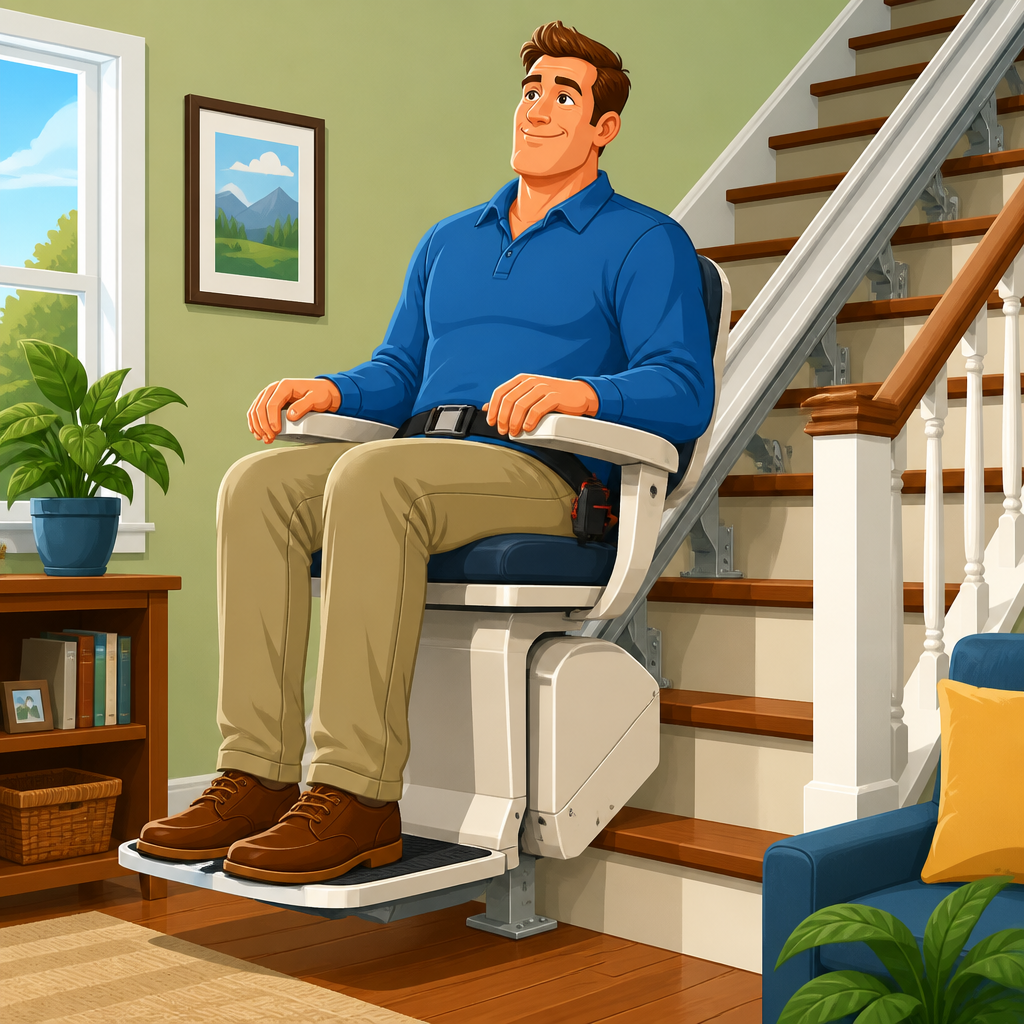
A proper fit should allow the rider to sit back in the seat with the pelvis supported, thighs comfortably resting on the cushion, knees bent naturally rather than sharply, and feet planted securely on the footrest. The rider should feel stable, not compressed. At the landings, they should also be able to get on and off without feeling like they are rising from a child-sized chair. If a test ride leaves the user feeling folded up or strained, the issue is not likely to improve with time; it usually means the dimensions are wrong for that person.
4. Are adjustable seats, footrests, or custom options worth it for tall users?
In many cases, yes. For taller riders, adjustability can be the difference between a stair lift that merely works and one that is truly usable every day. A seat with adjustable height can help create a more natural sit-to-stand transfer, reducing stress on the knees and hips. An adjustable or better-positioned footrest can improve lower-leg angle and give the rider enough room to sit with less compression through the hips. These adjustments matter even more when a user is both tall and heavier, because the body needs more space to sit in a stable, supported posture.
Custom or semi-custom options are especially valuable when the staircase itself limits available room. For example, a model may need a different seat style, a higher perch position, or a track placement that preserves better knee clearance. Some manufacturers offer heavy-duty versions with wider seats, stronger frames, and revised seating geometry, but not all of them proportion the chair well for height. A wider seat does not automatically create better legroom. That is why it is important to ask specifically how the model accommodates long femurs, greater knee height, and larger shoe size, rather than assuming “bariatric” or “HD” means tall-user friendly.
That said, not every adjustment solves every problem. If the base design places the rider too low or too close to the stair treads, small modifications may not be enough. The best approach is to view adjustability as a valuable tool, not a guarantee. For tall users, it is worth paying close attention to models with multiple fit options because they are more likely to provide long-term comfort, safer transfers, and better confidence on every ride.
5. What should tall users ask a stair lift dealer before buying a heavy-duty model?
Tall users should ask detailed fit questions, not just price and weight capacity questions. Start with the exact seat-to-footrest distance, seat height options, seat depth, and any available adjustments. Ask whether the model has been successfully fitted for users of similar height and build. If a dealer answers only in general terms such as “it’s our heavy-duty model” or “it fits most people,” push for actual dimensions. Tall-user fit depends on measurements, not labels.
It is also smart to ask how the dealer evaluates knee clearance over the stairs, especially if the rider has long legs or large feet. Request an in-home assessment that includes a transfer evaluation at both the top and bottom landings. Ask whether the user can test the chair in person, and whether any seat, armrest, or footrest adjustments are made during installation. Find out if the swivel seat, arm height, and footrest position can be configured to improve comfort and safety for a taller rider. If the staircase is narrow, ask directly whether the rider’s knees or feet may project into the stair path or near the wall.
Finally, ask about return policies, refit options, and service support if the initial setup does not feel right. Even a well-specified lift may need fine-tuning after installation. A knowledgeable dealer should be comfortable discussing dimensions, posture, transfer mechanics, and clearance concerns in detail. That kind of conversation is a strong sign that they understand the difference between a lift that can carry a tall user and a lift that truly fits one.