Wide-seat stair lifts solve a specific mobility problem: a standard stair lift seat can feel restrictive, unstable, or unsafe for larger users, people with broad hips or shoulders, and anyone who needs more room to transfer comfortably. In practice, seat width is not a cosmetic specification. It affects posture, pressure distribution, arm support, belt fit, transfer technique, and whether the user can ride without twisting. As someone who has reviewed stair lift specifications for families comparing heavy-duty lifts, I have seen that the right seat width often determines whether a purchase restores independence or creates a daily frustration. For that reason, this guide explains how to choose the right seat width within the broader category of heavy-duty stair lifts.
A wide-seat stair lift is usually part of a heavy-duty stair lift design, but the two terms are not identical. Heavy-duty lifts generally combine a higher weight capacity, a larger chair, reinforced frame components, and a rail or drive system engineered for greater load. Seat width refers to the usable space between armrests or across the seat base, depending on the manufacturer’s measurement method. That distinction matters because brochures do not always measure width the same way. One brand may list overall chair width, while another lists internal sitting width. Buyers who compare numbers without checking definitions can easily choose a model that looks spacious on paper yet feels cramped in use.
This topic matters because stair lifts must fit both the user and the staircase. A wider chair can improve comfort, but it can also require more clearance on the stairs, create tighter folded dimensions, and limit compatibility with narrow hallways or doorways at the top landing. The best choice balances body size, transfer needs, home layout, and future mobility changes. This article serves as a hub for heavy-duty lifts by outlining the key measurements, safety standards, fit considerations, installation constraints, and buying questions that shape a smart decision.
What qualifies as a wide-seat or heavy-duty stair lift
A stair lift is generally considered heavy-duty when it is built for users above the capacity of compact residential models and when it includes a larger seating platform. Standard residential stair lifts often support around 250 to 350 pounds. Heavy-duty models commonly start around 350 pounds and may go to 400, 500, or 600 pounds depending on rail configuration, seat design, and whether the lift is installed on a straight or curved staircase. The wider seat is part of that engineering package, not an isolated upgrade.
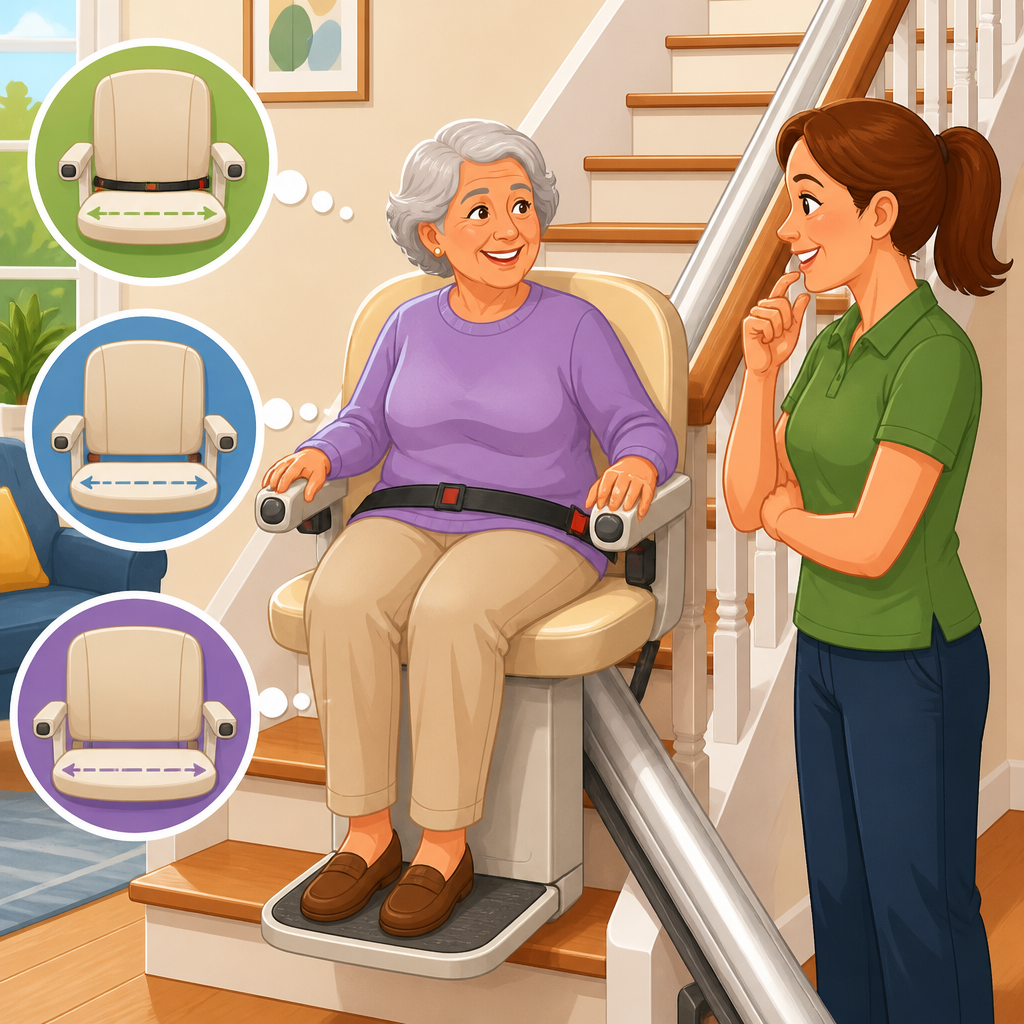
In plain terms, a wide-seat stair lift gives the rider more usable room across the seat and more support through the backrest and armrests. That extra space helps users sit centered without leaning, reduces side pressure at the hips, and makes winter clothing, braces, or assistive garments less restrictive. It can also improve confidence during transfers from a walker, wheelchair, or rollator, especially when the seat swivels and locks at the landing.
However, bigger is not always better. If the seat is too wide for the user, the armrests may sit too far apart to provide leverage during sitting and standing. A belt may cross the body at an awkward angle, and a smaller rider may slide or sit off-center. The right wide seat is not simply the widest model available. It is the model that gives enough lateral room while preserving support, control access, and secure posture.
How to measure the user correctly before comparing models
The most reliable way to choose seat width is to measure the user in the conditions in which the lift will actually be used. Start with seated hip width at the widest point, measured on a firm chair. Then measure shoulder breadth, thigh depth, and seated height from floor to top of shoulder. In homes where the user rides with a coat, orthopedic brace, or continence product, include that added bulk. I advise families to add comfort clearance rather than guessing from clothing size alone, because apparel sizing varies widely and tells you little about seated fit on a mobility device.
Transfer style is just as important as body size. Some users lower straight down onto the seat, while others approach at an angle from a walker or pivot from a wheelchair. A person with limited trunk rotation may need extra width to avoid twisting. Someone with weak upper body strength may need firm, close armrests more than additional lateral space. If the user tends to push off both armrests to stand, measure not only seat width but also armrest spacing and height. Those details affect daily function far more than a marketing label.
Ask the dealer exactly how each dimension is measured. Request the internal seat width, external chair width, folded width, seat height from footrest, and armrest span. If possible, perform a live seating trial in a showroom or during an in-home assessment. In every project I have seen go smoothly, the buyer treated the stair lift chair like fitted equipment rather than ordinary furniture.
Seat width is only one fit variable that affects comfort and safety
Choosing the right seat width means understanding the full seating system. The best heavy-duty stair lifts match width with seat depth, back height, footrest size, and seat-to-footrest distance. A wider seat with shallow depth can leave the thighs unsupported. A good width paired with a low back can make taller users feel unstable. A large rider on a narrow footrest may angle the feet outward, which affects comfort and can create an awkward knee position.
Pressure management also matters. A seat that is too narrow concentrates pressure at the outer thighs and hips. A seat that is too wide can reduce lateral support and encourage slumping, especially during longer rides on multi-story homes. Upholstery density, contouring, and edge design change how the seat feels in daily use. Flat cushions often make transfers easier, while heavily contoured cushions may hold the rider in position better. Neither is universally best.
Safety features should be evaluated together. Look for a secure seat belt, swivel lock, obstruction sensors, overspeed governor, and battery backup. Established manufacturers build stair lifts to recognized safety frameworks such as ASME A18.1 for platform and stairway chairlifts, though model details and local code requirements vary. A heavy-duty label does not replace a proper assessment of fit, landing space, and safe mounting conditions.
How staircase dimensions limit wide-seat stair lift choices
The main constraint on a wide-seat stair lift is usually the staircase, not the catalog. Wider chairs occupy more space when unfolded and sometimes when folded. On a straight staircase, installers look at the clear walking width remaining when the lift is parked and folded, as well as knee and shoulder clearance while riding. On curved stairs, turns and landings can be even more restrictive because the chair must travel through changing geometry without striking walls, banisters, or trim.
Most dealers will measure the staircase width, tread depth, riser height, headroom, and top and bottom landing clearances. They also assess whether doors open onto the stairs and whether a hinged rail or overrun is needed to create safer entry and exit points. In narrow homes, the right answer may be a heavy-duty straight lift with a carefully chosen seat width rather than the absolute largest chair. In some cases, no wide-seat chairlift is appropriate, and a vertical platform lift, ramp, or relocation of sleeping space may be safer.
One common mistake is focusing on stair width alone. A staircase may appear wide enough, yet the top landing can be too tight for a larger user to swivel comfortably. I have seen installations where the rail fit technically, but the rider could not position a walker at the dismount point without blocking the hallway. That is why a full landing and transfer analysis should always accompany seat sizing.
Comparing heavy-duty stair lift specifications the right way
Manufacturer brochures are useful, but they can hide important differences. Compare specifications side by side and verify them with a dealer. Capacity is the first filter, but it should not be the only one. A 400-pound rating on a straight stair may not apply to the curved version of the same product. Seat dimensions may vary by upholstery package or armrest style. Battery-powered lifts may perform differently under repeated use if the charging points are limited to certain parking positions.
| Specification | Why it matters | What to ask the dealer |
|---|---|---|
| Internal seat width | Determines actual sitting room between supports | Is this measured between armrests or across the cushion? |
| Weight capacity | Must safely exceed user weight with real-world margin | Does this rating change on curved rails or upgrades? |
| Folded width | Affects stair access for other household members | How much clear walking space remains when folded? |
| Seat height and depth | Influences transfers, thigh support, and knee angle | Can these dimensions be adjusted for the user? |
| Swivel and landing space | Controls safe entry and exit at top and bottom | Will the user have enough room to pivot with a walker? |
| Rail type | Straight and curved systems differ in fit and price | Is a heavy-duty option available for this stair layout? |
Pay attention to powered features as well. Powered swivel seats and powered footrests can be especially valuable for larger users with limited bending or trunk control. These options add cost, but they often improve safety more than cosmetic upgrades do. If the user cannot reliably lift the footrest by hand or rotate the seat without strain, automation may be justified.
Real-world use cases: matching seat width to user needs
Different users need wide seats for different reasons. A larger adult with stable balance may simply need more hip room and a higher capacity frame. In that case, the priority is usually a broad, firm seat with supportive armrests and a standard joystick or rocker control that is easy to reach. By contrast, a user with obesity plus arthritis may need a wide seat, extra seat height, powered swivel, and a rail overrun so the transfer happens on level flooring away from the stair edge.
Another common case involves a bariatric user who has recently returned home after hospitalization. Families often focus on published capacity first, but clinicians are usually more concerned with transfer safety, deconditioning, edema, and changing body size. A seat that fits today may not fit if braces, dressings, or fluid retention change over the next month. In those situations, choosing a model with a little additional width and generous armrest spacing can provide useful adaptability.
There are also users who are not heavy but still benefit from a wider chair. Someone with a fused spine, broad shoulders, or a neurological condition that causes extensor tone may need more lateral room to sit without twisting. This is why body weight alone should never determine selection. The right seat width is about functional fit.
Costs, installation, and when to consider alternatives
Heavy-duty stair lifts usually cost more than standard lifts because the chair, rail, and drivetrain are engineered for higher loads. Straight heavy-duty models are generally the most economical. Curved heavy-duty lifts are significantly more expensive because the rail is custom manufactured to the staircase. Added features such as power swivel, power folding footrest, call stations, upgraded upholstery, or hinge rails increase the total. Installation complexity, electrical access, and local service availability also affect price.
Used and rental inventory is often limited in the heavy-duty category, especially for curved stairs. That matters because buyers sometimes assume they can save by purchasing secondhand. In reality, refurbished straight lifts may be available, but wide-seat or bariatric-compatible models are not always easy to source, and proper reconditioning is essential. Batteries, seat belts, charging contacts, and safety sensors should be inspected and replaced as needed by qualified technicians.
Sometimes the best recommendation is not a stair lift. If the staircase is too narrow, the landings are too tight, or the user cannot transfer safely onto a chair, a vertical platform lift or home elevator may be more appropriate. On a single short staircase to an entry, a ramp may be simpler. Good providers say this plainly. The goal is safe access, not forcing every problem into a stair lift solution.
How to choose a provider and make a confident final decision
Choose a provider that performs an in-home assessment, not just a phone quote. A qualified assessor should measure the user, measure the staircase, review medical and transfer needs, and explain tradeoffs clearly. Ask which brands they install, whether their technicians are factory trained, what service response times look like, and how warranty coverage works for batteries, motors, and electronics. Reputable companies document model limitations instead of glossing over them.
Request a demonstration if possible. Sit in the chair, fasten the belt, test the control, and simulate the transfer with the mobility aid the user actually uses. Check whether the knees feel compressed, whether the arms can rest naturally, and whether the top landing exit feels stable. These practical observations often reveal more than spec sheets do.
The key takeaway is simple: the right seat width is the narrowest width that still allows safe, comfortable, centered seating and an easy transfer, provided the staircase can accommodate the lift. Heavy-duty lifts work best when capacity, seat dimensions, landing space, and daily transfer habits are considered together. If you are comparing wide-seat stair lifts, schedule a full home assessment, gather exact measurements, and use this heavy-duty lift hub as your starting point for deeper model-by-model research.
Frequently Asked Questions
What seat width is considered “wide” on a stair lift, and how do I know if I need it?
On most stair lifts, a standard seat is designed to fit the average user comfortably, while a wide seat offers extra room across the sitting surface and often more space between the armrests as well. There is no single industry-wide measurement that defines “wide,” because manufacturers use different seat shells, padding, armrest shapes, and weight capacities. In real-world terms, a wide-seat stair lift is meant for people who feel pinched, crowded, or unstable in a standard seat, especially around the hips, thighs, shoulders, or elbows.
You may need a wide seat if the user has broad hips or shoulders, carries weight through the midsection, has difficulty lowering into a narrow sitting area, or struggles to keep their body centered without leaning. It is also a strong option for anyone who needs more room during transfers from a walker, wheelchair, or standing position. A standard seat can sometimes technically “fit,” but still create discomfort or unsafe riding posture if the user has to angle their body, pull in their shoulders, or perch rather than sit fully supported.
The best way to decide is to look beyond the label and focus on functional fit. Measure the user while seated naturally, including hip width, thigh spread, and how much room they need to place both hands on the armrests without squeezing inward. Then compare those numbers with the manufacturer’s actual usable seat dimensions, not just the overall product width. If a user feels pressure at the outer thighs, cannot sit all the way back, or has trouble buckling the belt without twisting, a wider seat is usually not a luxury feature. It is a safety and comfort requirement.
How should I measure for the right stair lift seat width?
Start with the person, not the staircase. The goal is to measure how much seated space the user needs to ride comfortably and transfer safely. Have the user sit in a firm chair with a flat seat, wearing the type of clothing they typically wear at home. Measure the widest point across the hips or upper thighs while seated naturally, without asking them to pull their legs inward. Then add reasonable clearance on each side so the user is not compressed by the armrests or side bolsters. You also want to assess seat depth, back support, and armrest spacing, because seat width alone does not tell the full story.
Next, observe transfer mechanics. Can the user back up to the seat, reach for the armrests, and lower themselves in a controlled way without needing to twist sharply? Do they need room for a gait belt, sling, brace, or winter clothing? Are their knees naturally wider apart when sitting? These details matter because the right seat width should support the whole transfer process, not just the moment of sitting. A seat that looks wide enough on paper may still feel restrictive if the armrests taper inward or the belt anchor points reduce usable space.
After measuring the user, compare those needs with the stair lift’s published dimensions and, if possible, an in-person demo. Ask specifically for the usable sitting width between the armrests, the width of the seat base itself, and whether optional wide-seat packages change the armrest position, footrest size, or swivel clearance. If the user is close to the upper range of a standard seat, it is usually worth testing both standard and wide versions. A proper fit should allow the user to sit back fully, keep weight evenly distributed, rest their arms comfortably, and buckle the restraint without strain.
Does choosing a wider seat affect safety, comfort, or the ability to transfer on and off the lift?
Yes, and usually in positive ways when the seat is matched correctly to the user. The right wider seat can improve posture, reduce pressure points, support better balance, and make transfers more controlled. Users who feel cramped on a standard seat often sit forward, lean to one side, or ride with their shoulders rotated. Those compensations can make the stair lift feel less secure even if the lift itself is functioning perfectly. A properly sized wide seat allows the user to sit centered, use both armrests evenly, and maintain a more natural upright position during travel.
Comfort is not just a convenience issue here. It directly affects whether someone will use the lift consistently and safely. If the seat presses into the outer thighs, cuts into soft tissue, or forces the user to wedge themselves in place, they may rush transfers or avoid fully sitting back. Over time, that can increase fatigue and anxiety, especially for users with arthritis, limited trunk control, or pain issues. Wider seating can also improve belt fit by allowing the restraint to lie across the body more naturally instead of pulling awkwardly from the side.
That said, wider is not automatically better in every case. If a seat is too wide for the user, they may lose side support and feel as though they are sliding or reaching too far for the armrests. The safest setup is one that gives enough room without sacrificing stability. Transfer ability is especially important: the seat should allow the user to approach, turn, sit, and stand with minimal twisting. Features such as a swivel seat, adjustable armrests, folding footrest, and appropriately placed controls often matter just as much as the extra width itself.
Will a wide-seat stair lift fit on any staircase, or are there space and installation limits?
Not every staircase can accommodate every wide-seat configuration, so this is one of the most important questions to ask early. A wide seat does not necessarily mean the rail cannot be installed, but it can affect how much space remains on the stairs when the lift is folded and when it is in use. Staircase width, wall obstructions, handrails, doorways at the top or bottom landing, and the turning radius needed for a swivel seat all come into play. Curved staircases, narrow landings, and tight hallways often require more careful planning than straight stair runs.
It is also important to distinguish between overall lift width and usable seat width. Some models create more room for the user through smarter armrest design or a higher-capacity chassis rather than dramatically increasing the outer footprint. Others may require a larger carriage or a different seat style that projects farther into the stairwell. If there are other household members using the stairs on foot, the installer needs to confirm that the folded lift still leaves adequate walking clearance based on local codes and practical daily use.
A professional home assessment is essential here. The installer should measure the staircase width at its narrowest point, evaluate top and bottom transfer space, check for any radiators, trim, door swings, or protrusions, and explain how the chosen seat affects clearance. In many homes, a wide-seat stair lift is absolutely workable, but the right model matters. The best outcome comes from balancing user fit with stair geometry, rather than assuming the widest available seat is always the right answer.
What other features should I compare along with seat width when choosing a stair lift?
Seat width should be one of the top decision factors, but it should never be evaluated in isolation. Weight capacity is closely related, because many wide-seat stair lifts are built on heavy-duty frames designed for larger users. If the user needs extra room, they may also need higher capacity, stronger arm support, and a more robust drive system. Check the seat height from the footrest and floor, because a seat that is too low or too high can make standing up much harder, even if the width is ideal.
Look carefully at armrest spacing, armrest length, seat depth, backrest shape, footrest size, and belt design. These details change how secure the seat feels in everyday use. For example, a user with broad shoulders may need extra width up top, while someone with limited hip mobility may benefit more from a seat that offers easier side access and a smooth swivel at the landing. If the user wears a brace, uses a transfer board, or needs caregiver assistance, those factors should be discussed before buying. A seat that seems roomy can still be a poor match if the controls are awkward to reach or the belt is difficult to fasten.
Finally, ask about real-world usability: Can the user test the lift before purchase? Is there a wide-seat option on the same model, or does moving to a wider seat require changing to a different product line? How easy is it to fold the seat and footrest? Is maintenance support available locally? The right stair lift is the one that combines proper seat width with safe transfer design, reliable operation, and a fit that supports the user’s body every day. When families focus on overall function rather than a single number in a brochure, they usually make a much better long-term choice.