
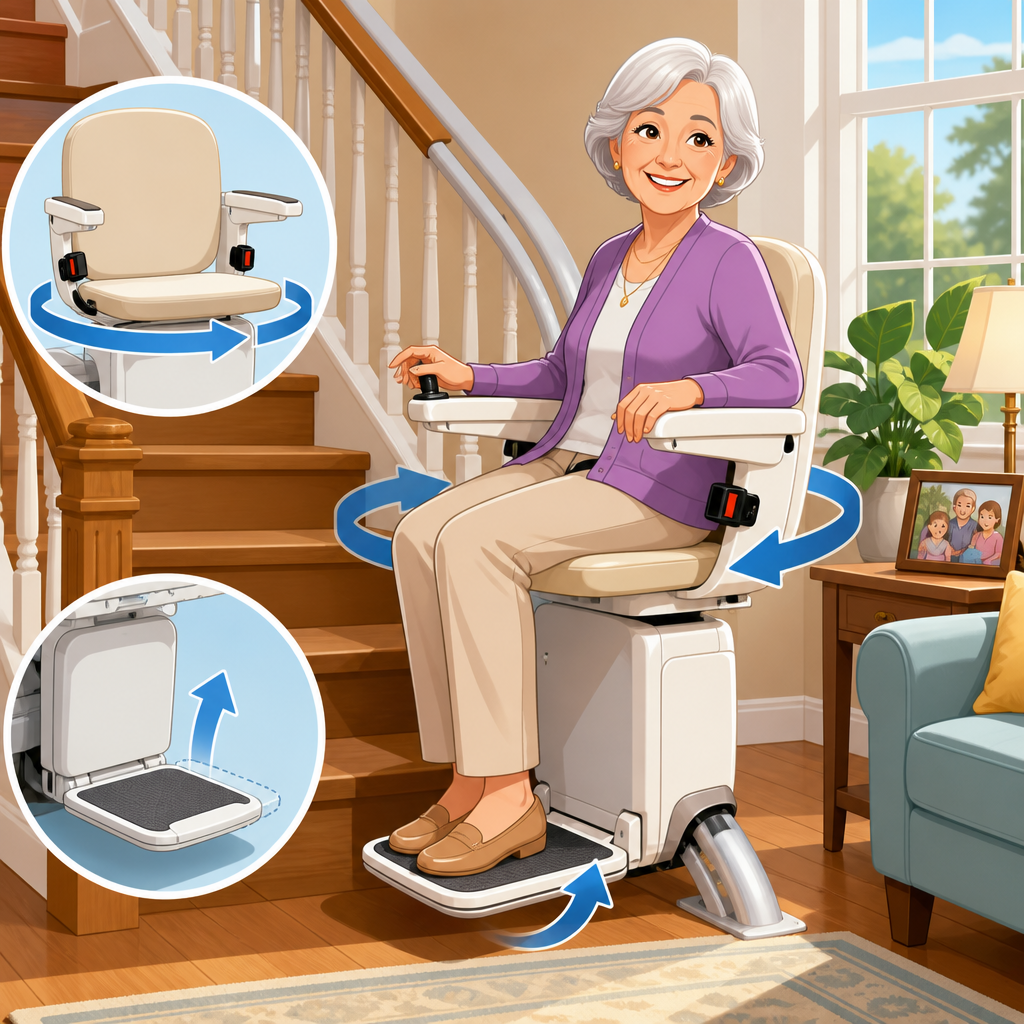
Premium stair lifts with power swivel seats and automatic footrests are built for users who want safer transfers, easier boarding, quieter operation, and a more refined ownership experience than standard models usually provide. In mobility equipment, “premium” does not simply mean decorative finishes or a higher price tag. It generally refers to advanced drive systems, powered seating functions, improved ergonomics, tighter rail engineering, stronger diagnostics, better warranties, and dealer support that reduces service interruptions over time. Power swivel seats rotate electronically at the landing so the rider exits facing away from the staircase, lowering twisting strain on the hips, knees, and spine. Automatic footrests fold and unfold without bending, which matters for people with arthritis, back pain, limited reach, or balance concerns. After working with homeowners comparing stair lift options, I have seen these two features move from nice extras to essential requirements when daily comfort and transfer safety are the top priorities.
These features matter because the moment of getting on and off a stair lift is where many users feel most vulnerable. Riding the chair is usually straightforward; positioning the body at the top landing, clearing the stair edge, and managing feet placement are the harder tasks. A powered swivel can create a stable exit angle, while an automatic footrest helps keep legs supported during travel and minimizes the need to stoop before or after the ride. Premium models also tend to package these functions with other high-value upgrades such as seat height adjustment, soft-start and soft-stop travel, obstruction sensors, retractable rails, heavier weight capacities, and cleaner upholstery options. For households researching luxury and premium models, this hub explains what these lifts are, how they differ from mid-range units, which specifications actually matter, and how to evaluate them with confidence before making a large purchase.
What Defines a Premium Stair Lift
A premium stair lift combines core safety standards with convenience features that materially improve daily use. In practical terms, that usually means a powered swivel seat, automatic footrest, remote call-send controls, battery backup, seatbelt integration, safety edges, and smoother acceleration profiles. It may also include a custom-upholstered seat, slimmer folded profile, larger armrests, digital status display, and a refined rail finish that suits visible interiors. Reputable brands in the premium tier commonly include Bruno, Stannah, Handicare, Harmar, Savaria, and Access BDD, though available models vary by region, staircase type, and dealer network. Straight stair lifts often offer the widest feature choice, while curved stair lifts can integrate premium functions into highly customized rail systems built from detailed measurements or photo-mapping.
The most important distinction is that premium models are designed around transfer quality, not just transport. A basic chair gets a person up the stairs. A premium chair reduces physical effort before the ride, during travel, and at the landing. That is a meaningful difference for older adults aging in place, users recovering from surgery, and anyone with progressive conditions affecting strength, dexterity, or trunk rotation. In my experience, buyers often underestimate how often they will fold, unfold, swivel, or reposition the chair. Those micro-movements become the real test of satisfaction. A model with a manual swivel and manual footrest may appear adequate in a showroom but feel demanding after months of daily use, especially at the top landing where confidence matters most.
Why Power Swivel Seats Improve Safety and Comfort
A power swivel seat rotates the chair automatically when it reaches the upper landing, and on some models at the lower landing as well. This allows the user to exit onto a flat surface rather than turning over the staircase edge. The direct benefit is reduced torsional stress through the hips and lower back. For people with osteoarthritis, lumbar stenosis, joint replacements, or limited single-leg stability, that reduction in twisting can be decisive. Many dealers treat the powered swivel as a comfort upgrade, but in real homes it often functions as a transfer-risk reduction feature. The seat locks in position before transfer, which supports a more deliberate stand-up movement using the armrests for leverage.
There are tradeoffs to understand. Powered swivel mechanisms add cost, require reliable motor components, and can slightly increase diagnostic complexity if a fault occurs. They also need user-friendly controls. The best systems use rocker switches or armrest toggles that are easy to operate for riders with limited hand strength. Some premium lifts coordinate the swivel with call-send controls and final parking position, reducing extra steps. Others still require the user to maintain pressure on the switch until rotation completes, which can be harder for users with tremor or neuropathy. Testing the seat rotation speed, stopping precision, and stability at the locked position is essential. In premium buying guides, this is one of the most important in-home demonstration points because showroom conditions rarely replicate a tight landing or a narrow hallway.
How Automatic Footrests Change Everyday Usability
An automatic footrest addresses one of the most overlooked strain points in stair lift ownership: bending down to fold or unfold the platform. On manual models, that repeated stooping can be difficult or impossible for users with spinal issues, dizziness, poor balance, or restricted shoulder mobility. Premium stair lifts with automatic footrests let the rider deploy the foot platform with a switch, often linked to the seat fold system. This supports safer leg positioning, keeps feet aligned during travel, and simplifies parking the chair when not in use. In multi-user homes, a powered footrest also makes it more likely the lift will be folded properly, which helps preserve walking clearance on the stairs.
Automatic footrests are particularly valuable for people who transfer independently but have limited forward flexion. I have seen buyers focus first on weight capacity or upholstery color, then realize during a live demonstration that touching the footplate is their biggest obstacle. A well-designed automatic unit eliminates that friction. It should also retain obstruction sensors on the footrest edges, stopping the lift if it contacts an object on the staircase. Premium models typically combine this with pressure-sensitive carriage covers and seat-base safety circuits. The result is not just convenience; it is a system engineered to reduce everyday handling demands while preserving the protective features required for residential use.
Features That Usually Accompany Luxury and Premium Models
High-end stair lifts rarely rely on power swivel seats and automatic footrests alone. They are usually part of a broader package that improves ride quality, fit, and serviceability. Soft-start and soft-stop control is one example. Rather than jerking into motion, the chair ramps speed gradually, which feels more secure for frail riders and reduces the sense of pitching forward. Premium units also tend to include higher-grade batteries, onboard charging points, and clearer fault indicators that help technicians diagnose issues quickly. For homes where the lift is installed in a main entry hall or visible living area, aesthetics matter too. Slim rails, concealed gear racks, and upholstery choices can make a stair lift look integrated rather than improvised.
| Feature | Why it matters | Who benefits most |
|---|---|---|
| Power swivel seat | Improves landing transfer angle and reduces twisting | Users with hip, knee, or back limitations |
| Automatic footrest | Eliminates bending to deploy or stow the platform | Users with arthritis, poor balance, or spinal pain |
| Soft start and stop | Creates smoother travel with less sudden motion | Frailer riders and anxious first-time users |
| Retractable rail | Keeps doorways or walkways clear at the bottom landing | Homes with tight entry spaces |
| Advanced diagnostics | Speeds troubleshooting and service visits | Owners prioritizing uptime and dealer support |
Other premium features include powered hinges for rail clearance, larger perch seats for users who struggle to bend fully at the hip, and heavier-duty drivetrains for higher weight capacities. Some brands offer integrated armrest controls with tactile differentiation, which sounds minor until you watch a user with reduced sensation navigate the interface. Better premium models also fold compactly. A narrow folded profile is not just cosmetic; it can preserve staircase access for other household members. For readers exploring related buying guides and product reviews, this hub connects naturally to topics such as straight versus curved stair lifts, stair lift measurements, heavy-duty stair lifts, and service contract comparisons.
Straight vs Curved Premium Stair Lifts
Straight premium stair lifts mount on staircases without turns, intermediate landings, or spiral sections. They are faster to install, less expensive, and more standardized in configuration. Because the rail is modular or cut to length, straight lifts often provide the clearest value path into premium ownership. A buyer can allocate more budget to powered features, upholstery upgrades, or warranty coverage without absorbing the engineering cost of a custom rail. Curved premium stair lifts, by contrast, are made to match staircases with bends, half-landings, or complex geometry. The rail is custom fabricated from detailed measurements, and the chair must maintain clearance through each turn while preserving comfortable seat orientation.
Curved systems are where dealer skill becomes especially important. Measurement errors, landing congestion, and rail placement can affect knee room, folded clearance, and transfer ease. In luxury installations, the best outcomes come from careful site surveys, often using digital measuring tools or photo-based mapping systems. Curved lifts also show wider variation in power swivel behavior. On some staircases, the exact dismount angle is constrained by walls, banisters, or door swing. That makes an in-home assessment more valuable than any brochure specification. Buyers should ask where charging points are located, whether the rail parks away from the main living space, and how the automatic footrest behaves on tight curves. These details determine whether a premium curved lift feels elegantly integrated or merely expensive.
How to Evaluate Brands, Dealers, and Installation Quality
The best premium stair lift is the one supported by a strong local dealer with trained installers, stocked parts, and responsive service. Brand reputation matters, but the dealer often shapes the ownership experience more than the logo on the seatback. Ask whether the installer is factory trained, whether service is handled in-house or subcontracted, and what the average response time is for a nonemergency repair. Reputable dealers should assess staircase width, landing depth, power supply location, user height, transfer pattern, and any diagnosis that affects seating or balance. They should also explain applicable standards, including common safety expectations aligned with North American and European lift practices, and document warranty coverage in plain language.
A careful quote should separate equipment cost, custom rail cost if applicable, installation, powered options, and ongoing service plans. It should also state weight capacity, folded dimensions, rail overrun details, and what happens if the home layout changes later. In my experience, the strongest dealers do not rush the sale. They encourage test rides, discuss limitations honestly, and identify when a stair lift is not the best solution compared with a home elevator, vertical platform lift, or first-floor living reconfiguration. That balance is a sign of credibility. Premium buyers should also ask about battery replacement intervals, expected service life, upholstery cleaning requirements, and whether annual maintenance is recommended or required to preserve warranty terms.
Cost, Value, and Who Should Buy a Premium Model
Premium stair lifts cost more because they include more hardware, more customization, and often better service infrastructure. Straight premium models commonly land above the entry-level market, while curved premium systems can rise significantly once custom rail fabrication and powered options are added. Yet the value equation is not only upfront price. If a power swivel seat prevents difficult transfers and an automatic footrest removes the need for unsafe bending, those features can determine whether the lift is actually used consistently. For many households, that difference supports aging in place, reduces caregiver strain, and delays costlier housing changes. In practical terms, paying more for the right transfer features often delivers better long-term value than buying a basic unit that the user dislikes.
These models are best for buyers with visible transfer challenges, premium interior expectations, or plans to remain in the home for years. They are also sensible for couples where one rider needs maximum assistance reduction and the other wants the staircase to remain tidy and accessible. Not every buyer needs the top tier. If the user has good flexibility, strong hand function, and a simple straight staircase, a mid-range model may be sufficient. But when comfort, independence, and daily ease are the priorities, premium stair lifts with power swivel seats and automatic footrests justify their position clearly. Compare leading brands, insist on a detailed home assessment, and use this hub as your starting point for deeper buying guides and product reviews across the luxury stair lift category.
Frequently Asked Questions
1. What makes a premium stair lift different from a standard stair lift?
A premium stair lift is designed to improve far more than appearance. While high-end upholstery, slimmer rails, and cleaner styling may be part of the package, the real difference is usually found in the engineering, safety, and day-to-day usability. Premium models often include advanced drive systems that deliver smoother starts and stops, quieter travel, and better performance over time. They may also feature tighter rail design, more refined charging systems, stronger onboard diagnostics, and higher-grade components that reduce vibration and wear.
Another major difference is user comfort and transfer safety. Premium stair lifts with power swivel seats and automatic footrests are built to reduce physical strain when getting on and off the chair. Instead of manually twisting the seat or bending down to fold the footrest, the user can often operate these functions with a control switch, armrest button, or remote. That can be especially valuable for people with limited balance, arthritis, hip or knee pain, or reduced flexibility.
Premium ownership also tends to include stronger warranties, more dealer support, and more precise installation practices. In many cases, the product is backed by better service networks and more robust maintenance guidance. So when people ask what “premium” means in mobility equipment, the best answer is this: it usually means better transfer safety, more convenient powered features, improved ride quality, stronger long-term reliability, and a more polished overall experience than standard models typically offer.
2. How do power swivel seats and automatic footrests improve safety?
These two features directly address one of the most important parts of stair lift use: the transfer on and off the chair. Many falls do not happen while the lift is moving. They happen when a person is stepping onto the footrest, lowering themselves into the seat, standing up, or trying to turn at the top landing. A power swivel seat helps by rotating the chair into a safer exit position, usually at the upper landing, so the user can get off facing away from the staircase rather than twisting awkwardly near the edge of the steps. This can reduce the risk of losing balance during the transfer.
An automatic footrest adds another important safety advantage. With a manual footrest, a user often has to bend down to unfold or fold it, which can be difficult or unsafe for someone with limited mobility, back pain, dizziness, or poor stability. An automatic footrest removes that step by letting the foot platform move with powered assistance. This helps the user maintain an upright posture and avoid unnecessary reaching or bending.
Together, these features create a more controlled boarding and exiting process. They can also help caregivers by reducing the amount of hands-on assistance needed for routine use. Of course, safety still depends on proper installation, correct fit, regular maintenance, and user training. Seat belts, obstruction sensors, armrest design, and landing space all matter too. But in practical everyday use, power swivel seats and automatic footrests are among the most meaningful upgrades for people who want safer, easier transfers.
3. Are premium stair lifts worth the higher cost?
For many households, yes, especially when the user plans to rely on the stair lift every day or has mobility limitations that make transfers difficult. The higher price often reflects meaningful functional upgrades rather than purely cosmetic add-ons. Powered seating functions, smoother drive systems, improved ergonomics, quieter operation, and more advanced diagnostics can make the lift easier to use consistently and more comfortable over the long term. If a stair lift feels awkward, noisy, or physically demanding to operate, there is a greater chance it will be used less confidently or less often.
Premium features can also provide value by reducing physical effort and supporting independence. A user who cannot safely bend to adjust a footrest or manually rotate a seat may find a standard model frustrating or even impractical. In that situation, a premium model may not be a luxury at all. It may be the version that actually fits the person’s needs. Better ride quality, more precise stopping, and stronger transfer support can make a substantial difference in confidence and safety.
It is also important to look at ownership value rather than purchase price alone. Better warranties, stronger dealer support, readily available service, and durable components can matter just as much as the initial feature list. A lower-priced lift that needs more service or does not meet the user’s mobility needs may be less cost-effective over time. The right question is not simply, “What does it cost?” but rather, “What level of comfort, safety, and long-term usability does the user need?” When viewed that way, premium stair lifts are often well worth the investment for buyers who want a dependable and easier daily experience.
4. Who benefits most from a stair lift with a power swivel seat and automatic footrest?
These features are especially helpful for users who have difficulty with bending, twisting, lifting, or maintaining balance during transfers. That includes many older adults, people with arthritis, users recovering from surgery, and individuals living with conditions that affect strength, flexibility, or coordination. Someone with knee pain, hip stiffness, spinal limitations, or reduced core stability may find manual seat rotation or footrest adjustment uncomfortable or unsafe. In those cases, powered functions can make the stair lift significantly easier to use.
They can also be a strong choice for users who are still fairly independent but want to reduce strain and preserve energy. A premium stair lift is not only for someone with severe mobility limitations. It can also be ideal for a person who wants a smoother, more convenient, and more dignified experience every time they use the stairs. Quieter travel, more refined controls, and easier transfers often lead to greater confidence and better long-term satisfaction.
Caregivers benefit as well. If a family member currently helps the user position the chair, adjust the footrest, or manage transfers at the top landing, powered features can reduce that workload and lower the chance of awkward lifting or unstable movement. The best candidates are people who want a combination of safety, comfort, independence, and reliability. A professional in-home assessment is the best way to confirm whether these features match the user’s physical needs, staircase layout, and transfer habits.
5. What should I look for when shopping for a premium stair lift?
Start with transfer safety and everyday usability, not just the brochure feature list. Make sure the power swivel seat and automatic footrest are easy to operate and genuinely useful for the intended user. Ask how the seat rotates, whether it locks securely at the landing, how the footrest deploys, and what happens if there is an obstruction on the stairs. A quality stair lift should also include seat belts, safety sensors, reliable armrest controls, and a comfortable seat height and width for the user’s body type and mobility level.
Next, evaluate ride quality and engineering. Ask about the drive system, the smoothness of starts and stops, battery backup, charging method, rail design, and noise level during operation. Premium models typically distinguish themselves through quieter movement, more refined rail fit, and better overall ergonomics. Diagnostics are another important consideration. Advanced diagnostic systems can make troubleshooting faster and improve service efficiency if an issue arises.
Dealer quality matters just as much as product quality. Choose a provider that offers professional assessment, precise installation, user instruction, and dependable local service after the sale. Ask what the warranty covers, how quickly service calls are handled, whether maintenance plans are available, and how accessible replacement parts are. It is also wise to ask whether the lift can be tailored to the staircase and user needs, especially if there are narrow stairs, intermediate landings, or specific transfer concerns.
In short, the best premium stair lift is not simply the one with the highest price or longest list of upgrades. It is the one that combines powered transfer features, strong safety design, smooth operation, reliable support, and a proper fit for the user and home. A thorough in-home evaluation and a clear explanation of how the lift will be used every day are the best ways to make a confident decision.





