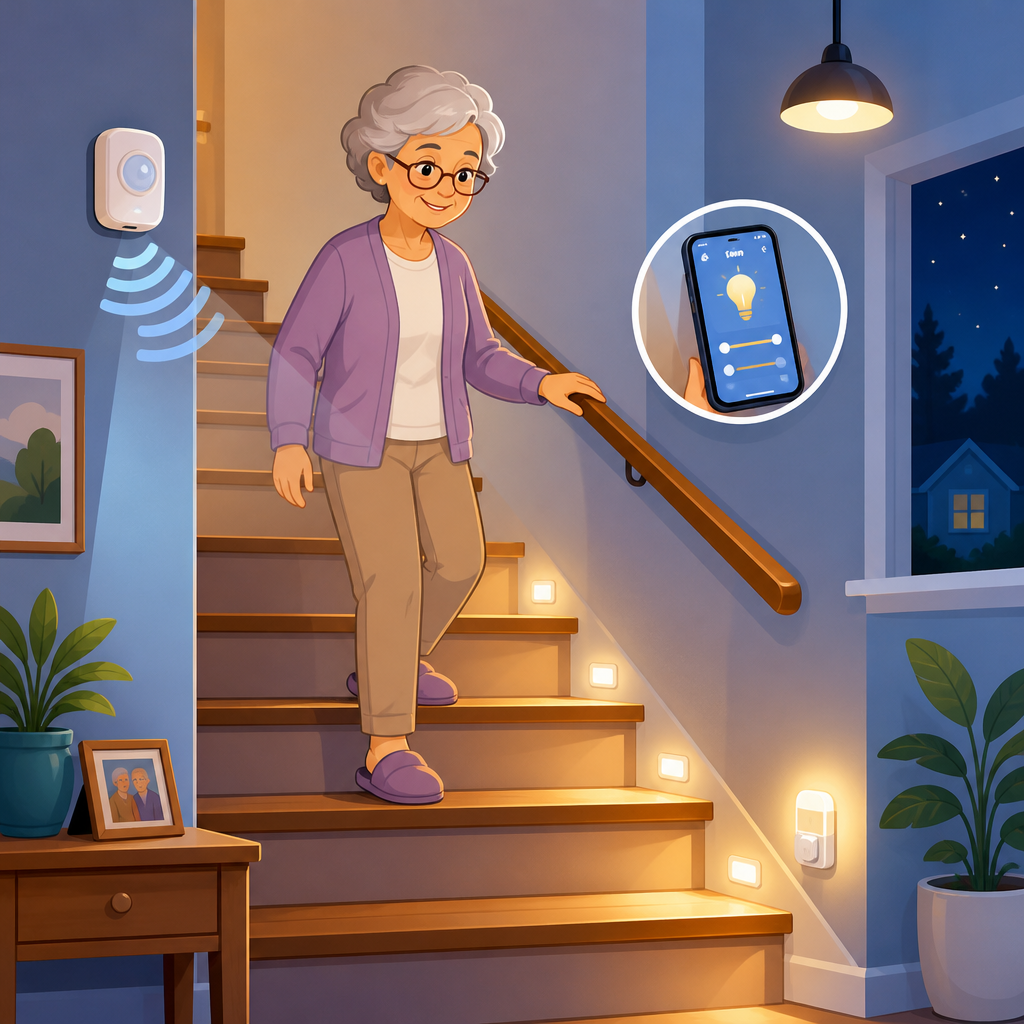
Smart stair lighting for seniors combines motion sensors, low-glare night lights, and home automation to make one of the most hazardous areas in a house safer, easier to navigate, and less dependent on memory or quick reflexes. In accessibility planning, stair lighting is not simply about brightness. It involves visibility, contrast, timing, switch placement, backup power, and how lights respond when someone approaches a step edge at night. For older adults, especially those with reduced vision, arthritis, neuropathy, balance changes, or slower reaction time, a poorly lit staircase can turn an ordinary trip to the bathroom into a serious fall risk.
I have worked on aging-in-place lighting upgrades in multilevel homes, and stairways are almost always underestimated. Families often install brighter bulbs and assume the problem is solved. In practice, that misses the real issue: seniors do not just need more light; they need the right light at the right moment without fumbling for a switch. The most effective systems layer task illumination, motion activation, and predictable automation so the stairs are visible before the first foot lands on the tread. That is where smart home integration becomes valuable.
A smart stair lighting system usually includes several components. Motion sensors detect movement near the top or bottom landing. Night lights provide low-level illumination for orientation after dark. Smart bulbs, LED strips, dimmers, switches, or plug-in modules control brightness and schedules. A hub or platform such as Apple Home, Amazon Alexa, Google Home, Samsung SmartThings, Hubitat, or a Matter-compatible controller can coordinate devices so they behave consistently. Some homes also add contact sensors, occupancy sensors, voice control, daylight sensors, and battery-backed emergency lighting.
This matters because falls are a major health threat for older adults, and stairs are a common location for severe injuries. Better stair visibility helps people judge tread depth, identify edges, and maintain confidence. Well-designed automation also supports caregivers. If lights reliably activate at night, family members worry less about missed switches or dark hallways. As the hub page for smart home integration under accessibility and mobility solutions, this guide explains how to choose motion sensors, place night lights, automate safely, and connect stair lighting to a broader accessible home strategy.
Why Stair Lighting Needs a Senior-Focused Design
Senior-friendly stair lighting starts with the fact that aging affects vision and movement in specific ways. Older eyes generally need more illumination to perceive detail, but excessive brightness can create glare, which reduces contrast and makes step edges harder to read. Warm, diffused light often feels comfortable, yet if it is too dim or uneven, it can leave the nose of each tread visually ambiguous. The goal is not theatrical accent lighting. The goal is uniform, shadow-controlled illumination that reveals every step clearly from both directions.
Physical changes matter too. A younger person can often recover from a missed step with a quick correction. Many seniors cannot. Arthritis may limit how quickly they can reach a rail. Peripheral neuropathy can reduce foot sensation. Parkinsonian gait, post-stroke weakness, and vestibular disorders can all make stair travel more deliberate. In homes I have assessed, even a one-second delay between entering the stair zone and lights reaching useful brightness was enough to create hesitation or missteps. That is why response time and sensor placement are not minor technical details.
Design should also account for cognition and routine. Automation reduces reliance on remembering a switch, but only if the system behaves predictably. Lights that trigger inconsistently, dim too soon, or change color temperature unexpectedly can confuse users. The best systems are simple: the stairs light up when needed, stay on long enough for a full trip, and return to a low-energy state afterward. Seniors and caregivers benefit most when the system is understandable without needing an app for everyday use.
Motion Sensors: What Works, What Fails, and Where to Place Them
Motion sensors are the backbone of smart stair lighting because they solve the problem of switch access. The two most common types are passive infrared, which detects body heat movement, and microwave or mmWave-based sensors, which can detect finer motion through radio frequency patterns. Passive infrared sensors are widely available and inexpensive, but they can miss slow movement or activation from awkward angles. mmWave sensors are more sensitive and useful for slow walkers, though they can be harder to tune and may trigger through thin walls if poorly placed.
For most homes, the best setup uses one sensor at the top landing and one at the bottom landing, each aimed to catch approach movement before a person reaches the first step. A common mistake is mounting a sensor so it sees only the stairs themselves. That often means the light turns on after the person has already committed to the first step. Better practice is to cover the approach path by several feet. If there is a hallway leading to the stairs, detect the hallway. If a bedroom opens near the landing, detect the doorway area as well.
Placement height and field of view matter. Wall-mounted sensors around switch height can work well because they capture lateral approach motion. Ceiling sensors are useful on wider landings but may miss directionality. In narrow stairwells, side-wall placement usually gives more dependable coverage than mounting directly above the stairs. Sensitivity should be high enough to catch a cane user or shuffling gait, but not so high that a pet activates the lights all night unless that is acceptable for safety.
Timeout settings should match real walking speed. In many senior homes, thirty seconds is too short. Sixty to one hundred twenty seconds is more realistic, especially on stairs with turns, landings, or rail transfers. If the platform supports occupancy logic, combine motion with ambient light conditions so the automation runs only when needed. That prevents daytime nuisance activation while preserving reliable nighttime function.
Night Lights, Step Lights, and LED Strips: Choosing the Right Fixture
Night lights are not all equal. Plug-in units are easy to add, but many block outlets, create bright hotspots, or leave upper steps in shadow. Recessed step lights mounted low on the wall can define each flight more elegantly and reduce glare because the light is directed downward. LED strip lighting installed under tread noses, beneath handrails, or along stair skirting can create continuous guidance, but it must be diffused properly. Bare LED dots can cause glare and visual distraction, especially for older eyes.
Color temperature should usually stay in the warm-white to soft-neutral range at night, often around 2700K to 3000K. Very cool light can feel harsh and may increase discomfort during nighttime wake-ups. However, extremely amber lighting can reduce perceived contrast depending on wall and tread colors. In homes with dark wood stairs, I often find that a soft neutral white provides better edge definition than very warm decorative light. Brightness should be enough to reveal tread geometry without overwhelming a dark-adapted eye. Dimmable fixtures are ideal because the right level varies by home and user.
Consistency matters more than style. Mixing smart bulbs in one fixture, plug-in night lights in another area, and a separate battery puck on a landing often creates uneven color and intensity. A coordinated system delivers a more readable path. If the staircase is open on one side, wall washing or rail lighting can help outline the route. If carpet patterns make edges hard to distinguish, low-angle side lighting can improve step recognition more than simply increasing overhead wattage.
| Lighting option | Best use case | Main advantage | Main limitation |
|---|---|---|---|
| Plug-in night light | Quick retrofit near landings | Low cost and easy installation | Limited coverage and possible glare |
| Recessed step light | Permanent renovation or remodel | Directed light with clean appearance | Requires wiring and wall work |
| LED strip under rail or tread edge | Continuous guidance along full stair run | Excellent path definition | Needs diffuser and careful installation |
| Smart bulb in existing fixture | Using current overhead lights | Simple automation and dimming | May still create shadows without layered lighting |
Automation Rules That Improve Safety Instead of Adding Complexity
The safest automations are boring in the best sense of the word. They run quietly, predictably, and without requiring the user to think about them. A strong base rule is simple: if motion is detected near the stairs and ambient light is below a set threshold, turn stair lights on to a preset brightness. Keep them on until no motion has been detected for a generous interval. If the system allows scene-based control, use different levels by time of day. For example, stairs might go to 40 percent brightness overnight, 70 percent early morning, and full brightness during daytime low-light conditions.
Another useful rule is path lighting. Instead of lighting only the stairs, trigger adjacent hall or bathroom pathway lights at low level so the entire route is visible. This reduces the jarring effect of stepping from darkness into a bright stairwell and back into darkness. In one two-story home, we linked upstairs hall sconces, stair rail LEDs, and a downstairs night light into a single scene. The senior homeowner reported that the route felt continuous rather than fragmented, which reduced nighttime anxiety.
Voice control can help, but it should never be the primary safety layer. If a person has to say a command before descending stairs, the design has already failed. Voice assistants are best used as an override: “turn stairs full bright” or “keep lights on longer.” Physical controls remain essential. Smart switches with large paddles, illuminated faces, or backlit labels are often better than relying on phones. Phones are too slow, too small, and too easy to misplace during a nighttime wake-up.
Good automations also include failure planning. If internet service drops, local control should still work. Platforms that support local execution, such as Hubitat or certain SmartThings and Apple Home configurations, generally offer more dependable response than cloud-only routines. Reliability is a safety feature, not a luxury.
Smart Home Integration Across Accessibility Systems
As a hub topic, smart stair lighting should connect to the rest of an accessible home ecosystem. The most useful integrations extend beyond lights. Door sensors can trigger path lighting when a bedroom door opens overnight. Bed occupancy sensors can activate a low-level scene before feet touch the floor. Smart locks and security systems can raise stair brightness if an exterior door opens late at night. Video doorbells and cameras are less directly related, but they can feed occupancy routines in homes with caregivers coming and going on set schedules.
Fall detection and emergency response systems also fit into this picture. While consumer fall detection is not perfect, some households pair wearable alerts with automated full-house lighting if an emergency signal occurs. That helps responders move quickly and safely. Handrail design, anti-slip tread treatments, and contrasting nosing should be considered alongside lighting because automation cannot compensate for fundamentally unsafe stairs. Accessibility works best when environmental modifications support one another.
Compatibility matters. Matter promises broader interoperability, but real-world support still varies by device type and brand. Before buying, verify whether sensors, switches, and lights can communicate through the same platform without awkward workarounds. Zigbee devices often offer low power use and strong mesh networking. Z-Wave remains common in accessibility retrofits because of mature switch options. Wi-Fi devices are easy to find but can be less stable at scale and depend more heavily on router quality. In practice, a mixed system can work well if managed carefully, but fewer protocol layers usually mean fewer support issues for families.
Installation, Maintenance, and Common Mistakes to Avoid
Retrofitting stair lighting can be as simple as adding smart plug-in lights and battery sensors or as involved as hardwiring low-voltage step lights with a central controller. The right approach depends on budget, the age of the home, and whether walls are being opened anyway. In older homes, I usually start with a safety audit: tread visibility, switch accessibility, outlet availability, Wi-Fi strength, rail condition, and whether the user wears bifocals or progresses slowly on stairs. Those details shape the design more than gadget features do.
Several mistakes appear repeatedly. First, people choose lights that are too bright because they test them in daytime. At 2 a.m., those same lights can feel blinding. Second, they place sensors where they detect motion too late. Third, they ignore backup power. A rechargeable emergency stair light or battery-supported fixtures are worth considering because outages make stairs especially dangerous. Fourth, they create app dependence. Caregivers may enjoy dashboards, but the senior should not need one to walk safely to the kitchen.
Maintenance should be planned from the start. Battery-powered sensors need scheduled replacement or low-battery alerts. Adhesive LED strips may sag in humid environments unless mounted in channels. Smart bulbs should have power available at all times, which means wall-switch habits must be addressed or replaced with smart switches. Test automations seasonally because daylight patterns change, and verify that guest behavior, furniture moves, or holiday decorations have not blocked sensor coverage.
Cost varies widely, but an effective starter system does not have to be extravagant. Many families begin with two sensors, one smart switch or plug, and several low-glare lights, then expand into full integration later. The best investment is not the fanciest device. It is the system that turns on reliably, lights the entire route, and remains easy to use months after installation.
Smart stair lighting for seniors works best when safety drives every decision: detect approach early, illuminate steps evenly, avoid glare, and keep controls simple. Motion sensors remove the need to search for switches, night lights maintain orientation, and automation makes the route dependable at any hour. When those elements are integrated with the broader smart home, the result is not just convenience. It is a more accessible house that supports confidence, independence, and caregiver peace of mind.
The key takeaway is that no single product solves stair safety by itself. Effective design layers sensors, fixtures, timing rules, manual overrides, and backup planning. It also respects the realities of aging, from slower walking speeds to changing vision and the need for predictable routines. Whether you are upgrading a parent’s home, planning to age in place, or building out a full accessibility strategy, stair lighting is one of the highest-value smart home improvements you can make.
Use this hub as your starting point for smart home integration within accessibility and mobility solutions, then map your next steps room by room. Evaluate the staircase, choose the simplest reliable automation, and test it with the person who will use it every day. A safer home often begins with a single well-lit step.
Frequently Asked Questions
What makes smart stair lighting especially important for seniors?
Smart stair lighting is important for seniors because stairs combine several fall-risk factors in one place: changes in elevation, limited reaction time, shadows, and the need to see each tread clearly before taking the next step. As people age, they may experience reduced contrast sensitivity, narrower night vision, slower depth perception, and more difficulty adjusting from dark to light spaces. A stairway that seems “bright enough” during the day can become hazardous at night if step edges are hard to distinguish or if the light source creates glare.
Well-designed smart stair lighting helps solve these problems by making illumination automatic, predictable, and consistent. Motion sensors can turn lights on before a person reaches the first step, reducing the need to search for a switch in the dark. Low-glare fixtures and night lights can define the stair path without creating harsh brightness that makes it harder to see. Automation can also ensure the lights stay on long enough for someone who moves more slowly or uses a cane or handrail. For seniors, the real benefit is not just convenience. It is safer movement, less dependence on memory, and a lower chance of misjudging where a step begins or ends.
What type of stair lighting works best for older adults: motion sensors, night lights, or full automation?
The best setup is usually a layered system that combines all three rather than relying on just one solution. Motion sensors are highly effective because they activate lighting automatically when someone approaches the staircase, which is useful during late-night bathroom trips or early morning movement when a person may be tired or unsteady. However, sensors work best when they are placed carefully and calibrated to detect movement early enough, not after someone is already at the edge of the first step.
Low-level night lights add another layer of safety by keeping the stair area gently visible even when the main lighting is off. This can reduce the sudden contrast change that happens when someone goes from a dark hallway into a brightly lit staircase. For many seniors, that softer visual transition is more comfortable and easier on the eyes. Full automation adds even more value by coordinating multiple lights at once, such as hallway lights, stair tread lights, and landing lights. It can also allow customized schedules, brightness levels, and timers based on the person’s routine.
In practice, the best arrangement often includes dim night lighting for continuous visibility, motion-triggered brighter lighting for active use, and automation rules that make the whole sequence reliable. This approach supports both safety and comfort. It also reduces the chance of a senior being left in darkness because of a missed switch, a delayed sensor, or a light that turns off too soon.
How bright should stair lights be, and how can you avoid glare?
For seniors, stair lighting should be bright enough to clearly reveal every tread, riser, landing, and handrail, but not so bright that it causes glare or washes out contrast. This balance is critical. A common mistake is installing a very bright overhead bulb that creates sharp reflections, deep shadows, or a blinding effect when someone looks up or down the stairs. Glare can make steps harder to read, especially for older adults with cataracts, macular changes, or general light sensitivity.
The goal is even, well-distributed illumination. Lights should help define the front edge of each step and reduce shadowy areas where depth is difficult to judge. Warm or neutral color temperatures are often more comfortable in residential settings, while shielded fixtures, step lights, under-rail lighting, or diffused LED strips can provide visibility without shining directly into the eyes. Dimmers are also helpful because they allow a home to maintain lower ambient lighting at night while still increasing brightness enough for safe stair use when motion is detected.
It is also wise to think beyond raw brightness. Contrast matters just as much. If the stair materials are all similar in tone, lighting should support visual separation between treads and edges. In some homes, adding tread-edge contrast strips along with good lighting can improve safety more than increasing wattage alone. The safest result usually comes from combining moderate brightness, low glare, and clear step definition rather than choosing the brightest fixture available.
Where should motion sensors and switches be placed on a staircase?
Placement is one of the most important parts of a smart stair lighting system. Motion sensors should ideally detect a person before they step onto the staircase, not after they are already on it. That usually means placing sensors near the approach to the stairs at both the top and bottom, and sometimes in adjoining hallways or bedrooms if nighttime traffic patterns are predictable. In longer or curved staircases, additional coverage may be necessary so lighting remains responsive from all likely angles of approach.
Switch placement matters too, especially in homes where seniors may still prefer manual control or where caregivers need an easy override. Switches should be easy to reach, clearly visible, and located at both the top and bottom of the stairs. Large paddle-style switches, illuminated switches, or smart buttons can be easier to use than smaller traditional toggles. If someone has arthritis, limited grip strength, or reduced dexterity, control design becomes a practical safety issue, not just a convenience feature.
Good planning also includes timing. Sensors should keep lights on long enough for someone who walks slowly, pauses, or uses a walker or cane nearby. A shutoff period that is too short can be dangerous. Many systems allow adjustable sensitivity and duration, which should be tailored to the user rather than left at factory defaults. The most effective setups combine smart placement, sufficient detection range, and simple manual backup controls so the lighting remains dependable under everyday conditions.
What backup and reliability features should seniors look for in an automated stair lighting system?
Reliability is essential because a lighting system that fails occasionally may still create serious risk on a staircase. Seniors should look for solutions that continue working during common real-world problems such as power outages, internet interruptions, dead batteries, or app failures. One of the best features is backup power, either through battery-backed fixtures, rechargeable emergency lighting, or a home backup power solution that keeps critical circuits active. Even a short outage can make stairs dangerous if there is no light source available immediately.
It is also smart to choose systems that do not rely entirely on cloud connectivity. A motion sensor or stair light that works locally, even if Wi-Fi goes down, is usually a better choice for safety applications. Manual override is equally important. Seniors and caregivers should always have a straightforward way to turn the lights on without needing a phone, voice assistant, or complicated app. This makes the system more resilient and easier to trust.
Regular maintenance should also be part of the plan. Sensor batteries need to be checked, bulbs or LED components should be monitored for dimming or failure, and automation routines should be tested to make sure they still match the person’s habits. In many homes, the best setup is the one that is simple, predictable, and easy to maintain over time. For stair safety, reliability often matters more than advanced features. A dependable system that turns on every time, stays on long enough, and still works during an outage provides the greatest protection.