
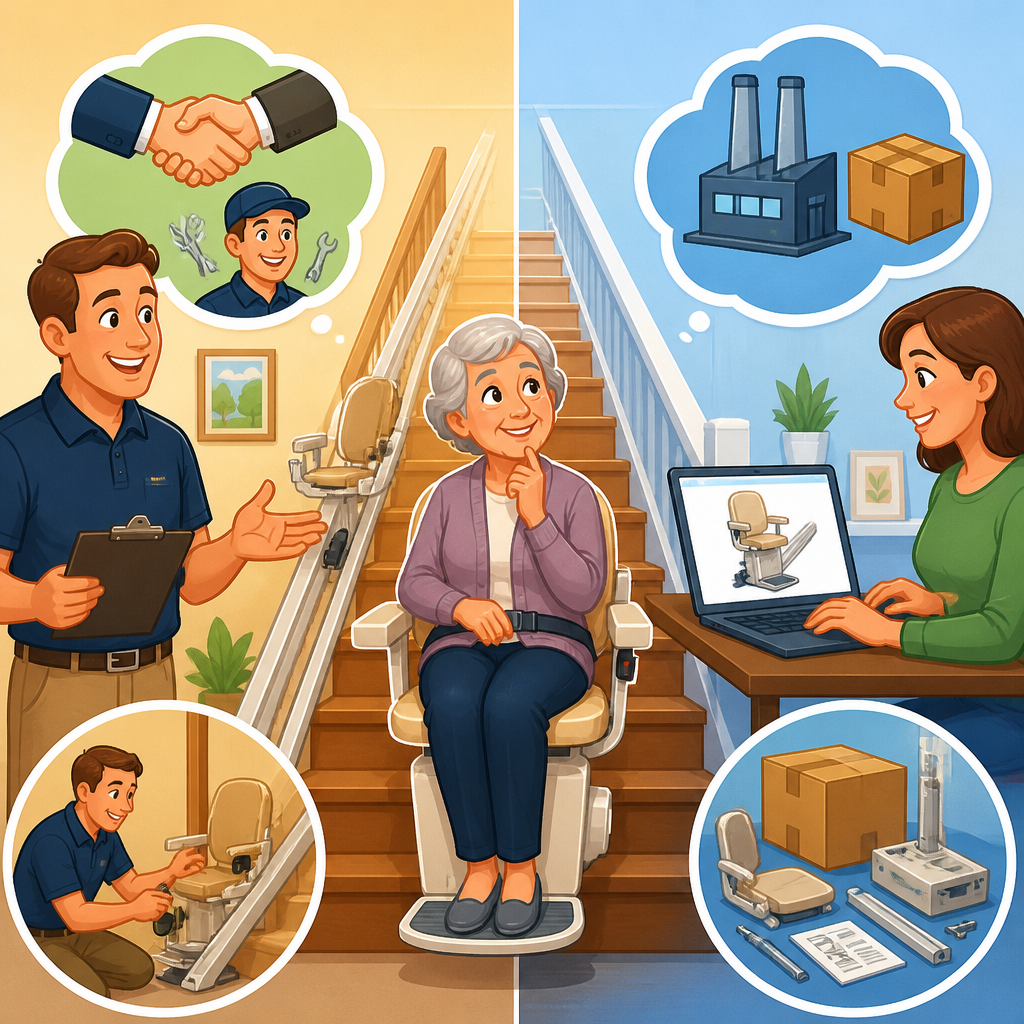
Choosing between a stair lift dealer and a manufacturer-direct purchase affects price, installation quality, warranty support, and long-term reliability. For families comparing stair lift buying options, this decision often matters more than the brand name on the rail. A stair lift is a motorized chair that travels along a track mounted to the staircase, helping people with limited mobility move safely between floors. Dealers are independent local or regional companies that sell, install, and service one or more brands. Manufacturer-direct sellers handle sales through the brand itself, usually with centralized scheduling and approved installers. In practice, the difference shapes everything from how quickly your home is measured to who answers the phone if the lift stops working on a Sunday.
I have worked with homeowners, occupational therapists, and installers on stair lift evaluations, and the same questions come up every week. Is dealer pricing higher? Does buying direct mean better warranty coverage? Who is responsible for permits, maintenance, and service calls? The answer is that both routes can work well, but they solve different problems. Local dealers often excel at site assessment and after-sale responsiveness, while direct sales can simplify brand selection and standardize the buying process. The right choice depends on staircase complexity, urgency, geography, and your comfort level with remote sales versus in-home consultation.
This guide explains the pros and cons of stair lift dealers versus manufacturer-direct purchase, with a focus on retailers and online stores as part of the broader buying journey. If you are building a shortlist for a straight stair lift, curved stair lift, outdoor stair lift, or reconditioned model, understanding the retail channel is essential. It helps you compare quotes fairly, avoid service gaps, and choose a seller that can support the lift for years, not just deliver it next week.
How the Stair Lift Retail Market Actually Works
The stair lift market is not structured like typical consumer electronics retail. Most lifts are sold through a consultative process because each staircase has unique measurements, headroom constraints, landing clearances, and user needs. Even many so-called online stair lift stores do not complete the sale entirely online. Instead, they collect lead information, schedule a call, and route the inquiry to a dealer network or internal sales team. That means the “retailer” may be a local mobility company, a national lead aggregator, a franchise operation, or the manufacturer itself.
In the United States, many recognized brands rely heavily on authorized dealers for field work. The dealer usually performs the home survey, confirms power requirements, installs the rail, tests seat swivel and obstruction sensors, and explains operation. For straight stair lifts, the product may be stocked locally and installed within days. For curved stair lifts, the dealer typically measures the staircase using photographic surveys or digital tools, then submits specifications for rail fabrication. Direct sellers may follow the same technical workflow, but the customer relationship is managed by the brand rather than an independent business.
This distinction matters because service quality in the stair lift industry is local, even when the marketing is national. A strong product installed poorly will underperform. A weaker warranty backed by a fast local technician can create a better ownership experience than a stronger warranty with slow response times. When comparing retailers and online stores, buyers should focus less on website polish and more on who takes final responsibility for assessment, installation, training, maintenance, and emergency repairs.
Advantages of Buying From a Stair Lift Dealer
A reputable stair lift dealer usually provides the most hands-on buying experience. In my experience, this is especially valuable for older homes, narrow staircases, split landings, and households where more than one person will use the lift. Dealers know local housing stock and can spot issues quickly, such as an overhanging radiator, a door swing conflict at the bottom landing, or a need for a folding hinge rail to keep a hallway clear. That practical judgment is difficult to replace with a phone consultation alone.
Another major advantage is brand choice. Many dealers carry multiple product lines, which lets them match the lift to the staircase instead of forcing the staircase to fit one product family. One straight staircase might be best served by a basic AC-powered unit with a manual swivel seat, while another needs a powered hinge, higher weight capacity, or perch seat. Multi-brand dealers can compare features across manufacturers and explain tradeoffs in plain language. That creates a more competitive quote process and often leads to a better fit.
Dealers also tend to be stronger on local service. If a battery charger fails, a footrest safety edge is triggered repeatedly, or the rail needs adjustment after settling, a nearby technician can usually respond faster than a centralized call center dispatching third parties. For mobility equipment, downtime is not a minor inconvenience. It can change where someone sleeps, bathes, and stores medications. Local relationships matter because the seller who knows the staircase can diagnose recurring issues faster and keep common replacement parts in stock.
Finally, dealers often offer reconditioned stair lifts, rentals for short-term recovery, and trade-in options. Those flexible programs are common in local markets because dealers remove, refurbish, and reinstall straight lifts regularly. Manufacturer-direct programs are often more standardized and may not support the same range of used inventory.
Advantages of Buying Direct From the Manufacturer
Buying direct can be the best path when you want a simplified process centered on one brand with consistent national standards. Manufacturer-direct sales teams usually know their own product line in depth. They can explain seat widths, diagnostic systems, rail options, and warranty terms with precision because they are not balancing multiple catalogs. For buyers who have already chosen a brand after research or referral from a therapist, direct purchase removes an extra layer between the customer and the source of the product.
Direct sales can also create clearer accountability in some situations. When one company owns the marketing, quote, contract, and warranty administration, there is less room for finger-pointing. If a customer complains about installation timing or part availability, the manufacturer cannot easily shift blame to an independent reseller. Some buyers value that single point of contact, especially when managing a purchase from another state for an aging parent.
Another benefit is standardized communication. Larger direct operations often use structured intake forms, CRM systems, installation scheduling software, and formal post-install follow-up. The process may feel less personal than working with a local dealer, but it can be more consistent. Documentation, financing disclosures, and warranty registration are sometimes handled more systematically, reducing clerical mistakes that later create service disputes.
In certain markets, manufacturer-direct buying may also improve access to the latest model revisions. If a brand has recently updated armrest controls, battery systems, or remote monitoring capabilities, direct channels may promote those changes faster than smaller dealers updating showroom stock and sales materials over time.
Where Dealers Often Fall Short
Not every dealer is equally qualified. The biggest risk in the dealer channel is inconsistency. One company may have factory-trained technicians, a responsive office, and excellent online reviews. Another may operate with minimal staffing, limited inventory, and weak communication after the sale. Because stair lifts are a specialized category, a dealer can appear established while still outsourcing key tasks or lacking depth on unusual installations.
Pricing can also be less transparent. Dealer quotes frequently bundle the product, rail, labor, travel, and optional features into one number. That is not inherently bad, but it makes apples-to-apples comparison harder. Some dealers also use promotional pricing language that resembles the wider home-improvement sector, where urgency and discounts can distract from the real issue: total installed cost and service coverage. Buyers should ask exactly what is included, whether there are trip charges for warranty calls, and how annual maintenance is priced.
Another limitation is territory dependence. A dealer may represent a strong brand but provide weak coverage outside a narrow service radius. If the home is in a rural area, response times may be slow and weather delays more common. That problem is particularly important for outdoor stair lifts, which face greater wear from moisture, heat, and debris and therefore need reliable local maintenance.
Where Manufacturer-Direct Purchase Can Disappoint
The main weakness of direct purchase is that it can feel local only until something goes wrong. Many direct sellers still depend on regional installers or subcontracted service partners, especially outside major metros. If dispatch quality is uneven, the brand’s centralized customer service may not translate into fast on-site repair. A polished website and a recognizable name do not guarantee strong field support.
Direct channels may also limit comparison shopping. When one brand handles the consultation, the recommendation will naturally stay within that brand’s catalog. That can work if the product line is broad enough, but it can still narrow the discussion. I have seen homes where another manufacturer offered a tighter folded profile or a better parking solution at the upper landing, yet the direct process never presented that option because it was outside the brand ecosystem.
Customization can be another challenge. Some manufacturer-direct operations are optimized for volume and standardized workflows. Straight stair lifts fit that model well. Complex curved stairs, intermediate landings, parking around doorways, or user-specific seating needs may require the adaptive thinking that an experienced dealer develops through varied installations. When the home does not fit the template, flexibility matters as much as product quality.
Dealer vs. Direct: Key Differences at a Glance
| Factor | Stair Lift Dealer | Manufacturer-Direct |
|---|---|---|
| Brand selection | Often multiple brands and models | Usually one brand only |
| Home assessment | Typically local and hands-on | May be local, regional, or hybrid |
| Service response | Can be faster if nearby | Depends on local partner network |
| Pricing structure | More variable by market and dealer | More standardized, not always lower |
| Used and rental options | Common for straight lifts | Less common |
| Accountability | Strong if dealer is reputable | Clear brand ownership, but field quality varies |
How to Evaluate Retailers and Online Stores Before You Buy
Start by verifying who will actually install and service the lift. Ask whether the seller uses employees or subcontractors, how many stair lifts they install each month, and whether technicians are trained on the specific model quoted. Request a written breakdown covering equipment, rail, powered options, installation, warranty length, battery coverage, and service call policy. If a quote is much lower than others, find out what has been omitted. Common gaps include hinge rails, parking remotes, electrical work, permit handling, and labor on future warranty visits.
Check local reputation carefully. Google reviews help, but read them for service details rather than star averages alone. Better signs include mentions of on-time installation, respectful technicians, clear user training, and fast repair response months after the sale. For business credibility, review Better Business Bureau history, state licensing where applicable, and how long the company has worked specifically in accessibility equipment rather than general durable medical equipment.
Ask operational questions that reveal how the company functions under pressure. What is the average response time for a nonworking lift? Do they stock batteries and chargers locally? Can they service older models they installed five years ago? Is preventive maintenance recommended annually? Will they remove the lift later if the user moves or no longer needs it? Strong answers to these questions usually matter more than a small upfront price difference.
Cost, Warranty, and Long-Term Ownership Considerations
Price comparisons should always be made on a fully installed basis. Straight stair lifts commonly cost less than curved models because the rail is standardized, while curved rails are custom fabricated to staircase dimensions. A lower sticker price from an online retailer can become more expensive if installation, travel, or follow-up service is billed separately. Conversely, a higher dealer quote may include local support that reduces total ownership cost over several years.
Warranty language deserves close attention. Most stair lifts include coverage for major components, but batteries are consumables and often carry shorter terms. Labor coverage may differ from parts coverage. Some sellers include one or two years of service labor, while others cover parts but charge for site visits after the initial period. Ask whether diagnostic visits, battery replacements, and adjustment calls are included. Written clarity here prevents many disputes.
Ownership is not only about warranty duration. It is about serviceability, parts availability, and the probability that the seller will still answer the phone later. A stair lift is not a disposable purchase. Buyers should choose the sales channel that combines suitable equipment with dependable local execution. If you are comparing retailers and online stores for your next stair lift, collect detailed quotes, confirm service responsibility in writing, and make your decision based on support, not just price.
Frequently Asked Questions
What is the main difference between buying a stair lift from a dealer versus directly from the manufacturer?
The biggest difference is who manages the experience before, during, and after the sale. A stair lift dealer is usually a local or regional company that represents one or more brands, handles the in-home assessment, recommends a model, installs the lift, and often provides service and repairs. A manufacturer-direct purchase means you are buying from the company that makes the stair lift, but the practical details can vary. In some cases, the manufacturer sends its own team for consultation and installation. In others, it still relies on local subcontractors or service partners, even though the sale was made directly.
For most families, this distinction matters because a stair lift is not a simple boxed product. It needs to be matched to the user’s mobility needs, the staircase’s dimensions, and the home’s layout. The quality of the measuring, installation, testing, and follow-up support can have a major effect on safety, comfort, and long-term reliability. A strong local dealer may offer more personalized guidance and faster service because they are nearby and work in the community every day. A manufacturer-direct option may appeal to buyers who want to deal with the brand itself, possibly access standardized pricing, or feel more confident working with the original maker of the equipment. The right choice usually depends less on the sales channel alone and more on who will actually install and support the stair lift over time.
Is buying manufacturer-direct always cheaper than using a stair lift dealer?
Not necessarily. Many buyers assume that cutting out the dealer automatically lowers the price, but stair lift pricing is more complicated than that. The total cost includes the lift itself, the rail or track, installation labor, the home assessment, customization for the staircase, warranty coverage, and future service availability. A manufacturer-direct quote may look attractive at first, but it is important to confirm exactly what is included and what is not. Some direct programs bundle everything into one package, while others may charge separately for installation, upgrades, or service visits.
A dealer may sometimes be more competitive than expected, especially if they have local inventory, run promotions, offer reconditioned units, or have flexibility in package pricing. Dealers also tend to know which options are truly necessary and which add-ons may not be worth the cost for a particular user. That can prevent overspending. In addition, a lower upfront price does not always mean lower overall value. If a slightly higher quote includes better installation, faster repair response, or stronger local support, it may save money and frustration later. The best way to compare is to request detailed written estimates from both options and look beyond the sticker price. Ask about installation, service call fees, warranty labor, battery replacement, rail modifications, and how quickly repairs are handled if the lift stops working.
Which option usually provides better installation quality and long-term reliability?
Installation quality depends more on the skill and accountability of the people doing the work than on whether the sale came from a dealer or directly from a manufacturer. That said, local stair lift dealers often have an advantage because installation is a core part of their business. Experienced dealers typically evaluate the staircase carefully, check power access, identify landing clearance issues, and make sure the lift is adjusted for the user’s height, balance, and transfer needs. Because they work repeatedly in the same service area, their reputation depends heavily on doing clean, accurate installations and being available if adjustments are needed.
Manufacturer-direct programs can also provide excellent results, particularly when the company uses factory-trained teams and standardized processes. The key question is not simply “dealer or direct,” but “who is installing it, how much experience do they have, and who stands behind the work?” A well-installed stair lift should operate smoothly, fit the staircase precisely, park safely, and allow the rider to get on and off with confidence. Poor measuring or rushed installation can lead to nuisance issues, premature wear, and repeated service calls. For long-term reliability, ask whether the installer is trained specifically on that brand, how many similar systems they install each year, and whether they handle follow-up service themselves. Reliability comes from a combination of product quality, proper setup, and responsive maintenance support.
How do warranty coverage and service support compare between dealers and manufacturer-direct purchases?
Warranty support is one of the most important areas to compare carefully because the real value of a warranty depends on how service is delivered. With a dealer purchase, the manufacturer may provide the product warranty while the dealer handles labor, diagnostics, adjustments, and local service calls. This can be very convenient because the homeowner usually has one nearby company to call if something goes wrong. A good dealer can often respond quickly, keep common parts on hand, and resolve minor issues without long delays.
With a manufacturer-direct purchase, the warranty may sound strong on paper, but you should ask exactly who performs the service in your area. Some manufacturers have dedicated service networks, while others rely on third-party technicians. If support is routed through a call center and then assigned to an outside provider, response times may vary by location. This does not mean direct is worse, but it does mean the service structure should be verified before purchase. Ask whether labor is covered, how long batteries and major components are covered, whether annual maintenance is required to keep the warranty valid, and what happens if a problem occurs after hours or during a holiday. Since stair lifts are often essential mobility devices, fast and dependable service may matter more than having the broadest warranty wording. Practical support is what counts when a user needs the lift every day.
How should families decide whether a stair lift dealer or a manufacturer-direct purchase is the better fit?
The best choice usually comes down to the family’s priorities, the complexity of the staircase, and the strength of local support. If the home has a straight staircase and the buyer is mainly focused on straightforward pricing, a manufacturer-direct option may be worth considering, especially if the company has a well-established installation and service system in the area. If the staircase is curved, narrow, has multiple landings, or involves unique safety concerns, an experienced dealer may offer more hands-on guidance and a more tailored solution. Families should also consider how quickly the lift is needed, whether ongoing service is likely, and how important it is to have a nearby company available for questions and adjustments.
A practical way to decide is to compare both options using the same checklist: in-home assessment quality, product fit for the user, installation experience, timeline, total price, warranty details, service response times, and reputation. Read reviews, ask who performs repairs, and do not hesitate to ask for references or examples of similar installations. It is also wise to consider the user’s future needs, not just their current mobility level. The right stair lift buying option is the one that combines safe installation, dependable support, transparent pricing, and confidence that help will be available if the lift needs attention later. In many cases, the real deciding factor is not whether the seller is a dealer or a manufacturer, but whether the company delivering the solution is knowledgeable, responsive, and equipped to support the lift for years to come.





