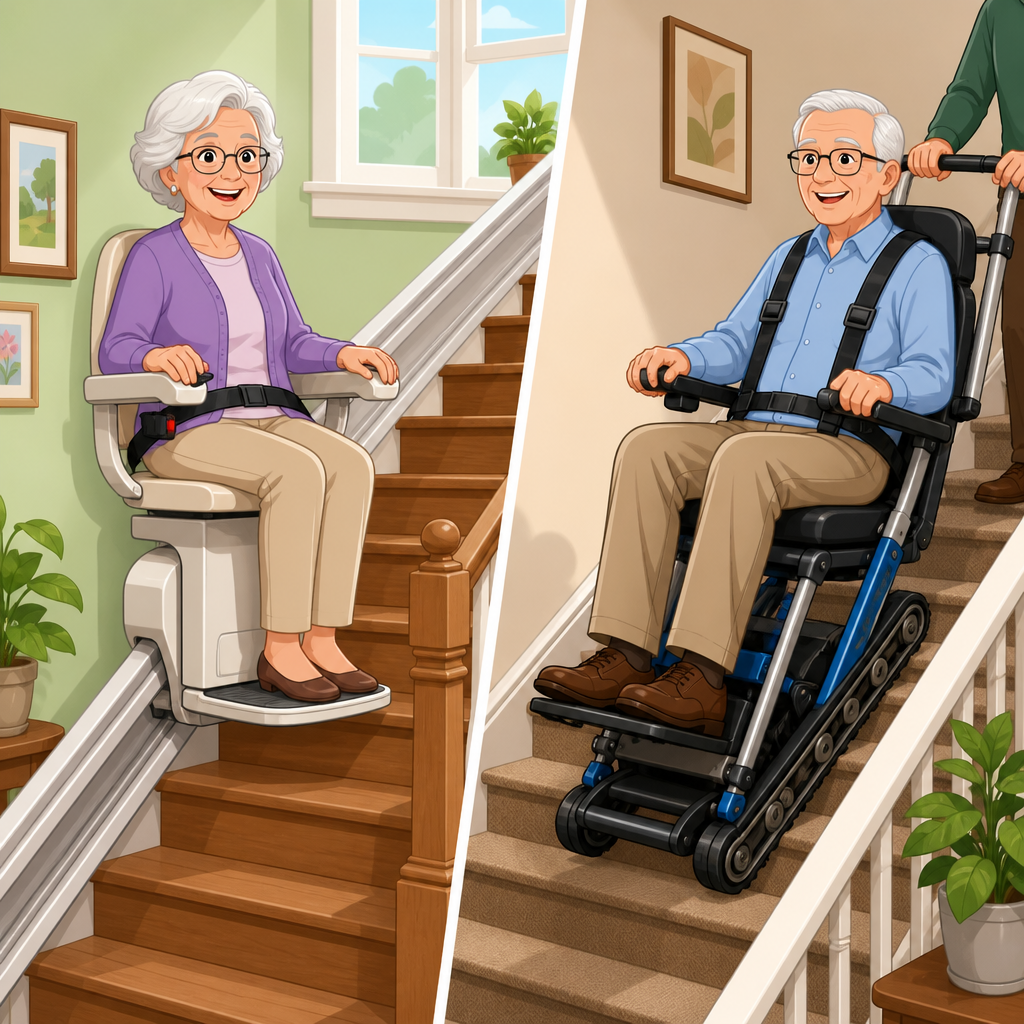
Choosing between a stair lift and a stair climber is not just a shopping decision; it is a home safety decision that affects independence, caregiver workload, fall risk, and the long-term usability of a property. In the mobility aids and devices category, these two options solve a similar problem in very different ways. A stair lift is a motorized chair mounted to a rail fixed along a staircase, carrying one seated user between floors. A stair climber is usually a portable device, often used with a wheelchair or integrated seat, that helps a person move up or down stairs with assistance from an operator. Both can improve access, but they are built for different users, different homes, and different risk profiles.
I have evaluated both in real homes, including narrow townhouses, split-level entries, and multigenerational properties where one mobility device had to work for more than one person. The biggest mistake families make is assuming that any device that gets someone up the stairs is equally safe. It is not. Safety depends on transfer ability, staircase geometry, emergency preparedness, user weight, cognitive function, caregiver training, and how often the device will be used. A solution that is safe in a rehab discharge plan may be unsafe for permanent home use. Likewise, a device that works well for occasional access can become frustrating or hazardous when used six or eight times per day.
This article is the hub for mobility aids and devices within the broader accessibility and mobility solutions topic. It explains what stair lifts and stair climbers do, who they suit best, and where each fits among related equipment such as wheelchairs, walkers, transfer aids, ramps, grab bars, and bathroom safety products. If you are comparing options for an older adult, a wheelchair user, or someone recovering from surgery, the core question is straightforward: which device reduces fall risk most reliably in a home setting? In most cases, the safer answer for regular home use is a professionally installed stair lift, but there are important exceptions. Understanding those exceptions is what leads to a sound decision.
What a Stair Lift and a Stair Climber Actually Do
A stair lift is a fixed accessibility device designed for repeated daily travel on the same staircase. It typically includes a rail, carriage, seat, footrest, seat belt, call-send controls, obstruction sensors, battery backup, and charging points at one or both ends of the rail. Models are available for straight stairs, curved stairs, and outdoor installations. Reputable manufacturers include Bruno, Stannah, Handicare, Harmar, and Access BDD. When installed correctly, a stair lift creates predictable, mechanical movement with minimal physical demand on the user. The person sits, secures the belt, and rides while the motor controls speed and braking.
A stair climber is different. In home settings, the term usually refers to a portable powered unit that helps an attendant move a seated person over stairs. Some models carry the user in an integrated seat; others attach to a manual wheelchair. Well-known examples include tracked evacuation-style systems and wheel-mounted climbing devices. These units are valuable when a rail cannot be installed, when stairs are used only occasionally, or when portability matters. However, most stair climbers depend heavily on caregiver skill, user positioning, stair condition, and careful battery management. They are not generally a hands-free independence device. For many households, that distinction determines safety more than any marketing claim.
The simplest way to define the difference is this: a stair lift turns the staircase into a semi-automated route for one known user, while a stair climber turns the staircase into an assisted transfer task. Assisted transfer tasks carry more variables. Variables create risk. That does not make stair climbers bad equipment; it means they must be matched to the right scenario. In mobility planning, fixed systems usually outperform portable systems when the goal is daily independent use by a person with limited strength, balance, or endurance.
Which Option Is Safer for Home Use?
For most private homes, a stair lift is safer than a stair climber because it reduces operator error, lowers the physical demands of stair travel, and provides consistent movement on every trip. Once installed and maintained, a stair lift follows the same path at the same controlled speed each time. The user is secured by a belt, supported by a seat and footrest, and protected by sensor systems that stop the unit if it meets an obstruction. Many modern units continue to work during a power outage because the drive system runs on onboard batteries that charge automatically.
By contrast, stair climber safety is much more situational. A high-quality powered stair climber can be safe when operated by a trained attendant on stairs that meet the manufacturer’s specifications. But the margin for error is narrower. The caregiver must manage device angle, weight distribution, hand placement, stair edge contact, turning clearances, and communication with the passenger. If the user spasms, panics, leans suddenly, or exceeds the safe center of gravity for the device, the task becomes more dangerous. Homes with winding stairs, small landings, thick carpet, inconsistent riser heights, or poor lighting make operation harder.
There is also a key difference in transfer risk. With a stair lift, the user usually transfers onto the seat at the top and bottom landings, where grab bars, walkers, or another stable support can be positioned. Some models have powered swivel seats to improve exit safety. With a stair climber, transfers may involve repositioning into a portable chair or securing a wheelchair to the climbing mechanism. Each extra step adds opportunities for slips, skin tears, shoulder strain, and caregiver injury. In real-world home use, simpler routines are usually safer routines.
Safety Factors That Matter More Than Product Labels
The device name alone does not decide safety. User profile matters first. If a person can sit upright, follow simple steps, tolerate seated travel, and perform or assist with a safe transfer, a stair lift is often the strongest choice. If the person cannot transfer at all, uses a complex rehab wheelchair, or requires full support from a caregiver, then a stair climber or a home elevator may need consideration. Weight capacity matters as well. Standard stair lifts often support around 300 to 350 pounds, while heavy-duty models can exceed 400 pounds. Stair climbers also have strict rated capacities, and exceeding them changes stability dramatically.
Stair design is the next filter. Straight staircases are easiest and least expensive for lifts. Curved stairs can still be fitted, but custom rails raise cost and lead time. Stair climbers need adequate tread depth, landing space, and turning room. Building features that seem minor, such as a radiator near the base of the stairs or a doorway opening into a landing, can make a portable climber awkward or unsafe. I have seen otherwise excellent devices ruled out by a landing that was six inches too tight for a controlled turn.
Cognitive status is another overlooked factor. People with dementia, impaired judgment, or impulsive behavior may forget belts, stand mid-ride, or resist caregiver instructions. A stair lift can still be appropriate if supervision is available and controls are simplified, but any mobility device must fit the user’s behavior pattern, not just their strength level. Finally, maintenance is part of safety. A stair lift with overdue service, dirty rail, or weak battery is less safe than a properly maintained one. Portable climbers need battery checks, wheel or track inspection, and regular operator practice.
Comparing Stair Lift and Stair Climber Performance at Home
| Factor | Stair Lift | Stair Climber |
|---|---|---|
| Best use case | Daily home access on one staircase | Occasional assisted stair travel or no-install situations |
| Independence level | Often usable with minimal help | Usually requires a trained attendant |
| Transfer demands | Moderate, at top and bottom landings | Moderate to high, depending on chair setup |
| Caregiver strain | Low once installed | Higher due to lifting, balancing, and steering |
| Suitability for narrow stairs | Possible with compact models, but site-specific | Possible only if landing and tread requirements are met |
| Power outage readiness | Usually battery-backed | Depends on charge status and model |
| Installation requirement | Professional rail installation | Little or no structural installation |
| Long-term safety for routine use | Usually better | Usually lower unless use is limited and supervised |
This comparison explains why stair lifts dominate home accessibility projects. They are purpose-built for repeated use in one environment. Stair climbers are more like specialized transport devices. That distinction mirrors other mobility aid choices. A rollator is excellent for stable walking on level surfaces; it is not a substitute for a transfer bench in the shower. A portable threshold ramp is useful for one doorway; it does not replace a properly graded exterior ramp. Matching the tool to the exact environment is what improves safety.
When a Stair Lift Is the Better Choice
A stair lift is usually the better choice when the same person needs to travel between floors every day, especially if they live alone part of the time or want to reduce dependence on family members. It is particularly effective for older adults with arthritis, reduced balance, heart failure, COPD, Parkinsonian gait changes, or post-surgical weakness. In those cases, climbing stairs is not only tiring; it is unpredictable. Fatigue halfway up a staircase is one of the most dangerous mobility scenarios in a home. A stair lift removes that exposure.
It is also the better choice when the household wants consistency. Once users learn the controls, operation becomes routine. Good models fold when parked, leaving walking space on the stairs. Call-send controls let the chair move away after use or be summoned from another floor. For couples, that matters because the staircase can remain functional for ambulatory residents while still serving the person with limited mobility. I have seen stair lifts extend safe occupancy in a beloved home by years, delaying or avoiding a move to a single-level property.
Another strength is integration with broader accessibility planning. A stair lift works best when paired with handrails, non-slip treads, proper landing clearance, lighting upgrades, and, where needed, walkers or canes on both floors. In that sense it fits naturally into a whole-home mobility strategy rather than acting as a one-off gadget. If your mobility aids and devices plan includes bathroom modifications, grab bars, ramp access, or wheelchair storage, a stair lift often becomes the central link that makes the entire floor plan usable.
When a Stair Climber Makes More Sense
A stair climber makes more sense when installation is impossible, impractical, or unnecessary. Renters may not be allowed to install a rail. Historic homes or shared stairwells may present permission barriers. Some households need portability because the user visits multiple locations, such as a relative’s home, a place of worship, or a building without an elevator. In these cases, a stair climber can be an effective access tool, especially for planned trips with a confident trained operator.
It can also be useful as part of an emergency or short-term care plan. After discharge from rehab, a person may need temporary assistance on stairs for a few weeks while recovering. Buying or renting a stair climber may be more practical than commissioning a custom curved lift with a long lead time. Certain EMS, evacuation, and home care contexts also rely on stair climbers because they can move a non-ambulatory person when no fixed system exists.
Still, safer use depends on training and realistic limits. The operator should practice without the passenger first, read the manufacturer’s stair specifications, confirm weight compatibility, and maintain battery charge. The user must be secured correctly and briefed not to lean or reach. If more than one caregiver will operate the device, all must be trained the same way. In my experience, stair climbers work best when treated as controlled equipment, not casual household gear.
Cost, Maintenance, and the Hidden Risks of the Wrong Choice
Price often drives the first conversation, but the cheaper option upfront is not always the safer or less expensive choice over time. Straight stair lifts commonly cost far less than custom curved lifts, while portable stair climbers vary widely by design and capacity. Rental may be available for both in some markets. Installation, service coverage, warranty terms, battery replacement, and resale value all affect the real number. A family that buys a portable device to save money may later spend more on caregiver hours, injury risk, or a rushed replacement.
The wrong choice also has opportunity costs. If a stair climber is too cumbersome for daily use, the user may begin avoiding one floor of the house, sleeping in a recliner, skipping showers, or becoming isolated from family space. If a stair lift is installed for someone who cannot transfer safely, the equipment may sit unused. That is why a home assessment matters. A qualified occupational therapist, aging-in-place specialist, or experienced accessibility contractor can measure stairs, observe transfers, and identify constraints that online product listings never reveal.
For most households, the practical path is simple: prioritize the device that reduces fall exposure every single day. Then support it with related mobility aids and devices, from bedside rails to shower chairs and threshold ramps, so the entire route through the home becomes safer.
Conclusion
Stair lift vs. stair climber is ultimately a question of routine safety versus situational flexibility. For regular home use, a stair lift is usually safer because it offers controlled travel, fewer operator variables, and lower caregiver strain. A stair climber has a valid role when portability is essential, installation is not possible, or short-term assisted access is the goal. The right answer depends on transfers, stair layout, supervision, weight capacity, and frequency of use.
As the hub for mobility aids and devices, this comparison should guide how you evaluate related solutions across the home. The best mobility equipment is not the most advanced product; it is the one that matches the user, the property, and the daily routine with the least risk. Start with a home assessment, compare device specifications carefully, and choose the option that makes every trip between floors predictable and secure.
Frequently Asked Questions
1. Which is generally safer for home use: a stair lift or a stair climber?
For most residential settings, a stair lift is generally the safer option for routine home use. That is because a stair lift is a fixed, purpose-built system installed directly onto the staircase, allowing one user to travel between floors while seated and secured. It does not depend on the physical strength, balance, coordination, or lifting technique of a caregiver in the same way a stair climber often does. Most stair lifts also include built-in safety features such as a seat belt, swivel seat for safer entry and exit, footrest sensors, obstruction detection, and battery backup in case of a power outage.
A stair climber can also be safe when used properly, but its safety depends much more heavily on the situation and the people involved. In many cases, a stair climber is a portable device used to move a person up or down stairs with assistance from a trained caregiver or operator. That means safety can be affected by operator skill, user posture, stair dimensions, landing space, the weight being transported, and whether the user can remain stable throughout the ride. If the caregiver is fatigued, untrained, or navigating tight turns, the risk profile changes quickly.
In simple terms, a stair lift usually offers more predictable, repeatable safety for everyday access inside a home. A stair climber may be helpful in specific cases, especially when a permanent installation is not possible, but it typically introduces more variables. For homeowners focused on minimizing fall risk and supporting long-term independent access, a stair lift is often considered the safer choice.
2. What are the main safety differences between how a stair lift and a stair climber work?
The biggest safety difference is that a stair lift is passive for the user, while a stair climber is often operator-dependent. With a stair lift, the user transfers into a mounted chair at the top or bottom of the stairs, fastens the seat belt, and rides along a rail. The system is anchored to the staircase and designed to move at a controlled speed. This setup reduces sudden shifts in weight, manual lifting, and the physical strain associated with stair transfers. It is especially valuable for people with poor balance, lower-body weakness, joint pain, or conditions that make climbing stairs unsafe.
By contrast, a stair climber typically involves more active management during use. Depending on the design, the user may remain in a wheelchair attached to the device or be transferred into a transport seat while an operator guides the machine up or down the staircase. Although many modern stair climbers are engineered with braking systems, tracks, and stabilization features, they still require more hands-on control. That means training, confidence, and proper technique are central to safe use. A small mistake in positioning, speed control, or turning on a landing can increase risk.
Another key difference is consistency. A properly maintained stair lift works the same way every day on the same staircase. A stair climber may perform differently depending on battery charge, user weight, caregiver strength, and stair geometry. So while both devices can reduce stair-related hazards, a stair lift usually creates a more controlled environment with fewer moving parts from the user’s perspective.
3. Who is a better candidate for a stair lift, and who might need a stair climber instead?
A stair lift is typically better for someone who lives in a multi-level home and needs regular, dependable access between floors. It is especially well suited for individuals who can safely transfer on and off the seat, even if they cannot walk up stairs independently. Many older adults, people recovering from surgery, and individuals with arthritis, muscle weakness, or chronic balance issues do well with stair lifts because the device supports independence without requiring another person to assist every trip.
A stair climber may be more appropriate when a person cannot install a stair lift, needs a portable access solution, or must transport someone who cannot use a stair lift seat safely. For example, a stair climber may be considered in settings where the user remains in a wheelchair, where the home is temporary, or where the staircase design makes permanent installation difficult or cost-prohibitive. It can also be useful for emergency access or intermittent use, rather than multiple trips per day.
That said, the safest choice depends on more than mobility level alone. Transfer ability, trunk control, cognition, caregiver availability, upper-body stability, and the layout of the home all matter. Someone who becomes disoriented easily or cannot follow basic positioning instructions may not be a good stair climber candidate. Likewise, someone who cannot transfer onto a stair lift seat may need a different solution altogether. A home safety assessment by a mobility professional, occupational therapist, or accessibility specialist can help determine which device matches the user’s physical needs and the home’s real-world conditions.
4. How do caregiver workload and fall risk compare between stair lifts and stair climbers?
In most homes, a stair lift reduces caregiver workload more effectively than a stair climber. Once installed, a stair lift allows the user to travel between floors with minimal physical assistance, assuming they can transfer into the chair safely. That can make a major difference for spouses, adult children, or home aides who would otherwise need to supervise stair use or help with every trip. Less manual involvement often means fewer chances for caregiver strain, missteps, or rushed movements during transfers.
A stair climber usually places more responsibility on the caregiver or operator. Even when the device is powered, the operator often needs to position it correctly, secure the user, maintain control during ascent or descent, and navigate landings carefully. This not only increases physical and mental workload, but also raises the importance of training and experience. Repeated stair transport can be tiring, and fatigue is a real safety issue when moving a person on stairs.
From a fall-risk standpoint, stair lifts often lower risk more consistently because they remove the need for someone to physically manage a person on the staircase. The user remains seated on a guided rail, and the trip path is fixed. Stair climbers can still reduce fall risk compared with attempting stairs manually, but they do not eliminate as many variables. If the goal is to make everyday home access safer while also easing caregiver burden, a stair lift usually has the advantage.
5. What should homeowners consider before deciding which option is safer for their specific home?
Homeowners should look beyond the product brochure and evaluate how the device will function in their actual living environment. Start with the staircase itself: width, straight or curved design, number of landings, clearance at the top and bottom, handrail placement, and whether other household members need to use the stairs comfortably. A stair lift can often be customized for straight or curved stairs, but installation feasibility and cost vary. A stair climber may seem more flexible, but it still needs enough space for safe maneuvering and stable operation.
Next, consider the user’s day-to-day abilities. Can they transfer independently or with limited help? Can they sit upright securely? Do they have the cognitive awareness to use controls or follow instructions? Will they need to move between floors several times a day, or only occasionally? A device that is technically compatible with the staircase may still be unsafe if it does not match the person’s strength, endurance, or balance.
It is also important to think long term. A stair lift is often the better solution when the goal is aging in place, preserving independence, and making a home more usable over time. A stair climber may be practical as a short-term, portable, or backup option, but it may not be the best fit for frequent daily use in a private home. Maintenance, battery reliability, emergency procedures, and caregiver training should all be part of the decision.
The safest path is usually to schedule an in-home evaluation with a qualified stair lift provider, accessibility contractor, or rehabilitation professional. They can assess both the person and the property, identify hidden risks, and recommend the option that offers the best combination of safety, usability, and long-term support.