Choosing the best chair lift design for seniors living alone starts with one practical question: which system delivers safe, independent movement every day with the fewest complications? A chair lift, often called a stair lift, is a motorized seat that travels along a rail fixed to the staircase, allowing a user to move between floors without climbing steps. For older adults who live alone, design matters more than marketing labels because the lift must be easy to operate, reliable during routine use, and suited to the exact layout of the home. In my experience reviewing installations and comparing manufacturer specifications, the wrong design usually fails not because the motor is weak, but because the seat is awkward, the controls are confusing, or the staircase geometry was not matched correctly. That is why this topic deserves a careful comparison.
The stakes are high. Falls remain one of the leading causes of injury among older adults, and stairs are a common hazard inside multi-level homes. A well-matched chair lift can extend aging in place, reduce reliance on family visits for basic movement, and preserve access to bedrooms, bathrooms, and laundry areas. Yet not every senior living alone needs the same design. Some need a straight rail with minimal maintenance. Others need a curved system with a powered swivel because arthritis limits trunk rotation. A few may be better served by a standing perch model, though that option works only for specific users. The best chair lift design is the one that fits the staircase, the user’s body mechanics, and the daily routine of solo living without adding unnecessary complexity.
This hub article covers the main chair lift designs seniors living alone should compare: straight, curved, outdoor, standing, and heavy-duty models, plus the seat, rail, control, and power features that determine long-term usability. It also explains how to evaluate safety standards, installation constraints, battery backup, seat dimensions, and transfer requirements in plain language. If you are trying to decide what chair lift design is best for seniors living alone, the short answer is usually a battery-powered straight chair lift with a folding seat, swivel function, obstruction sensors, and call/send controls at both ends of the rail. The longer answer depends on the staircase and the user, and that is what the rest of this guide will break down clearly.
Straight chair lifts are usually the best starting point
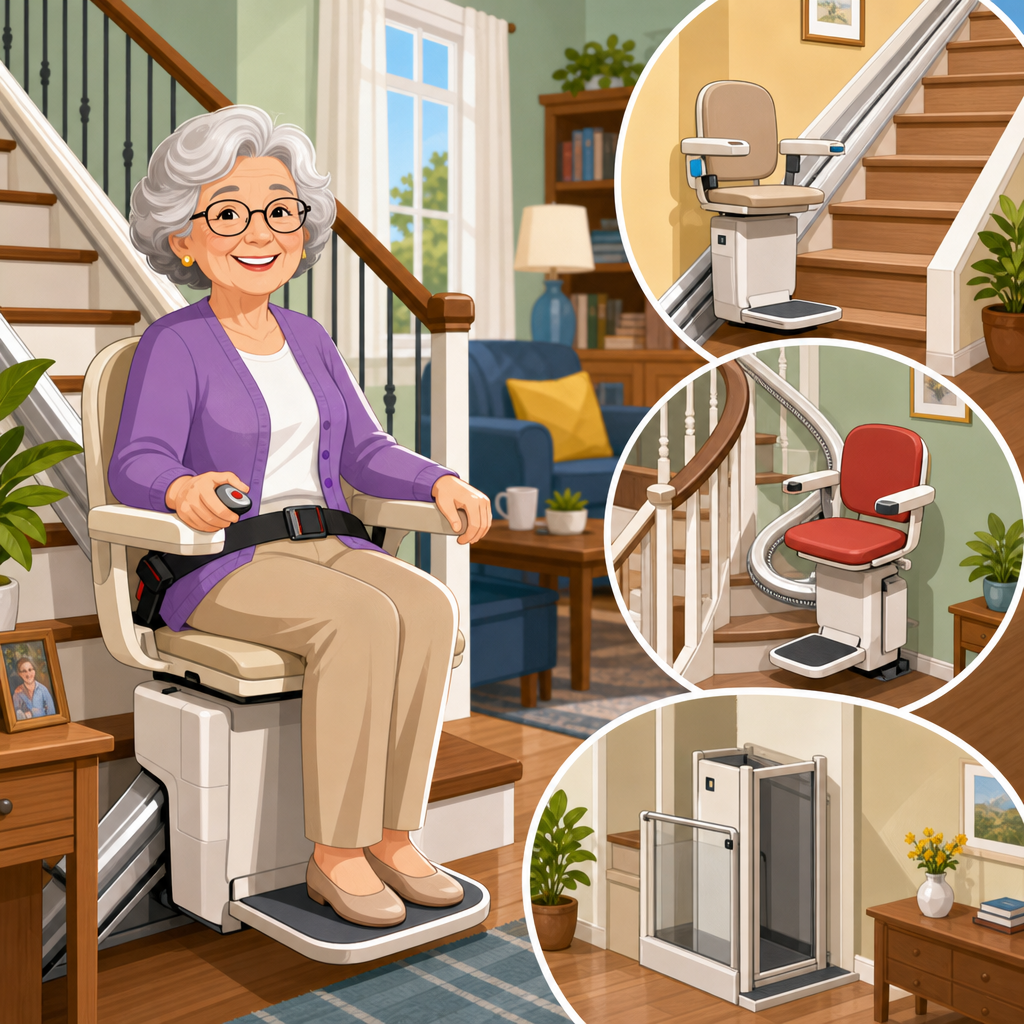
For most seniors living alone, a straight chair lift is the best chair lift design because it is simpler, less expensive, faster to install, and generally easier to service than other types. A straight lift runs on a single rail for a staircase with no turns, landings, or directional changes. In real installations, this design solves the needs of many homes built with one uninterrupted stair run from the first floor to the second. Because the rail is standardized rather than custom-bent, lead times are shorter and replacement parts are usually easier to source.
The practical advantage for a solo user is predictability. Straight lifts typically have straightforward controls, smooth start-and-stop motion, and fewer alignment variables than curved systems. Brands such as Bruno, Harmar, Acorn, Handicare, and Stannah all offer straight models with battery power, fold-up arms, seat belts, obstruction sensors, and call/send remotes. In day-to-day use, these details matter more than cosmetic styling. A senior who lives alone benefits from a seat that folds neatly, a footrest that does not become a trip hazard, and a charging system that keeps the unit ready even during a power outage.
That does not mean a straight lift is always ideal. If the staircase has an intermediate landing or a turn, trying to force a straight model into the space usually creates transfer problems or leaves part of the stair route inaccessible. But where the home layout allows it, straight designs offer the cleanest balance of safety, affordability, and reliability.
Curved chair lifts solve complex staircases but require more planning
A curved chair lift is designed for staircases with bends, corners, split landings, spirals, or multiple directional changes. The rail is custom manufactured to the staircase dimensions, allowing the seat to travel continuously around turns instead of forcing the user to stand and transfer at a landing. For seniors living alone, that continuous ride can be the difference between real independence and a system that still requires assistance.
I usually recommend a curved design when the home’s main bedroom and bathroom are upstairs and the staircase includes a 90-degree or 180-degree turn. In those homes, two separate straight lifts can create awkward transition points that are unsafe for a person with poor balance, neuropathy, or limited grip strength. A properly fitted curved rail avoids that mid-route transfer. However, curved lifts cost more because the rail is custom built, survey measurements must be exact, and installation errors are harder to correct. Repair timelines can also be longer if a proprietary rail component is damaged.
The biggest design issue is not simply the turn itself; it is how the lift parks at the top and bottom. A good curved system should place the seat where the user can step on and off away from the edge of the stairs. Many manufacturers offer parking bends and overrun options so the user dismounts on a hallway or landing rather than directly above the staircase opening. For seniors living alone, this feature is often worth the additional cost.
Seat, rail, and control features determine real usability
When families ask what chair lift design is best for seniors living alone, they often focus first on rail shape. In practice, seat and control design are just as important. The seat height must allow an easy sit-to-stand transfer without excessive knee flexion. The seat width must accommodate winter clothing, body size, and any postural asymmetry. Armrests should be stable enough for light push-off, but not so high that they interfere with lateral transfer.
Swivel seats are especially important at the top landing. A manual swivel can work for active users with good hand strength, but a powered swivel is often safer for seniors with arthritis, shoulder pain, or Parkinsonian rigidity. The same logic applies to footrests. Manual folding footrests keep costs down, but powered footrests reduce the need to bend forward, which is a common trigger for dizziness and falls. Some newer designs link the footrest and seat fold action, simplifying storage when others use the stairs.
Controls should be intuitive, with constant-pressure toggles or rocker switches rather than cluttered keypads. Call/send controls at both levels are essential for anyone living alone because the user may need to bring the lift to their floor without assistance. A diagnostic display is useful, but only if error messages are understandable to service technicians and not overly technical for the user.
| Design element | Best choice for many seniors living alone | Why it matters |
|---|---|---|
| Rail type | Straight if staircase is uninterrupted | Lower cost, faster installation, easier service |
| Power source | Battery-powered with automatic charging | Continues operating during power outages |
| Seat function | Swivel seat, ideally powered at top landing | Safer transfers away from stair edge |
| Footrest | Foldable, obstruction-sensing, powered if bending is difficult | Reduces trip risk and strain |
| Controls | Simple toggle plus call/send stations | Easier independent use |
| Safety | Seat belt, overspeed governor, obstruction sensors | Prevents common incidents |
Battery power, safety systems, and maintenance are nonnegotiable
The best chair lift design for seniors living alone should be battery powered, even when the home has dependable electrical service. Most modern lifts plug into household current to charge onboard batteries, and the batteries power travel on the rail. This matters because storms, breaker trips, or utility interruptions should not strand a user on one level of the house. A direct-powered unit without meaningful backup introduces unnecessary risk for someone who has no immediate helper at home.
Core safety systems should include a retractable seat belt, obstruction sensors on the footrest and carriage, a speed governor, final limit switches, and a lockable or controlled parking function if children visit. Reputable products are commonly evaluated to standards such as ASME A18.1 and, depending on market and model, relevant UL or third-party testing requirements. Those standards do not guarantee perfect comfort, but they establish baseline expectations for mechanical and electrical safety.
Maintenance deserves equal attention. Stair lifts are durable machines, but they need periodic service, rail cleaning, battery replacement over time, and proper charging contact alignment. I advise buyers to ask three direct questions before purchase: How quickly can a technician respond locally, what does the warranty actually cover, and are batteries and control boards stocked regionally? A lower upfront price is not a better value if the lift sits unusable for two weeks waiting for parts.
Specialty designs: heavy-duty, standing, and outdoor models
Some households need a specialty chair lift design. Heavy-duty models are appropriate when the user needs a higher weight capacity, a wider seat, or more stable seating geometry. Standard residential lifts often support around 250 to 350 pounds, while heavy-duty versions may reach 400 pounds or more. Capacity should never be treated as a rough guideline. Exceeding the rated limit affects braking, motor load, rail stress, and long-term reliability.
Standing or perch lifts are niche products for users who cannot comfortably bend their knees into a seated position or who have very narrow staircases. They require good balance, the ability to tolerate upright riding posture, and reliable hand control. For seniors living alone, I recommend caution. Although perch lifts can solve a space problem, they often demand more physical stability than a standard seated model. They are rarely the safest default choice.
Outdoor chair lifts are built with weather-resistant covers, sealed components, and materials suited to temperature swings. They are useful for porch stairs, garage entries, and garden approaches, especially where a senior relies on a specific entrance. But outdoor exposure shortens the life of upholstery and moving parts if maintenance is ignored. In cold or wet climates, homeowners should confirm operating temperature ranges, cover quality, and service availability before buying.
How to choose the right design for one person, one home, and one routine
The most reliable selection process starts with the user, not the catalog. Assess transfer ability, balance, vision, hand strength, cognition, body size, and whether the person uses a cane, walker, or wheelchair on each level. Then assess the staircase: width, number of steps, landings, turns, headroom, nearby door swings, and whether other household members need unobstructed access. A design that looks perfect in a brochure may be wrong if the parked seat blocks a hallway or creates a new trip point.
Daily routine matters too. If the senior carries laundry, medications, or a phone between levels, plan where those items will be placed during travel. If they wake at night to use an upstairs bathroom, low-effort controls and dependable charging are critical. If they have mild cognitive decline, simplify operation and avoid models with unnecessary settings. If emergency responders may need stair access, discuss folded dimensions and parking positions during the site survey.
For many seniors living alone, the best answer is a straight, battery-powered chair lift with a swivel seat, folding arms and footrest, obstruction sensors, and call/send controls. For homes with turns, a curved lift with a top or bottom overrun is usually the safest upgrade. The decision should always follow an in-home assessment by a qualified dealer, not a phone quote based only on photos.
The best chair lift design for seniors living alone is the one that makes independent movement safe, repeatable, and simple every single day. In most homes, that means a straight chair lift because straight systems cost less, install faster, and are easier to maintain. In homes with turns or landings, a curved lift is usually worth the added investment because it eliminates risky transfers. Beyond rail shape, the most important design features are battery backup, a stable seat, easy controls, reliable safety sensors, and a transfer position that keeps the user away from the edge of the stairs.
The clearest takeaway is that chair lift design is not just about fitting the staircase. It is about matching the machine to the person who will use it alone, often when tired, in low light, or during an outage. Small features such as a powered swivel, a folding footrest, or a better parking location can materially improve safety and confidence. On the other hand, oversized, overly complicated, or poorly serviced systems can undermine the very independence they are meant to support.
If you are comparing chair lift types and designs, use this page as your hub and move next into the specific lift categories most relevant to your home layout. Start with a professional in-home assessment, ask detailed questions about service and safety standards, and choose the simplest design that fully meets the user’s needs. That approach produces the best long-term result.
Frequently Asked Questions
What type of chair lift design is usually best for seniors who live alone?
For most seniors living alone, the best chair lift design is one that prioritizes simplicity, safety, and dependable daily use over extra features that may add confusion or maintenance needs. In many homes, that means a straight stair lift is the most practical choice if the staircase runs in a single line without turns, landings, or curves. Straight models are typically easier to install, less expensive, and mechanically simpler, which can make them a strong option for someone who needs reliable mobility without unnecessary complication. If the staircase includes bends, intermediate landings, or spiral sections, then a custom curved chair lift is the correct design, because it allows smooth travel along the actual shape of the stairs without requiring risky transfers.
For a senior living alone, the ideal design should include a swivel seat for easier entry and exit, a seat belt that is easy to fasten with limited hand strength, simple armrest controls, and fold-up components so the staircase remains usable for others. Battery backup is especially important because it allows the lift to keep working during a power outage, which is a major concern when no caregiver is present. A dependable chair lift should also have obstruction sensors, a smooth start-and-stop system, and call/send controls so the chair can be moved between floors without having to climb stairs. In practical terms, the best design is the one that matches the staircase correctly, is easy to understand, and supports independent use every day with as little physical effort and as few technical problems as possible.
What safety features should seniors living alone look for in a chair lift?
Safety features are especially important when a senior lives alone because there may not be anyone nearby to help if the lift is used incorrectly or stops unexpectedly. The most important safety feature is a secure seat belt, since it keeps the user stable during travel. A swivel seat with a locking mechanism is also essential because it allows the user to get on and off at the top landing while facing away from the stairs, reducing the risk of a misstep. Footrest and carriage obstruction sensors matter as well because they automatically stop the lift if an object is on the stairs, helping prevent damage, sudden jolts, or accidents involving pets, dropped items, or mobility aids.
Reliable operation during emergencies is another major safety issue. A battery-powered system or one with battery backup is strongly recommended so the lift can still function if the home loses electricity. Seniors living alone should also look for easy-to-use call/send controls, a lock feature if grandchildren or visitors are in the home, and arms and seats designed to provide steady support during transfers. Soft start and soft stop technology improves safety by reducing abrupt movement, which can be unsettling for older adults with balance issues, joint pain, or limited core strength. The safest chair lift design is one that reduces physical strain, minimizes chances for operator error, and continues working predictably under everyday conditions, including power interruptions and routine household obstacles.
Is a straight chair lift or a curved chair lift better for independent aging at home?
Neither design is universally better in every situation; the right choice depends entirely on the shape of the staircase. A straight chair lift is best for independent aging at home when the stairs go directly from one floor to another without any turns or landings. This design is often preferred because it is more affordable, faster to install, and mechanically straightforward. For seniors living alone, that simplicity can be a real advantage. There are fewer custom components, installation is usually less disruptive, and future servicing may be more predictable. If the home’s staircase is straight, choosing a straight model is often the most efficient way to improve daily mobility and reduce fall risk.
A curved chair lift becomes the better design when the staircase changes direction, wraps around corners, or includes a landing in the middle. In those homes, trying to force a straight solution usually creates more problems than it solves because it may require unsafe transfers or leave sections of the stairs inaccessible. A curved lift is custom-built to follow the exact path of the staircase, which allows the user to remain seated for the full trip. For a senior living alone, that can make a major difference in safety and confidence. The best option is not about which lift sounds more advanced; it is about which one allows complete, uninterrupted, and low-stress movement through the home. In short, straight lifts are best for straight staircases, while curved lifts are best for staircases with turns, and choosing the wrong design can undermine both convenience and safety.
How important is ease of use when choosing a chair lift for a senior who lives alone?
Ease of use is one of the most important design factors for a senior living alone because the chair lift must function as a dependable daily tool, not a device that requires frequent assistance or troubleshooting. Controls should be intuitive, clearly labeled, and easy to operate with limited dexterity. Many older adults have arthritis, reduced grip strength, vision changes, or slower reaction times, so a complicated interface can quickly become frustrating or even unsafe. A well-designed chair lift should allow the user to sit down, fasten the belt, press a simple control, and ride smoothly without having to manage multiple steps or confusing settings.
Ease of use also includes the transfer process at the top and bottom of the stairs. A comfortable seat height, stable armrests, and a swivel seat that locks securely can make getting on and off much safer. Foldable arms, seats, and footrests are helpful, but they should be easy to move without excessive bending or force. Call/send controls are valuable for independent living because they allow the chair to be brought to the user or parked out of the way when not in use. The more natural and repeatable the routine feels, the more likely the senior is to use the lift consistently instead of attempting the stairs on foot. For someone living alone, a chair lift that is simple, predictable, and comfortable is not just convenient; it is central to maintaining independence and reducing the chances of a dangerous fall.
What design details help a chair lift stay reliable with the fewest complications?
Reliability comes from a combination of good engineering, appropriate fit, and practical features that reduce wear and daily frustration. For seniors living alone, battery backup is one of the most valuable design details because it keeps the lift usable during power outages and avoids the possibility of getting stranded on one floor. A smooth rail fit for the staircase, quality drive system, and consistent charging points also contribute to dependable operation. Straight stair lifts often have an advantage here because they are less customized and generally simpler in structure, but a properly made curved system can also be very reliable when installed correctly and maintained as recommended.
Other helpful design details include easy-access controls, a durable seat mechanism, swivel locks that engage firmly, and obstruction sensors that reduce the chance of minor issues turning into bigger service problems. A lift with soft start and stop places less stress on both the rider and the equipment over time. It is also wise to choose a design from an established manufacturer with strong service support, available replacement parts, and a clear maintenance plan. For a senior living alone, the fewest complications usually come from selecting a chair lift that matches the staircase exactly, avoids unnecessary complexity, and includes the core features needed for safe everyday travel. In real-world terms, the best design is one that works the same way every day, requires minimal effort to use, and inspires enough confidence that the senior can rely on it without hesitation.