
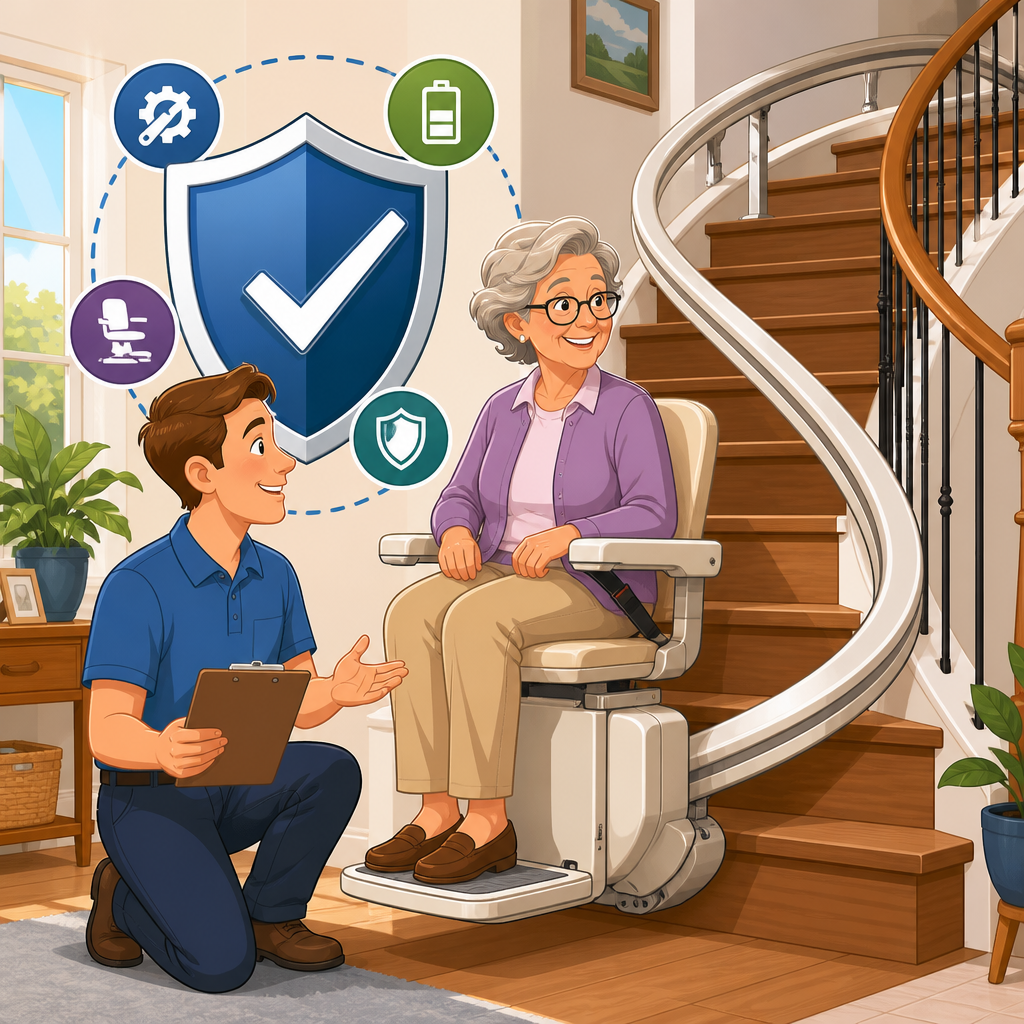
Buying a curved stair lift is a major accessibility investment, and warranty coverage should be evaluated as carefully as rail design, seat comfort, and installation quality. A curved stair lift is a motorized chair that travels on a custom rail built to match turns, landings, and elevation changes on a specific staircase. Because every curved rail is manufactured to order, these systems cost more than straight stair lifts and involve more complex components, longer lead times, and tighter installation tolerances. That complexity makes warranty and return policy details especially important. In practice, buyers who focus only on the quoted price often miss the fine print on drivetrain coverage, electronics exclusions, labor terms, and what happens if the lift fails after the installer has left.
When I review stair lift proposals, I look at warranty coverage in layers: the rail and structural components, the motor and gearbox, batteries and charging system, electronics, seat and upholstery, and labor for diagnosis and repairs. I also look beyond the manufacturer’s printed warranty to the dealer’s service promise, because the real ownership experience depends on who answers the phone and how quickly parts are fitted. For curved stair lifts, the custom rail itself is often the single biggest return-policy issue. Unlike a boxed appliance, it usually cannot be restocked once fabricated to your staircase measurements. That means buyers should expect tighter cancellation rules, limited returns after production begins, and more responsibility to verify measurements, handedness, seat options, and power location before signing off.
This guide explains what warranty coverage you should expect on a curved stair lift, where the common exclusions sit, and how return policies typically work for custom mobility equipment. It also serves as a central reference point for the broader warranty and return-policy questions that matter when comparing brands, dealers, rental options, and refurbished units. If you understand the standard terms before you buy, you can compare quotes on a like-for-like basis, avoid preventable disputes, and choose a dealer that will still be useful years after installation.
What a strong curved stair lift warranty should include
A strong curved stair lift warranty usually combines manufacturer coverage on major parts with dealer-backed labor for installation-related issues and field service. At minimum, buyers should expect written coverage for the motor, transmission or gearbox, rail, carriage, and core electronic controls. Better packages also include call-out labor for an initial period, often twelve months, and clear language on response times, travel charges, and whether diagnostic visits are included. In my experience, the difference between a merely acceptable warranty and a genuinely good one is not the headline length alone. It is whether the agreement spells out who pays when a technician needs to return, which parts are wear items, and how failures are documented and approved.
For curved units, the rail warranty matters more than many buyers realize. A custom rail is expensive, difficult to replace, and specific to one staircase geometry. Reputable manufacturers commonly provide multi-year or lifetime coverage on the rail and structural frame against defects in materials and workmanship. The motor and gearbox may carry several years of parts coverage, while printed circuit boards, charging contacts, call stations, and seat swivels sometimes have shorter terms. Batteries are often the shortest-covered item because they are consumables with performance affected by usage patterns, charging behavior, ambient temperature, and power interruptions.
You should also expect the warranty to identify the start date. Some begin on installation day, while others begin on delivery or invoice date. That distinction matters if a project is delayed because the home is being renovated or an electrical outlet is moved. A good contract should state whether replacement parts inherit the remainder of the original warranty or receive their own limited term. Ask for that in writing, not verbally. Dealers change staff, and undocumented promises tend to disappear when service issues arise.
Typical coverage periods by component
Coverage periods vary by manufacturer and dealer, but market patterns are consistent enough to set realistic expectations. Structural components such as the rail, brackets, and chassis often receive the longest protection, sometimes many years or a lifetime limited warranty for the original purchaser. Drive components such as the motor and gearbox commonly fall into a mid-range term. Electronics and controls may match the motor term or be shorter. Batteries, remote controls, and upholstery usually have the most limited protection. Labor may be included for a year, omitted entirely, or sold separately through an extended service plan.
| Component | Typical Coverage You Should Expect | Common Limitation |
|---|---|---|
| Custom rail and structural frame | 5 years to lifetime limited parts coverage | Original purchaser only; defects, not misuse or house movement |
| Motor and gearbox | 2 to 5 years parts coverage | No coverage for damage from power surges, liquid exposure, or overload |
| Control board and electronics | 1 to 3 years parts coverage | Shorter term than mechanical parts; surge damage often excluded |
| Batteries and charger | 30 days to 1 year, sometimes 2 years | Battery capacity loss treated as normal wear |
| Seat, armrests, footrest, upholstery | 1 to 3 years on defects | Cosmetic wear, tears, and impact damage excluded |
| Labor and service call-outs | 30 days to 1 year, if included | Travel fees, after-hours visits, and annual maintenance not always covered |
These ranges are not guarantees, but they are a useful benchmark when reviewing quotes. If one dealer advertises a lifetime warranty, inspect what “lifetime” actually covers. It may apply only to the rail, while labor ends after twelve months and batteries after ninety days. Another dealer may offer a shorter parts term but include stronger local service with stocked spares and next-day visits. In real ownership, prompt competent service can be worth more than an impressive but narrow headline warranty.
Parts, labor, and service response are not the same thing
Many buyers assume a stair lift warranty means all repairs are free for the stated period. That is often incorrect. Warranty coverage is usually divided into parts and labor, and sometimes a third category applies for travel or call-out charges. A failed armrest switch might be covered as a part, yet you may still pay a technician to diagnose and replace it if labor coverage has expired. For homes located far from the dealer’s branch, the travel fee can be significant. That is why every quote should answer three direct questions: which parts are covered, how long is labor included, and who pays for travel after the initial period.
Response times are equally important, especially if the stair lift is the user’s only safe way to reach a bedroom or bathroom. Some dealers offer emergency support, weekend visits, or loaner solutions; others work only standard business hours. Ask whether the company keeps common parts in local vans or must order them from a national warehouse. A warranty that authorizes parts quickly but leaves you waiting a week for field service is weaker than it sounds. Reputable providers are willing to discuss their average repair turnaround and escalation process for mobility-critical users.
Scheduled maintenance is another area of confusion. Most curved stair lifts do not require frequent intensive servicing, but periodic inspection of charging points, seat swivel locks, safety edges, overspeed governors, and rail fixings is good practice. Some warranties require annual maintenance by an authorized technician to remain valid. Others recommend it without making it a strict condition. If maintenance is mandatory, the contract should say so clearly, along with the expected cost. Hidden maintenance conditions are a common source of denied claims.
Common exclusions and why claims are denied
The most common warranty exclusions on curved stair lifts are not unusual or unfair, but they need to be understood before purchase. Batteries are excluded or limited because all rechargeable batteries degrade over time. Upholstery damage from pets, cleaning chemicals, or abrasion is generally not covered because it is considered wear or accidental damage. Power-surge damage to chargers or control boards may be excluded unless the system was protected according to the manufacturer’s requirements. Misuse also voids claims. Examples include exceeding the weight capacity, allowing children to play on the lift, blocking the footrest safety edges, or moving household items on the chair.
Installation environment matters as well. Indoor curved stair lifts are designed for climate-controlled residential spaces. If a lift is fitted in a damp coastal property, an unheated outbuilding, or a stairwell subject to condensation, corrosion or electronic issues may fall outside standard coverage. House movement can also affect rail alignment. In older homes, I have seen settlement alter clearances enough to require adjustment. Manufacturers usually cover product defects, not structural changes in the building. The distinction is important during dispute resolution, because a homeowner may perceive any malfunction as a product failure when the root cause is actually the installation environment.
Another reason claims are denied is unauthorized repair. If an unapproved handyman opens the carriage, rewires charging contacts, or substitutes a non-original battery, the manufacturer may decline later claims. The same applies if a customer relocates the lift to another property. Curved rails are staircase-specific, and dismantling and refitting without factory approval introduces alignment and safety risks. Always confirm whether any third-party service affects warranty status.
Return policies for custom curved stair lifts
Return policies for curved stair lifts are stricter than for straight lifts because the rail is custom-manufactured from a survey of your staircase. Once production starts, the dealer has little chance of reselling that rail. As a result, you should expect a staged cancellation policy. There may be a cooling-off period before final measurement approval, then a reduced refund or no refund after the rail order is released to the factory. This is standard in custom mobility equipment and should not be treated as a red flag by itself. The key is transparency.
Before signing, ask exactly when the order becomes non-cancellable, what portion of the deposit is refundable at each stage, and whether any site-survey fee is separate. Good dealers document the survey, confirm staircase dimensions, review seat orientation, park positions, hinge options, and upholstery color, then obtain a signed approval. That process protects both parties. If the home layout changes after approval, the customer may have to pay for rail redesign or remanufacture. If the dealer measures incorrectly, that is different; the provider should take responsibility for correcting its own error.
Returns after installation are usually limited to defective goods, misrepresentation, or installation problems the dealer cannot cure. Most providers will attempt repair or replacement before accepting a return. That approach aligns with how durable medical and accessibility equipment is normally handled. If you believe the lift is unsuitable, document issues immediately, avoid altering the equipment, and communicate in writing. A clear paper trail helps resolve disputes faster than phone calls alone.
Questions to ask before you buy
Buyers should ask specific warranty and return-policy questions rather than accepting brochure language. Start with component coverage: how long are the rail, motor, gearbox, control board, charger, and batteries covered? Then move to service logistics: is labor included, are travel charges covered, what are standard response times, and do you offer emergency support? Ask whether preventive maintenance is required to keep the warranty valid and whether service must be performed by an authorized dealer. Clarify transferability too. Most warranties apply only to the original purchaser at the original address, which matters if the home may be sold.
Next, ask for the cancellation policy in writing with milestone dates. Find out when measurement approval is final, when the rail order is placed, and what happens if you need to postpone installation. If the quote includes an extended warranty or service plan, request a copy of that agreement before paying a deposit. Some plans are worthwhile because they bundle labor, annual service, and battery replacement; others mainly repackage what the manufacturer already covers. I compare the annual cost against the local call-out rate, the age of the user, and how essential uninterrupted operation is in that household.
Finally, assess the dealer, not just the brand. A premium manufacturer paired with a weak local installer can produce a poor ownership experience. Check how long the dealer has been fitting curved systems, whether technicians are factory trained, and whether they stock parts for the model quoted. Read recent reviews with an eye for service patterns, not isolated complaints. The best stair lift warranty on paper is only as useful as the company that administers it.
How this hub helps you compare warranty and return policy topics
This page is the starting point for evaluating stair lift warranty and return policy issues across the wider buying journey. From here, buyers should compare manufacturer warranties by brand, understand how new and refurbished stair lift coverage differs, and examine whether rental or reconditioned options make sense for temporary needs. Another important branch is labor-only service plans after the original warranty expires. Those plans can be cost-effective for households that depend on the lift daily, especially where replacement parts remain available but technician travel is expensive.
It is also useful to separate product warranty questions from consumer-rights questions. Contract cancellation rights, off-premises sales rules, financing disputes, and installation workmanship complaints may be governed by local law and dealer terms, not only by the manufacturer’s warranty booklet. If you are comparing quotes, build a simple checklist and score each provider on parts coverage, labor period, exclusions, response time, maintenance conditions, and cancellation flexibility. That method turns a vague promise into a measurable purchasing criterion.
In short, you should expect a curved stair lift warranty to protect major structural and mechanical components clearly, limit coverage on batteries and wear items, and define labor and travel terms without ambiguity. You should also expect a custom-order return policy with reduced cancellation rights once fabrication begins. The main benefit of understanding these terms upfront is confidence: you can buy the right lift from the right dealer without being surprised later by exclusions or service costs. Use this hub as your reference point, gather every promise in writing, and compare warranty and return policies as carefully as price.
Frequently Asked Questions
1. What parts of a curved stair lift are usually covered under warranty?
Most curved stair lift warranties cover the major mechanical and electrical components that make the unit operate safely and reliably. This often includes the motor, gearbox or transmission, control board, batteries, charger, seat assembly, armrests, footrest mechanisms, and safety sensors. In many cases, the custom curved rail itself is also covered, which is especially important because that rail is manufactured specifically for your staircase and represents a significant portion of the total system cost.
That said, coverage is not always uniform across every part. Manufacturers and dealers commonly separate the warranty into categories, such as lifetime coverage on the rail, several years on core components, and a shorter term on batteries or wearable items. Because curved stair lifts have more custom engineering than straight models, buyers should ask for a written breakdown of exactly what is covered and for how long. It is also wise to confirm whether cosmetic items, upholstery, remote controls, folding hinges, and power swivel seats are included or treated differently. The best warranty is one that clearly spells out coverage by component rather than relying on broad marketing language.
2. How long should a good curved stair lift warranty last?
A strong curved stair lift warranty generally includes multiple layers of coverage rather than one single term for everything. Many buyers should expect the rail to carry the longest protection, sometimes for many years or even for the life of the unit in the original home, since the rail is custom-built and not easily reused elsewhere. Major mechanical and electrical parts often receive coverage for several years, while batteries may be covered for a shorter period because they naturally wear down over time with charging cycles and use.
When comparing warranties, the goal is not just to find the longest number on a brochure. A five-year comprehensive parts warranty with clear service support may be more valuable than a so-called lifetime warranty that applies only to one component and excludes labor. A good rule is to look for written terms that protect the expensive custom rail, provide meaningful coverage on the drive system and electronics, and explain what happens after the initial term ends. Ask whether there are prorated periods, whether replacement parts carry their own warranty, and whether the warranty transfers if the home is sold. Duration matters, but clarity and practical value matter just as much.
3. Does stair lift warranty coverage usually include labor, service calls, and installation issues?
This is one of the most important questions a buyer can ask, because many people assume a warranty covers all repair costs when it may only cover replacement parts. In reality, some curved stair lift warranties include parts but charge separately for technician visits, diagnostics, travel time, and labor. Since curved stair lifts require precise installation and adjustment on a staircase with turns, landings, and custom measurements, service costs can add up if labor is not included. A warranty that covers both parts and labor for at least an initial period can provide much better real-world protection.
Installation-related coverage is equally important. If a ride quality issue, alignment problem, charging fault, or rail fit concern appears after installation, you want to know whether that is treated as a warranty matter or a billable service call. Reputable providers often stand behind both the product and the installation workmanship, but the terms should be written down. Buyers should ask how long installation labor is guaranteed, whether follow-up adjustments are included, and how quickly service is typically scheduled. On a product this customized and costly, workmanship and support responsiveness are just as critical as the parts warranty itself.
4. What common exclusions or limitations should buyers watch for in a curved stair lift warranty?
Even a solid warranty will have exclusions, and understanding them in advance can prevent expensive surprises later. Common limitations include normal wear and tear, battery deterioration over time, cosmetic damage, misuse, accidental damage, unauthorized repairs, power surges, and problems caused by neglect or failure to maintain the lift according to manufacturer guidelines. Some warranties also exclude issues related to changes in the home environment, such as water exposure, excessive dust, pet damage, or electrical irregularities. If the stair lift is installed in a setting not approved by the manufacturer, coverage may also be restricted.
Another key limitation to review is ownership and transferability. Some warranties apply only to the original purchaser or only while the lift remains in the original installation location. Others may become void if the unit is moved, modified, or serviced by a non-authorized technician. Since curved stair lifts are custom-built for a specific staircase, rail remake costs caused by measurement errors, remodeling, or stair changes may not be covered unless the dealer specifically guarantees them. The safest approach is to ask for a copy of the full warranty terms before purchase and review the exclusions line by line, especially on a system involving custom fabrication and specialized installation.
5. What should you expect from the best curved stair lift warranty and support package overall?
The best warranty package combines strong component coverage with dependable post-installation support. For a curved stair lift, buyers should expect written protection on the custom rail, meaningful multi-year coverage on the motor and electronics, and clear terms regarding batteries, charger systems, seat functions, and safety devices. Just as important, the provider should explain whether labor is included, how service calls are handled, what the response times are, and whether preventive maintenance plans are available. Since curved systems are more expensive and mechanically complex than straight lifts, warranty value should be judged by total support, not by a single headline term.
You should also expect transparency from the dealer or manufacturer. A quality provider will be able to explain who honors the warranty, whether parts come from the manufacturer or local dealer stock, how repairs are documented, and what happens if a component fails years later. It is smart to ask whether loaner solutions, emergency service options, or extended warranties are available. In short, the best curved stair lift warranty should make ownership feel predictable and protected. Because this is a major accessibility investment tied directly to daily mobility and household safety, the strongest coverage is coverage that is clear, enforceable, and backed by responsive local service.





