Outdoor chair lifts expand independence by making porches, decks, garden paths, and front entries accessible in every season, but winter introduces risks that indoor systems never face. Snow, wind, road salt, freezing rain, and repeated thaw-freeze cycles can affect rails, call stations, seat materials, batteries, and safety sensors. Winterizing your outdoor stair lift means preparing the unit, its surroundings, and your maintenance routine so the lift stays reliable when temperatures drop. For homeowners, caregivers, and property managers, this matters because an outdoor lift often serves as the only safe route into the home. If it fails during a cold snap, mobility and emergency access can be compromised immediately.
An outdoor stair lift is a motorized seat that travels along a rail mounted to exterior stairs. Most models are built from weather-resistant materials such as aluminum rails, sealed gearboxes, marine-grade vinyl, UV-stable plastics, and coated fasteners. They differ from indoor lifts because they include covers, drainage design, corrosion protection, and electronics rated for wider temperature swings. Winterizing does not mean turning the lift off for the season. In practice, it means cleaning debris, protecting exposed components, checking battery charging, verifying proper operation of limit switches and obstruction sensors, and managing the staircase environment so ice does not build around the travel path. I have seen well-installed outdoor lifts perform dependably through harsh winters, but only when owners treat them like exterior mechanical equipment rather than patio furniture.
This guide serves as a hub for outdoor chair lifts within the broader chair lift types and designs category. It explains what winter weather does to lift systems, how to prepare a lift before the first freeze, what maintenance tasks matter during the season, and when to call a certified technician. It also clarifies common questions, such as whether you can leave a lift plugged in outside, how often to clear snow from the rail, and whether a cover alone is enough protection. If you are comparing outdoor chair lifts, maintaining an existing unit, or planning seasonal service, the sections below give you a practical framework you can apply right away.
How Winter Weather Affects Outdoor Chair Lifts
Cold weather affects an outdoor stair lift in several connected ways. First, battery performance drops as temperatures fall. Most outdoor lifts use battery-powered drive systems charged from a household circuit at designated charge points. Lead-acid and similar sealed batteries deliver less effective capacity in low temperatures, so a lift that normally handles multiple trips may feel slower or produce low-battery alerts sooner in January than in June. Second, moisture intrusion becomes more dangerous in winter because water can freeze around moving parts, safety edges, or footrest hinges. Third, deicing chemicals accelerate corrosion on brackets, fasteners, and lower rail sections, especially near sidewalks and driveways where salt spray is common.
Mechanical tolerances also tighten in winter. Grease viscosity changes, vinyl gets stiffer, and packed snow can obstruct the carriage path or charging contacts. I often tell owners that the lift itself is only half the system; the staircase is the other half. If handrails drip onto the track, roof runoff lands on the top landing, or drifting snow accumulates at the lower overrun, the lift will face repeated operating problems no matter how robust the manufacturer’s weatherproofing is. Outdoor models from established brands are engineered for rain and temperature swings, but they are not designed to plow through ice or operate while buried under snow.
The main winter hazards are predictable: loss of traction on approach areas, frozen seat belts, blocked swivel seats at landings, ice near folding arms and footrests, and failure to maintain charging at the parked position. These issues are manageable when caught early. They become expensive when ignored, because repeated forcing of frozen components can damage hinges, seat-lock mechanisms, and plastic housings. A winterization plan is therefore both a safety measure and a cost-control strategy.
Pre-Winter Inspection and Service Checklist
The best time to winterize an outdoor stair lift is before nighttime temperatures regularly drop below freezing. Start with a full visual inspection. Look for cracked seat upholstery, loose armrests, damaged weather covers, worn call/send station buttons, frayed wiring at hinge points, and any rust bleeding from fasteners or mounting feet. Check the rail for leaf debris, spider nests, hardened grime, or residue from prior cleaning products. Exterior rails collect contamination slowly, and that buildup can interfere with carriage rollers and charge strips over time.
Next, test every user function exactly as it is used in daily life. Fold and unfold the seat, arms, and footrest. Engage the seat swivel at the top landing and confirm it locks securely before exit. Ride the lift both directions and listen for changes in sound: grinding, chattering, delayed starts, or beeping at charge points. Run the remote call/send controls from both landings. If your lift includes a powered hinge rail to keep a walkway clear, verify that the hinge cycles completely and stops without binding. Standards used by reputable installers, including common practices aligned with manufacturer service bulletins and accessibility equipment protocols, treat these functional checks as essential before winter begins.
A professional annual service is worth scheduling even for owners who do routine cleaning. Certified technicians inspect battery health, charging voltage, carriage lubrication points, rack condition, overspeed governors where applicable, and safety circuits that are not obvious to a homeowner. They can also confirm whether firmware updates, revised seals, or replacement covers are available for your model. In my experience, preventive service in autumn prevents the midwinter service call that is hardest to schedule after a storm.
Cleaning, Protection, and Safe Operating Habits
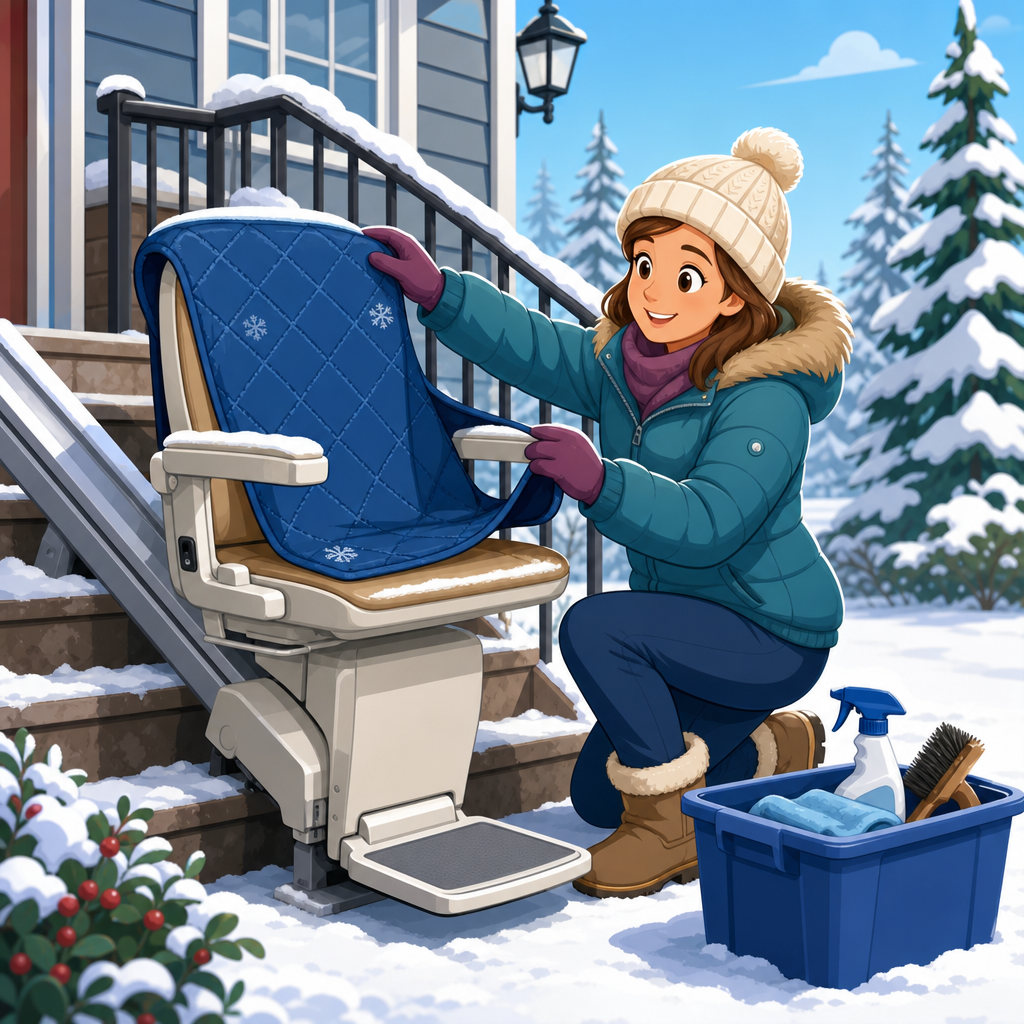
Cleaning an outdoor stair lift for winter is simple but must be done correctly. Use a soft cloth, mild soap, and water on exposed surfaces unless the manufacturer specifies otherwise. Avoid pressure washers, solvent cleaners, silicone overspray on the rail, and thick general-purpose grease. These products can force water into seals, degrade plastics, or attract abrasive grit. After cleaning, dry the rail and seat thoroughly, especially around charging contacts and footrest joints. If the cover is wet inside, dry it before reinstalling it; trapping moisture under a cover during freezing weather creates the exact problem the cover is meant to prevent.
Protective covers are important, but they are not a complete winterization solution. A fitted, manufacturer-approved cover shields the seat and controls from precipitation and UV exposure while the lift is parked. It should sit securely without rubbing sharp edges or trapping standing water. Even with a good cover, you still need to clear snow from the staircase and rail before operation. Never run the lift with snow packed on the footrest or ice adhered to the track. Doing so can trigger obstruction sensors or strain the drive system.
Daily operating habits matter as much as seasonal preparation. Park the lift at its designated charge point after each use. Keep a soft brush nearby to remove light snow from the seat, arms, and rail. Use a plastic snow shovel rather than a metal tool near the rail to avoid scratching protective finishes. If freezing rain is forecast, inspect the lift before the first trip rather than assuming the cover prevented ice formation. Small habits like these greatly reduce nuisance faults.
| Winter task | What to do | Why it matters |
|---|---|---|
| Clear snow | Brush rail, seat, and landings before each use | Prevents obstruction faults and slip hazards |
| Check charging | Park fully at charge point and confirm indicator status | Cold weather reduces battery performance |
| Use the cover | Install a dry, fitted weather cover when parked | Limits moisture, UV exposure, and debris buildup |
| Inspect for ice | Look at footrest hinges, seat swivel, and charge contacts | Ice can immobilize safety components |
| Manage salt exposure | Rinse nearby splash residue when conditions allow | Road salt accelerates corrosion on metal parts |
Battery Care, Power Reliability, and Cold-Weather Performance
Most modern outdoor chair lifts run on onboard batteries and charge automatically from a standard electrical supply. This design allows the lift to keep operating for several trips during a household power outage, which is valuable in winter storms. However, cold weather changes battery behavior. Capacity drops, charging can take longer, and a battery nearing end of life will reveal its weakness sooner outdoors than indoors. If your lift hesitates, slows noticeably, or beeps after short trips in cold weather, battery testing should be high on the troubleshooting list.
Leave the lift powered and parked at the correct charging position unless the manufacturer explicitly directs otherwise. Turning the unit off for long periods can allow batteries to discharge below healthy levels. Sealed batteries in stair lifts commonly last around three to five years, but outdoor exposure, heavy use, and inconsistent charging can shorten that range. A homeowner can verify obvious issues such as a tripped breaker or a dead outlet, yet battery load testing and charger diagnostics are technician tasks. Because many winter failures are wrongly blamed on the motor, it is important to remember that weak batteries often cause the symptoms users notice first.
Power reliability also depends on the environment around the charging points. Leaves, grit, oxidation, or ice on contacts can interrupt charging even when the outlet and charger are fine. If the staircase is exposed to drifting snow, pay particular attention to the lower charging station, which often sits closer to splashback and slush. In regions with frequent outages, some owners also ask whether a whole-home generator helps. It does, but the priority remains healthy onboard batteries, because the lift’s DC drive system relies on them regardless of backup household power.
Preventing Corrosion, Ice Buildup, and Structural Problems
Corrosion is the slow winter problem that owners often notice only after it has advanced. Outdoor lifts are built with protective finishes, stainless or coated hardware, and weather-resistant materials, yet no exterior system is immune to salt and moisture. The lower rail end, mounting brackets near concrete, and hardware exposed to shovel splash are common trouble spots. Inspect these areas monthly for white oxidation on aluminum, rust staining around bolts, bubbling paint on brackets, or stiffness in folding components. Early cleaning and part replacement are far cheaper than rail or carriage damage caused by long-term corrosion.
Ice management starts with water management. If a gutter discharges onto the top landing, if a downspout empties near the bottom stop, or if the stairs pitch water toward the rail, the lift will repeatedly ice over. Correcting runoff is often the most effective winter upgrade. Simple changes such as extending downspouts, sealing cracks in adjacent masonry, or improving drainage at the landing can dramatically reduce service issues. I have seen lifts that seemed unreliable become dependable once roof runoff was redirected away from the staircase.
Structural conditions around the stairs matter too. Freeze-thaw cycles can loosen masonry anchors, shift pavers at the lower landing, and create uneven approach surfaces. Outdoor chair lifts do not usually mount to the wall; they mount to the stair treads or supporting structure through brackets that depend on stable substrate. If steps are heaving, cracking, or retaining water, ask the installer or a qualified contractor to inspect the stair structure. Reliable winter performance depends on both the machine and the stairway remaining sound.
When to Troubleshoot Yourself and When to Call a Technician
Some outdoor stair lift problems in winter have safe homeowner solutions. If the lift will not move, first confirm the seat is fully lowered, the swivel is locked in travel position, the armrests and footrest are not obstructed, and the unit is parked correctly on charge. Remove visible snow from the rail and landings, check that the household breaker has not tripped, and verify that remote batteries still work if the call/send controls are unresponsive. These are straightforward checks that solve many common no-start situations.
Stop and call a certified technician if you see damaged wiring, recurring fault codes, grinding noises, water inside control housings, a cracked gear rack cover, intermittent charging, or looseness in the seat or rail. Do not bypass safety edges, force a powered hinge, chip ice off sensitive components with metal tools, or spray deicer directly onto electrical parts. Chemical deicers can help on surrounding walking surfaces when used according to product instructions, but keep them off the lift unless the manufacturer approves a specific method. The goal is safe access, not improvised repair.
As the hub page for outdoor chair lifts, this article connects the core issues every owner should understand: weatherproof design, maintenance routines, battery behavior, corrosion control, and safe operation in snow and ice. Winterizing your outdoor stair lift is not complicated, but it does require consistency. Clean the unit, protect it with the right cover, keep it charging, control water and salt exposure, and schedule professional service before problems escalate. Those steps preserve reliability when you need the lift most. Review your owner’s manual, inspect your staircase this week, and book seasonal maintenance if anything looks questionable.
Frequently Asked Questions
1. Why is winterizing an outdoor stair lift so important?
Winterizing an outdoor stair lift is essential because outdoor systems are exposed to conditions that indoor lifts never encounter. Snow accumulation, freezing rain, drifting debris, road salt, and repeated freeze-thaw cycles can all interfere with normal operation. Moisture can collect on the rail, seat, footrest, and call/send controls, then freeze overnight and create resistance or block moving parts. Salt and slush can also speed up corrosion on metal components if they are not cleaned off regularly. Even when a lift is built for exterior use, it still performs best when it is protected and maintained with seasonal conditions in mind.
Proper winter preparation also helps preserve reliability and safety. A stair lift depends on a clean track, responsive safety sensors, stable power supply, and healthy batteries to operate correctly. If snow or ice obstructs the rail, or if sensors are covered with grime, the lift may stop unexpectedly or refuse to run as a safety precaution. Cold temperatures can also affect battery performance, especially if the unit is not charging consistently. Taking steps before and during winter reduces service calls, helps prevent sudden breakdowns during storms, and supports dependable access to porches, decks, entrances, and outdoor pathways when mobility is most important.
2. What parts of an outdoor stair lift should I inspect before winter begins?
Before winter starts, inspect every part of the lift that is exposed to weather or plays a role in safe travel. Begin with the rail and make sure it is clean, free of leaves or dirt, and securely mounted. Check the carriage path for anything that could freeze or create drag once temperatures drop. Look closely at the seat, armrests, footrest, hinges, and swivel mechanism to confirm that everything folds, locks, and moves smoothly. If your model has a weather cover, inspect it for tears, loose seams, or worn fasteners so it can protect the lift properly throughout the season.
Next, review the electrical and control components. Test the call/send stations, seat belt, key switch if equipped, and all visible safety edges or obstruction sensors. Confirm that the lift is charging correctly at its designated charge points and that the batteries are holding a full charge. If the unit shows warning lights, error codes, or slower-than-normal performance, address those issues before severe weather arrives. It is also smart to inspect the area around the lift itself. Handrails, steps, landings, and drainage paths should be checked so water does not pool and freeze near the rail. A pre-winter inspection gives you the best chance to correct small issues before they become cold-weather failures.
3. How should I clean and protect an outdoor stair lift during winter?
The best winter cleaning routine is simple, consistent, and gentle. Brush off snow with a soft broom or cloth rather than using metal tools, sharp scrapers, or anything abrasive that could damage finishes, wiring covers, or sensors. Remove snow from the seat, footrest, rail, and charging areas whenever accumulation appears. If you notice ice, do not chip at it aggressively. Instead, follow the manufacturer’s guidance for safe removal and allow time for the ice to loosen naturally if needed. Keeping the rail clear is especially important because even a small frozen obstruction can interrupt travel or trigger safety stops.
Protection matters just as much as cleaning. Use the lift’s outdoor cover whenever the unit is parked and not in use, making sure the cover fits securely and does not trap excessive moisture. Wipe away road salt residue, mud, and slush with approved cleaning materials because salt can gradually damage metal surfaces and hardware. Avoid harsh cleaners, de-icing chemicals, or lubricants unless the manufacturer specifically recommends them. Many homeowners assume more lubricant is helpful in winter, but the wrong product can attract dirt or thicken in cold temperatures. Following the stair lift maker’s cleaning instructions is the safest way to protect the finish, preserve sensor performance, and keep the unit ready for dependable daily use.
4. Can cold weather affect the stair lift’s batteries, controls, or safety features?
Yes, cold weather can affect several key systems, even on a model designed for outdoor installation. Batteries are one of the most important examples. Most stair lifts rely on battery power for operation, with the batteries charging automatically when the unit is parked in the proper position. In winter, batteries can lose efficiency, recharge more slowly, or provide shorter run times if they are aging or not staying fully charged. If the lift is frequently left off the charge point, or if snow and debris interfere with charging contacts, you may notice weaker performance when temperatures drop.
Controls and safety features can also become less reliable if winter conditions are ignored. Ice, condensation, and grime may affect call/send stations, seat controls, or safety edges that are meant to stop the lift when an obstruction is detected. Outdoor-rated materials are built to handle moisture better than indoor components, but they still need regular attention. If you notice delayed response, repeated stopping, unusual beeping, or inconsistent charging, schedule service promptly rather than waiting for a complete outage. Staying proactive helps ensure that critical safety systems continue to function as intended and that the lift remains dependable when conditions outside are at their worst.
5. What ongoing winter maintenance habits help keep an outdoor stair lift reliable all season?
The most effective winter maintenance habits are frequent visual checks, prompt snow removal, and consistent attention to the surrounding entry area. After every storm, inspect the full rail path, both landings, and any charging points. Remove snow before it becomes compacted or turns to ice. Keep nearby walkways, steps, and decks shoveled and treated according to safe access guidelines, but be careful with de-icing products around the lift itself unless they are known to be compatible with the equipment. Good drainage is also important. If melting snow repeatedly runs toward the rail or lower landing, it can refreeze and create ongoing operational problems.
It is equally important to maintain a regular service routine. Follow the manufacturer’s maintenance schedule and arrange professional service if the lift makes unusual noises, hesitates, stops unexpectedly, or shows signs of wear. Do not ignore a minor issue simply because the lift still runs; winter conditions often make small problems worse very quickly. Encourage everyone in the household to use the lift correctly, replace the cover after use, and avoid forcing any component that seems stiff or frozen. With a steady routine of cleaning, inspection, safe storage, and timely professional support, an outdoor stair lift can continue to provide secure and reliable access throughout the entire winter season.