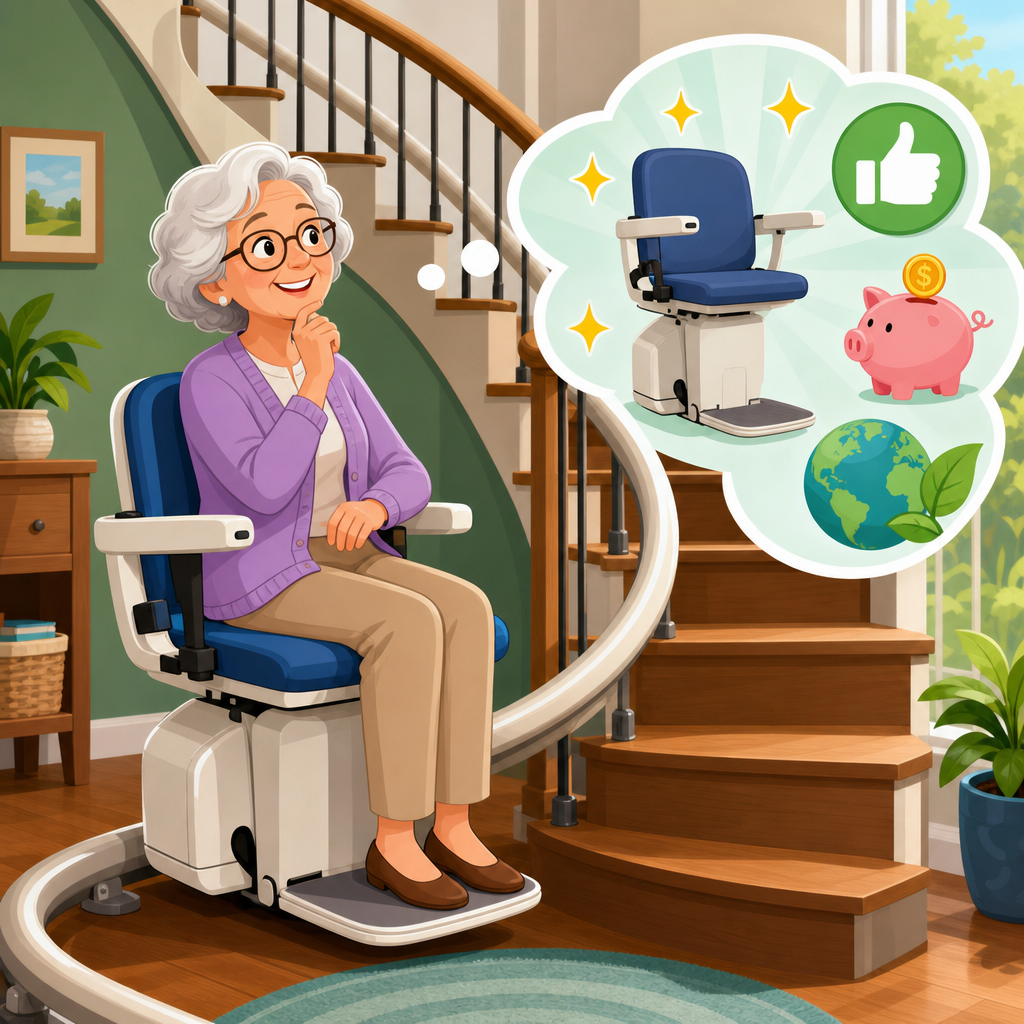
Refurbished curved stair lifts can be worth it, but only under specific conditions: the rail must be professionally remanufactured to match the staircase, the carriage and safety systems must be tested to current standards, and the warranty must be strong enough to offset the higher installation risk that comes with reused equipment. For buyers comparing mobility solutions, this question matters because curved stair lifts are usually the most expensive category of chair lift, often costing several times more than straight models due to custom rail fabrication, more complex surveying, and longer installation times.
A curved stair lift is a motorized seat that travels along a staircase with turns, intermediate landings, pie-shaped steps, or spiral geometry. Unlike straight stair lifts, which can often be moved and reused with minimal modification, curved units depend on a rail shaped to the exact dimensions of a specific staircase. That single fact drives almost every buying decision in the used and refurbished market. In practice, when people say “refurbished curved stair lift,” they may mean one of three things: a reused chair mounted on a newly made rail, a factory-remanufactured system with replaced wear parts, or a lightly used unit removed from one home and adapted for another. Those are not equal products, and pricing alone does not tell you which one you are getting.
I have seen buyers save meaningful money with refurbished systems, but I have also seen poorly specified purchases turn into expensive delays when measurements were off, parts were obsolete, or service coverage was weak. Because this page serves as a hub for used and refurbished chair lifts, it is important to define the broader category clearly. “Used” usually means sold largely as-is after removal. “Refurbished” should mean inspected, repaired, cleaned, and tested, with key components replaced as needed. “Remanufactured” often implies a deeper rebuild closer to factory condition. When you compare offers, insist on those definitions in writing.
The reason this topic deserves close attention is simple: mobility equipment is not a decorative purchase. It affects daily safety, independence, caregiver workload, and whether someone can remain in a multilevel home. The wrong purchase can leave a user stranded or unsafe on the stairs; the right one can extend aging in place by years. If you are researching used and refurbished chair lifts, curved models demand the most scrutiny, because customization, compatibility, and after-sales support matter more here than in any other stair lift segment.
How the Refurbished Curved Stair Lift Market Actually Works
Most refurbished curved stair lifts are not complete secondhand systems dropped into a new home unchanged. In the real market, the reusable value usually sits in the chair, carriage, power components, footrest, seat assembly, and controls, while the rail is newly manufactured or heavily modified from fresh measurements. Established brands such as Handicare, Bruno, Stannah, and Access BDD build curved systems around precise surveying data. Dealers commonly use photo measuring, digital templating, or site surveys to map every rise, run, angle, and landing clearance before ordering the rail.
That means a reputable refurbished offer typically combines old and new parts. A dealer may source a returned or previously installed chair lift, strip and inspect it, replace batteries, rollers, wiring harnesses, switches, armrest controls, and cosmetic panels as needed, then pair it with a custom rail produced for the buyer’s staircase. This approach can lower cost compared with a fully new curved lift, but the savings are usually smaller than buyers expect because the custom rail remains a major expense. If a salesperson promises a dramatic discount without explaining rail fabrication, ask hard questions.
The used and refurbished chair lift market also varies by seller type. Factory-authorized dealers usually offer the safest route because they have access to genuine parts, manufacturer survey protocols, and trained installers. Independent resellers may offer lower pricing, but service quality depends heavily on their technical depth and local parts network. Auction platforms and private sales create the greatest risk. A curved stair lift removed from another property may look complete, yet still be unsuitable because the rail geometry, load rating, charge points, or seat orientation do not match the new installation site.
As a hub topic, this is where many buyers need a clear rule: for curved stair lifts, the term “refurbished” is valuable only when paired with documented compatibility, measured fit, installation by qualified technicians, and service support after handover. Without those elements, it is just used equipment with a nicer label.
When a Refurbished Curved Stair Lift Is Worth Buying
A refurbished curved stair lift is worth buying when it delivers meaningful savings without compromising fit, safety, or repairability. The strongest case appears when a buyer wants a premium curved model but has budget pressure, when the local dealer is factory authorized, and when the refurbishment includes a new custom rail plus a clear parts-and-labor warranty. In those circumstances, the buyer can often get dependable access at a lower upfront cost than a fully new system while avoiding the biggest risk of trying to reuse an old rail.
It is also worth considering when the user’s needs are stable and well defined. For example, if the rider can transfer independently, does not require a heavy-duty seat, and has a staircase with adequate width for a standard perch and footrest, a refurbished unit may perform just as well as new for daily home use. Many modern stair lifts use robust DC drive systems, battery backup, obstruction sensors, overspeed governors, swivel seats, and call/send controls that remain reliable after proper refurbishment. Replacing wear items and testing the drivetrain often restores excellent service life.
In my experience, the best refurbished outcomes happen when the dealer treats the project like a custom mobility installation rather than a bargain resale. They start with a full assessment of user height, weight, transfer method, hand function, seat position at top and bottom landings, and emergency egress. Then they survey the staircase, confirm electrical charging points, and explain maintenance intervals. Buyers who receive that level of planning usually end up satisfied, because the lift was selected around real use, not just price.
Another situation where refurbished can make sense is short-to-medium-term occupancy. If a family expects to use the lift for several years rather than a decade, a professionally refurbished model can deliver strong value. The same applies when a home adaptation budget must stretch across several modifications, such as grab bars, ramps, bathroom changes, and doorway widening. In these cases, controlled savings on the stair lift may preserve funds for other essential accessibility work.
When It Is Not Worth the Risk
Refurbished curved stair lifts are not worth it when the equipment is obsolete, the installer cannot source parts reliably, or the proposal lacks a strong warranty. Battery-powered stair lifts rely on chargers, control boards, limit switches, safety edges, and drive components that must work together consistently. If one of those elements fails and the model has been discontinued for years, downtime can stretch from days to months. For a user who depends on the lift multiple times per day, that is not a minor inconvenience; it can make an entire floor of the home inaccessible.
They are also poor value when the quoted savings are too small. If a refurbished curved stair lift costs only slightly less than a new one, the remaining risk may not justify the discount. New units generally provide the longest manufacturer backing, the broadest parts availability, and the greatest likelihood of software or electronic compatibility for future service. I advise buyers to compare total installed cost, not headline price. Include survey charges, rail fabrication, installation, warranty length, maintenance, and likely battery replacement over time.
Another red flag is a staircase with unusually tight turns, narrow landings, or complex transfer requirements. In those cases, precision matters more than ever. A chair that stops a few inches short, parks awkwardly, or leaves the user twisting to exit can turn a theoretical bargain into an unsafe daily routine. Users with significant balance issues, bariatric requirements, or progressive conditions may also be better served by a new system selected around long-term needs, not just today’s measurements.
| Option | Typical Cost Position | Best Use Case | Main Risk |
|---|---|---|---|
| Used as-is curved lift | Lowest upfront price | Rarely appropriate for residential buyers | Poor fit, no warranty, obsolete parts |
| Refurbished chair with new custom rail | Mid-range | Budget-conscious buyer using a reputable dealer | Quality varies by refurbisher |
| Factory-remanufactured curved lift | Mid to upper range | Buyer wanting stronger support at reduced cost | Availability may be limited by region |
| Brand-new curved lift | Highest upfront price | Long-term use, complex needs, highest confidence | Greater initial expense |
What to Check Before You Buy Any Used or Refurbished Chair Lift
Because this article is the hub for used and refurbished chair lifts, the checklist matters beyond curved models. Start with the manufacturer and model number. You need to know whether the unit is still supported, whether parts are stocked locally, and whether the installer is authorized to work on it. Then verify the serial number, age, service history, and removal source. Equipment removed after a short-term need can be an excellent candidate for refurbishment; equipment removed because it was unreliable is a different story.
Next, ask exactly what was refurbished. A proper process should cover batteries, rollers, gearbox inspection, seat belts, swivel mechanism, footrest sensors, arm controls, remote call/send stations, charger output, and rail mounting hardware. Request a written list of replaced components and a documented functional test. Good providers will explain load testing, charge-cycle checks, final limit setup, and obstruction sensor verification in plain language.
Warranty terms deserve close reading. A six-month parts-only warranty is not equal to a one-year parts-and-labor warranty backed by local technicians. Ask who performs repairs, what response time is typical, whether emergency callouts are available, and what happens if a replacement board is unavailable. Also ask about maintenance. Many stair lift manufacturers recommend regular service intervals, and batteries often need replacement every few years depending on use, temperature, and charging habits.
Finally, evaluate the installer, not just the product. Skilled installation determines ride quality, charging reliability, and safe transfer at landings. Ask how many curved lifts the company installs each year, whether survey staff are employed directly, and whether they follow recognized accessibility and electrical safety practices. In the United States, dealers should understand relevant building and electrical considerations and the intent of accessibility guidance, even though private residential stair lifts are not the same as commercial platform lift installations. Precision, documentation, and service capacity matter more than polished sales copy.
Costs, Savings, and the Real Value Equation
Curved stair lifts commonly cost several thousand dollars more than straight lifts because every project is custom. Depending on brand, staircase complexity, and region, new curved lifts often land in a broad range from roughly $10,000 to $20,000 or more installed, while refurbished options may reduce that figure by a noticeable but not dramatic margin. The reason is straightforward: the survey, engineering, rail manufacture, and installation labor still drive much of the bill. Reusing the chair assembly helps, but it does not erase the custom nature of the job.
That is why the real value equation is not “How cheap can I buy a curved stair lift?” but “What level of reliability and support am I getting per dollar?” A lower price becomes expensive if the lift fails repeatedly, if a family member must assist on the stairs, or if the home user loses confidence and stops using it. On the other hand, paying full new price is not automatically the smartest move if a certified refurbishment gives comparable performance, a fresh rail, new batteries, and a solid service agreement.
Buyers should also consider resale horizon and total adaptation costs. If the home may be sold soon, a professionally refurbished stair lift can meet immediate access needs without tying up as much capital. If the occupant plans to remain long term, the added cost of a new system may be justified by longer warranty protection and easier parts sourcing later. Either way, ask for a line-item quote. Transparent pricing is one of the best signals that a provider understands the used and refurbished chair lift category and is not hiding compromises in vague package language.
How This Hub Fits the Wider Used and Refurbished Chair Lift Topic
This page sits at the center of the used and refurbished chair lift conversation because curved lifts force buyers to understand the entire category correctly. If you learn only one lesson, make it this: the success of any secondhand mobility purchase depends less on the word “used” or “refurbished” and more on supportability, installation quality, and fit for the person using it. Straight lifts, outdoor lifts, standing stair lifts, and heavy-duty models each raise their own questions, but curved units concentrate nearly all of them in one purchase decision.
The key takeaways are clear. Refurbished curved stair lifts are worth it when they are professionally rebuilt, paired with a custom-fit rail, installed by experienced technicians, and backed by meaningful warranty support. They are not worth it when sold as generic bargain equipment, when parts support is uncertain, or when the savings versus new are too small to justify the risk. For anyone comparing used and refurbished chair lifts, start with the user’s safety, the staircase geometry, and the service network in your area. Then request detailed quotes, ask what was replaced, and verify who will maintain the lift after installation. If you do that work upfront, you can choose with confidence and avoid the costly mistake of buying a stair lift that is cheaper only on paper.
Frequently Asked Questions
Are refurbished curved stair lifts actually worth buying?
They can be, but only when the refurbishment is done properly and the savings are meaningful enough to justify the added complexity. A curved stair lift is not like a straight stair lift that can often be moved from one home to another with minimal changes. Curved models rely on a rail that must match the exact turns, landings, and dimensions of a specific staircase. That means the value of a refurbished unit depends heavily on whether the rail is being professionally remanufactured for your home rather than simply reused in a way that compromises fit, safety, or ride quality.
In practical terms, a refurbished curved stair lift is usually worth considering if three things are true. First, the rail is custom-built or professionally reworked to fit your staircase precisely. Second, the carriage, motor, transmission, batteries, seat assembly, and safety sensors have been fully inspected and tested to current standards. Third, the warranty is strong enough to protect you if reused parts fail earlier than expected. If any of those pieces are weak, the lower price can quickly stop looking like a bargain.
For many buyers, the appeal is simple: curved stair lifts are often the most expensive type of stair lift, so even moderate savings can matter. But the smartest way to evaluate “worth it” is not just by asking how much less it costs than new. Ask how much risk you are taking on, how long the lift is expected to last, what service support is available locally, and whether the company will stand behind the installation. When those answers are solid, refurbished can be a sensible option. When they are vague, new is often the safer investment.
Why is the rail such a big issue with refurbished curved stair lifts?
The rail is the most important reason curved stair lifts are harder to refurbish than straight models. On a curved system, the rail is custom-engineered to follow the exact path of your staircase, including bends, intermediate landings, inside or outside turns, parking areas, and final stopping points. Even small measurement errors can affect how smoothly the lift travels, how safely it levels at the top and bottom, and how well it clears walls, handrails, and doorways.
Because of that, a reused curved rail is not automatically a good thing. In many cases, the original rail from another home will not fit your staircase at all. A reputable company may instead use a refurbished carriage with a newly manufactured rail, or they may professionally remanufacture sections using precise surveying and production methods. That is very different from trying to adapt an old rail in a way that introduces jolts, uneven movement, or awkward boarding positions.
If you are considering a refurbished option, ask exactly what “refurbished” refers to. Does it mean only the carriage is reused while the rail is new? Does it mean the rail has been remade to your staircase specifications? Has the staircase been measured with modern digital tools? A trustworthy provider should be able to explain this clearly. If the company glosses over the rail or treats it like a minor detail, that is a red flag. On curved stair lifts, the rail is not a side issue. It is central to safety, comfort, fit, and long-term reliability.
What should be checked before buying a refurbished curved stair lift?
Before buying, focus on the mechanical condition, safety performance, installation quality, and after-sale support. Start with the major operating components: the carriage, drive system, motor, gearbox, batteries, charger, seat, swivel mechanism, footrest, armrests, and call/send controls. These should not just be cleaned and resold. They should be inspected, tested, and replaced where wear suggests future failure. A reputable dealer should be able to tell you what parts are original, what parts are replaced, and what testing was performed before the unit was approved for installation.
Safety systems deserve special attention. Ask whether the overspeed protection, obstruction sensors, seat belt, seat interlocks, charge points, limit switches, and stop functions have all been tested to current standards. A curved stair lift may still operate even when certain components are degraded, but that does not mean it is safe or dependable. You want confirmation that the unit has been evaluated as a system, not just powered on to see whether it moves.
You should also look closely at the installer and the company behind the product. Experience matters much more on curved installations because the fit is custom and the margin for error is smaller. Ask who performs the survey, who manufactures or remanufactures the rail, who handles installation, and whether service technicians are local. Then review the warranty in detail. A vague or short warranty often shifts too much of the risk back to the buyer. Finally, ask about future serviceability. Even a well-refurbished lift is only as good as the company’s ability to supply parts and provide maintenance over time.
How much money can you realistically save with a refurbished curved stair lift?
The potential savings can be significant, but they are often less dramatic than buyers expect once customization, installation, and warranty coverage are factored in. The reason is simple: even when the carriage or some components are reused, a curved stair lift still usually requires a rail tailored to the home and a skilled installation team to fit and calibrate the system. Those custom elements make up a large portion of the total cost, so the savings from refurbishment may be real but not enormous.
That is why price should be compared in terms of total value, not just the sticker number. A refurbished quote may look attractive at first, but if it comes with limited warranty coverage, fewer service visits, older electronics, or uncertain parts support, the lower upfront price may not translate into lower overall cost. On the other hand, if a reputable company offers a professionally rebuilt unit with a custom-fitted rail, current safety testing, reliable local support, and a strong warranty, then the discount can be worthwhile.
The best approach is to request itemized quotes for both new and refurbished options. Compare what is included in the rail, installation, service coverage, battery replacement policy, labor warranty, and emergency support. Also ask about expected lifespan. If the refurbished system is meaningfully cheaper and still backed by strong support, it may be a smart purchase. If the price difference is relatively small, many buyers decide the lower risk and longer expected service life of a new unit are worth paying for.
What kind of warranty should a refurbished curved stair lift include?
A strong warranty is one of the clearest signs that a refurbished curved stair lift is being sold responsibly. Because reused equipment carries a higher installation and longevity risk than a new unit, the warranty should do more than cover a few parts for a short period. Ideally, it should include both parts and labor, clearly define what components are covered, and explain how service calls are handled if the lift stops working. You should also ask whether the rail, carriage, motor, batteries, electronics, and safety systems are all covered equally or whether certain items are excluded.
What matters most is not just the length of the warranty, but how usable it is in real life. A one-year warranty from a company with fast local service can be more valuable than a longer warranty from a seller that relies on distant subcontractors or slow parts ordering. Ask how quickly technicians can respond, whether diagnostic visits are included, and what happens if a major component fails. If the company hesitates to provide clear written terms, that should lower your confidence in the refurbished option.
In general, the warranty should be strong enough to offset the uncertainty that comes with reused equipment. That means clear coverage, credible service capacity, and a company willing to stand behind both the product and the installation. If the warranty is thin, heavily limited, or difficult to understand, the lower purchase price may not be enough to justify the risk. With refurbished curved stair lifts, warranty quality is not a minor detail. It is one of the main factors that determines whether the purchase is truly worth it.