
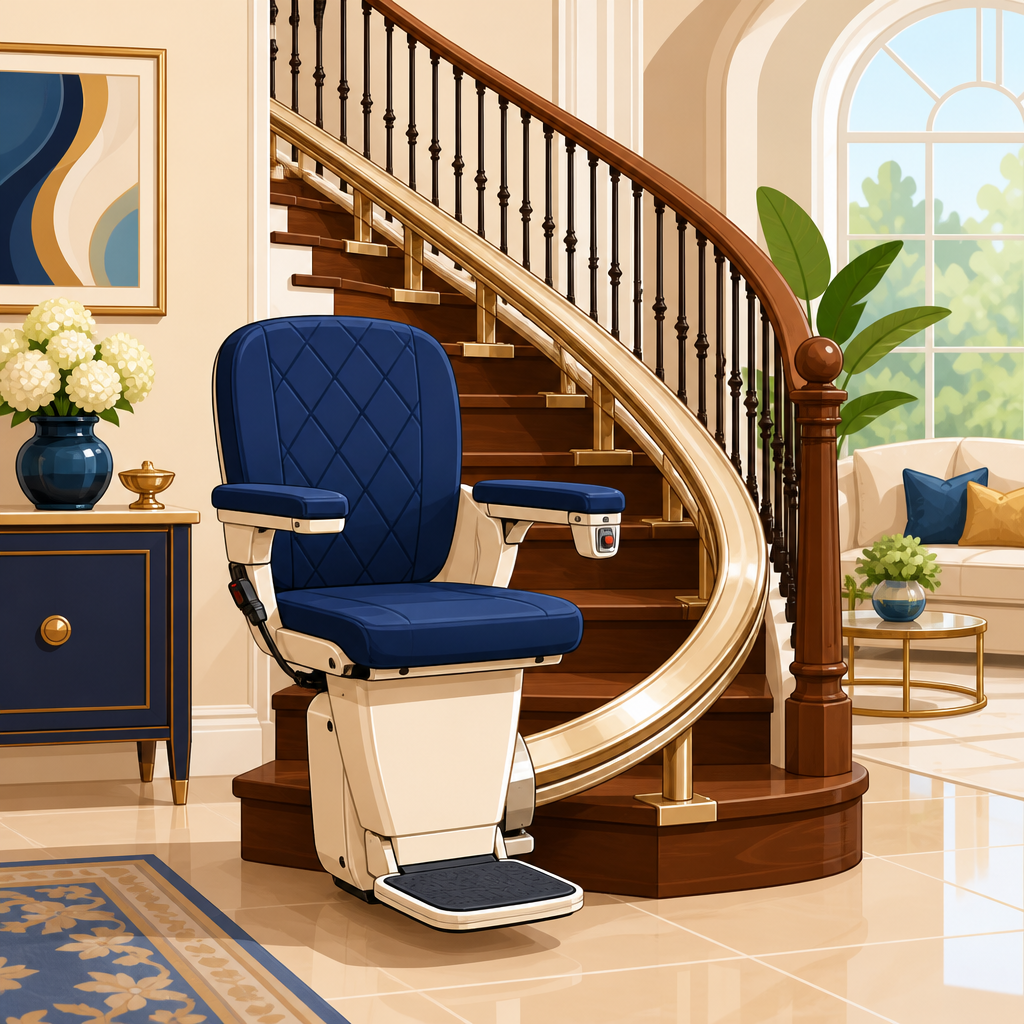
Luxury curved stair lifts with custom upholstery and rail finishes turn an accessibility product into an architectural feature, which is why they sit at the premium end of the home mobility market. A curved stair lift is a motorized chair that travels on a rail engineered to follow turns, intermediate landings, spiral sections, or split-level changes, unlike a straight stair lift that fits one uninterrupted run. In luxury models, the engineering remains the same at its core—safe seated transport up and down stairs—but the visible details change dramatically: hand-stitched seating, designer fabrics, premium vinyls, leather options, powder-coated or color-matched rails, slimmer carriage covers, and quieter drive systems. After working with homeowners comparing standard and premium installations, I have seen the same decision pattern repeatedly: buyers start by asking about function, then quickly realize the lift will live in the center of the home for years, often in a foyer or main staircase where every finish matters.
This matters because a curved stair lift is usually one of the most customized pieces of mobility equipment a homeowner will buy. The rail is built from precise measurements, commonly taken with a digital survey system, then manufactured to exact tolerances so the chair clears walls, balusters, and door swings. Once the rail geometry is fixed, premium buyers focus on appearance, comfort, seat ergonomics, swivel behavior, folding dimensions, and integration with the interior design scheme. In practical terms, a luxury curved stair lift can preserve independent access to upper floors without forcing a disruptive move or a full residential elevator project. It can also protect resale appeal better than a basic, clinical-looking installation when chosen carefully. This hub article explains what defines a luxury curved stair lift, which premium features justify the higher cost, how upholstery and rail finishes are specified, what major brands offer in this segment, and how to evaluate proposals so you buy a lift that is both beautiful and dependable.
What Makes a Curved Stair Lift “Luxury”
A luxury curved stair lift is not just a standard chair with a higher price tag. It combines bespoke rail manufacturing, elevated materials, refined industrial design, advanced ride quality, and dealer-supported customization. The first differentiator is the rail itself. Premium curved systems are fabricated for a specific staircase from a survey, often using modular tube or monorail designs engineered to minimize visual bulk. Better systems also support tight inside bends, parking positions away from the main staircase, and powered options that reduce user effort at the top and bottom landings.
The second differentiator is visible craftsmanship. On entry-level products, upholstery is usually limited to a few vinyl colors and standard molded plastic trim. Premium models expand those choices to include tailored upholstery, upgraded stitching, color-coordinated arm caps, and cleaner hinge and carriage enclosures. The difference is especially obvious on open-plan staircases where the lift is fully visible from the front door or living area. A luxury model aims to look intentional, not medical.
Ride experience also separates premium units from commodity products. In higher-end installations, buyers typically expect soft-start and soft-stop motion, lower operational noise, smooth transitions across bends, and comfortable seat geometry for longer travel paths. Curved staircases can require a longer seated ride than straight staircases, so padding density, back support, armrest shape, and footrest operation matter more than many first-time buyers assume. Premium units often include powered swivel seats, powered footrests, and one-touch folding, all of which reduce strain for users with limited hip flexion, arthritis, or balance issues.
Finally, a luxury purchase includes design coordination and service confidence. The best dealers do more than quote equipment. They advise on parking locations, upholstery durability, finish matching, code-aware placement, battery charging points, and future service access. On a premium stair lift, the buying experience should feel closer to commissioning a built-in home feature than ordering a boxed appliance.
Custom Upholstery Options: Materials, Comfort, and Durability
Custom upholstery is usually the most visible premium upgrade because it changes how the seat feels and how the lift blends with the home. The most common materials are heavy-duty vinyl, polyurethane-based performance upholstery, woven fabrics, and leather or leather-look finishes. Vinyl remains popular because it is easy to sanitize, resists moisture, and holds up well under repeated transfers. In luxury projects, however, the better vinyls have a softer hand, more refined grain, and improved seam detailing than standard medical-grade coverings.
Fabric upholstery appeals to buyers who want the chair to resemble residential furniture rather than mobility equipment. Performance fabrics can work well if the staircase is in a climate-controlled interior and the user does not need frequent wipe-down cleaning. They also reduce the “cold seat” feeling some people dislike with vinyl or leather. The tradeoff is maintenance. Fabric can show wear, absorb odors, and hold pet hair more easily, so it is best suited to low-soiling households.
Leather and premium faux leather sit at the top of the style ladder, especially in formal foyers or homes with matching millwork and upholstered banquettes. Genuine leather can look exceptional, but it needs conditioning and may not be ideal in homes with sharp pet claws, strong sun exposure, or frequent sanitizer use. High-quality faux leather often delivers the better balance of appearance, cleaning ease, and durability. For many buyers, it is the smartest luxury choice rather than a compromise.
Comfort depends on more than the outer material. Seat foam density, back angle, waterfall front edges, lumbar contour, and armrest spacing affect transfer safety and pressure distribution. I advise buyers to sit in showroom models for several minutes, not just a quick test. Users recovering from joint surgery or living with reduced trunk stability often discover that a slightly firmer cushion makes standing easier than a deeply plush seat. Premium upholstery should support function first, then style.
Rail Finishes and Design Integration
Rail finish selection is where a curved stair lift moves from “acceptable” to visually integrated. Most manufacturers offer standard colors such as cream, white, beige, brown, silver, or black, but premium programs may allow custom powder coating or coordinated trim packages. Powder-coated finishes are preferred because they are durable, resistant to chips and corrosion, and more consistent than field-applied paint. On dark wood stairs, a black or bronze rail can visually recede. On painted balustrades and pale walls, off-white rails usually disappear best.
Rail shape matters almost as much as rail color. Some curved lifts use a twin-tube rail, while others use a single larger tube or compact monorail. A slender profile can make the staircase feel less crowded, especially on narrow or decorative stairways. Parking the chair around a corner, beyond the top landing, or in a hallway can also improve aesthetics because the visible portion of the staircase remains clear when the lift is not in use. Premium installations often rely on overruns and articulated parking points for exactly this reason.
Finish integration should extend to the seat base, carriage cover, and footrest. A color-matched rail with mismatched gray plastics still looks aftermarket. The strongest luxury installations use coordinated tones throughout and account for surrounding materials such as iron balusters, oak treads, painted risers, and runner carpets. Dealers who ask for interior photos before finalizing finish choices usually produce better results than dealers who treat color as an afterthought.
| Design Element | Luxury Choice | Best For | Main Tradeoff |
|---|---|---|---|
| Seat upholstery | Premium vinyl or faux leather | High use, easy cleaning, refined look | Can feel warmer or cooler with room temperature |
| Seat upholstery | Performance fabric | Residential furniture appearance | Harder to clean than wipeable surfaces |
| Rail finish | Custom powder coat | Matching millwork or metal accents | Higher price and longer lead time |
| Rail profile | Compact monorail | Narrow or highly visible staircases | Brand availability varies by layout |
| Parking location | Corner or hallway park | Keeping the main staircase clear | Requires enough landing space |
Premium Features Worth Paying For
Not every upgrade on a quote delivers equal value. The premium features that consistently justify cost are powered swivel, powered footrest, seat height fit, slim folded dimensions, and advanced diagnostic controls. A powered swivel seat helps the user rotate safely onto the landing without twisting at the hips. This is especially important at the top landing, where awkward pivoting can increase fall risk. In luxury models, powered swivel operation is often smoother and easier to control than on lower-tier units.
A powered footrest matters more than buyers expect. Many stair lift users can sit down and stand up independently but cannot bend far enough to fold the footrest manually. If the footrest is left down, the staircase becomes harder for others to use. A one-touch powered footrest solves that daily friction point and improves household acceptance of the lift.
Diagnostic systems are another worthwhile upgrade. Better stair lifts display fault codes, battery status, charging status, and service indicators that help technicians resolve issues faster. Remote controls, call/send stations, and key locks are standard on many models, but premium systems often implement them with better usability and cleaner hardware. Some brands also offer linked seat and footrest folding systems that reduce effort and present a tidier appearance when parked.
Noise control is an underappreciated premium feature. A luxury lift should not dominate the acoustic environment of the home. Gear rack design, motor insulation, carriage fit, and rail fabrication all affect sound. During product demonstrations, ask to hear the unit through starts, stops, and bends. The smoothest ride on paper is not always the quietest in a high-ceiling foyer.
Leading Luxury and Premium Models to Consider
Several established manufacturers compete in the premium curved stair lift market, though exact finishes and options vary by region and dealer. Handicare’s Freecurve is widely recognized for its single-tube design, tight bend capability, and strong aesthetic appeal. It is often specified where buyers want a sleek rail and compact folded footprint. Stannah’s Sadler and Siena seats, when paired with its curved rail systems, appeal to buyers prioritizing seating ergonomics, brand reputation, and broad dealer support. Stannah’s perch-style Sadler can also solve fit challenges for users who have difficulty bending fully at the knee or hip.
Bruno’s Elite Curved is a frequent choice in North America for buyers who want robust build quality and established dealer networks. It is not always the slimmest-looking option, but it has a strong service reputation and comfortable ride characteristics. Harmar’s Helix Curved focuses on modular rail advantages, which can simplify some installations and reduce wait times compared with fully bespoke welded rails. Access BDD, available through some dealer channels, is another name buyers may encounter in design-forward or space-sensitive projects.
The right model depends on staircase geometry, body fit, finish priorities, and local dealer competence more than brand marketing. I have seen a visually beautiful product underperform because the dealer measured poorly or ignored transfer needs. I have also seen less glamorous models become excellent long-term solutions because the installer optimized seat height, park points, and controls. In premium buying, the dealer is part of the product.
Buying, Installation, and Long-Term Ownership
Expect a luxury curved stair lift to cost substantially more than a straight unit because the rail is custom made and the fitting process is more complex. In many markets, premium curved installations commonly start around the mid-four figures and extend well into five figures depending on rail complexity, powered options, upholstery upgrades, and finish customization. Extremely ornate staircases, multiple parking stations, or unusual geometry can increase pricing further. Any quote that seems far below market should be examined closely for omitted options, limited service coverage, or a less capable rail design.
Ask every dealer the same questions: Who performs the survey? Is the rail fully custom or modular? What is the folded width? Where will it charge? What are the weight capacity and seat dimensions? Which upholstery and rail finishes are included? What is the lead time? Who provides warranty service after installation? How quickly can a technician respond? Clear answers separate premium providers from polished sales presentations.
Installation quality determines long-term satisfaction. Rails typically mount to stair treads, not the wall, but tread condition, carpet thickness, nosing shape, and landing geometry all influence fit. A proper installation includes battery charging verification, obstruction sensor testing, swivel lock confirmation, and user training for every household member. It should also include discussion of emergency procedures, because most modern stair lifts run on batteries and continue operating during a power outage until charging capacity is depleted.
Maintenance is straightforward but essential. Batteries eventually need replacement, moving parts require inspection, and rail cleanliness matters for smooth travel. Annual service is a sensible baseline for most households, with heavier-use lifts benefiting from more frequent inspection. If appearance is a major reason for choosing a luxury model, cleaning products should match the upholstery and finish specifications to avoid dulling, cracking, or discoloration over time.
Luxury curved stair lifts with custom upholstery and rail finishes succeed when they solve mobility needs without compromising the home’s design language. The best systems combine precise rail engineering, comfortable seating, quiet travel, thoughtful parking positions, and finish options that blend with the staircase rather than fight it. Custom upholstery is not just decoration; it affects comfort, hygiene, and how residential the chair feels. Rail finish is not just color; it shapes whether the lift visually disappears or becomes an obvious add-on. Premium features such as powered swivel, powered footrest, and compact folding dimensions often deliver more daily value than purely cosmetic upgrades.
As the hub for luxury and premium models, this guide should help you narrow the field before moving into brand reviews, upholstery comparisons, curved-versus-straight decisions, and dealer evaluations. Start with your staircase geometry and transfer needs, then match those requirements to a model with the right rail profile, service support, and customization range. Request finish samples, sit in demonstration units for more than a minute, and compare proposals line by line. A well-chosen luxury curved stair lift can preserve independence, protect the look of the home, and feel like a permanent architectural solution rather than a temporary medical device. If you are gathering quotes now, use this article as your checklist and insist on equal attention to engineering, comfort, and design.
Frequently Asked Questions
What makes a luxury curved stair lift different from a standard curved stair lift?
A luxury curved stair lift performs the same essential job as any high-quality curved model: it provides safe, seated transportation up and down a staircase that includes turns, landings, spiral sections, or split-level transitions. The difference is in how the product is specified, finished, and integrated into the home. In premium installations, the rail is not treated as a purely functional piece of equipment. Instead, it is custom-engineered to fit the exact geometry of the staircase and then finished in a way that complements nearby architectural details, trim, flooring, and metalwork. That may include custom rail colors, upgraded coatings, or finish selections chosen to coordinate with interior design elements rather than stand apart from them.
The chair itself is also elevated beyond basic functionality. Luxury models often offer custom upholstery, refined seat profiles, designer fabric or leather options, and a more furniture-like appearance that helps the lift blend into an upscale interior. In many homes, that matters just as much as performance. Homeowners want accessibility without making the staircase look clinical or institutional. A luxury curved stair lift addresses that concern by preserving the visual character of the space while still delivering the safety features expected from a mobility product, such as seat belts, obstruction sensors, secure swivel seating, and dependable battery backup.
Another major distinction is the level of customization and project coordination involved. Because every curved staircase is unique, these lifts are typically manufactured to order after a detailed survey. In luxury projects, that process may include collaboration with interior designers, builders, or renovation teams to ensure the final installation feels intentional and cohesive. The result is an accessibility solution that supports independence while also enhancing the overall presentation of the home.
Can custom upholstery and rail finishes really help a stair lift blend into a high-end interior?
Yes, and for many homeowners, that is one of the main reasons to choose a luxury curved stair lift. In a high-end home, visual continuity matters. A staircase is often a central architectural feature, especially in foyers, great rooms, and multi-level open-plan spaces. If a stair lift looks generic or purely medical, it can disrupt the design language of the room. Custom upholstery and rail finishes allow the lift to become a more integrated part of the interior rather than an obvious afterthought.
Custom upholstery gives homeowners the opportunity to select materials, textures, and colors that align with existing furniture, wall treatments, rugs, or millwork. Depending on the manufacturer and dealer, options may include premium vinyls, woven textiles, faux suede, or leather-look materials designed for both style and durability. In some cases, the goal is to make the chair visually disappear by matching surrounding tones. In others, the homeowner may choose a contrasting finish that turns the stair lift into a deliberate design statement. Either approach can work when it is done thoughtfully.
Rail finishes are equally important because the rail is the most visible structural component of the system. Premium finish options can help coordinate the lift with stair balusters, handrails, door hardware, flooring accents, or paint colors. This is especially valuable on staircases with sweeping curves or open sides where the rail is visible from multiple angles. A carefully selected finish can soften the visual impact of the equipment and make the installation feel much more tailored to the home. While aesthetics should never come at the expense of safety, modern luxury curved stair lifts are designed to deliver both. When properly specified, they can support mobility needs while respecting the architectural quality of the space.
How is a curved stair lift measured and installed on a staircase with turns or landings?
A curved stair lift begins with a precise site survey because no two curved staircases are exactly alike. Unlike a straight lift, which can use a more standardized rail for a single uninterrupted flight, a curved model requires a rail that is manufactured specifically for the home. During the survey, a specialist measures the staircase in detail, documenting the length of each section, the angle and radius of every turn, the size of intermediate landings, the position of walls and banisters, the location of power sources, and any tight clearances at the top or bottom of the stairs. In many cases, digital measuring systems are used to create an accurate three-dimensional profile of the staircase.
That information is then used to engineer a rail that follows the path of the stairs as closely as possible while maintaining smooth travel and safe boarding positions. The goal is not simply to make the chair move around corners. It is to ensure that the rider has a comfortable, stable trip and that the seat can stop in practical locations for getting on and off. For example, the rail may be designed with a start or finish overrun so the user can mount or dismount away from the edge of the staircase. On complex layouts, careful planning is essential to preserve walking space for other members of the household as well.
Installation typically involves mounting the rail to the stair treads rather than the wall, which means major structural changes are often unnecessary. Once the custom rail arrives from manufacturing, the installation team fits it section by section, secures the carriage and chair, tests charging points, and calibrates operation throughout the full route. Final testing includes safety sensors, seat swivel function, remote controls, stop positions, and battery operation. In a luxury installation, there is also close attention to finish quality, alignment, cable management, and overall appearance. The end result should feel polished, quiet, and highly intentional, not improvised.
Are luxury curved stair lifts as safe and reliable as they are stylish?
They should be, and in a reputable product, safety remains the foundation of the entire system. A luxury curved stair lift may offer premium upholstery, sophisticated rail finishes, and enhanced design details, but the core engineering is still centered on secure mobility. The chair travels on a custom-built rail using a motorized drive system designed for controlled movement, consistent stops, and dependable performance along complex stair paths. Well-made units include essential safety features such as a seat belt, obstruction sensors on the carriage and footrest, a swivel seat for safer entry and exit, lockable controls if needed, and battery backup so the lift can continue to operate during a power outage.
Reliability depends on both manufacturing quality and proper installation. Because curved lifts are custom fabricated, accuracy matters at every stage, from the initial survey to the final commissioning. An experienced dealer or installer will make sure the rail geometry, parking positions, charging points, and seat orientation are all optimized for the user and the staircase. That is particularly important in premium homes with complex staircases, where the route may involve multiple bends, landings, or narrow transitions. When those details are handled correctly, the lift should provide smooth starts and stops, stable travel, and predictable operation over time.
It is also worth noting that premium appearance does not mean delicate construction. The materials used for visible surfaces may be more refined, but the system itself is still built for regular daily use. Homeowners should ask about weight capacity, service intervals, warranty coverage, battery life, and manufacturer support. Routine maintenance and annual servicing are typically recommended to keep the lift running at its best. In short, a luxury curved stair lift should never ask a homeowner to choose between elegance and safety. The best systems deliver both with equal confidence.
Is a luxury curved stair lift worth the higher cost?
For many households, yes, especially when the staircase is a prominent architectural element and long-term accessibility is a priority. Curved stair lifts already cost more than straight stair lifts because the rail must be custom designed and manufactured for the exact staircase. When you add custom upholstery, upgraded rail finishes, and design-oriented detailing, the price moves further into the premium category. That higher cost reflects not only materials and appearance, but also engineering complexity, manufacturing precision, and a more tailored installation process.
The value comes from several directions. First, a curved stair lift can make a multi-level home usable again for someone who would otherwise struggle with stairs. That can extend independent living, delay or avoid the need to relocate, and preserve access to bedrooms, bathrooms, and living spaces that would otherwise become difficult to reach. Second, in a luxury home, aesthetics carry real weight. A poorly matched accessibility product can feel intrusive in a carefully designed interior. A custom-finished model helps protect the visual integrity of the home while delivering a practical mobility solution. For homeowners who have invested significantly in architecture and interior design, that integration can be well worth the premium.
There is also the matter of daily experience. A lift that fits the staircase precisely, parks neatly, operates smoothly, and looks appropriate in the space tends to feel less like a compromise. That can improve user acceptance and overall satisfaction. Whether it is worth the investment ultimately depends on the user’s needs, the complexity of the staircase, the importance of design continuity, and the expected length of use. For households seeking both accessibility and a polished, upscale result, a luxury curved stair lift is often the most complete solution available.





