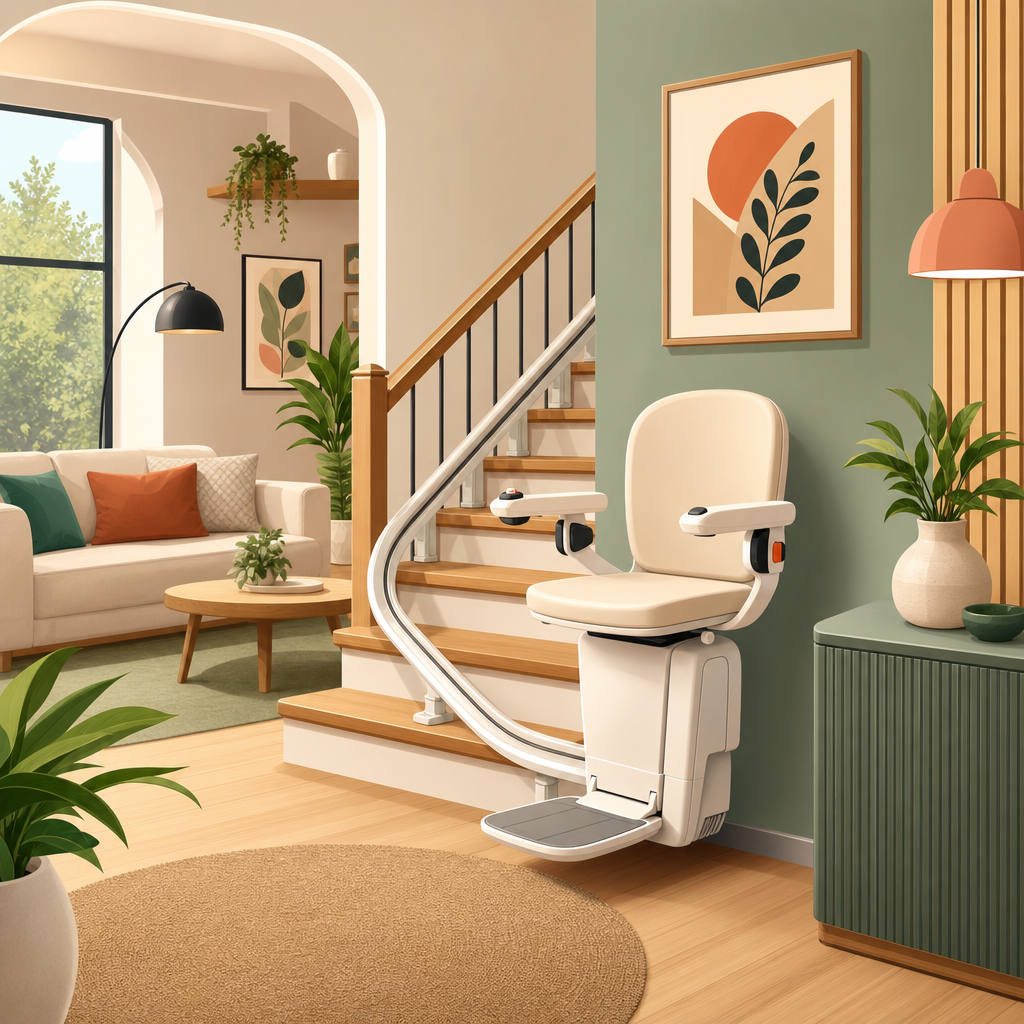
Modern homeowners no longer have to choose between accessibility and style, because aesthetic chair lifts that blend into modern decor now combine advanced mobility support with premium interior design. A chair lift, also called a stair lift, is a motorized seat that travels along a rail fixed to a staircase, helping users move safely between floors without climbing steps. In the luxury segment, the goal is not merely function. It is integration: slimmer rails, cleaner upholstery, quieter drivetrains, power-swivel seats, and finishes that sit naturally beside oak treads, glass balustrades, matte black ironwork, or minimalist wall palettes.
This matters for three reasons. First, demographics are changing. More adults are choosing to age in place, and many want a home that remains elegant while becoming easier to navigate. Second, renovation costs are high. A premium chair lift is often far less disruptive and less expensive than moving bedrooms downstairs or installing a residential elevator. Third, design expectations have risen. In my work reviewing mobility products and walking clients through showroom demos, the first question is rarely about top speed. It is usually, “Will this look medical?” The best luxury and premium models answer that concern directly with concealed engineering, tailored materials, and compact parking positions that keep the staircase visually open.
As a sub-pillar hub for luxury and premium models, this guide explains what separates truly aesthetic chair lifts from standard units, which features justify a higher price, how leading brands approach design, and what tradeoffs buyers should understand before purchasing. If you are comparing premium stair lift options for a modern home, this article will help you identify the models and specifications worth deeper review.
What Makes a Chair Lift Look Premium in a Modern Home
A premium chair lift does not look expensive simply because it uses leather or costs more. It looks premium because every visible and audible part has been considered. Rail profile is the biggest factor. Standard lifts often use bulkier extrusions that project farther from the wall or stair edge. Better-designed premium units use narrower rails, tighter bends on custom curves, and cleaner mounting geometry, which reduces visual clutter. When the seat is folded, the lift should occupy as little depth as possible so the staircase still reads as architecture, not equipment.
Seat design is the second factor. High-end lifts use better padding density, more refined stitching, and neutral upholstery tones that harmonize with contemporary interiors. Cream, taupe, graphite, sand, and charcoal usually integrate more easily than clinical beige or bright vinyl. Premium armrests also feel more intentional, with softer contours and smoother hinge action. The difference is obvious in person. Lower-cost models often feel like durable machinery. Luxury models feel closer to a well-designed task chair.
Noise matters just as much as appearance. A chair lift can be visually discreet yet still undermine the atmosphere of a home if the motor whines. Premium manufacturers invest in smoother transmissions, soft-start and soft-stop programming, and better ride damping. In open-plan houses where a staircase sits near living and dining spaces, that refinement changes the day-to-day experience significantly.
Modern decor compatibility also depends on parking and folding behavior. Aesthetic chair lifts should park away from the main sightline when possible, using hinge rails, call/send controls, or upper-landing storage positions. Folded footrests, slim arm assemblies, and swivel seats reduce obstruction. In small foyers, these details can be the difference between a lift that disappears into the background and one that dominates the room.
Key Luxury Features Worth Paying For
Not every premium add-on is worthwhile, but several features consistently improve both design integration and long-term usability. Powered swivel and powered footrest systems are among the most valuable. They help users mount and dismount with less strain, and they reduce the need to bend when folding the lift away. For buyers with limited hip mobility or balance concerns, these are practical upgrades, not cosmetic indulgences.
Custom upholstery and finish packages are another justifiable expense. Many premium brands offer fabric, vinyl, or leather-effect materials in several colorways, along with seat shell accents or rail finish options. Matching the stair lift to wall color, wood species, or metal hardware creates a built-in look. I have seen matte ivory seats disappear against pale plaster walls, while darker graphite upholstery works beautifully with walnut stairs and black balusters.
Advanced safety systems also separate luxury models from entry-level units. Look for obstruction sensors on the carriage and footrest, seatbelt monitoring, diagnostic displays, battery backup, overspeed governors, and lockable controls. Reputable lifts sold in North America commonly align with ASME A18.1 platform and chair lift safety expectations, while European models frequently follow Machinery Directive and related conformity requirements. These standards are not decorative features, but premium products tend to implement them more elegantly, with fewer exposed components and cleaner user interfaces.
Finally, custom curved engineering is where premium design becomes most visible. Straight stair lifts are easier to manufacture and often look acceptable on simple stairs. Curved lifts for landings, turns, split-levels, and spiral-adjacent configurations require made-to-measure rails. Brands that handle curves well preserve more usable stair width and create smoother transitions. That precision is expensive, but it is often essential in architect-designed homes where proportion and line matter.
Leading Premium Brands and How They Differ
Several established brands dominate the luxury and premium stair lift conversation, but they do not all excel in the same areas. Handicare, Bruno, Stannah, Access BDD, and Platinum are among the names buyers encounter most often through dealers. Bruno is especially well known in the United States for robust build quality and dependable support networks. Its Elite models emphasize ride quality and reliability, though the visual language leans slightly more substantial than ultra-minimal European designs.
Stannah has earned a strong reputation for fit, finish, and seat styling, especially in homes where clients care deeply about upholstery quality and compact folding dimensions. The company’s curved solutions are frequently specified for complex staircases, and its seats tend to feel more furniture-like than institutional. Handicare offers broad model coverage and useful options for tighter spaces, while Platinum is often praised by installers for sophisticated curved rail engineering and a polished final appearance.
Access BDD, known for the Flow series, stands out when stair width is constrained. The seat can perch and travel in a way that helps maintain clearance on narrow or steep stairs. That makes it a premium solution for design-led townhouses and older properties with challenging geometry. In practical terms, the “best” luxury chair lift depends less on branding than on the staircase, user mobility, local dealer skill, and willingness to pay for customization.
| Brand | Premium Strength | Best Fit | Design Consideration |
|---|---|---|---|
| Bruno | Durability, smooth ride, strong dealer presence | Buyers prioritizing reliability and service access | Solid appearance rather than the most minimalist styling |
| Stannah | Refined seat design, compact folding, strong curved options | Modern interiors needing a softer furniture-like look | Excellent upholstery integration in visible staircases |
| Handicare | Broad lineup, practical options for varied stair layouts | Homes needing flexibility across straight and curved installs | Depends heavily on model and dealer specification |
| Platinum | Advanced curved rail engineering | Architecturally complex stairs and tighter clearances | Often delivers a clean custom-fitted result |
| Access BDD Flow | Narrow stair performance and perch seating geometry | Steep, narrow, or awkward premium staircases | Highly functional design that can look discreet when parked |
Choosing Finishes That Blend With Modern Decor
The simplest way to make a stair lift blend into modern decor is to treat it like furniture and millwork, not medical equipment. Start with the dominant tones already present in the staircase. If the stairs are white oak, ash, or pale engineered timber, choose warm neutrals rather than stark white plastics. If the house uses darker walnut, smoked oak, or black-stained wood, a charcoal or graphite seat often sits more comfortably in the palette. Matching undertones matters more than exact color matching.
Rail color deserves equal attention. Many buyers focus on the seat and ignore the rail, even though the rail creates the strongest linear visual impression. In bright, minimal interiors, a light rail can disappear against white trim. In industrial-modern homes with black metal details, darker rails may integrate better. Ask the dealer which powder-coat or finish choices are factory approved. A clean manufacturer finish is usually preferable to after-market repainting, which can affect warranty coverage or chip more easily.
Texture is another overlooked detail. Glossy plastics can clash with matte walls, brushed hardware, and natural wood. Upholstery with subtle grain or woven character tends to look richer. Stitching should be neat and restrained. Oversized logos, shiny trim, or thick molded shells make a product feel cheaper, even at a high price point. In luxury interiors, visual restraint is the hallmark of quality.
If the staircase is in a formal entry, ask for parking demonstrations before buying. A beautiful chair lift while in motion may still look awkward when parked at the bottom landing. Some dealers can configure park positions around corners or at upper landings, which preserves the first impression of the space. That single installation choice often has more visual impact than upholstery upgrades.
Installation, Space Planning, and Custom Fit
Even the most attractive premium chair lift fails if the installation is poorly planned. The first technical checkpoint is stair width. Many straight lifts can work on stairs around 28 inches wide, but true comfort and passability improve with more clearance. Curved and perch-style solutions can preserve access on narrower stairs, though exact requirements vary by model and user body size. A professional survey should measure tread depth, riser height, nosing projection, landing space, headroom, and any door swing conflicts.
Premium buyers should also ask how the rail mounts interact with finished surfaces. Most stair lifts mount to the treads rather than the wall, which is helpful in glass-railed or plaster-detailed spaces. Still, bracket spacing, rail overrun, charging positions, and hinge-rail operation all influence the final appearance. I always recommend viewing dealer photos of completed installations in homes similar to yours, not just manufacturer catalog images. Showroom displays rarely capture real trim conditions, radiator locations, or awkward lower landings.
Electrical planning is straightforward for battery-powered lifts, since the batteries charge at designated points and the unit can usually operate during a power outage for a limited number of trips. However, outlet placement should still be considered early so cords do not disrupt the design. If you are renovating, coordinate with your electrician and interior designer before final decorating. It is far easier to hide a receptacle or align a park position during a remodel than after finishes are complete.
Dealer craftsmanship matters enormously. A premium product installed by a rushed team can look misaligned, squeak, or park unevenly. The best dealers template curved stairs carefully, explain bracket placement in advance, and fine-tune the final ride. In the luxury tier, installation quality is part of the product.
Cost, Value, and When a Premium Model Is Worth It
Luxury chair lifts cost more because they involve better materials, more customization, and often more intricate rail fabrication. In broad market terms, straight lifts often start in the low-thousands, while curved premium models can rise substantially depending on geometry, power options, upholstery upgrades, and dealer labor. For many buyers, the sticker shock is real. The right question is not whether a premium model is cheap. It is whether the added cost solves visible, practical problems in the home.
If the lift will sit on a secondary staircase in a utility area, a standard model may be perfectly sensible. If it will be seen from the main living space every day, premium design has lasting value. It can preserve resale presentation, reduce stigma for the user, and make family members more willing to keep the equipment in place rather than removing it when guests visit. I have seen clients delay a needed installation because they feared ruining a carefully renovated hallway. A better-looking model often removes that hesitation and leads to safer decisions sooner.
There are limitations. Chair lifts do not replace full wheelchair accessibility, and they may not suit users with severe transfer difficulties unless paired with other supports. Premium aesthetics also cannot compensate for a weak service network. Before committing, verify warranty terms, response times, battery replacement costs, and parts availability through the local dealer. Beautiful design matters, but dependable support matters more over ten years of ownership.
How This Hub Helps You Compare Luxury and Premium Models
The most successful purchase starts with a clear framework: staircase type, user mobility needs, design priorities, service coverage, and budget. From there, compare straight versus curved rails, standard versus powered seat functions, upholstery and finish options, and dealer capability with custom installations. Focus on how the lift looks folded, sounds in motion, parks at each landing, and fits with existing materials. Those are the details that determine whether a chair lift feels integrated or intrusive.
As the hub for luxury and premium models within buying guides and product reviews, this page gives you the criteria that matter most before diving into model-specific comparisons. The key takeaway is simple: the best aesthetic chair lifts blend into modern decor when engineering, material choices, and installation quality work together. Choose a brand with proven curved or narrow-stair expertise when needed, insist on finish options that match your interior, and evaluate the local dealer as carefully as the product itself. Use this guide as your starting point, then move on to detailed brand reviews and side-by-side comparisons to shortlist the right premium chair lift for your home.
Frequently Asked Questions
What makes a chair lift look modern instead of medical or bulky?
A modern chair lift is designed to feel like part of the home rather than an afterthought added purely for mobility. The biggest difference is visual integration. Today’s aesthetic stair lifts use slimmer rails, compact carriage systems, low-profile footrests, and seats that fold neatly away when not in use. This reduces visual clutter on the staircase and helps preserve the open, architectural look that many modern interiors depend on. In higher-end models, manufacturers also pay close attention to upholstery, color palettes, and material finishes, offering options that coordinate with hardwood, metal, stone, and contemporary wall treatments.
Beyond appearance, modern chair lifts also improve the overall feel of the space through quieter motors and smoother ride quality. A unit that glides with minimal noise and has concealed or refined mechanical components feels much more premium than older, visibly industrial designs. Many luxury-focused models are intentionally engineered to avoid the “institutional” look, using tailored seat shapes, understated controls, and clean lines that complement modern decor. In other words, what makes a chair lift look modern is not just one design choice, but a complete approach that balances accessibility, elegance, and discreet engineering.
Can a stair lift really blend into a high-end interior design scheme?
Yes, a stair lift can absolutely blend into a high-end interior when it is selected and installed with design in mind. The most successful installations treat the lift as part of the home’s visual language instead of a standalone mobility device. That means choosing rail finishes that work with the staircase, selecting upholstery tones that match nearby furnishings, and prioritizing compact models that minimize interruption to sightlines. In luxury homes, even small details matter, so features like folding arms, retractable footrests, and parked seat positions at the top or bottom of the stairs can make a significant difference in keeping the lift unobtrusive.
Professional customization is often the key. Many premium stair lift manufacturers offer bespoke fabrics, leather-look finishes, neutral and designer-inspired color selections, and curved rail systems that follow the exact architecture of the staircase. This is especially important in homes with statement staircases, custom millwork, or open-concept layouts where the stairs are highly visible. When properly specified, an aesthetic chair lift can preserve the clean, refined character of the home while still delivering safe, dependable mobility support. The result is a solution that feels intentional and sophisticated rather than purely functional.
Which design features should homeowners look for when choosing an aesthetic chair lift?
Homeowners should start by evaluating the lift’s overall profile. A slim rail is one of the most important visual features because it keeps the staircase from looking crowded. Compact seats, fold-up components, and a narrow footprint also help maintain usable stair width and a cleaner appearance. If decor matters, upholstery options deserve close attention as well. Look for refined fabrics or easy-care materials in colors that complement the home’s palette, whether that means soft neutrals, deep charcoals, warm taupes, or modern monochromatic tones. The goal is to choose a model that visually belongs in the space.
It is also wise to consider operational details that contribute to a premium experience. Quiet drive systems, smooth start-and-stop motion, and intuitive controls all affect how elegant the lift feels in daily use. Swivel seats, safety sensors, and battery backup are critical practical features, but in the luxury segment, those essentials should come in a polished package. Homeowners may also want remote call stations, powered folding footrests, and custom rail finishes for added convenience and a more seamless look. Ultimately, the best aesthetic chair lift combines safety, comfort, and sophisticated design so the staircase remains both accessible and visually appealing.
Are curved and custom stair lifts available for modern homes with unique staircases?
Yes, curved and custom stair lifts are widely available, and they are often the best solution for modern homes with architectural staircases. Many contemporary homes feature stair layouts with turns, landings, spirals, or sweeping transitions that cannot accommodate a standard straight rail. A custom curved stair lift is fabricated to match the exact dimensions and contours of the staircase, allowing the chair to travel smoothly along complex paths while staying close to the steps. This tailored fit is essential not only for function and safety, but also for maintaining a polished, built-in appearance.
In design-forward homes, customization goes beyond the rail shape. Homeowners can often choose finish colors, seat styles, upholstery materials, and parking positions to make the unit less visually intrusive. This matters especially on highly visible staircases that serve as focal points within the home. While custom systems typically cost more and require detailed measurement and manufacturing, they offer a much better result than trying to force a generic solution into a unique space. For homeowners who want accessibility without compromising architectural integrity, a custom stair lift is often the smartest and most elegant choice.
Does installing a stylish chair lift add value, or does it hurt the look of the home?
A well-chosen chair lift is far more likely to support the home’s livability than harm its appearance, especially when the model is selected for both design and performance. In many cases, the value it adds is practical rather than purely resale-based. It allows homeowners to age in place more safely, continue using upper floors confidently, and avoid the disruption of relocating or undertaking major structural renovations. For multigenerational households, it can also improve comfort and independence for family members with mobility challenges. When the unit is compact, attractive, and professionally installed, it tends to be seen as a thoughtful upgrade rather than a visual drawback.
From a design standpoint, the concern is usually less about the presence of a chair lift and more about whether it looks out of place. Older, bulky lifts could detract from a refined interior, but modern aesthetic stair lifts are specifically made to minimize that risk. Their slimmer silhouettes, better upholstery, quieter operation, and more customizable finishes help them blend in with contemporary decor. If resale is a concern, many systems can also be removed later with limited impact compared with major accessibility remodeling projects. For homeowners focused on style as well as accessibility, the right chair lift can protect both quality of life and the overall elegance of the space.