
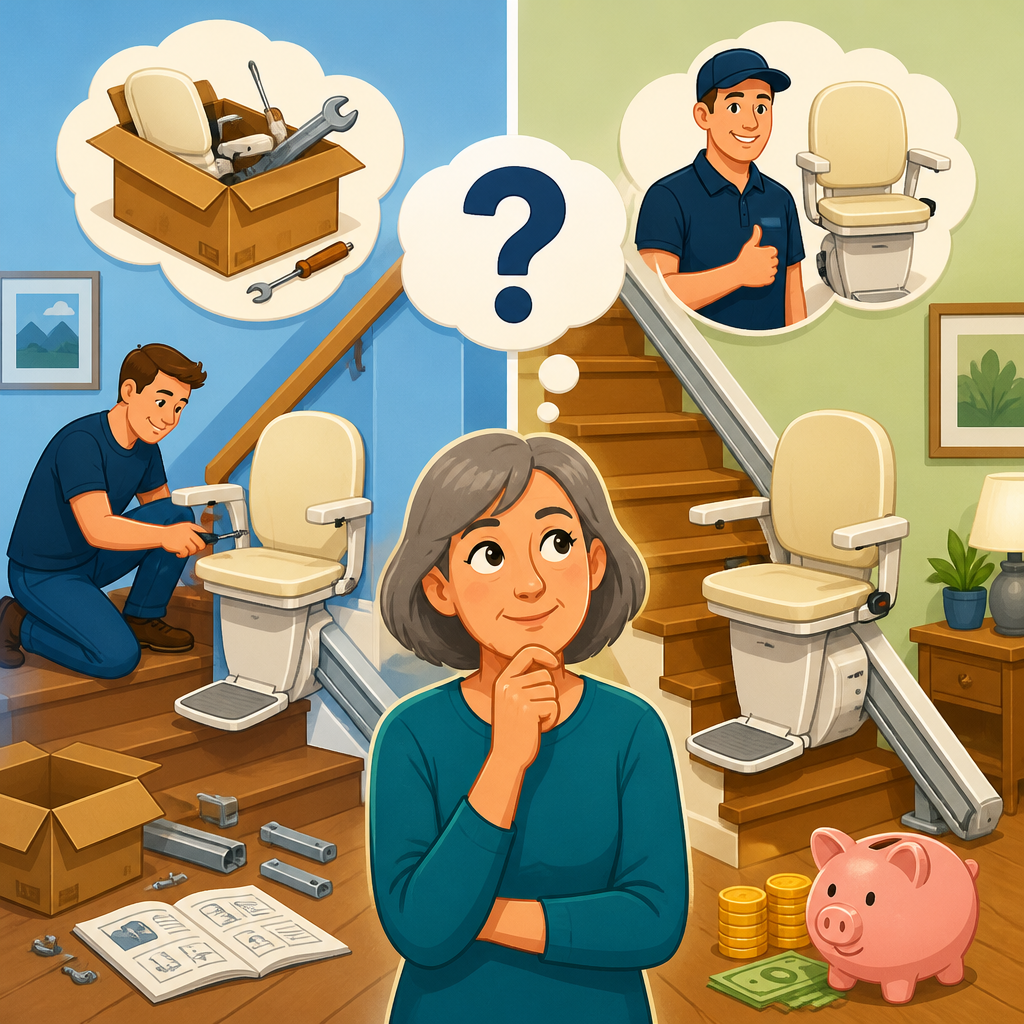
Online DIY stair lifts look cheaper at first because the advertised price usually covers only the rail, chair, and basic parts, not the full cost of making the lift safe, code-compliant, and reliable in a real home. For buyers comparing budget-friendly options, that distinction matters more than the headline number. A stair lift is a motorized chair system that travels along a rail fixed to stair treads, helping people with limited mobility move between floors without climbing stairs. “DIY” generally means the seller ships the product directly to the homeowner and expects self-measurement, self-installation, or coordination with an independent handyman instead of a manufacturer-certified installer. “Installation cost” includes labor, electrical preparation, measuring, shipping, permits where required, disposal of packaging, adjustments, and future service risk caused by setup errors.
I have worked with families comparing online stair lift listings against dealer-installed models, and the same pattern appears repeatedly: the online option can be cheaper, but only in narrow circumstances. Straight staircases, technically confident buyers, and homes with standard dimensions can sometimes realize savings. Curved stairs, older homes, and buyers who need warranty support often end up paying more than expected. The budget conversation is not simply purchase price versus labor. It is total cost of ownership over several years, including repairs, downtime, battery life, resale value, and whether the lift fits the user safely from day one.
This article serves as a hub for budget-friendly stair lift buying decisions. It explains how online DIY stair lifts are priced, where hidden costs appear, when lower prices are legitimate, and which alternatives may deliver better value. It also points buyers toward the major cost drivers you should evaluate before reading more focused guides on used stair lifts, rental options, financing, warranties, and dealer comparisons. If your goal is to save money without creating safety problems, the key question is not “What is the cheapest stair lift?” but “What is the cheapest stair lift that will work safely in my house for the next several years?”
What online DIY stair lift prices usually include and exclude
Most online stair lift listings emphasize a base price for a straight-rail unit. In today’s market, entry-level straight stair lifts sold online often land around $2,000 to $3,500 before add-ons. By comparison, dealer-installed straight stair lifts commonly range from roughly $3,500 to $6,000, depending on brand, rail length, seat style, weight capacity, and service area. That gap makes DIY stair lifts appear like an obvious bargain. However, the listing price often excludes professional measuring, freight surcharges, callout fees, folding rail upgrades, powered swivel seats, and installation labor that can add $500 to $1,500 or more. In some markets, independent installer rates are higher because fewer technicians will touch equipment they did not sell.
Curved stair lifts make the difference much sharper. A curved rail is custom-built to the exact geometry of the staircase, including landings, turns, and parking locations. Online sellers may advertise curved systems at an attractive starting figure, but final quotes can climb quickly after a site survey or photo review. Dealer-installed curved lifts often run from $10,000 to $20,000 or higher because custom fabrication, templating, and fitting are specialized tasks. There is rarely a true low-risk DIY path for a curved unit. If a curved rail is off by even a small amount, the chair may bind, stop short, or fail to park correctly, making “cheaper” a short-lived promise.
Another exclusion is support. A local stair lift dealer typically bundles some combination of assessment, installation, testing, user training, and an initial warranty response into the sale. An online seller may provide phone support and manuals, but not rapid in-home service. That matters because stair lifts are mobility devices, not convenience gadgets. If the lift is the user’s only practical way to reach a bedroom or bathroom, every day of downtime has a real cost. A lower online purchase price can evaporate quickly if repeated service visits, shipping delays for replacement parts, or troubleshooting by trial and error are required.
Installation costs that change the real price
Installation cost is not a single fee. It is a stack of small and large variables that differ from house to house. The first variable is measurement accuracy. Straight stair lifts are more forgiving than curved models, but rail length still needs to match the staircase correctly. I have seen buyers save a few hundred dollars online, then spend additional money replacing a rail because the top overrun or bottom clearance was misjudged. A certified installer typically measures rise, run, nosing profile, obstructions, and seat clearance before ordering. That expertise reduces expensive mistakes.
The second variable is labor complexity. A basic straight lift on open, unobstructed stairs may take only a few hours to install. Older homes can complicate the work. Narrow staircases, radiators near the bottom step, projecting trim, and weak or damaged treads can all require extra time. While stair lifts usually attach to the stair treads rather than the wall, deteriorated wood may need reinforcement. Some homeowners also need a dedicated outlet near the charging point. Modern battery-powered lifts plug into standard household power, but if no outlet exists in the correct location, an electrician may add $150 to $500 or more.
The third variable is risk allocation. If a dealer installs the lift, that dealer usually owns the fit and function outcome. If a homeowner hires a local handyman to install an online unit, responsibility can become fragmented. The seller may blame installation, the installer may blame manufacturing tolerances, and the homeowner may pay both parties while the problem is sorted out. That is not a theoretical issue. Stair lift faults often come from sensor alignment, charge point positioning, seat interlock calibration, or rail joints that are mechanically secure but not perfectly aligned. Each issue is fixable, but each costs time and money.
| Cost Factor | Online DIY Purchase | Dealer-Installed Purchase |
|---|---|---|
| Base straight lift price | Usually lower upfront | Usually higher upfront |
| Measurement and survey | Often self-service or extra fee | Usually included |
| Installation labor | Extra or self-managed | Usually included |
| Electrical preparation | Usually extra | Usually extra if needed |
| Warranty service coordination | Can be slower or fragmented | Simpler single point of contact |
| Risk of ordering errors | Higher | Lower |
| Best fit | Straight stairs, capable buyer | Complex homes, higher service needs |
When online DIY stair lifts can actually be cheaper
Online DIY stair lifts can be genuinely cheaper when the home and buyer fit a narrow profile. The best case is a straight staircase with standard dimensions, solid treads, nearby power, and no unusual obstructions. In that situation, a reputable online supplier selling a proven straight model can undercut a full-service dealer by a meaningful margin. If the buyer or a trusted installer is comfortable following torque specifications, aligning charge contacts, testing seat and footrest safety edges, and confirming final clearances, the savings may remain intact. Straight lifts from established manufacturers are modular enough that installation is not inherently mysterious.
Another case where online buying can reduce cost is replacement of an older straight lift in the same stair position. If the buyer already understands how the staircase functions, knows the user’s seat height needs, and can verify dimensions accurately, fewer surprises appear. Some households are also price-sensitive because the lift is expected to be temporary after surgery or rehabilitation. In that scenario, minimizing upfront cash can be rational, especially if the property may be sold soon or the user may transition to single-floor living. Budget-friendly choices are strongest when the timeline is short and the tolerance for complexity is higher.
Price advantages also improve when the seller has transparent support. The best online stair lift retailers provide exact rail measurement instructions, model-specific manuals, replacement parts availability, phone troubleshooting, and a clear returns policy. Some maintain networks of independent installers for buyers who want a hybrid approach. That combination can preserve part of the online savings while reducing risk. However, these are exceptions that require careful vetting. If a listing is vague on brand, parts sourcing, battery specifications, or support channels, low price should be treated as a warning sign rather than a deal.
When the cheaper option becomes more expensive
The online DIY route usually stops being cheaper when the staircase is curved, unusually narrow, or heavily trafficked by other family members. A lift that folds improperly, parks in the wrong position, or leaves too little walking space creates daily frustration and possible safety hazards. In those homes, installers often need to optimize the rail start, charge points, and seat orientation around real movement patterns, not idealized catalog images. Spending more upfront for correct placement can prevent repeated adjustments and rework.
Service frequency also changes the math. Stair lifts use batteries, charging contacts, limit switches, hinges, and safety sensors. Quality units are reliable, but they are not maintenance-free. Batteries typically last several years, often around three to five depending on usage and charging consistency. If the rail was not aligned correctly or the unit routinely sits off the charge point, battery life can shorten. A bargain stair lift that burns through batteries, throws fault codes, or needs multiple paid visits loses its budget advantage quickly. Access BDD, Bruno, Handicare, Stannah, and Harmar all build recognized products, but even strong brands perform poorly when installed badly.
There is also the cost of user mismatch. A stair lift is not just a machine moving on a rail; it is an accessibility device fitted to a person’s body and abilities. Seat width, armrest height, swivel controls, joystick sensitivity, and transfer space at the top landing all matter. If the user has limited trunk stability, arthritis, or reduced vision, a model chosen solely on price may be impractical. Replacing the first “cheap” unit with a better-suited model is the most expensive outcome of all.
Smarter budget-friendly alternatives to consider
Buyers focused on budget-friendly options should compare more than new online DIY units. A professionally installed used stair lift can offer better value if it includes refurbishment, a fresh battery, and a labor warranty. Straight used lifts are far more common than curved ones because rails can sometimes be cut or replaced economically. Rental stair lifts are another practical option for temporary needs such as post-operative recovery. Monthly rental plus installation can beat the cost of purchasing, especially when usage will last only a few months. Not every market has strong rental inventory, but where it exists, it deserves serious comparison.
Dealer promotions and financing can also narrow the gap. I have seen households dismiss local dealers too quickly because the quoted purchase price looked high, only to find that seasonal promotions, open-box inventory, or certified pre-owned stock brought the installed cost close to an online unit. Some dealers also remove old equipment, provide annual service packages, or guarantee response times. Those extras have measurable value. If the stair lift is mission-critical for aging in place, a responsive service agreement may save far more than it costs.
For this budget-friendly stair lift hub, the next best step is to compare total installed cost across four paths: new online DIY, new dealer-installed, used/refurbished, and rental. Ask each provider for the exact model, rail configuration, weight capacity, battery type, warranty terms, service response process, and all-in price. Then evaluate the quote against your staircase, your timeline, and the user’s physical needs. Online DIY stair lifts are sometimes cheaper after installation costs, but only when the project is simple and the support structure is strong. In every other case, the smartest savings come from avoiding hidden costs, preventing fit mistakes, and choosing the option that works safely the first time. Start by gathering two local quotes and one online comparison so you can judge real value, not just the sticker price.
Frequently Asked Questions
1. Are online DIY stair lifts really cheaper once installation costs are included?
Usually, not by as much as the advertised price suggests. Online DIY stair lifts often look dramatically less expensive because the listed price commonly includes only the core equipment, such as the chair, rail, and a limited set of standard parts. What that number often does not reflect is the real-world cost of getting the unit safely installed, properly fitted to the staircase, tested, and ready for dependable everyday use. Once you add shipping, measurement errors, extra brackets, power upgrades, folding rail options, service calls, and labor, the price difference between a DIY purchase and a professionally supplied stair lift can narrow quickly.
Another important factor is that stair lifts are not one-size-fits-all products in practice, even when they are sold that way online. Every staircase has its own width, angle, landing space, tread condition, and clearance requirements. A unit that looks affordable on a website may still require adjustments or added components to work properly in a specific home. If those needs are discovered after delivery, the homeowner can end up paying more than expected for corrections, modifications, or professional help to finish the job. In many cases, the true cost is not the sticker price but the total installed cost required to make the lift safe, usable, and reliable over time.
2. What extra costs do homeowners often overlook when buying a DIY stair lift online?
The biggest overlooked costs are usually installation-related rather than product-related. Many buyers focus on the advertised base price and assume that is close to the final total, but several common expenses may appear later. These can include freight or residential delivery charges, tools, professional stair measurements, additional rail sections, specialized mounting hardware, electrical work for charging points or outlets, and fees for correcting problems if the unit does not fit as expected. If the staircase has unusual dimensions, tight landings, or obstructions such as trim, doors, or handrails, the project can become more complicated and more expensive than expected.
Homeowners should also think about the cost of mistakes and long-term support. If the wrong model is ordered, return shipping can be expensive, and some sellers charge restocking fees. If assembly instructions are unclear or a safety feature is not calibrated properly, a technician may need to be hired anyway. Warranty coverage may also be limited if the unit was self-installed, which means future repair costs could come directly out of pocket. In short, the hidden costs of a DIY stair lift are often found in logistics, troubleshooting, and service, not just in the equipment itself.
3. Why does professional installation matter so much for a stair lift?
Professional installation matters because a stair lift is more than a piece of furniture or a simple home upgrade. It is a mobility device that carries a person up and down a staircase, so safety, fit, and performance are critical. Proper installation involves more than attaching a rail to the stairs. The installer must make sure the rail is aligned correctly, the chair travels smoothly, the charging system works consistently, the seat and footrest clear the staircase safely, and all controls operate as intended. If any of those elements are off, the stair lift may stop unexpectedly, wear out faster, or create a hazard for the user.
There is also the issue of code compliance, manufacturer requirements, and practical usability. A trained installer can identify whether the selected model is appropriate for the user’s weight, mobility level, transfer needs, and home layout. They can also spot problems that a homeowner might miss, such as insufficient landing room, trip hazards at the rail end, or the need for a hinged rail to avoid blocking a doorway. Professional installation reduces the chances of an unsafe setup and generally improves reliability, which is especially important for people who depend on the lift every day. Saving money upfront is rarely worth it if the result is a device that is difficult to use or unsafe in real conditions.
4. Is a DIY stair lift ever a good value for budget-conscious buyers?
It can be, but only in a narrow set of circumstances. A DIY stair lift may offer good value when the staircase is straight, standard in shape, easy to measure, and free of unusual obstacles, and when the buyer is comfortable with mechanical assembly and understands the risks and limitations involved. It can also make more sense when the product comes from a reputable company that provides strong technical support, clear installation guidance, accessible replacement parts, and transparent warranty terms. In those cases, a capable homeowner may reduce labor costs and end up with a workable lower-cost solution.
That said, “good value” is not the same as “lowest price.” A budget-friendly stair lift should still be safe, durable, and practical for the person who will use it. If the user has significant mobility limitations, balance concerns, or relies on the lift multiple times a day, the reliability and support that come with professional installation may be worth more than the initial savings of a DIY approach. For many buyers, the best value comes from comparing total ownership cost rather than just the purchase price. That means looking at installation, warranty protection, expected maintenance, service availability, and the likelihood of future adjustments or repairs.
5. How can you compare a DIY stair lift with a professionally installed stair lift fairly?
The most accurate way is to compare total installed cost and long-term reliability, not just the headline number on the product page. Start by listing every likely expense for the DIY option: equipment price, shipping, tax, tools, measurement services if needed, installation labor if you might outsource part of the job, electrical work, accessory upgrades, and any return or restocking risks. Then compare that figure with a professional quote that includes in-home assessment, installation, testing, user instruction, warranty support, and service access. This side-by-side view often reveals that the gap is smaller than expected.
You should also compare what is included beyond the hardware. A professionally installed stair lift often comes with expert fitting, safety checks, setup adjustments, and a clearer path for maintenance or repairs. Those benefits can be especially important if the lift will be used by an older adult, someone recovering from surgery, or a person with ongoing mobility challenges. A fair comparison asks a simple question: what will it cost to get a stair lift that works safely and reliably in this actual home for this actual user? When buyers compare options that way, they can make a more informed decision and avoid being misled by a low advertised price that does not reflect the full cost of installation and ownership.





