
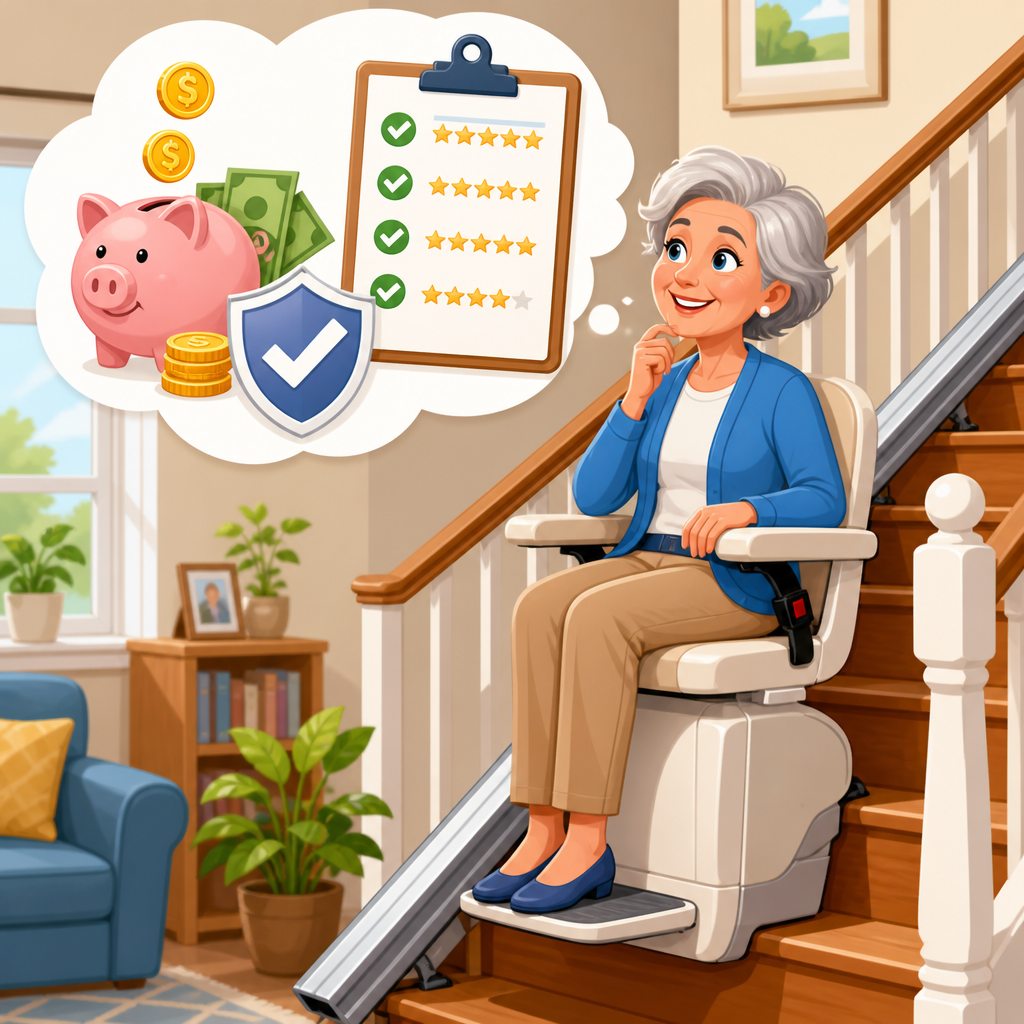
A stair lift is a motorized chair or standing platform that travels along a rail fixed to your staircase, helping people move safely between floors without major remodeling. When shoppers look for a budget stair lift, many assume the only way to save money is to buy the lowest-priced unit available. In practice, that approach often costs more over time. I have worked with families comparing stair lift quotes, rental contracts, service plans, and used inventory, and the pattern is consistent: the cheapest model on paper can become the most expensive choice once installation limits, warranty gaps, battery failures, and poor resale value enter the picture.
Saving money on a stair lift without buying the cheapest model means reducing total cost of ownership while protecting safety, reliability, and fit. Total cost of ownership includes the purchase price, installation, maintenance, callout fees, battery replacement, rail configuration, transfer safety, and eventual removal or resale. A straight stair lift for a simple staircase is usually far less expensive than a custom curved stair lift, but even within those categories there are meaningful differences in seat design, weight capacity, diagnostic features, and dealer support. The right value decision is not about stripping features blindly. It is about identifying which features prevent future costs and which extras add little practical benefit.
This matters because stair lifts are usually bought during stressful transitions: after a fall, during recovery from surgery, or while adapting a home for aging in place. In those moments, buyers are vulnerable to two expensive mistakes. The first is overbuying premium features they will never use. The second is underbuying by choosing a bargain unit that does not fit the user well, struggles on the staircase, or lacks local service. A smart budget-friendly stair lift plan balances immediate affordability with dependable daily operation. That is the goal of this guide and the reason this article serves as the hub for budget-friendly options within buying guides and product reviews.
Know which costs drive the real price
The headline price on a stair lift quote rarely tells the full story. The largest cost drivers are staircase type, rail complexity, installation labor, and service availability. Straight stair lifts use standardized rails and usually install faster, so they are the most budget-friendly option. Curved stair lifts require custom rail manufacturing to match landings, turns, and intermediate bends. That custom work is why curved systems often cost several times more than straight models. If a buyer only compares advertised chair prices without understanding rail design, the quote can feel inconsistent or inflated when it is actually reflecting real engineering requirements.
There are also hidden expenses that only appear after purchase if they were not discussed up front. Common examples include power supply upgrades, folding rail add-ons near doorways, parking or charging stations at both ends, removal of an old unit, and post-warranty labor rates. In my experience, the most budget-conscious buyers ask dealers for an itemized quote that separates equipment, rail, installation, warranty length, and annual service expectations. That one step makes it much easier to compare value across brands such as Bruno, Harmar, Handicare, and Stannah because you are comparing like with like instead of reacting to a single top-line number.
Another real price factor is user fit. A seat that feels unstable, a swivel control that is hard to operate, or a footrest that does not fold easily can turn a lower-cost unit into a poor investment. Returns are limited in this category because lifts are often installed to order. Spending moderately more for a chair that fits the user’s body size, dexterity, and transfer style is often the lower-cost outcome because it reduces nonuse, service calls, and replacement risk.
Choose the right stair lift category before comparing brands
The fastest way to save money is to narrow the correct category first. Straight stair lifts are best for staircases without turns or intermediate landings. They offer the broadest choice of new, used, and rental units, making them the strongest value segment. Curved stair lifts fit staircases with bends, but their custom rails sharply limit low-cost options. Outdoor stair lifts are built to resist weather with sealed components and durable covers, so they cost more than indoor models but prevent corrosion and premature failure. Perch or standing stair lifts can help users with limited knee flexion, though they are more specialized and should only be chosen after a careful mobility assessment.
Matching the category to the home can prevent expensive missteps. For example, some families try to force a straight stair lift into a staircase that really needs a curved solution by planning awkward transfers on a landing. That may look cheaper initially, but it introduces safety risks and often fails in practice. A better budget strategy is to ask whether relocating a bedroom or bathroom temporarily could make a straight lift or even a short-term rental sufficient. In rehabilitation cases after hip or knee surgery, a rental can be more economical than purchase, especially when the need is expected to last only a few months.
As a hub topic, budget-friendly options should also include alternatives adjacent to purchase. Reconditioned units, certified pre-owned inventory, rental agreements, and dealer demonstration models all belong in the value conversation. They are not right for every staircase, but they frequently offer a better savings path than buying the absolute cheapest new stair lift.
Use pricing strategy, not price chasing
Good stair lift budgeting is mostly about timing, scope, and negotiation. Start by getting at least three quotes from local authorized dealers. Ask each dealer the same questions: What is included in installation, how long is the parts warranty, how long is the labor warranty, what are the standard service call charges, and what battery type does the unit use? Many buyers focus only on the chair price and miss the labor warranty, even though labor can be one of the more expensive post-installation costs. A slightly higher quote with a stronger labor term can be the cheaper deal.
Requesting options at multiple price levels is also effective. Dealers often have a good-better-best range that includes a basic reliable model, a midrange unit with useful convenience upgrades, and a flagship model with premium cosmetics or advanced controls. Ask the dealer to explain which features affect safety and durability versus which features mainly affect comfort or appearance. The answer usually clarifies where to cut cost without cutting quality. For example, a manual swivel or manual footrest may be perfectly acceptable for one user and a false economy for another with weak grip strength.
Negotiation works best when tied to specifics. Instead of asking for a vague discount, ask whether the dealer can waive removal fees, include a service visit, match a competitor’s labor warranty, or offer a reconditioned straight rail. Dealers are more likely to adjust accessories, service terms, or scheduling than slash core pricing on custom equipment. End-of-month timing, showroom stock, and canceled orders can also create legitimate savings opportunities.
| Money-saving option | Best for | Main advantage | Main tradeoff |
|---|---|---|---|
| New straight stair lift | Long-term use on simple stairs | Lowest custom complexity and strong availability | Still requires installation and future maintenance |
| Reconditioned straight stair lift | Buyers seeking lower upfront cost | Meaningful savings if dealer refurbishes and warranties it | Model selection may be limited |
| Rental stair lift | Short-term recovery or temporary mobility needs | Avoids full purchase cost | Monthly fees can exceed purchase value over long periods |
| Dealer demo or canceled order | Flexible buyers with standard staircases | Discounted equipment in near-new condition | Availability is unpredictable |
Buy used carefully and rent when the timeline is short
Used stair lifts can save real money, but only in the right conditions. Straight stair lifts are the best used-market candidates because rails can often be cut or replaced more easily than custom curved systems. The safest route is a dealer-refurbished unit that has been inspected, fitted with fresh batteries if needed, tested under load, and sold with a written warranty. Private-party stair lift listings are much riskier. Missing brackets, unknown service history, discontinued parts, and incompatible rail lengths can erase any savings quickly. I have seen buyers pay less for a used unit online and then spend heavily on installation corrections because the original package was incomplete.
Renting is often the most overlooked budget-friendly option. If someone needs a stair lift after surgery, during cancer treatment, or while recovering from a fracture, a rental can dramatically reduce total spend. Most rental programs focus on straight stair lifts because standard rails can be installed and removed efficiently. Buyers should compare the upfront installation fee, monthly charge, minimum term, included service, and removal costs. The key question is simple: how long will the lift likely be needed? If the answer is uncertain but probably short, rental deserves serious consideration before purchase.
For long-term needs, renting can become more expensive than owning. The break-even point varies by dealer and region, but this is exactly why timeline matters. Budget-conscious shopping is less about finding one universally cheap answer and more about choosing the right ownership model for the actual duration of use.
Spend selectively on features that reduce future costs
Not every feature is a luxury, and that distinction matters. Battery backup is essential, not optional, because most modern stair lifts use battery power charged from household electricity. During a power outage, the lift should continue operating for multiple trips if the batteries are healthy. Soft start and soft stop reduce jolting, which can improve confidence for frail users. Swivel seats with secure locking positions support safer transfers at the top landing. Obstruction sensors help prevent damage and service calls by stopping the lift if something blocks the path.
By contrast, some upgrades are nice but not necessary for every budget buyer. Powered folding footrests, premium upholstery, or custom color finishes may be worth paying for if they solve a real problem, but they are not always value drivers. The practical rule is straightforward: pay for features that improve safety, usability, and long-term reliability; skip features that mainly change appearance. One exception is if a power-folding feature prevents repeated bending that the user simply cannot do. In that case, it shifts from convenience to necessity.
Warranty terms should be treated like a feature because they affect long-term cost directly. Parts coverage, drivetrain coverage, and labor coverage are not the same thing. A longer parts warranty with minimal labor support can still leave the owner paying substantial callout charges. Ask how quickly the dealer can respond to faults, whether they stock common parts locally, and what the battery replacement interval typically looks like. Sealed lead-acid batteries often last several years, but actual lifespan depends on use frequency, charging habits, and ambient temperature.
Use grants, tax advantages, and home access funding
Many buyers miss outside funding because they assume stair lifts are always paid fully out of pocket. Depending on location and circumstances, help may be available through veterans’ programs, state assistive technology initiatives, Medicaid waiver pathways, nonprofit aging organizations, or local area agencies on aging. In the United States, some medically necessary home modifications may also qualify as medical expenses for tax purposes when supported by proper documentation. Rules vary, so buyers should confirm with a tax professional and their local programs rather than relying on sales claims.
Hospital discharge planners, occupational therapists, and aging-in-place specialists can be valuable sources of funding information because they routinely work with home accessibility cases. An occupational therapist can also document why a specific lift configuration is medically appropriate, which can strengthen applications for assistance. This is an important cost-saving step because the wrong product recommendation does not just waste money; it can undermine funding eligibility if it appears poorly matched to functional need.
Another way to save is coordinating stair lift purchase with broader home access planning. If grab bars, better stair lighting, contrasting tread edges, or a bathroom modification are also needed, bundling assessments can reduce duplicate visits and produce a more coherent safety plan. A stair lift works best as part of a home mobility strategy, not as an isolated purchase made in a rush.
Work with the right dealer and plan for ownership
The best budget stair lift is the one that keeps working reliably with manageable support costs. That outcome depends heavily on the dealer. Choose an authorized dealer with trained installers, local references, clear service hours, and experience with your staircase type. Ask whether installation follows the manufacturer’s specifications, whether the rail is mounted to stair treads rather than the wall when appropriate, and how post-installation user training is handled. Proper handover matters because misuse, improper charging, and ignored fault beeps often lead to avoidable service calls.
Ownership planning should include cleaning the rail as recommended, keeping charge points unobstructed, parking the chair correctly, and scheduling service when performance changes appear. Small issues such as slower travel, beeping, or rough seat swivel action should be addressed early. Delaying maintenance usually increases cost. If more than one person may use the lift, confirm weight capacity and seat dimensions in writing. Oversized or heavy-duty models cost more, but they are cheaper than replacing an underspecified unit later.
One final hub-level principle ties all budget-friendly options together: value comes from fit, not from the lowest sticker price. Compare ownership models, insist on itemized quotes, prioritize straight or rental solutions when they genuinely suit the situation, buy used only through reputable refurbishment, and pay for the features that prevent future expense. If you are shopping now, start by measuring your staircase, documenting the user’s transfer needs, and requesting three detailed quotes. That simple process is the surest way to save money on a stair lift without buying the cheapest model.
Frequently Asked Questions
How can I save money on a stair lift without choosing the cheapest model?
The smartest way to save money on a stair lift is to focus on total value rather than the lowest sticker price. A very low-cost unit can look appealing at first, but if it has limited warranty coverage, higher repair rates, fewer local service options, or poor battery performance, it may end up costing more over time. In many cases, the better strategy is to compare quotes from reputable dealers, ask what is included in the base price, and look closely at the long-term ownership costs. That means evaluating installation, warranty length, service response times, maintenance expectations, and whether replacement parts are readily available.
It also helps to match the lift to the actual need instead of overbuying or underbuying. For example, if the stair lift is needed for a short recovery period, a rental may cost much less than a new purchase. If the user expects long-term use, a quality pre-owned unit with a new rail or updated batteries may offer major savings without sacrificing reliability. Buyers can also reduce costs by requesting multiple estimates, asking dealers about floor models or certified used inventory, and checking whether a straight stair lift will meet needs more affordably than a custom curved model. The goal is not to buy the cheapest chair on paper, but to buy the most dependable solution at the best overall cost.
Is a used or refurbished stair lift a good way to lower the price?
Yes, a used or professionally refurbished stair lift can be one of the best ways to save money, provided it comes from a trusted dealer and includes proper inspection, installation, and support. Many straight stair lifts can be removed from one home, reconditioned, tested, and installed in another at a significantly lower price than a brand-new model. This can be especially cost-effective for families who want dependable equipment but do not need the newest cosmetic features. In the right situation, a refurbished lift can deliver excellent performance while reducing upfront costs substantially.
That said, not all used stair lifts are equal. The biggest savings usually come from dealer-certified pre-owned units, not random private-party listings. A reputable dealer should explain the age of the unit, what components were replaced, whether the batteries are new, what warranty is included, and whether service will be available after installation. This matters because the rail, carriage, charger, seat controls, and safety sensors all need to function correctly. A used stair lift without professional setup may seem cheaper, but if it lacks support, parts availability, or a meaningful warranty, it can become expensive quickly. For many households, the best middle ground is a refurbished lift from a local company that stands behind both the product and the installation.
When does renting a stair lift make more sense than buying one?
Renting often makes the most financial sense when the need is temporary. This includes recovery after surgery, rehabilitation from an injury, hospice situations, or a short-term stay with a family member. In those cases, buying even an entry-level stair lift may cost more than necessary, especially once installation and removal are considered. A rental typically spreads the cost into a lower upfront payment plus a monthly fee, which can be easier on the budget and more practical if the lift is only needed for a few months.
However, the value of renting depends on the staircase type and expected duration of use. Rentals are most commonly available for straight staircases because the rails are standardized and easier to reuse. Curved stair lifts are usually custom-built, so rental options may be limited or less economical. It is important to ask for the full rental breakdown, including installation, monthly charges, service coverage, and removal fees. Families sometimes assume renting is always cheaper, but once the rental continues for many months, the total may approach or exceed the price of buying a quality used unit. A good dealer should help calculate the break-even point so you can choose the lower-cost option based on realistic timing, not assumptions.
What hidden costs should I watch for when comparing stair lift quotes?
Hidden costs are one of the main reasons a “cheap” stair lift can become expensive. When comparing quotes, ask whether the price includes professional installation, the rail, power supply connection, remote controls, seat upgrades, folding footrest options, and any required staircase modifications. You should also ask about warranty coverage in detail. Some low-priced offers only include limited parts coverage and little or no labor, which means even a minor service visit may become an out-of-pocket expense. Battery replacement, annual maintenance, diagnostic visits, and after-hours service calls can also affect the true cost of ownership.
Another area to review carefully is removal, relocation, and transferability. If the user may move homes or no longer need the lift later, find out whether the dealer offers a buyback, trade-in, or removal program. Service availability matters as well. A low quote from a company without strong local support may look attractive until you need repairs and face long delays or high travel charges. The best way to avoid surprises is to request an itemized quote and compare apples to apples. A slightly higher initial price may actually be the better bargain if it includes stronger warranty terms, faster service, and fewer future expenses.
Are there practical ways to negotiate or reduce the cost of a stair lift purchase?
Yes, and many buyers are surprised by how much flexibility there can be. One of the most effective steps is to get multiple quotes from established stair lift providers and let each company know you are comparing options. Dealers may be willing to adjust pricing, include free installation, extend labor coverage, or offer discounts on service plans in order to earn the job. It is also worth asking whether they have discontinued models, open-box inventory, showroom units, or refurbished lifts available. These options can lower the cost without forcing you into a low-quality product.
You should also ask about financing, seasonal promotions, manufacturer rebates, and any local assistance programs. In some situations, veterans, seniors, or people with disabilities may qualify for grants, nonprofit support, or benefit programs that offset part of the cost. If the stair lift is medically necessary, it may also be worth discussing documentation with a healthcare provider and reviewing whether any tax advantages or health-related spending accounts apply. Even when outside funding is not available, buyers can often save by choosing only the features they truly need rather than every optional upgrade. The best negotiation approach is informed and specific: compare warranty terms, used inventory, service plans, and installation scope, then ask the dealer to help you build the most cost-effective package for your situation.





