
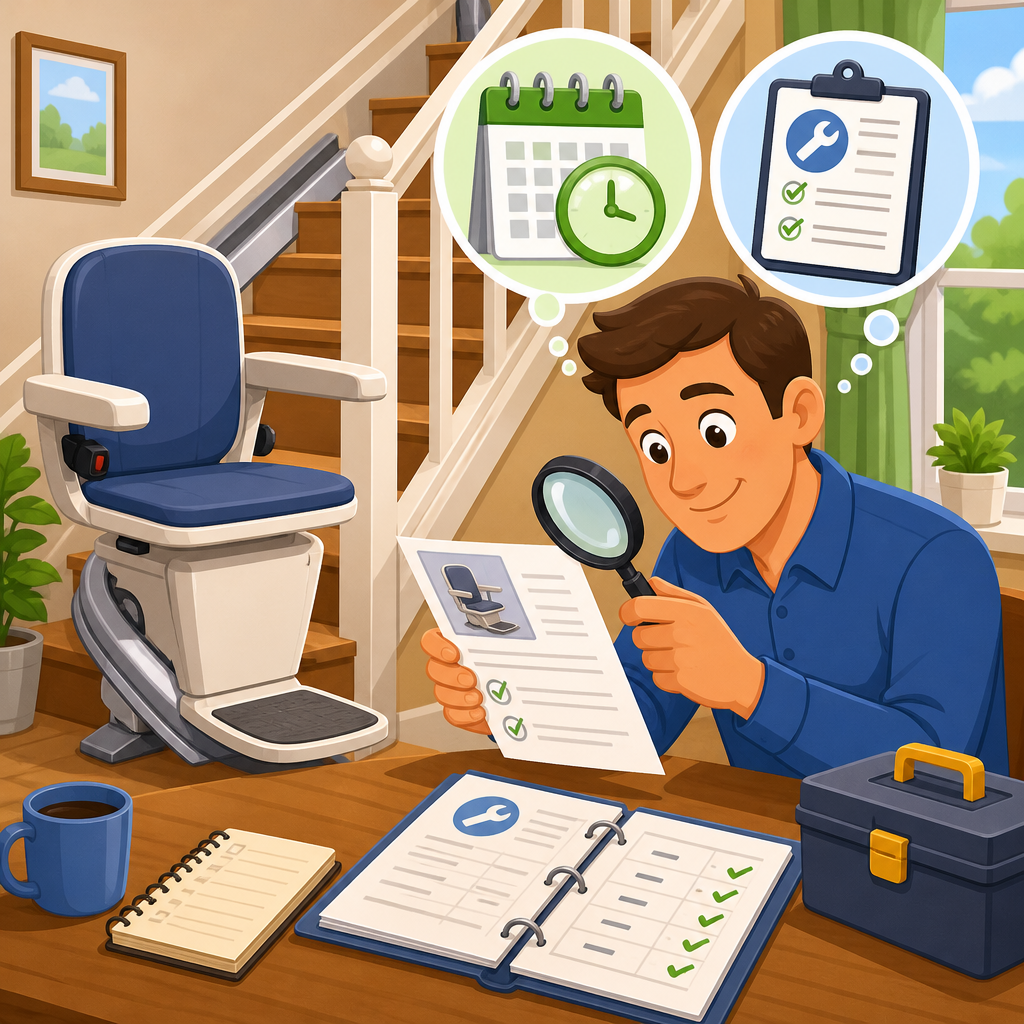
Buying a preowned accessibility device can save thousands of dollars, but only if you verify exactly what you are getting. Knowing how to verify the age and service history of a used stair lift is the difference between a safe bargain and an expensive mistake. A used stair lift is a previously installed mobility chair system that travels on a rail mounted to the staircase, while a refurbished stair lift has typically been inspected, repaired, cleaned, and tested before resale. Those labels sound reassuring, yet they do not guarantee the same thing from one seller to another. In practice, I have seen “refurbished” describe anything from a full factory rebuild with replacement batteries, carriage rollers, and safety edges to a simple wipe-down and fresh upholstery.
Age and service history matter because stair lifts are electromechanical systems with wear points, software settings, and safety components that degrade over time. Batteries lose capacity, drive gears wear, carriage wheels flatten, harnesses become brittle, and older control boards may be hard to replace. A stair lift can still run after years of deferred maintenance, but that does not mean it will perform safely under daily use. Buyers also need to know whether parts remain available. Brands such as Bruno, Stannah, Acorn, Handicare, Harmar, and Access BDD generally support many models for years, but support varies by product line and market.
This guide serves as a hub for used and refurbished chair lifts within buying guides and product reviews. It explains how to confirm a lift’s age, trace its maintenance record, evaluate the quality of refurbishment, and decide when an older unit is still worth considering. It also answers the practical questions buyers usually ask first: Where is the serial number? What paperwork should a seller provide? Can a local dealer service the model? Is a straight lift easier to buy used than a curved lift? By the end, you will know how to inspect the evidence, what to request in writing, and how to compare listings with confidence.
Start with identification: model, serial number, rail type, and original installation date
The first step is to identify the exact stair lift, not just the brand. Ask for the manufacturer, model name, model number, serial number, and a clear photo of the data plate. On most units, the label sits on the carriage under or behind the seat, inside a side cover, or near the footrest hinge. The rail may also carry a label. The serial number lets a dealer or manufacturer confirm the production period, original specification, and sometimes the first installation date. If the seller cannot provide a serial number, treat that as a major warning sign. You cannot reliably verify age, parts support, or recall status without it.
Straight stair lifts are usually better candidates on the used market because the rail is simpler, easier to cut or replace, and less tied to one staircase. Curved stair lifts often use custom rails built to a specific stair geometry. A used curved unit may have a perfectly functional carriage, but the rail often cannot be reused unless the new home has nearly identical dimensions, which is rare. In many purchases I have reviewed, buyers focused on the visible chair and ignored the rail. That is backwards. Rail compatibility, track condition, and mounting layout determine whether the lift can be legally and safely installed.
Ask for the original installation invoice or commissioning document. Reputable installers record the install date, stair angle, rail length, charge point locations, battery readings, and final safety tests. That paperwork establishes a baseline age that is more useful than a seller’s estimate. If the unit came from a dealer trade-in, request the decommissioning report from the old home and the intake inspection from the reseller. A serious reseller will have both.
Use documents and manufacturer records to confirm age and ownership chain
The strongest age verification comes from overlapping records. Start with the serial number, then compare it against invoices, warranty registration, service receipts, and any manufacturer email confirming the build date. Many dealers can contact brand support and ask whether the serial number is still in their system, whether the model is discontinued, and whether major assemblies such as PCB boards, arm switches, chargers, and transmission components remain available. You want confirmation from a source that has no reason to exaggerate the unit’s value.
Ownership history matters almost as much as age. A lift that spent six years in a lightly used single-user home can be a better buy than a three-year-old lift from a high-use environment such as a care property. Ask where it was installed, how many users relied on it, average trips per day, and why it was removed. Look for consistency. If the seller says the lift was barely used, but the seat vinyl is polished smooth, the arm caps are loose, and the footrest hinges sag, the wear tells a different story.
When reviewing documents, check dates, names, and addresses. The address on the original install invoice should align with the service tickets. If the stair lift changed hands, there should be a removal record, resale invoice, or refurbishment intake note. Missing paperwork does not always mean fraud, but it does reduce confidence. In that case, the serial number and a technician inspection become even more important.
Read the service history like a technician, not just a shopper
A real service history does more than prove maintenance happened. It shows what failed, how often, and whether the unit has a pattern of recurring issues. Request all maintenance logs, not just the latest tune-up. You want to see battery replacements, charger tests, fault codes, gearbox work, seat swivel switch repairs, safety edge adjustments, and final operational test results. Good records include technician notes, parts used, and post-service checks under load.
Some repairs are routine and positive signs of upkeep. Battery replacement every few years is normal for most DC-powered stair lifts. Replacing arm switches, call/send controls, seat belts, or carriage rollers can also be expected. More concerning entries include repeated overcurrent faults, chronic charge failures, rail joint alignment issues, or multiple visits for the same stopping problem. Those patterns suggest either an unresolved root cause or a model that is entering a high-failure stage.
| Record item | What it tells you | What to ask next |
|---|---|---|
| Battery replacement date | Whether the lift can hold charge reliably | Which battery brand and capacity were installed? |
| Fault code history | Recurring electrical or sensor problems | Was the root cause fixed or only reset? |
| Charger output test | If charging system meets specification | What voltage was measured at charge points? |
| Gearbox or motor service | Drive system wear and expected longevity | Were OEM parts used and who performed the work? |
| Safety edge adjustment | Condition of obstruction sensors | Was a full safety test documented after service? |
| Decommissioning report | Condition when removed from prior home | Was damage found during removal or transport? |
If the seller only offers verbal assurances such as “just serviced” or “fully reconditioned,” ask for the actual checklist. A trustworthy refurbisher will show the inspection criteria, measured values, replaced parts, and final test procedure. Without that, the phrase means very little.
Inspect the physical condition for clues the paperwork may miss
Even complete records should be matched against a hands-on inspection. Cosmetic wear is not the issue by itself; uneven wear is. Look at the seat pivot, folding arms, hinge points, footrest linkage, and carriage shrouds. Excess movement, rattles, or scraped covers can indicate prior impact or rough handling during removal. Check the rail for dents, corrosion, joint misalignment, or nonstandard drilling. A rail that was cut down or modified improperly can create ride quality and charging problems.
Power the unit through multiple full-length runs. Listen for grinding, clunking, or changes in motor pitch under load. A healthy lift should move smoothly with no hesitation at rail joints or charge points. Test the seat swivel lock at the upper landing, footrest obstruction sensors, overspeed governor function if applicable, arm controls, remote call/send stations, and key switch. On battery-powered models, unplug mains power briefly and confirm the lift still operates as designed. Then reconnect power and verify charging resumes at the park points.
Upholstery, labels, and accessories also reveal age. Faded warning decals, yellowed plastic, obsolete remotes, and discontinued armrest shapes often indicate an older generation than the listing suggests. None of those signs automatically disqualify a purchase, but they should align with the age being claimed.
Verify refurbishment quality, safety standards, and future serviceability
The best refurbished stair lifts are rebuilt to a documented standard, not merely cleaned and resold. Ask exactly what refurbishment included. At minimum, there should be electrical testing, battery health verification or replacement, cleaning of the rail and charge contacts, inspection of safety edges, seat and swivel function checks, carriage roller assessment, and a loaded operational test. Better programs replace wear items proactively and provide a limited warranty with labor terms clearly stated.
Ask whether the refurbisher follows recognized standards and manufacturer procedures during reinstallation. In North America, stair lifts are commonly evaluated against ASME A18.1 requirements for platform lifts and stairway chairlifts, while electrical listing and local code considerations may also apply. In the UK and Europe, dealers often reference relevant machinery, installation, and conformity obligations. The exact code pathway depends on jurisdiction, but the important point is simple: the seller should be able to explain how the lift will be installed, tested, and signed off legally in your area.
Future serviceability is where many used purchases fail. Before you buy, call two local dealers and ask whether they service that exact model, whether parts are still available, and typical response times for breakdowns. I strongly advise buyers to do this before paying a deposit. A discounted stair lift is not a bargain if no one nearby will touch it. Also ask whether diagnostic tools, service manuals, and replacement remotes are still obtainable. Older proprietary electronics can turn a minor fault into a total loss.
Questions to ask sellers, dealers, and private parties before you commit
The safest buyers are the ones who ask direct, uncomfortable questions early. Was the stair lift removed because the user no longer needed it, because the property sold, or because the unit became unreliable? Who removed it, and was the rail damaged during removal? Has the carriage ever been submerged, exposed to outdoor conditions, or stored in a damp garage? Are there any current fault codes? When were the batteries last replaced? Is the charger original? What warranty covers the motor, gearbox, PCB, and labor?
For private-party sales, ask for a live video showing the serial label, startup, full travel, folding actions, swivel lock, and charging indicator. For dealer sales, request the refurbishment checklist, installation survey, and warranty terms in writing. Be cautious with online marketplace listings that mention “works great” but show the lift already removed from the staircase. Once deinstalled, a unit is harder to verify under real operating conditions.
This used and refurbished chair lifts hub should also guide your next research steps. After age and history verification, compare straight versus curved reuse economics, battery replacement costs, transferability of warranties, rental alternatives, and dealer review quality in your region. Those supporting topics help buyers evaluate the full ownership picture, not just the sale price.
When an older used stair lift is worth buying, and when to walk away
An older stair lift can still be a smart purchase if four conditions are true: the model is supported locally, the serial number and records confirm its identity, the refurbishment is documented, and a technician inspection shows smooth operation with strong battery performance. Straight lifts from established brands often meet those conditions. I have seen well-maintained units deliver years of reliable service after resale because the dealer replaced batteries, rollers, remotes, and worn switches before reinstalling them.
Walk away when the seller cannot prove age, cannot produce service records, or cannot explain who will support the unit after installation. Also pass on lifts with repeated charging faults, evidence of impact damage, heavily modified rails, missing safety features, or no available parts pipeline. Curved lifts with custom rails deserve extra caution unless the purchase includes a newly manufactured rail and confirmed compatibility with the carriage.
The main benefit of careful verification is simple: you reduce risk while protecting the user. A stair lift is not just a used appliance; it is a mobility and safety system. Verify the serial number, cross-check documents, read the service history critically, inspect the hardware, and confirm local service support before you buy. If a seller welcomes that scrutiny, you are usually dealing with a better product and a better business. Use this hub as your starting point, then create a shortlist and request records before agreeing to any used stair lift purchase.
Frequently Asked Questions
1. How can I verify the actual age of a used stair lift?
The most reliable way to verify the age of a used stair lift is to start with the manufacturer label or data plate, which is usually attached to the chassis, carriage, rail, footrest base, or under the seat. This plate often includes the model number, serial number, and sometimes the manufacturing date. If the date is not clearly printed, the serial number can usually be used by the manufacturer or an authorized dealer to confirm when the unit was built and, in some cases, when it was originally sold or installed. That is far more dependable than accepting a seller’s estimate or advertisement language such as “lightly used” or “recent model.”
You should also compare the model number against the manufacturer’s product history. Some stair lift models have been discontinued for years, so even a clean-looking unit may be significantly older than it appears. Cosmetic cleaning, replacement upholstery, or a new battery can make an older system look newer than it really is. Ask for original paperwork, installation invoices, warranty cards, or user manuals with matching serial information. If those documents do not match the unit, treat that as a warning sign.
If possible, contact the manufacturer directly or work through a local dealer. They may be able to tell you the production date, whether the model is still supported, and whether replacement parts are still available. That last point matters just as much as the age itself. A ten-year-old stair lift from a major brand with current parts support may be a safer purchase than a slightly newer model that is obsolete and difficult to repair.
2. What service history should I ask for before buying a preowned stair lift?
Ask for a complete service and maintenance record, not just a statement that the unit “works fine.” A meaningful service history should show installation date, previous ownership or use environment, routine maintenance visits, battery replacements, diagnostic repairs, safety inspections, and any parts that were replaced. This information helps you understand not only how old the stair lift is, but also how well it was cared for and whether it has a pattern of recurring problems.
Pay close attention to components that commonly wear over time, including batteries, seat swivel mechanisms, arm controls, rail charging contacts, motor assemblies, gear systems, and safety sensors. If the stair lift has required repeated service for stopping unexpectedly, beeping errors, charging problems, or inconsistent travel, that can point to deeper electrical or mechanical issues. A good record should show what was fixed, when it was fixed, and who performed the work.
It is also important to find out whether the unit was used in a private home, a high-use care setting, or in conditions with dust, humidity, or temperature extremes. Heavy-use environments can shorten component life even if the unit still operates. If the seller cannot provide records, ask whether the original servicing dealer can confirm maintenance history from the serial number. No paperwork does not automatically make a stair lift a bad purchase, but it should lower your confidence and increase the need for an independent inspection.
3. Is there a difference between a used stair lift and a refurbished stair lift when checking age and history?
Yes, and the difference matters. A used stair lift is simply a stair lift that has been previously installed and removed from another property. A refurbished stair lift usually means the seller has inspected it, cleaned it, tested it, and replaced worn or faulty parts before offering it for resale. However, “refurbished” is not a regulated term in many resale situations, so you should never assume that it guarantees a specific level of quality or safety. You still need to verify the age, model, and service background.
When evaluating a refurbished unit, ask exactly what was refurbished. Did the seller replace the batteries, check the motor load, inspect the gearbox, test the overspeed governor, verify the seat swivel lock, and confirm all obstruction and limit sensors work properly? Were the rail, carriage, and controls tested under load, or was the unit only powered on and cleaned? A trustworthy seller should be able to explain the refurbishment process clearly and provide a checklist or invoice showing what was done.
You should also ask whether the refurbished stair lift uses original manufacturer parts, compatible aftermarket parts, or salvaged parts from another unit. That affects reliability, future repairs, and warranty coverage. In short, refurbishment can add value, but only if it is documented and done professionally. The label “refurbished” should be viewed as the beginning of your verification process, not the end of it.
4. What are the biggest red flags that a used stair lift may not be worth buying?
One major red flag is a seller who cannot provide a serial number, removes or obscures the identification label, or avoids questions about the unit’s origin. Another is vague language such as “should work,” “came out of a home remodel,” or “was operating when removed,” without any supporting records or testing. These phrases often mean the seller does not know the full condition of the equipment or does not want to commit to it.
Be cautious if the stair lift is very old, from a discontinued brand, or no longer supported by the manufacturer. Even if the price looks attractive, you may struggle to get replacement parts, service, or safe installation. Physical warning signs include excessive rail wear, cracked plastic housings, frayed wiring, corrosion near charging points, weak batteries, rough movement, unusual noises, seat wobble, sticky controls, or inconsistent stopping. Any of these can signal neglected maintenance or hidden wear.
You should also watch for mismatched parts, missing safety labels, incomplete track sections, or evidence that the unit was pieced together from multiple systems. In addition, if the seller cannot confirm compatibility with your staircase layout, weight requirements, and power setup, that is a practical red flag as well as a safety concern. A stair lift that is cheap to buy but expensive to adapt, repair, or service quickly stops being a bargain. When in doubt, have a qualified stair lift technician inspect the unit before purchase.
5. Should I have a professional inspect a used stair lift before I buy it?
Absolutely. A professional inspection is one of the smartest steps you can take when buying a preowned stair lift. Even if the unit appears clean, runs smoothly, and comes with some paperwork, a trained technician can spot wear patterns, electrical issues, compatibility problems, and safety concerns that most buyers will miss. This is especially important because stair lifts are mobility and fall-prevention devices, not ordinary household appliances. Small defects can create serious safety risks.
A proper inspection should confirm the unit’s model and serial number, verify manufacturing age, assess whether the rail and carriage are in good condition, test batteries and charging performance, check safety edges and obstruction sensors, evaluate seat locks and swivel functions, inspect wiring and control boards, and determine whether the system still meets the manufacturer’s service standards. The technician can also tell you if parts are still available and whether installation on your staircase will require modifications that increase the total cost.
Just as important, a professional can help you understand the true value of the purchase. A low-priced unit with weak batteries, outdated electronics, unsupported parts, and a questionable service record may cost more in repairs than a newer certified resale option from a dealer. On the other hand, a professionally inspected and properly maintained used stair lift can deliver excellent value and save thousands of dollars. If you want confidence in both safety and long-term cost, an independent inspection is well worth arranging before you commit.





