
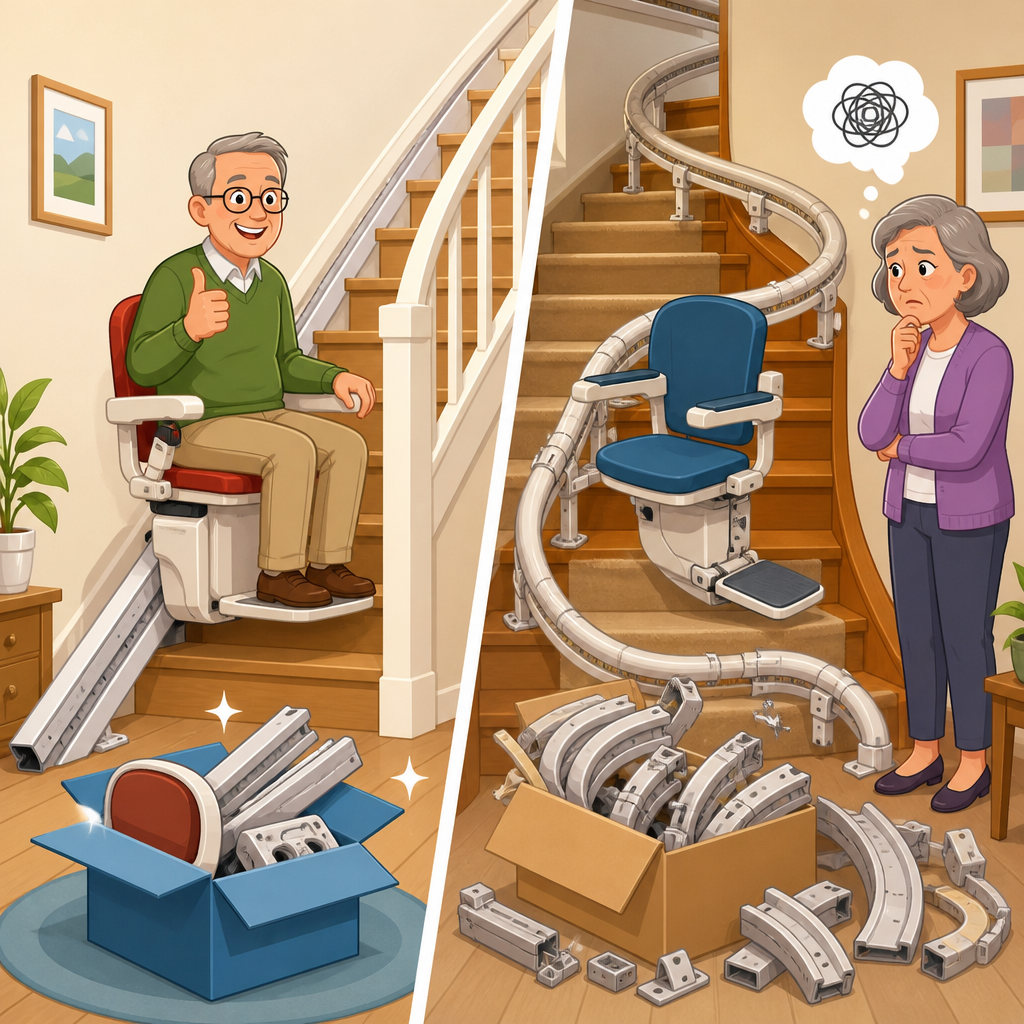
Buying a pre-owned stair lift can look like an easy way to cut costs, but used curved stair lifts are much harder to reuse than straight models because the rail is built for one staircase, not for staircases in general. In the stair lift industry, “straight” means the staircase runs in a single uninterrupted line, while “curved” covers any stairway with turns, intermediate landings, spiral sections, pie-shaped treads, or changes in gradient. That difference shapes everything about the secondary market. I have worked with families comparing refurbished units, dealers evaluating trade-ins, and installers measuring difficult homes, and the pattern is consistent: straight lifts are modular and transferable, while curved lifts are customized and often effectively married to the original property. For shoppers researching used and refurbished chair lifts, this matters because the headline price of a secondhand unit rarely reflects the full installation reality. The most important question is not whether a chair, motor, or carriage can be reused; it is whether the rail system can be safely and economically fitted to another staircase. Once you understand that point, the economics of the used stair lift market become much clearer and the buying decision gets easier.
Why straight stair lifts have a stronger resale market
Straight stair lifts are easier to reuse because they are designed around standardized rail lengths, simpler mounting geometry, and faster installation. In most cases, the rail can be cut to size on site or assembled from stock sections. The carriage, seat, footrest, charging system, and call stations are usually compatible with many staircases as long as weight capacity, incline range, and local code requirements are met. Brands such as Bruno, Harmar, Handicare, and Stannah all offer straight models that technicians can routinely remove, refurbish, and reinstall without redesigning the whole system.
That flexibility creates a practical used market. If a lift comes out of one home, a dealer can inspect the drivetrain, replace batteries, test safety edges, fit new upholstery if needed, and match it to another customer whose staircase has similar width and pitch. The biggest variable is rail length, which is manageable. Installers can trim aluminum or steel track, add overruns when supported by the manufacturer, and verify final limits during commissioning. Because the engineering is repeatable, labor stays predictable and the refurbished sale still saves money compared with new equipment.
For buyers, this means used straight stair lifts often make sense in the right circumstances. A reputable dealer can tell you age, service history, parts availability, and whether the model still meets current manufacturer guidance. In many homes, especially those with a basic staircase from one floor to the next, a reconditioned straight model delivers a realistic balance of safety, performance, and price. That is why most legitimate used inventory is straight, not curved.
Why used curved stair lifts are harder to reuse
A curved stair lift rail is typically manufactured from a survey of one exact staircase. The rail follows every turn, landing, rise, tread depth variation, and parking position. Many systems use bespoke tube bending or custom-fabricated modular segments based on a digital photo survey or detailed template. Even small dimensional differences matter. A few millimeters at one bend can create clearance issues at the knee, the wall, the handrail, or the newel post farther down the run. Because of that, a rail removed from one property almost never drops cleanly into another.
The carriage itself may still be mechanically usable, but without a matching rail, the most expensive and staircase-specific part of the system has little resale value. That is the core reason curved lifts are harder to reuse than straight models. Consumers often assume they are buying a chair and motor, when in reality they are buying a route precisely engineered through the home. If the staircase includes a 90-degree turn, a 180-degree return, a split landing, or a narrow lower exit, the rail geometry is doing highly specific work that cannot be generalized.
There is also more variation between manufacturers in curved systems than in straight ones. Some brands use twin-rail designs, some single tube, some rack-and-pinion drives with proprietary carriage interfaces, and some have powered swivel or automatic folding sections tied into the rail design. You cannot simply take the rail from one brand and mount another carriage onto it. Even within one brand, older generations may not share parts or software with current models. Reuse is therefore limited by both physical fit and platform compatibility.
Custom rail fabrication changes the economics
When a used curved stair lift is offered for sale, the rail is usually the problem, not the seat. If the buyer needs a new custom rail anyway, the savings from purchasing a used carriage can shrink dramatically. The dealer still has to complete a site survey, send measurements to the factory, order a freshly built rail, schedule installation, and assume responsibility for safe operation. At that point, the transaction starts to resemble a new curved stair lift sale with a recycled chair assembly rather than a true secondhand bargain.
In practice, dealers often avoid this model because warranty exposure can exceed the margin. A carriage with unknown wear may require new batteries, rollers, wiring looms, arm switches, seat rotation components, and a main board before it is suitable for installation on a new rail. If one hidden fault appears after fitting, the installer is the party the customer calls. That service burden is why many established companies either decline to sell used curved units altogether or only refurbish relatively recent models with confirmed manufacturer support.
The custom fabrication process also adds time. A straight refurbishment can sometimes be installed within days from stock. A curved project often takes weeks because the rail must be designed, approved, produced, shipped, and fitted. For customers recovering from surgery or responding to a fall, delay matters. A temporary straight lift on a secondary staircase may sometimes be possible; a temporary curved solution rarely is. That urgency pushes many households toward a new system with full support rather than a reused assembly with narrower options.
Installation, safety, and compliance issues buyers overlook
Reusing any stair lift requires more than making the chair move. The installer must confirm staircase width, headroom, landing clearance, power supply, charging points, seat height suitability, and safe ingress and egress. Curved units add another layer: the rider’s body position changes through bends and transitions, so clearances must be checked all along the travel path. On narrow stairs, the difference between a safe fit and an unusable fit can come down to how the knees track around a turn or whether the footrest clips a skirting board.
Manufacturers and professional dealers also work within product-specific installation tolerances and national safety expectations. In the UK, stair lifts are commonly supplied with reference to machinery and lifting product standards, while in the US installers look to manufacturer instructions, local electrical requirements, and accessibility best practices. Regardless of market, substituting components outside approved configurations can create liability. If a used curved carriage is paired with a newly fabricated rail by a third party, the question becomes who stands behind the completed system and with what documentation.
That is why a cheap listing on a marketplace site can be misleading. The seller may honestly state that the lift “worked when removed,” but that tells you little about remaining battery life, charger condition, gearbox wear, diagnostic history, or whether all safety circuits function under load. A professional refurbishment includes bench testing, load testing, replacement of common wear parts, and installation validation. Without that process, low purchase price can quickly become false economy.
Used straight vs used curved stair lifts at a glance
| Factor | Used Straight Stair Lift | Used Curved Stair Lift |
|---|---|---|
| Rail compatibility | Often reusable with cutting or stock sections | Usually custom to one staircase and not reusable |
| Survey complexity | Basic measurement of length, width, and incline | Detailed multi-point survey of turns, landings, and clearances |
| Installation time | Often faster, sometimes from stock | Usually slower due to custom rail production |
| Refurbishment value | Strong if parts remain available | Limited unless carriage is recent and rail is newly made |
| Typical resale demand | Broad demand across many standard homes | Narrow demand because each staircase is unique |
| Risk for buyer | Moderate and manageable with a reputable dealer | Higher because customization and support are more complex |
How reputable dealers handle refurbished chair lifts
In the used and refurbished chair lifts market, dealer practices matter more than the word “used.” The best firms separate salvageable components from staircase-specific parts. For straight lifts, that may mean reusing the carriage and seat while supplying new track, new batteries, and new call controls. For curved lifts, it often means reusing only selected carriage components and ordering a new rail directly through the manufacturer or an authorized channel. The dealer should be able to explain exactly what is reused, what is replaced, and what warranty applies to each element.
Ask for a written scope. It should identify model number, age if known, serial number, weight capacity, folded width, battery type, and included safety features such as overspeed governor, obstruction sensors, seat belt, powered swivel, and diagnostic display. Request confirmation that replacement parts are still available. On older discontinued models, one failed board can make future repair impractical. I have seen families buy attractively priced used lifts only to learn six months later that a proprietary control component is no longer supported.
Service response is just as important. A refurbished stair lift is not a static product; it is mobility equipment that may become essential overnight. If the user cannot climb stairs at all, downtime is critical. Ask who services the lift, whether weekend coverage exists, what the average response time is, and whether the company stocks batteries and common parts locally. A lower quote with no meaningful aftercare is rarely the best value.
What buyers should consider before choosing used, refurbished, or new
Start with the staircase, not the budget. If your stairs are straight, a professionally refurbished model can be a practical option. If your stairs curve, the realistic comparison is often between a new curved lift and a partly refurbished curved package built around a new custom rail. In that case, the price gap may be smaller than expected. Ask for itemized quotes so you can see whether savings come from reused hardware, reduced warranty length, or omitted features such as powered hinge rails or automatic folding footrests.
Next, consider user needs. A person with limited knee flexion may need a perch seat or higher seat base. Someone with severe balance issues may need powered swivel and powered footrest operation. A narrow staircase may require a specific seat profile and parking arrangement. These details can rule out some older used models even if the basic lift still runs. Product suitability matters more than chasing the lowest number on paper.
Finally, think beyond purchase price. Include removal of any existing lift, electrical work if required, annual servicing, battery replacement every few years, and the cost of support if the user depends on the lift daily. For many households, the best outcome is a transparent purchase from an established dealer who can show survey data, explain limitations, and support the product long term. If you are comparing options, use this hub as a starting point and then review detailed guides on pricing, warranties, rental alternatives, and brand-specific refurbished availability before you decide.
Used curved stair lifts are harder to reuse than straight models for one central reason: the rail is custom-built to a single staircase, while straight systems are far more modular. That physical reality affects cost, lead time, safety checks, resale value, and long-term serviceability. For shoppers exploring used and refurbished chair lifts, the practical lesson is simple. A used straight stair lift can often deliver real savings when it is supplied, tested, and supported by a reputable dealer. A used curved stair lift usually requires a new custom rail, and once that is factored in, the bargain may be far smaller than the listing suggests.
The smartest way to buy is to match the product to the staircase and the user’s mobility needs, then judge value based on total installed cost and aftercare, not on the sticker price alone. Ask detailed questions, request an itemized quote, verify parts support, and insist on clear warranty terms. If you are building your shortlist under Buying Guides and Product Reviews, continue to the connected articles in this used and refurbished chair lifts hub to compare costs, dealers, features, and support options with confidence.
Frequently Asked Questions
Why are used curved stair lifts so much harder to reuse than used straight stair lifts?
The biggest reason is that a curved stair lift rail is custom-built for one specific staircase. A straight stair lift is designed for stairs that run in one continuous line, so the rail can often be cut to length and installed on another similar staircase with relatively minor adjustments. A curved stair lift works very differently. Its rail is manufactured to match the exact shape of the original stairway, including every turn, landing, change in angle, pie-shaped tread, spiral section, and variation in gradient.
That means the rail from one used curved stair lift usually does not fit another home, even if the staircases look similar at first glance. Small differences in dimensions, turning radius, headroom, overrun space, parking position, or step shape can make the rail unusable. In practical terms, the most expensive and staircase-specific part of the lift is the part least likely to transfer successfully. The chair and some mechanical or electronic components may still have value, but the full system is rarely a simple plug-and-play reuse. This is why the resale and reinstallation market for curved models is far more limited than it is for straight lifts.
What exactly counts as a “curved” staircase in the stair lift industry?
In the stair lift industry, “curved” does not only mean a staircase with a dramatic sweeping bend. It is a much broader category. A staircase is generally considered straight only when it runs in a single uninterrupted line from bottom to top with no turns and no intermediate landings. Once the stairs change direction, include a flat landing between sections, bend around a corner, narrow into pie-shaped treads, shift in slope, or form part of a spiral, the lift is treated as a curved model.
This distinction matters because every one of those features affects rail design. A landing may require the rail to turn and continue in a different direction. A staircase with changing pitch may need the chair to remain level while traveling across multiple gradients. Narrow steps or inside turns can affect where the rail sits and how much room the user has to get on and off safely. Even a staircase that appears fairly ordinary can fall into the curved category if it has a single bend or split run. From a manufacturing and installation perspective, these are not minor details. They are exactly what make the rail unique and what makes reuse so difficult in the secondhand market.
Can any part of a used curved stair lift be reused, or is the whole system usually unsuitable?
It is possible for some parts of a used curved stair lift to be reused, but that does not mean the entire system can be economically transferred to a different home. The rail is usually the main obstacle because it is the most customized component. However, depending on the brand, age, condition, and model support status, parts such as the seat assembly, footrest, carriage, charger, remote controls, or certain electronic components may still be serviceable.
Even then, reuse depends on much more than whether the parts still function. Installers must consider compatibility with current control boards, software, safety sensors, battery systems, and replacement part availability. Manufacturers also update product lines over time, and some older models become difficult to support if parts are discontinued. In many cases, the labor required to inspect, refurbish, test, transport, and adapt older components can reduce the savings buyers expect from going used. So while a curved lift may have reusable elements, the system as a whole is usually far less transferable than a straight stair lift, and the practical value often lies in parts recovery rather than full reinstallation.
Why can’t a used curved rail just be modified to fit a different staircase?
In theory, people often assume a rail can simply be bent, trimmed, or adjusted to fit another home. In practice, that is rarely realistic. Curved stair lift rails are engineered around precise measurements and exact geometry. They are designed not only to follow the path of the staircase, but also to maintain safe clearances, support the carriage properly, keep the seat level where required, and ensure reliable travel through turns and transitions. Changing one section of the rail can affect the entire route of the lift.
There are also structural and safety concerns. These rails are manufactured to exact tolerances, and alterations can compromise performance, ride quality, or user safety. Depending on the design, the rail may include complex joints, mounting points, rack systems, leveling mechanisms, or proprietary fabrication methods that are not intended for field modification. By the time a company measures a new staircase, determines whether the old rail can be adapted, performs custom metalwork, tests the result, and addresses liability concerns, the process is often less practical than ordering a newly manufactured rail built for the new staircase from the start. That is why used curved rails are not typically treated as universally adjustable assets in the way some buyers imagine.
Does buying a used curved stair lift ever make sense for homeowners trying to save money?
It can make sense in limited situations, but buyers need to go into the process with realistic expectations. If the goal is to buy a complete curved lift from one home and move it directly into another, that is usually where the economics break down. The custom rail often prevents straightforward reuse, and once you add measurement, engineering, transport, installation, refurbishment, and warranty considerations, the savings may be smaller than expected. In some cases, the final cost can approach the price of a new system while offering less flexibility and potentially less manufacturer support.
That said, a used curved stair lift may still be worthwhile if it comes through a reputable dealer who can evaluate which components are reusable and pair them with a newly made rail. Some providers refurbish the carriage and seat assembly while commissioning a brand-new rail for the new staircase. That approach can sometimes reduce costs compared with purchasing an entirely new unit, though the savings vary. The key is to work with a company that understands measurement, compatibility, safety standards, and ongoing service requirements. For most homeowners, the smart question is not simply “Can I buy a used curved stair lift?” but “What parts are actually reusable, what new fabrication is required, and what support will I have after installation?” Those answers determine whether the purchase is truly cost-effective.





