
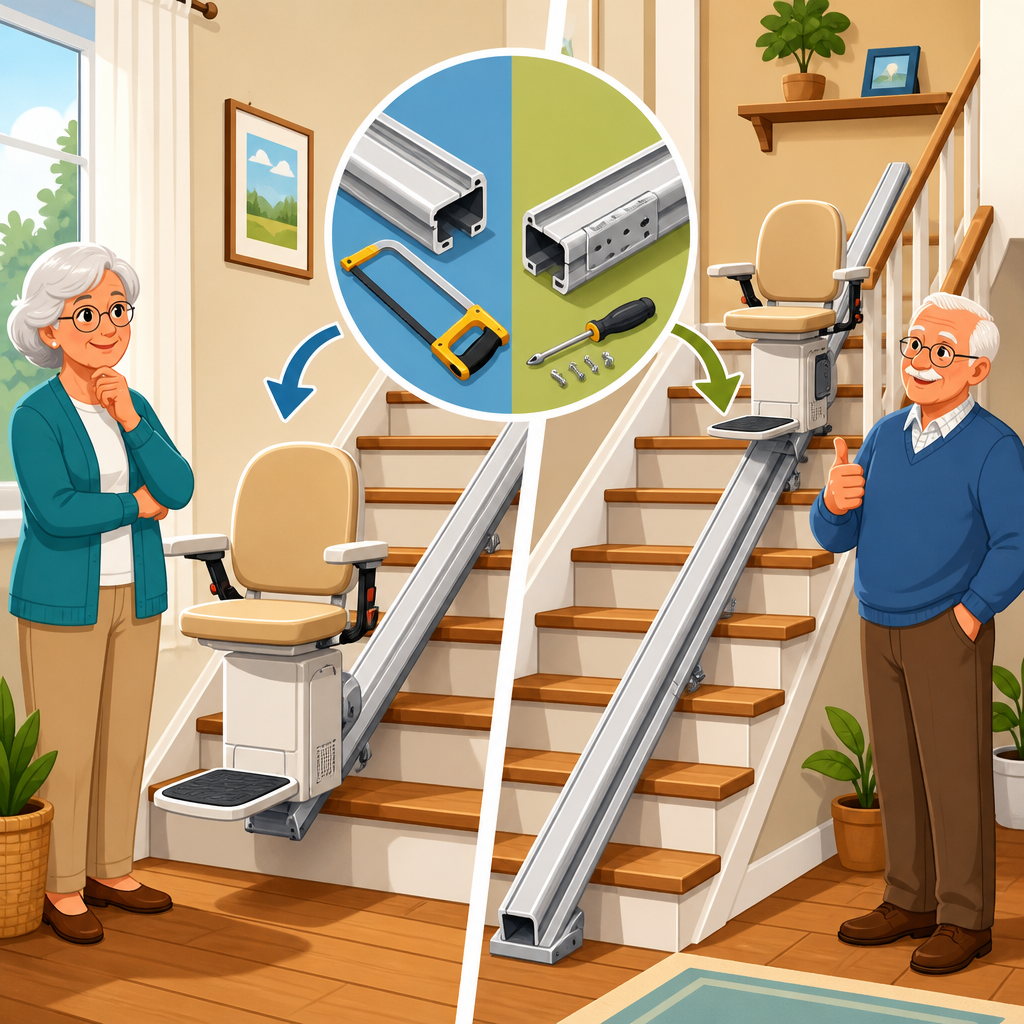
Buying a pre-owned stair lift can lower the cost of safer mobility, but one question comes up in almost every consultation I handle: can a used straight stair lift be cut down or extended to fit your stairs? The short answer is yes, in many cases a used straight stair lift rail can be shortened, and some models can be lengthened, but the real answer depends on rail design, manufacturer parts support, staircase measurements, safety standards, and the condition of the lift itself.
A straight stair lift is a chair lift built for a staircase that runs in a single line without turns, intermediate landings, or curved transitions. A used stair lift is a unit previously installed in another home, then removed and resold either as-is or after refurbishment. Refurbished chair lifts usually undergo cleaning, inspection, parts replacement, battery testing, and setup verification before being installed again. Those distinctions matter because a lightly used, factory-supported straight lift is very different from an outdated model with discontinued rails, missing brackets, or worn drive components.
This topic matters for practical and financial reasons. A new straight stair lift often costs far less than a curved model, yet for many households even that price is significant. Used and refurbished chair lifts can reduce purchase cost, speed up installation, and extend safe access for older adults, people recovering from surgery, and families preparing a home for long-term aging in place. Still, savings only count if the lift can be adapted safely. A rail that is the wrong length, a chair that cannot be repositioned properly at the landing, or a unit lacking compatible charge points can turn a bargain into a liability.
In my experience evaluating pre-owned accessibility equipment, the most successful used straight stair lift projects start with exact stair geometry, not the price tag. Dealers who know what they are doing measure the staircase pitch, overall run, top and bottom clearances, obstructions, folding dimensions, seat height, and power supply location before they promise anything. That process determines whether a specific used rail can be cut down, whether extension kits are available, and whether the installation will meet the safety and usability expectations most buyers assume are automatic.
When a Used Straight Stair Lift Can Be Cut Down or Extended
A used straight stair lift can often be cut down because many straight rails are modular, aluminum-based, or designed to be trimmed during initial installation. If the rail profile permits shortening, an installer can remove the rail, measure the required length precisely, cut it to the correct dimension, and reinstall the end stop and charging contacts where applicable. This is common with several mainstream straight stair lift platforms from brands such as Bruno, Harmar, Stannah, and Handicare, although the exact rail architecture varies by model generation.
Extending a used straight stair lift is more limited. Some manufacturers offer rail extension sections, overruns, folding rail options, and top or bottom parking extensions. If the exact model still has parts support, a dealer may be able to add a compatible section to reach a longer staircase or create a safer dismount point. If the rail is a one-piece cut-to-length system, extension may be impractical or prohibited. In other cases, adding length affects charging location, rack alignment, limit cams, footrest clearance, or the position of final stops, which means the work is more than attaching extra metal.
The key principle is simple: the chair, carriage, and rail must remain a matched system. Stair lifts are not generic chairs riding on universal tracks. The gearbox, pinion or cable system, rack, chassis width, call-send controls, and charging method are engineered as one assembly. A dealer can shorten or extend only within the manufacturer’s approved configuration for that specific unit.
What Determines Whether a Used Lift Will Fit Your Staircase
Fit starts with measurement. For a straight stair lift, installers usually measure from the upper landing edge down to the floor at the base while following the nose of each tread. They also record staircase width, number of steps, tread depth, riser height, handrail encroachment, door swing conflicts, and clearance at both landings. A staircase may be straight and still be a poor candidate for a used unit if there is not enough room for the seat to swivel safely or for other household members to pass.
Model-specific requirements matter just as much as dimensions. Some chairs fold tighter than others. Some have powered swivel seats, while others require manual operation. Some need a dedicated charging point at one or both ends. Battery-powered lifts typically charge at parked positions, so changing the rail length can affect where charging contacts engage. If those details are wrong, the lift may run but fail to charge reliably, leading to service calls and premature battery failure.
Weight capacity is another deciding factor. Many older used stair lifts were rated around 250 to 300 pounds, while newer heavy-duty straight lifts can support 350, 400, or even more depending on model. A lift that technically fits the staircase but does not fit the user is not a viable option. Seat width, arm height, transfer space, and footrest size all influence safe daily use.
Used, Refurbished, and Reconditioned Chair Lifts: What Buyers Need to Know
In the used and refurbished chair lifts market, terminology is inconsistent, so buyers should ask direct questions. “Used” may mean the lift was removed and stored with minimal testing. “Refurbished” often means batteries, rollers, wiring covers, seat upholstery, and safety edges were inspected or replaced, then the unit was tested before resale. “Reconditioned” can mean anything unless the seller explains the process in writing.
When I assess these systems, I look for four things first: age, parts availability, service history, and rail condition. Batteries are consumables and should be expected to need replacement eventually. More important is whether the carriage has excessive wear, whether the rack teeth are intact, whether the overspeed governor and limit systems work correctly, and whether the manufacturer still supports the model. Established brands with active dealer networks are usually safer used purchases because parts, technical bulletins, and setup procedures are easier to obtain.
Removal and reinstallation quality also matters. Stair lifts attach to stair treads, not typically to the wall, and poor removal can damage brackets, strip hardware, or distort rail alignment. A refurbished chair lift should be reinstalled with the same care as a new one: proper bracket spacing, secure fastening, tested stop points, and verified battery charging at the final park positions.
Common Scenarios for Cutting Down or Extending a Rail
The most common successful scenario is a used straight stair lift rail that is slightly longer than the new staircase requires. In that case, the installer trims the lower portion and resets the final stop so the chair parks safely near the bottom landing. This works best when the rail uses a standard straight extrusion and the lower end houses components that can be relocated according to the manufacturer’s instructions.
A more complex scenario is adding a short extension because the buyer’s staircase is longer than the original rail. Sometimes this is possible with approved rail sections or overruns. For example, a bottom overrun can move the parked seat away from the first step, reducing fall risk during transfer. A top overrun can allow the user to get on or off farther from the stair edge. These are meaningful safety features, not cosmetic add-ons, so compatibility must be exact.
The least promising scenario is trying to adapt a discontinued unit with missing proprietary parts. Even if a machine shop could physically modify the rail, a reputable installer will not guess at stop locations or bypass factory components. Stair lifts are mobility devices, and improvised modifications expose the user and installer to unnecessary risk.
Cost, Safety, and Value: Is a Used Straight Stair Lift Worth It?
A used straight stair lift is often worth considering when the staircase is standard, the buyer wants to control cost, and the model comes from a recognized brand with dealer support. In many markets, a refurbished straight stair lift can save hundreds or several thousand dollars compared with a new unit, depending on warranty length, installation complexity, and included options. The financial case is strongest when the staircase does not need custom fabrication and the user’s needs match common seat and capacity configurations.
Safety should outweigh price. Reputable dealers follow recognized accessibility and lift safety practices, perform load and function testing, verify seat belt operation, inspect obstruction sensors, and confirm charging. In North America, many professionals reference ASME A18.1 requirements for platform lifts and stairway chairlifts along with manufacturer installation instructions. Compliance is not a marketing extra; it is the baseline for responsible resale and installation.
| Factor | Good Candidate for Used/Refurbished | Poor Candidate for Used/Refurbished |
|---|---|---|
| Stair shape | Single straight run | Curved, split, or with landings |
| Rail fit | Can be trimmed or uses supported extensions | Needs unsupported custom modification |
| Brand support | Active parts and dealer network | Discontinued model with scarce parts |
| User needs | Standard seat and capacity requirements | Heavy-duty or highly specific seating needs |
| Budget goal | Wants lower upfront cost with warranty | Chooses lowest price regardless of condition |
How This Fits the Wider Used and Refurbished Chair Lift Buying Process
As a hub topic, used and refurbished chair lifts should be evaluated as a category, not just as one product listing. Buyers usually compare straight versus curved lifts, dealer-refurbished versus private-sale units, rental versus purchase, indoor versus outdoor models, and short-term recovery needs versus permanent mobility planning. The question about cutting down or extending a straight rail sits at the center of that decision because it directly affects inventory flexibility and final cost.
Private-sale stair lifts from classifieds or auction sites are where many buyers run into trouble. A unit may look clean, but if there is no proof of model number, installation manual, service record, or available parts, the price advantage can disappear quickly. Many dealers will not install customer-supplied used stair lifts because they cannot verify prior damage or guarantee safe operation after transport and storage. Dealer-refurbished lifts typically cost more than private-sale units, but that premium usually includes site measurement, adaptation assessment, installation, labor warranty, and a service contact if something fails.
Outdoor and weather-exposed units deserve special caution. Even if the rail can be cut or extended, long-term UV exposure, corrosion, water intrusion, and brittle upholstery can make a used outdoor stair lift a poor value unless it has been professionally rebuilt. Likewise, very old AC-powered models without modern battery backup may be less attractive than newer battery-operated lifts that continue to run during a power outage.
For families planning ahead, used chair lifts can be a practical bridge solution after knee replacement, stroke rehabilitation, or hospital discharge. For long-term users, however, the better choice may be a newer model with stronger warranty coverage, current parts support, and upgrade options such as power swivel, power footrest, or folding rail. The right answer depends on usage pattern, not just price.
Questions to Ask Before You Buy a Used Straight Stair Lift
Ask the seller whether the exact model rail can be shortened, lengthened, or fitted with an overrun using approved parts. Ask for the manufacturing date, serial number, original installation manual, and any refurbishment checklist. Confirm the maximum weight capacity, folded width, battery age, warranty terms, and whether future service is available in your area. If the seller cannot answer these points clearly, treat that as a warning sign.
Also ask how the staircase will be measured and who is responsible if the used rail does not fit after removal from storage. Professional dealers usually complete a home assessment before assigning inventory. That protects both sides and reduces the chance of forcing an ill-fitting unit into place. A careful process may feel slower, but it prevents expensive mistakes.
The central takeaway is straightforward. Yes, a used straight stair lift can often be cut down, and some can be extended, but only when the rail system, parts availability, and staircase dimensions all align with the manufacturer’s approved design. That is why this question belongs within a broader used and refurbished chair lifts buying guide, not as a standalone shortcut. Rail length is only one part of fit. User safety, service support, warranty, and installation quality determine whether the purchase delivers real value.
If you are shopping this category, start with an in-home measurement from a qualified stair lift dealer, ask specifically about approved rail modifications, and compare refurbished inventory from supported brands before making a decision. A well-matched used straight stair lift can save money and restore daily independence, but only when it is adapted professionally and installed without compromise.
Frequently Asked Questions
Can a used straight stair lift really be cut down to fit a shorter staircase?
Yes, in many situations a used straight stair lift rail can be cut down to fit a shorter staircase, and this is one of the main reasons pre-owned straight lifts are often practical. Straight stair lifts use a rail designed for a simple, non-turning run of stairs, so if the rail is longer than needed, a qualified technician can often trim it to match the exact stair length. That said, it is not as simple as cutting metal and reinstalling the unit. The installer must confirm the rail profile, carriage compatibility, charging points, limit settings, and the location of mounting brackets before any modification is made.
The most important factor is whether the specific make and model was designed in a way that allows safe shortening without affecting operation. Some rails are modular and more forgiving, while others are more brand-specific and rely on exact factory components. The installer also needs accurate measurements from the nose of the top landing to the bottom landing, along with stair pitch, width, clearance, and any obstructions such as trim, doors, or radiators. If the rail is shortened incorrectly, the chair may stop in the wrong place, charge improperly, or create unsafe entry and exit positions. So while the answer is often yes, it should always be handled as a technical fitting process rather than a basic alteration.
Can a used straight stair lift be extended if the rail is too short?
Sometimes, but this is where things become more model-dependent. Certain straight stair lifts can be extended by adding a rail section or ordering a compatible overrun, while others cannot be safely lengthened unless the manufacturer still supports that exact system and compatible parts are available. In the used market, this is one of the biggest challenges. A lift may appear to be a bargain, but if the rail is too short and extension parts are discontinued or unavailable, it may no longer be a good fit for your staircase.
Even when extension is technically possible, the installer must verify much more than rail length alone. They need to ensure the motor unit, rack or drive system, brackets, end stops, charging contacts, and parking positions all remain correct after the extension is added. The top and bottom dismount areas matter just as much as the travel distance. A lift that reaches the top step but does not provide a safe landing position is not properly fitted. In many homes, a bottom overrun or top overrun may also be recommended to improve safety by moving the user away from the staircase before getting on or off the seat. So yes, some used straight lifts can be extended, but only if the right parts, measurements, and safety conditions line up.
What determines whether a used straight stair lift is a good candidate for modification?
Several factors determine whether a pre-owned straight stair lift is worth cutting down or extending. First is the rail design itself. Straight stair lifts are generally more adaptable than curved lifts, but not every straight rail is equally reusable. Some are easier to resize because they use simpler track systems or modular sections, while others are highly specific to one manufacturer and one generation of lift. Second is parts support. If the manufacturer no longer makes replacement brackets, charging strips, hinges, overruns, or diagnostic components, modifying the lift may create future service problems even if the initial installation is possible.
Third is the condition of the lift. A used stair lift should be inspected for wear on the carriage, seat swivel, footrest safety edges, battery system, controls, gearbox, and rail. If a unit is older, heavily used, or poorly maintained, spending money to adapt it may not make sense. Fourth is staircase compatibility. The width of the staircase, the angle of the stairs, the condition of the treads, and the clearance at the top and bottom all matter. Finally, there is compliance and safety. A reputable provider will not modify a used lift just because it can be made to physically fit. They will also evaluate whether it will charge correctly, stop correctly, carry the needed weight, and allow safe mounting and dismounting. A used lift is only a good candidate when fit, function, and long-term support all check out.
Is it cheaper to modify a used straight stair lift than to buy a new one?
Often yes, but not always. The appeal of a used straight stair lift is that it can significantly reduce upfront cost, especially when the existing rail is close to the required length and the lift is from a well-supported brand. If the rail only needs to be shortened and the unit is in good mechanical condition, the savings can be meaningful compared with a brand-new system. This is why many homeowners explore the used market first when they need a mobility solution quickly and want to stay within budget.
However, the final value depends on the full scope of work. Costs can increase if the lift needs new batteries, replacement controls, additional brackets, a rail extension, a powered hinge, or discontinued components sourced through limited channels. Professional installation, safety testing, and warranty coverage should also be included in the comparison. In some cases, a heavily modified used lift ends up close in price to a new straight stair lift but with a shorter remaining service life and less manufacturer backing. The smartest approach is to compare total installed cost rather than sticker price alone. A lower purchase price does not automatically mean better value if the lift has limited support, older electronics, or uncertain reliability. The best decision comes from balancing cost savings with safety, serviceability, and expected lifespan.
Why is professional measurement and installation so important for a used stair lift adaptation?
Professional measurement and installation are essential because stair lifts are safety devices, not general home accessories. A straight stair lift must be fitted precisely to the staircase so the chair travels smoothly, stops at the correct points, charges properly, and allows safe transfer on and off the seat. When adapting a used unit, the margin for error becomes even smaller because the installer is working with an existing rail and carriage configuration rather than a brand-new factory-matched package. Accurate stair measurement includes the full travel line of the stairs, not just a rough floor-to-floor estimate, and it must account for landings, trim, obstructions, and user clearance.
A qualified installer also evaluates factors that many buyers do not think about at first. These include seat height relative to the steps, folded width of the lift, power supply location, battery charging points, safety sensor operation, weight capacity, and whether the user needs a manual or powered swivel seat. If the rail is cut too short, extended with the wrong part, or mounted in the wrong position, the lift can become unreliable or unsafe. Professional installation also helps ensure the unit is tested under real operating conditions and serviced according to manufacturer standards where possible. In short, the question is not only whether a used straight stair lift can be cut down or extended, but whether it can be adapted safely and correctly for your exact staircase and mobility needs. That is why expert assessment is the most important step in the process.





