
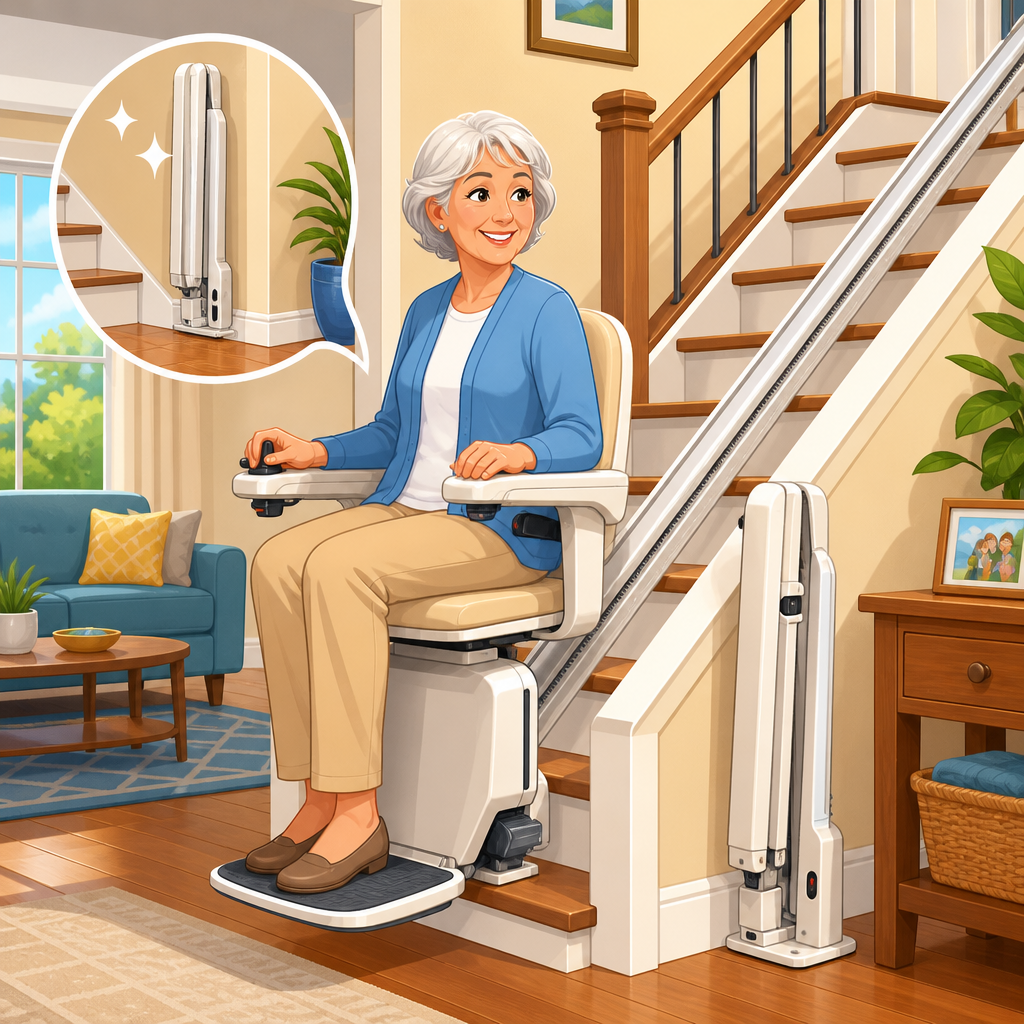
Premium stair lifts with powered folding rails sit at the top end of the mobility market because they solve a specific problem that standard models often cannot: they preserve doorway clearance or floor space at the bottom of the staircase without forcing the user to bend down and move the rail manually. A stair lift is a motorized chair that travels along a rail fixed to the stairs, while a powered folding rail is a hinged section near the lower landing that automatically lifts out of the way when the lift is parked or sent upstairs. In luxury and premium models, that feature is usually paired with upgraded upholstery, smoother start-stop programming, powered swivel seats, slimmer carriages, and stronger safety systems. I have assessed stair lift quotations, rail drawings, and installation layouts for homes where a fixed lower rail would have blocked a hallway, crossed a door threshold, or created a clear trip hazard, and in those cases the folding rail was not cosmetic at all. It was the difference between a workable installation and a poor one.
That is why this question matters. Premium stair lifts with powered folding rails cost more than basic straight lifts, often by several thousand pounds or dollars once powered options, installation complexity, and service coverage are included. Buyers are not just paying for a chair that goes up and down; they are paying for convenience, safer circulation at the foot of the stairs, cleaner integration with the home, and less physical effort for the user or carer. For households planning to age in place, choosing the right rail configuration at the start can prevent expensive modifications later. This guide explains where powered folding rails make practical sense, how luxury and premium models differ from standard lifts, what tradeoffs to expect, and how to judge whether the premium is justified for your staircase, your mobility needs, and your long-term budget.
What a powered folding rail does and why premium buyers look for it
A powered folding rail is a motorized hinged section installed at the lower end of the stair lift track. When the lift is not using the lower section, the rail folds upward automatically, usually through a wall control, a call-send remote, or the lift’s own parking routine. When the chair is needed downstairs, the section lowers into position so the carriage can travel its full route. The main purpose is simple: it keeps the rail from protruding into a walkway. On many staircases, especially those that end near a doorway, radiator, hall cupboard, or circulation route, a fixed rail extension can become an everyday obstacle. In premium installations, the powered version removes the need for the user to get up, reach down, and fold the section by hand, which is crucial for people with arthritis, limited balance, or reduced grip strength.
In practice, buyers usually consider this feature for one of three reasons. First, the staircase ends directly in front of a door, and the rail would prevent the door from opening fully. Second, the stairs discharge into a narrow hall where children, visitors, or carers need unobstructed access. Third, the user wants the chair parked away from the lower level so the living space looks less clinical. Premium manufacturers design around these concerns because luxury buyers are often balancing mobility with aesthetics and property usability. Brands such as Stannah, Handicare, Access BDD, Acorn, and Bruno all offer upper-tier configurations or powered options in selected ranges, though availability varies by market and staircase type. The powered folding rail is most common on straight stair lifts, but some curved systems use comparable hinged or parking solutions depending on site conditions and engineering constraints.
How luxury and premium stair lifts differ from standard models
Premium stair lifts are not defined by price alone. The better ones combine engineering refinements that improve comfort, reliability, and usability over years of daily operation. In my experience, the biggest difference buyers notice first is ride quality. Higher-end units typically use more refined transmission tuning, smoother acceleration and deceleration profiles, and better seat ergonomics. The result is less jolting at start and stop, which matters for users with back pain, post-surgical sensitivity, or neurological conditions. Many also include powered swivel seats, powered footrests, larger arm pads, and easier one-touch controls. These are not minor conveniences; they reduce twisting, bending, and manual strain during the riskiest part of stair lift use, which is getting on and off safely.
Premium models also tend to offer a better fit for the home. Upholstery choices may include woven fabrics, wipe-clean vinyls, and more contemporary color options. Rail profiles are often slimmer, and carriage units are designed to look less industrial. Installation quality is another dividing line. Reputable premium suppliers measure carefully, produce route drawings, confirm parking positions, and explain charging points, overrun sections, and obstruction clearances before work begins. Basic offerings can still be safe and effective, but they may provide fewer customization options and less flexibility when a hallway is tight. If your staircase layout is straightforward and the lower rail does not interfere with movement, the leap to a premium model may feel modest. If access is awkward, every powered feature becomes more valuable.
When a powered folding rail is truly worth the extra cost
The strongest case for a powered folding rail is environmental, not aspirational. If the bottom of the rail would create a regular obstruction, the upgrade solves a daily problem. I have seen layouts where a fixed lower overrun extended across the approach to a front door; every delivery, visitor, and emergency exit route had to work around it. In that scenario, paying more for automation is sensible because the feature protects circulation every single day. It can also be worth the money when the user cannot safely operate a manual hinge. Someone with rheumatoid arthritis, shoulder pain, Parkinsonian tremor, or poor balance may find a manual folding section impractical. Asking that person to handle the rail defeats the point of buying mobility equipment.
It is also worth considering if the lift will be used multiple times a day by one person living alone. Convenience becomes a safety factor when there is no helper available. Automatic folding reduces the number of steps in the transfer routine: call the chair, sit down, fasten the belt if fitted, and travel. For buyers preserving a higher-end home, a powered folding rail can support resale presentation too, because the staircase and hallway remain easier to navigate and visually cleaner when the lift is parked. That said, it is not universally necessary. If the staircase opens into a large hall and a fixed rail would not block anything, the money may be better spent on a powered swivel, heavier-duty seat, service plan, or battery-backed emergency lowering system.
Costs, maintenance, and the tradeoffs buyers should expect
Premium stair lifts with powered folding rails typically cost more because you are adding both a specialized rail assembly and another motorized component that must be integrated with the lift’s controls and safety circuits. Exact pricing depends on country, staircase shape, brand, weight capacity, upholstery package, and installation complexity, but straight premium lifts with powered options commonly sit well above entry-level models. Curved systems can rise dramatically because each rail is custom manufactured. Beyond purchase price, buyers should budget for preventive service, replacement batteries every few years in many models, and possible repairs to switches, hinges, or drive components over time. A powered folding rail is generally reliable when installed well, but it does introduce another moving part that manual rails do not have.
The tradeoff is therefore straightforward: higher convenience and better spatial usability in exchange for higher upfront cost and slightly greater mechanical complexity. Good suppliers manage that complexity through proper setup and support. Ask whether the rail folds under battery power during a mains outage, what happens if the hinge detects an obstruction, how the lift behaves if the folding section fails to reach its locked travel position, and whether the warranty covers the powered hinge motor. Reputable systems include interlocks that prevent movement unless the rail is correctly deployed. Standards and certification matter here. In many markets, stair lifts are built and installed with reference to recognized machinery, accessibility, and electrical safety requirements, and established brands usually document their compliance clearly. The premium price is easiest to justify when the supplier can explain the engineering, service intervals, and failure safeguards in plain terms.
Features that matter most in luxury and premium models
Not every premium feature delivers equal value. Buyers should prioritize the elements that materially improve safety and independence. The most useful upgrades are usually a powered folding rail, powered swivel seat, powered footrest, easy-grip controls, and a seat shape that supports secure transfers. Obstruction sensors on the footrest and carriage are standard on many good lifts and should not be treated as optional luxury. Battery operation is also essential because most modern stair lifts charge from the mains but run from onboard batteries, allowing several trips during a power cut. Better premium models pair that with soft start-stop programming and diagnostic displays that make servicing easier.
| Feature | Main benefit | Best for | Potential drawback |
|---|---|---|---|
| Powered folding rail | Keeps lower hallway or doorway clear automatically | Tight landings, door conflicts, solo users | Higher cost, more moving parts |
| Powered swivel seat | Reduces twisting when getting off at the top | Users with back, hip, or balance issues | Adds price and service complexity |
| Powered footrest | Avoids bending to fold footplate | Arthritis, limited reach, carers seeking easier use | More electrical components |
| Heavy-duty seat platform | Higher weight capacity and broader seating area | Larger users needing stable transfers | May need more staircase width |
| Premium upholstery and slim rail design | Better comfort and less intrusive appearance | Design-conscious households | Cosmetic gains can be overpriced |
In real homes, combinations matter. A user with knee pain may gain more from a powered swivel and higher seat perch than from upgraded upholstery. A narrow hall may make the powered folding rail non-negotiable, while a wider staircase may benefit more from a larger seat and twin remote controls. Focus on outcomes, not brochures: safe boarding, smooth travel, simple controls, and clear floor space where people actually walk.
How to evaluate brands, installers, and home fit
The best premium stair lift is the one that fits the user and the staircase, not the one with the longest option list. Start with a detailed home assessment. The surveyor should measure staircase width, tread depth, lower landing clearance, door swing, radiator projection, handrail position, and parking locations. Ask them to show exactly where the rail ends when folded and unfolded. If they cannot provide a clear explanation or drawing, keep shopping. On site visits I always look for transfer safety first: where will the user stand, where will they hold, and is there enough room to turn without stepping backward near the stairs?
Then evaluate the supplier. Strong companies offer written quotations that break down the base model, powered options, warranty length, service terms, and expected installation timeline. They explain whether the lift fixes to stair treads rather than the wall, which is common and important for many homeowners. They should also discuss aftercare response times and parts availability. Ask who performs the installation, whether engineers are factory trained, and how emergency callouts are handled. Reviews can help, but they are no substitute for technical competence. The premium market should feel consultative, not pushy. If a salesperson dismisses questions about batteries, hinge interlocks, or service intervals, that is a warning sign. A properly specified lift will feel expensive but rational, because every added feature addresses a defined user need or architectural constraint.
Who should buy one, and who can skip the premium
Premium stair lifts with powered folding rails are worth it for buyers whose lower landing is constrained, whose mobility limitations make manual adjustments unsafe, or whose long-term plan is to remain in the home with minimal daily effort. They are especially well suited to older adults living alone, couples where one partner may not be able to assist, and households where a protruding rail would interfere with a main route through the home. They also make sense in premium renovations where visual impact and seamless operation matter alongside accessibility. When chosen well, they remove friction from everyday routines and reduce the chance that the user will avoid the lift because it feels cumbersome.
They are less compelling for buyers with wide, open hallways and straightforward stairs where a standard fixed rail causes no obstruction. In those homes, a solid mid-range lift with a comfortable seat, reliable battery system, and good service backing may deliver better value. The key takeaway is that powered folding rails are not indulgent by default. They are a targeted solution to a real layout and usability problem. If your staircase geometry or physical condition creates that problem, the premium is often justified. If not, direct your budget toward the features that improve transfer safety and long-term reliability. Arrange in-home assessments from reputable stair lift specialists, compare drawings and service terms carefully, and buy the model that fits the way your home actually works.
Frequently Asked Questions
What is a powered folding rail on a premium stair lift, and how does it work?
A powered folding rail is a motorized hinged section at the bottom of a stair lift track that automatically raises and lowers as the lift is used. On a standard stair lift, the rail often extends beyond the last step and into the hallway or landing area so the chair can park safely. That extension can create a practical problem if it blocks a doorway, narrows a walkway, or becomes an obstacle in a small entrance area. A powered folding rail is designed specifically to solve that issue.
When the stair lift is sent up the stairs or parked away, the hinged rail section folds upward automatically, clearing the space at the bottom of the staircase. When the lift is needed, the rail lowers into position so the chair can travel normally. The main advantage is convenience: the user does not have to bend down, unlock anything, or physically move the rail by hand. For people with limited balance, arthritis, back pain, or reduced mobility, that automatic movement is often far more than a luxury feature. It can be the difference between a stair lift that is easy to use every day and one that becomes frustrating.
In premium models, the folding action is usually integrated into the lift’s controls and safety system, so the rail moves in a controlled, deliberate way. If there is an obstruction, many systems are designed to stop rather than force movement. That combination of automation, safety, and space-saving design is exactly why powered folding rails are considered a top-end feature in the stair lift market.
Are premium stair lifts with powered folding rails actually worth the extra cost?
For many households, yes, but the value depends heavily on the layout of the home and the needs of the person using the lift. These models cost more because they include added engineering, motorized components, and more complex installation requirements than a basic stair lift. If your staircase opens directly onto a doorway, a narrow hall, or a frequently used living space, that added cost can be very easy to justify. In those situations, a standard fixed rail may create a trip hazard, interfere with door swing, or make the entrance area feel cramped. A powered folding rail eliminates that daily inconvenience while also preserving safer access around the bottom landing.
The other major reason they can be worth the premium is ease of use. A manual hinged rail does solve the same space problem in principle, but it requires somebody to physically lift or lower the section. That may sound minor, yet for many stair lift users it is not realistic. If someone has limited reach, pain, weakness, poor balance, or simply wants to remain fully independent, the automatic operation becomes a meaningful quality-of-life upgrade. It reduces physical effort and removes one more barrier from the routine of using the stairs safely.
That said, they are not automatically the best choice for every buyer. If the bottom rail does not obstruct anything important, or if the staircase has plenty of open landing space, a standard rail may deliver excellent value at a lower price. The best way to judge whether the upgrade is worth it is to ask a simple practical question: does the lower rail create a real access problem in your home? If the answer is yes, then a powered folding rail is often worth the extra investment because it addresses a specific issue that cheaper models do not solve nearly as well.
Who benefits most from a stair lift with a powered folding rail?
The people who benefit most are those whose staircase ends in a space where every inch matters. Common examples include homes where the bottom of the stairs meets a hallway, opens across a front or back door, or leads into a tight landing that is used often by other family members. In these cases, a conventional rail extension can be intrusive, and a powered folding rail helps keep the area clear when the lift is not in use.
It is also especially useful for users who cannot comfortably manage a manual hinge. Someone living with arthritis, shoulder limitations, chronic pain, neurological conditions, or reduced flexibility may find it difficult or unsafe to lean down and move part of the track. Even if a caregiver is present sometimes, many buyers choose a powered folding rail because they want the stair lift to support true independent use rather than rely on help for setup every time.
Another group that often benefits is households trying to balance accessibility with shared living space. If multiple people use the staircase area, or if there are children, visitors, or pets moving around the lower landing, reducing floor-level obstructions can improve convenience for everyone. In premium homes or long-term aging-in-place plans, buyers also tend to appreciate the cleaner appearance and more refined operation of a powered system. In short, the feature delivers the most value when the user needs convenience and the home layout demands better space management.
Are powered folding rails reliable and safe, or do they add more maintenance concerns?
When supplied by a reputable manufacturer and installed properly, powered folding rails are generally reliable and designed with safety in mind. They are not an improvised add-on; they are engineered components of the stair lift system. Premium stair lifts typically include multiple safety features such as obstruction sensors, seat and footrest interlocks, controlled start-and-stop movement, and battery backup for operation during a power cut. The folding rail itself is usually integrated into those safety systems so it only moves under the right conditions and stops if something gets in the way.
Because a powered folding rail includes an extra motorized mechanism, it is fair to say that it introduces more complexity than a fixed rail. More moving parts can mean more points that need adjustment, inspection, or occasional servicing over time. However, that does not mean these systems are problematic by default. In practice, long-term reliability depends more on product quality, correct installation, routine servicing, and how heavily the lift is used. A well-made premium unit from an established supplier is usually built specifically for daily use in domestic environments.
Homeowners should still think in terms of maintenance expectations. Ask whether annual servicing is recommended, what the warranty covers, how quickly engineers can respond to faults, and whether replacement parts are readily available. These are smart questions for any stair lift purchase, but they matter even more with advanced features. The bottom line is that a powered folding rail is considered safe and dependable when chosen carefully, but it should be treated as a precision mobility product rather than a simple mechanical accessory.
What should you consider before buying a premium stair lift with a powered folding rail?
Start with the home layout, because that is the main reason this feature exists. Look closely at the bottom of the staircase and ask what the rail would interfere with if it remained fixed in place. Does it block a door? Narrow the hallway? Create a trip point in a busy area? If the answer is yes, a powered folding rail moves from being a nice extra to a highly practical solution. A professional home assessment is important because installers can measure exactly how much clearance is needed and explain whether a folding section is necessary.
Next, consider the user’s physical abilities now and in the future. If there is any difficulty with bending, reaching, balance, or grip strength, an automatic folding mechanism may be far more appropriate than a manual hinge. This is especially relevant for buyers planning ahead for aging in place. It is often better to choose a system that will remain easy to use for years rather than one that feels acceptable only under current circumstances.
You should also compare total ownership factors, not just the headline purchase price. Ask about installation time, warranty terms, servicing plans, battery performance, call-out support, and what happens if the folding mechanism needs adjustment later on. It is wise to choose a supplier with a strong local service reputation rather than focusing only on the lowest quote. Finally, think about everyday living: how often the lift will be used, who else shares the space, and whether preserving a clear lower landing will reduce stress in the home. When all of those factors point in the same direction, a premium stair lift with a powered folding rail is often a very sensible investment rather than an unnecessary upgrade.





