Smart devices that help caregivers monitor lift use are becoming essential in modern care settings because they turn routine transfers into measurable, safer, and more accountable processes. In this context, a lift is a mechanical patient transfer device, such as a ceiling lift, mobile floor lift, sit-to-stand lift, or bath lift, used to move someone with limited mobility between bed, chair, toilet, or bathing area. Monitoring lift use means tracking how, when, and whether those devices are used correctly, including transfer frequency, sling selection, battery health, maintenance status, and sometimes caregiver technique. I have seen facilities reduce avoidable strain injuries and missed transfers simply by moving from paper logs to connected systems that show real activity in real time. That matters because manual lifting remains a major cause of musculoskeletal injury among caregivers, while unsafe transfers expose patients to falls, skin injury, and loss of dignity. Smart monitoring does not replace training or judgment, but it gives caregivers and managers evidence they can act on. As a hub within caregiver support resources, this guide explains the devices, the data they capture, the standards that shape safe use, and the practical decisions families, home care agencies, and long-term care communities need to make.
Caregiver support resources include the tools, services, training materials, and operational systems that help both family and professional caregivers deliver safe, sustainable care. Lift monitoring belongs in that category because it supports the caregiver as much as the person being transferred. When teams can confirm that a transfer occurred on schedule, that the correct sling was attached, or that a battery is nearing failure, they prevent crises before they happen. Smart devices also create a record that supports care planning, staffing decisions, maintenance scheduling, and incident review. For home caregivers, the value is often peace of mind and simpler communication with clinicians or siblings. For providers, the value is risk reduction, compliance support, and workflow visibility across many rooms and shifts. The broader accessibility and mobility solutions field often focuses on equipment selection, but the support layer around that equipment is what determines whether mobility technology truly improves daily life. Understanding smart lift monitoring is therefore not a narrow equipment issue; it is a practical care management topic with direct consequences for safety, labor efficiency, and quality of care.
What smart lift monitoring devices are and how they work
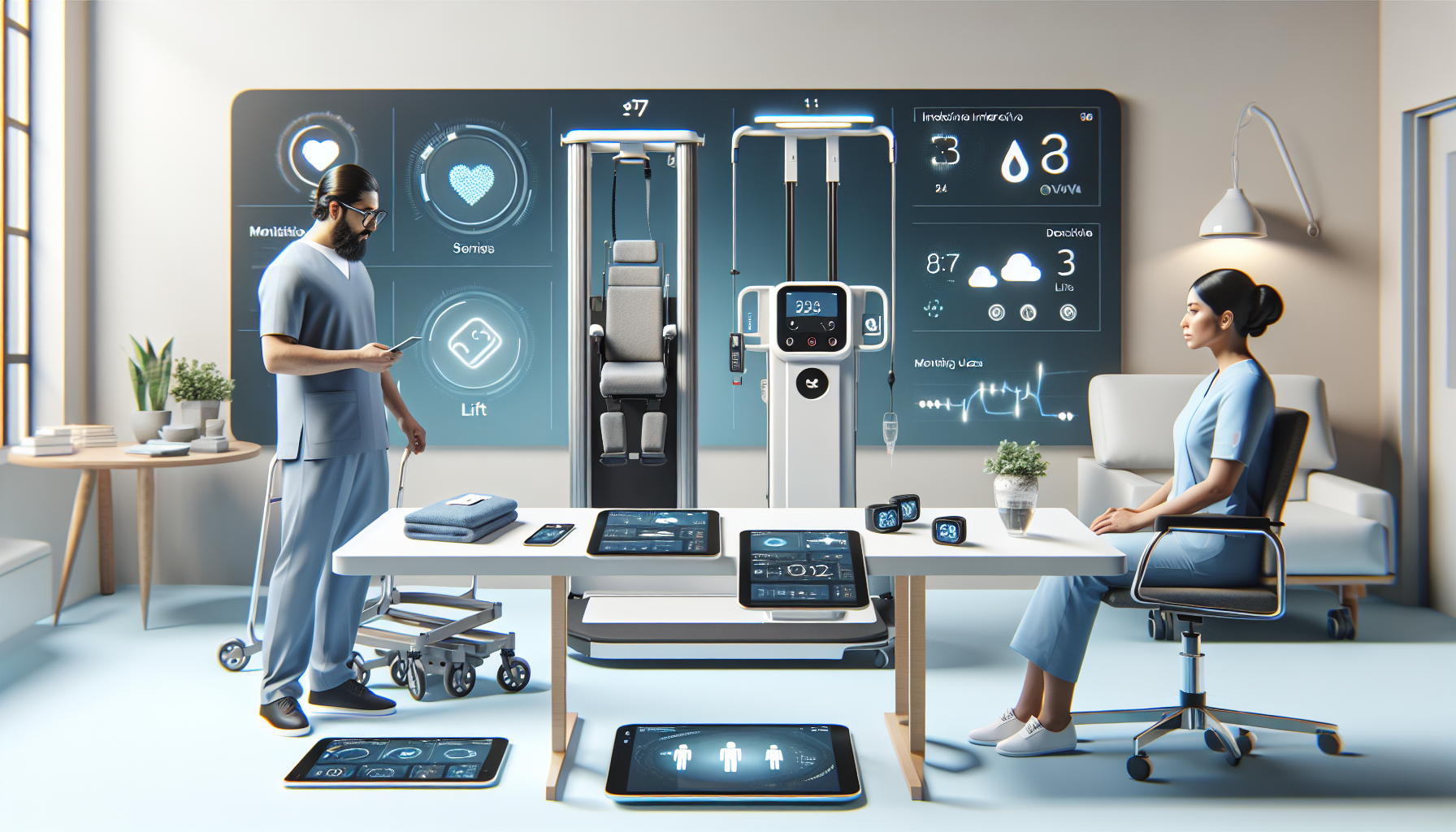
Smart lift monitoring devices combine sensors, connectivity, and software to record lift activity and present it in a usable format. The most common setups include onboard electronics built into a lift motor, add-on sensor modules attached to older lifts, sling identification tags using RFID or NFC, mobile apps for caregivers, and dashboards for supervisors or family members. A connected ceiling lift might log each transfer, time stamp the event, measure load, and report battery or charging status to a central platform. A floor lift may use a telematics module to send maintenance alerts and utilization data over Wi-Fi or cellular service. In home care, simpler products often focus on reminders, usage confirmation, and battery notifications rather than enterprise analytics.
The underlying logic is straightforward. Sensors detect movement, weight, spreader bar position, or attachment points. Software interprets those signals as a transfer event or a possible misuse event. A user interface then turns raw device data into actionable information, such as “lift used at 7:42 a.m. for bed-to-chair transfer” or “battery below safe threshold.” Better systems also allow notes, care-plan matching, and alert thresholds. This is especially useful when multiple caregivers rotate through a case, because the device creates continuity that memory and handwritten notes often cannot. The goal is not surveillance for its own sake. The goal is safer transfers, less guesswork, and a reliable record that supports care.
Why caregivers need visibility into lift use
Caregivers need visibility because transfers are high-risk, high-frequency tasks that are easy to underdocument. In many care environments, the lift itself is present, but no one has a dependable way to confirm whether it is being used consistently or correctly. I have seen situations where a resident’s care plan specified a full-body sling transfer with two trained staff, yet rushed shifts defaulted to manual repositioning because the sling was misplaced or the battery was low. Smart monitoring exposes those patterns quickly. If usage drops below expected levels, leaders can investigate whether the issue is staffing, workflow, equipment location, training gaps, or resident refusal.
Visibility also protects caregivers physically. According to long-standing occupational safety guidance, patient handling is a major source of back, shoulder, and overexertion injuries. A connected lift program can show whether safe patient handling equipment is actually being used enough to reduce that risk. It also supports root-cause review after an incident. If a transfer fails, the data may reveal whether maintenance was overdue, the battery was depleted, the wrong sling size was selected, or the resident’s care needs had changed. That is why lift monitoring belongs in the same conversation as staffing plans, transfer training, and home safety assessments. It creates an operational feedback loop around one of the most physically demanding parts of caregiving.
Key features that matter most in smart lift devices
Not every smart device adds meaningful value. The strongest systems focus on a few features that solve real caregiver problems. Event logging is the foundation, because it confirms when transfers happen and how often. Battery and charging alerts are next, since a dead lift can derail care at exactly the wrong moment. Maintenance tracking is equally important; preventive service based on usage hours is often more reliable than waiting for a visible failure. Sling verification can be a major safety gain when residents require a specific sling style, loop configuration, or weight capacity. Audit trails, caregiver prompts, and simple mobile notifications also help.
Ease of use matters as much as technical capability. If caregivers need six taps to document a transfer, adoption will suffer. The best products reduce administrative work rather than adding to it. Integration matters too. A platform that exports reports, sends alerts to existing communication tools, or connects with electronic health records is more useful than an isolated dashboard. In practice, I advise buyers to ask one question repeatedly: what decision will this feature improve? If a metric cannot guide training, maintenance, scheduling, care planning, or family communication, it is probably noise. Smart lift monitoring should clarify work, not drown caregivers in data.
| Feature | What it tracks | Why it matters for caregivers | Best fit setting |
|---|---|---|---|
| Transfer event logging | Date, time, duration, sometimes load | Confirms scheduled transfers happened and highlights missed routines | Home care, assisted living, skilled nursing |
| Battery and charging alerts | Charge level, charging cycles, low-power warnings | Prevents failed transfers caused by depleted batteries | Mobile lifts, mixed-shift environments |
| Maintenance monitoring | Usage hours, fault codes, service intervals | Supports preventive maintenance and reduces downtime | Facilities with multiple lifts |
| Sling identification | Sling type, size, compatibility | Reduces wrong-sling use and supports resident-specific care plans | Complex care and bariatric programs |
| Caregiver notifications | Prompts, overdue tasks, exception alerts | Improves coordination across family members and shift staff | Home care and agency care |
Real-world use across home care, hospitals, and senior living
The same core technology solves different problems in different settings. In private homes, smart lift devices are often used by family caregivers who need reassurance that routines are being followed when a paid aide is present. A daughter managing care remotely may want alerts confirming morning and evening transfers, plus battery reminders before a weekend. In that setting, simplicity and privacy controls matter more than deep analytics. The best solution may be a lift with a straightforward app and shared notifications rather than a large enterprise platform.
Hospitals and rehabilitation units use lift monitoring differently. Their focus is often on safe patient handling compliance, staff injury reduction, and equipment availability. Utilization reports can reveal that one unit has excellent lift adoption while another keeps lifts parked in hallways and continues manual boosting. That insight supports targeted retraining and better equipment placement. Senior living and skilled nursing facilities often use monitoring for recurring care-plan transfers, maintenance scheduling, and quality improvement. Because residents may transfer several times daily, even small inefficiencies scale quickly. A reliable dashboard helps managers identify bottlenecks, verify service completion, and justify investment in additional equipment or sling inventory.
How smart lift data supports caregiver support resources
As a hub for caregiver support resources, this topic connects directly to training, respite planning, care coordination, and documentation tools. Lift monitoring data strengthens each of those areas. For training, actual usage patterns show where caregivers need coaching. If one team rarely uses a sit-to-stand lift despite appropriate resident profiles, there may be uncertainty about sling placement or transfer sequencing. For respite and backup coverage, a monitored system gives substitute caregivers a clearer picture of established routines. For care coordination, transfer data can be shared with therapists, nurses, or case managers to adjust mobility goals and support schedules.
It also improves family communication. One of the most common sources of conflict in caregiving is uncertainty about what happened during the day. Objective transfer records reduce arguments and help families focus on care quality rather than assumptions. In professional settings, the data complements incident reports and maintenance records. It can also guide purchasing. If reports show chronic competition for a single mobile lift during morning care, the answer may not be faster staff but another appropriately specified device. In short, monitored lift use becomes a practical backbone for broader caregiver support systems, especially when paired with clear policies and regular review.
Safety, standards, privacy, and limitations
Smart monitoring is useful only when built on sound lift safety practice. Equipment should align with manufacturer instructions, resident assessment, and recognized safe patient handling principles. In the United States, caregivers often look to OSHA guidance on patient handling and to professional standards from rehabilitation and nursing organizations. Electrical safety, weight capacity, sling compatibility, charging procedures, and scheduled inspections are nonnegotiable. Monitoring can flag missed maintenance, but it cannot make an incompatible sling safe or compensate for poor transfer technique. Training remains essential, including emergency lowering procedures and what to do if a resident becomes distressed mid-transfer.
Privacy deserves equal attention. Some systems collect only equipment telemetry, while others connect caregiver identities, room locations, and timestamps. Families and providers should know exactly what data is stored, who can view it, how long it is retained, and whether vendors encrypt data in transit and at rest. In regulated care environments, policies must address consent, access control, and documentation. There are also limitations to the data itself. A logged transfer does not always prove perfect technique, patient comfort, or clinical appropriateness. Sensors can miss context. That is why the strongest programs combine smart device data with hands-on supervision, competency checks, and resident feedback. Technology should support professional judgment, not overshadow it.
How to choose the right system and build a workable program
Start with the transfer problem, not the gadget. List who is being transferred, how often, by whom, with what type of lift, and what failures currently cause stress or risk. Then match the technology to that reality. A family caregiver may only need low-battery alerts and simple transfer confirmations. A multi-site senior care operator may need fleet visibility, service records, and utilization analytics by unit. Ask vendors whether their system supports your lift models, whether data can be exported, how alerts are delivered, and what happens during internet outages. Request a live demonstration using realistic transfer scenarios.
Implementation should be treated like a care process change, not just an equipment purchase. Define who reviews alerts, who updates resident transfer profiles, who schedules maintenance, and how staff are trained. Pilot on a small group first, then compare outcomes such as missed transfers, battery failures, injury reports, and time spent documenting. Build clear expectations for response times and escalation paths. Finally, review data regularly enough to act on it. A dashboard no one checks is just decoration. Smart devices that help caregivers monitor lift use deliver the most value when they are tied to specific routines, accountable owners, and continuous improvement. If you are building out caregiver support resources, make lift monitoring part of that plan and choose a system that caregivers will actually use every day.
Frequently Asked Questions
What does it mean to monitor lift use with smart devices?
Monitoring lift use with smart devices means using connected technology to document and review how a mechanical patient lift is being used during everyday care. Instead of relying only on handwritten notes or memory, smart systems can capture details such as when a ceiling lift, mobile floor lift, sit-to-stand lift, or bath lift was used, how often transfers took place, and in some cases whether important steps were completed properly. Depending on the setup, the system may log time stamps, usage duration, battery status, weight-related data, sling identification, maintenance alerts, or even whether staff followed a required transfer workflow.
For caregivers, this turns lift use into something measurable rather than assumed. That matters because safe transfers are a critical part of protecting both the person receiving care and the staff member assisting them. If a resident is supposed to be transferred with a lift every time, but usage records show inconsistent activity, the care team can spot a gap early. If a particular lift is being used far more often than others, managers can identify workflow bottlenecks, staffing issues, or equipment shortages. In short, smart monitoring adds visibility, accountability, and insight to a task that has traditionally been difficult to track accurately.
How do smart lift monitoring devices improve safety for patients and caregivers?
Smart lift monitoring devices improve safety by helping care teams verify that proper transfer practices are actually being followed. In many care settings, transfer safety depends on consistency: using the right lift for the right person, making sure the lift is available and functional, checking sling compatibility, and confirming that transfers happen when needed. Smart devices support this process by creating a digital record of lift activity and surfacing issues that might otherwise go unnoticed. For example, alerts can notify staff when a battery is low, when a lift needs inspection, or when usage patterns suggest a lift may not be available where it is needed most.
These systems also support injury prevention. Manual transfers or inconsistent lift use can increase the risk of falls, skin injury, discomfort, and staff strain. By making lift usage easier to verify, smart monitoring encourages adherence to care plans and safe-handling policies. It can also provide a useful review trail after an incident. If a fall, near miss, or complaint occurs, supervisors may be able to examine whether the lift was used, whether maintenance was current, and whether staff had access to the appropriate equipment at the time. This kind of data-backed review helps organizations improve training, reduce repeat safety issues, and strengthen overall care quality.
What types of data can caregivers and care organizations track with smart lift technology?
Smart lift technology can track a wide range of operational and care-related data, although the exact features vary by manufacturer and system design. Common data points include the date and time of each lift use, the type of transfer performed, how long the transfer took, battery charge levels, service intervals, and whether the device is approaching a maintenance threshold. Some advanced systems may also link lift activity to a specific room, resident, sling, or caregiver badge, creating a more complete picture of how transfers happen across a facility or home care program.
This information can be valuable at several levels. At the bedside, caregivers may benefit from clear confirmation that a transfer was completed and that the equipment is ready for the next use. At the supervisory level, teams can evaluate patterns such as missed transfers, overused devices, peak usage times, and equipment downtime. At the organizational level, administrators can use aggregated data to support compliance efforts, justify equipment purchases, improve staffing plans, and identify whether mobility support policies are realistic in day-to-day practice. The strongest systems do not just collect data for its own sake; they turn it into practical insight that helps improve safety, workflow, and accountability.
Are smart devices for monitoring lift use useful in home care as well as in facilities?
Yes, smart devices that monitor lift use can be highly useful in both home care and facility-based settings, although the benefits may look a little different in each environment. In a hospital, skilled nursing facility, rehabilitation center, or assisted living community, lift monitoring often supports staff coordination, policy compliance, maintenance planning, and quality improvement across many residents and many pieces of equipment. In home care, the focus is often more personal and immediate. Family caregivers and home health professionals may use smart monitoring to confirm that transfers are happening consistently, to detect when a device needs charging or servicing, and to reduce uncertainty for multiple caregivers sharing responsibilities.
Home settings can especially benefit from simple, reliable visibility. When several family members or visiting aides assist one person, it can be difficult to know whether a transfer has already occurred, whether the lift was used correctly, or whether equipment problems are developing. A smart monitoring system can provide reassurance and better coordination without requiring constant in-person supervision. It can also support communication with clinicians, equipment providers, or case managers if there are concerns about transfer frequency, mobility changes, or safety risks. The key is choosing a solution that fits the home environment, is easy to use, and does not create unnecessary complexity for caregivers who are already managing many responsibilities.
What should care providers look for when choosing a smart device to monitor lift use?
When choosing a smart device for monitoring lift use, care providers should focus first on compatibility and real-world usefulness. The system should work with the types of lifts already in use, whether those are ceiling lifts, mobile floor lifts, sit-to-stand lifts, or bath lifts. It should also fit the workflow of the setting. A feature-rich platform is not very helpful if staff find it difficult to operate or if it adds extra steps during a time-sensitive transfer. The best solutions capture information automatically whenever possible, present it clearly, and make alerts easy to understand and act on.
Providers should also pay close attention to reporting, maintenance support, privacy considerations, and scalability. Good reporting tools should help supervisors identify trends without requiring advanced technical skills. Maintenance features should make it easier to keep lifts inspection-ready and fully functional. If the system associates usage data with individual patients or caregivers, organizations need to make sure data handling aligns with their privacy and security standards. Finally, it is wise to consider long-term needs: Can the system expand across multiple units or locations? Does it integrate with existing care documentation or asset management tools? Is vendor support responsive? Choosing the right smart monitoring solution is not just about adding technology to a lift; it is about selecting a system that strengthens transfer safety, caregiver confidence, and operational oversight over time.