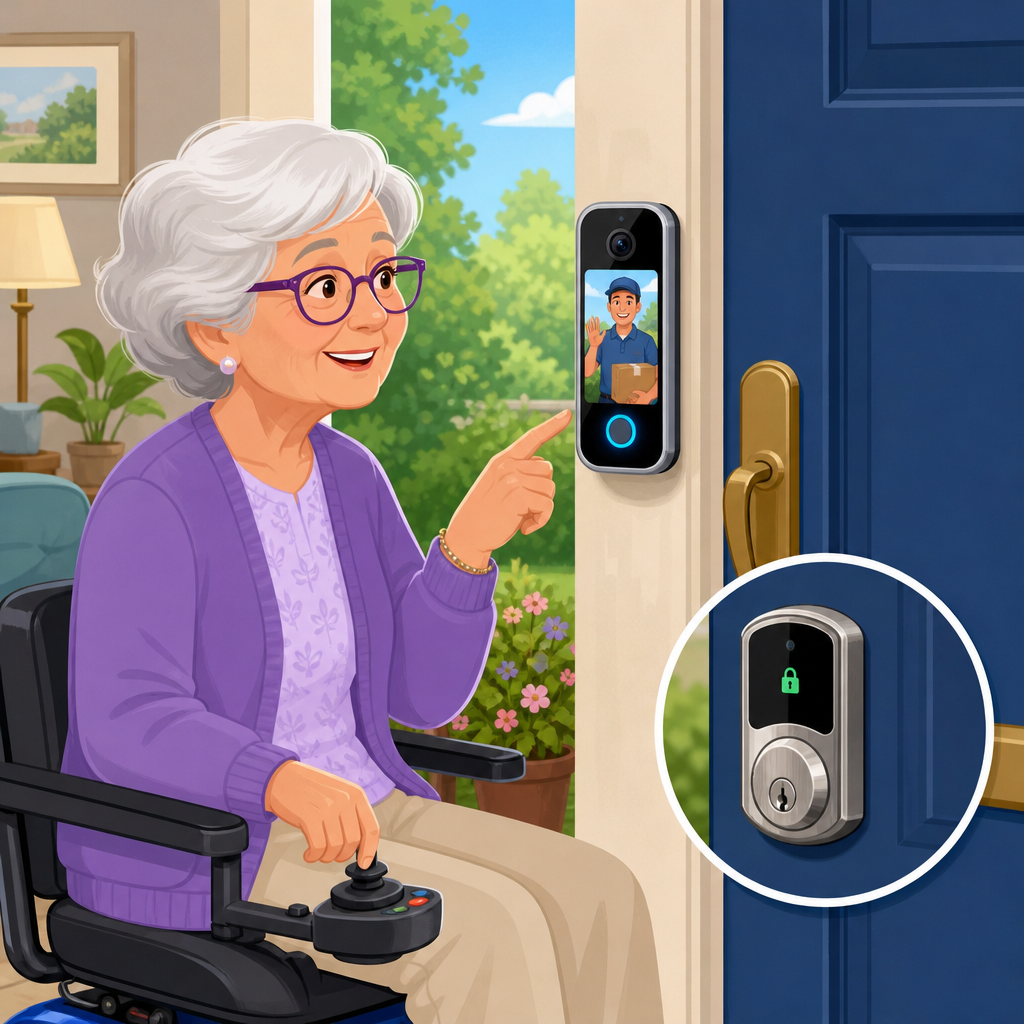
Smart doorbells and locks for seniors with limited mobility can turn a difficult daily task into a safer, simpler routine while helping families support independence without constant in-person supervision. In practical terms, a smart doorbell is a connected video or audio device that alerts a homeowner when someone approaches or presses the bell, and a smart lock is an electronic locking system that can be opened by keypad, smartphone, voice command, scheduled automation, or approved remote access. For older adults who use walkers, wheelchairs, canes, or lift chairs, the value is immediate: fewer rushed trips to the front door, less time standing, reduced fall risk, and more control over who enters the home. I have seen the difference these systems make in real households, especially when a senior is strong cognitively but slower physically. A package delivery, a home health aide arrival, or a grandchild stopping by no longer has to create stress. This topic matters because front-door access is a small moment repeated every day, and repeated friction wears people down. Thoughtful smart home integration removes that friction. As the central guide within accessibility and mobility solutions, this article explains the essential device types, setup decisions, accessibility features, privacy concerns, and integration strategies that make smart entry systems genuinely useful for aging in place.
Why smart entry systems matter for limited mobility
The first benefit is physical safety. Many falls happen during rushed transitions, and answering the door is a classic trigger. A senior may stand too quickly, walk without a mobility aid for “just a second,” or lean awkwardly to see through a peephole. A video doorbell replaces the peephole with a live view on a phone, tablet, smart display, or television. A smart lock replaces fine-motor key turning with easier options such as a large illuminated keypad, auto-unlock on approach, or remote release. These changes matter because limited mobility often overlaps with arthritis, reduced grip strength, low vision, hearing loss, and slower reaction time. Good systems are designed around all of those realities.
The second benefit is independence with oversight. Families often want to help without becoming intrusive. With shared access permissions, an adult child can confirm that a visiting nurse arrived, unlock the door for a grocery delivery, or receive a low-battery alert before the system fails. This supports aging in place while respecting autonomy. Brands such as Ring, Nest, Arlo, Eufy, Yale, Schlage, and August offer app-based sharing, event logs, and customizable notifications. The best setups let the senior remain the primary user while caregivers act as backup administrators. That balance is important: the goal is not surveillance for its own sake, but safer access control.
Core components of a smart home entry setup
A complete front-door system usually includes four layers: the doorbell camera, the lock, the viewing interface, and the automation platform. The doorbell camera captures motion events and two-way audio. The smart lock controls entry and records lock status. The viewing interface may be a smartphone, a mounted tablet near a favorite chair, an Amazon Echo Show, a Google Nest Hub, or an Apple device through HomeKit. The automation platform links everything so events trigger actions. For example, when the doorbell rings, the display can wake automatically, porch lights can turn on, and a caregiver can receive a secondary alert if the primary user does not respond.
In homes I have evaluated, the viewing interface is often the most overlooked element. A technically capable lock and camera are not enough if the senior cannot see or hear the alert where they actually spend time. A person with limited mobility may be in a recliner, bedroom, or kitchen for long stretches, so the interface should be placed there, not just on a mobile phone. Large-screen devices with adjustable brightness, high contrast, and loud speakers work better than relying on a small handset. This is why smart home integration is central to accessibility: the usefulness of each device depends on how well the whole system fits real habits.
Choosing the right smart doorbell
The best smart doorbell for a senior with limited mobility emphasizes clear alerts, easy viewing, strong audio, and dependable motion detection rather than flashy extras. Resolution matters, but not in isolation. A 1080p or 2K camera is usually sufficient if the field of view captures a person’s face and the doorstep clearly. More important are low-light performance, HDR for bright backlighting, and settings that reduce false alerts from passing cars or tree branches. Two-way audio should be loud and clean enough for someone with mild hearing loss to understand a visitor without opening the door. Pre-recorded quick responses can also help when speaking quickly is difficult.
Power source is a major decision. Wired doorbells are typically more reliable because they avoid battery charging, but they may require an existing compatible transformer, often 16 to 24 volts AC depending on the model. Battery doorbells are easier to install in apartments or older homes, yet recharging can become a burden unless a caregiver handles it. Cloud storage versus local storage also deserves attention. Cloud plans from Ring or Nest provide easy event review and richer notifications, while local-storage options from Eufy may appeal to users who prefer lower recurring costs. The right answer depends on budget, privacy preference, and who will manage updates.
Choosing the right smart lock
Smart locks for seniors should be judged first on ease of entry, then on security, then on convenience features. A lock that still requires painful twisting or tiny app controls misses the point. Look for large backlit keypads, motorized locking, auto-lock timers, and support for temporary access codes. Keypad codes are often easier than app-based unlocking for users who are not confident with smartphones. Models from Schlage Encode, Yale Assure Lock 2, and August Wi-Fi Smart Lock are common choices because they combine dependable hardware with broad platform support. ANSI/BHMA grading and built-in alarm features add useful context when comparing deadbolts.
Retrofit locks have a special place in accessibility projects because they keep the existing exterior key cylinder and familiar appearance. That can be ideal in condos, rentals, or households where changing keys would complicate caregiver access. Full replacement locks, however, usually provide a cleaner keypad experience and stronger integrated hardware. For users with severe hand weakness, pairing a lock with voice assistants can be transformative, but only when secure voice purchasing and unrelated permissions are disabled. I generally recommend creating named routines instead of broad unlock permissions. Security and accessibility are not opposing goals; well-designed permissions achieve both.
Integration features that make systems truly accessible
Smart home integration is what turns separate devices into a mobility solution. The most useful features are event-based automations, shared alerts, and multiple notification paths. If the doorbell rings, the system should notify the senior’s preferred screen, send a loud chime, and optionally text a caregiver after a delay. If the lock is left unlocked at night, it should announce the issue and relock automatically. If a trusted visitor unlocks the door with a code, the system can log the event and turn on hallway lights. These routines reduce the need for standing, walking, checking, and rechecking.
| Need | Recommended feature | Why it helps |
|---|---|---|
| Hard to reach the door quickly | Live video on smart display | Lets the user identify visitors from a chair or bed |
| Limited hand strength | Motorized smart lock with keypad | Avoids gripping and turning a physical key |
| Hearing loss | Visual alerts plus adjustable chime volume | Provides redundant notification paths |
| Caregiver coordination | Shared access codes and event logs | Confirms entry without constant calls or check-ins |
| Nighttime safety | Automation linking lock status to lights | Reduces falls during late arrivals or emergencies |
Platform compatibility matters here. Amazon Alexa, Google Home, Apple Home, Samsung SmartThings, and some proprietary ecosystems each handle automations differently. Apple Home is strong for privacy and simple scenes, Alexa is flexible for announcements and display devices, and SmartThings works well in mixed-device homes. Matter is improving interoperability, but support remains uneven, especially for cameras. Before buying, confirm exactly what works: live view, lock control, announcements, automation triggers, and user-role management. Marketing pages often imply broad compatibility when the actual function set is narrow.
Accessibility design details families often miss
Many installations fail because they focus on device specs instead of human factors. Mounting height is one example. A doorbell camera placed too high may capture only hats and foreheads, while a keypad mounted without considering wheelchair reach can be frustrating. The Americans with Disabilities Act offers useful design reference points for reach ranges, even in private homes that are not legally bound by ADA building rules. Visual ergonomics matter too. Seniors with cataracts or macular degeneration benefit from large text, simplified home screens, and high-contrast interfaces. On tablets, guided access or kiosk-style modes can prevent accidental app switching.
Audio design is equally important. Visitors should be heard clearly despite background television noise, hearing aids, or hearing loss in certain frequency ranges. In several homes, adding a secondary chime or smart speaker in the living room solved most missed-door events. Internet resilience is another overlooked factor. If Wi-Fi coverage at the front door is weak, video lag and failed lock commands will undermine trust quickly. A mesh Wi-Fi system, properly placed access point, or wired doorbell transformer upgrade often does more for usability than buying a more expensive camera. Reliability is an accessibility feature, not just a technical preference.
Privacy, security, and consent
Smart doorbells and locks collect sensitive data, so privacy should be handled explicitly. Video footage may capture neighbors, caregivers, and service workers, while lock logs reveal routines. Best practice includes strong unique passwords, multi-factor authentication, up-to-date firmware, and the minimum sharing permissions needed for each helper. Avoid giving every family member full administrative access. Instead, assign scheduled codes, viewer roles, or limited guest privileges where available. If an in-home aide or cleaner will use the system, explain what is recorded and when. Clear communication prevents misunderstandings and preserves dignity.
Security also has a physical layer. Electronic locks still depend on proper door alignment, strike plate strength, and frame condition. A premium smart lock on a weak jamb does not create meaningful protection. Standard upgrades such as 3-inch screws in the strike plate, reinforced door frames, and good exterior lighting remain essential. During power or internet outages, most smart locks continue basic keypad or Bluetooth functions, but remote control may stop. Families should plan for backup entry methods, battery replacement schedules, and mechanical key access where appropriate. The safest smart home is the one that keeps working under ordinary failure conditions.
Installation, training, and long-term maintenance
Installation quality determines whether these systems feel empowering or annoying. Start with a simple use-case map: who comes regularly, how the senior prefers to answer, what happens during deliveries, and who needs emergency access. Then choose one primary workflow and one backup workflow. For example, primary: doorbell rings on living-room display and senior speaks through the device. Backup: caregiver receives the same alert after thirty seconds and can unlock remotely for a known visitor. This kind of planning prevents over-automation and confusion.
Training should be hands-on and repetitive. I recommend printed one-page instructions with large text, labeled screenshots, and only the actions the user actually needs. Practice common scenarios: talking to a visitor, opening for a nurse, locking at bedtime, and checking whether the door is secure. Maintenance should be scheduled, not improvised. Review battery levels monthly, test two-way audio, verify caregiver permissions, and update firmware during low-risk hours. Families building a broader accessibility system should also connect this hub topic to related upgrades such as smart lighting, voice assistants, fall detection, medication reminders, and emergency response wearables. When smart entry is integrated thoughtfully, it protects mobility, supports privacy, and makes aging in place more realistic. Choose the simplest reliable setup, install it carefully, and test it with the people who will depend on it every day.
Frequently Asked Questions
How can smart doorbells and smart locks help seniors with limited mobility stay independent?
Smart doorbells and locks can make everyday home access much easier for seniors who have difficulty walking quickly, standing for long periods, using stairs, or reaching the front door in time. Instead of physically rushing to answer a knock or unlock a deadbolt, a senior can see who is outside through a connected video doorbell and communicate with that person using two-way audio. This can be especially helpful for someone who uses a walker, wheelchair, or cane, or for anyone managing arthritis, balance issues, fatigue, or chronic pain.
Smart locks add another layer of convenience by reducing or even eliminating the need to handle traditional keys. Depending on the model, the door can be opened with a keypad code, smartphone app, voice assistant, or a pre-programmed routine. For example, a senior may be able to unlock the door for a family member, home health aide, or delivery driver without getting up from a chair. Some systems also support scheduled access, which means trusted caregivers can enter during approved hours without the senior needing to respond each time.
Beyond convenience, these devices can support safer independent living. Seniors can confirm who is at the door before engaging, which helps reduce the risk of scams, unwanted solicitors, or opening the door to strangers. Family members can also gain peace of mind when paired access features are enabled, allowing them to check activity logs, receive alerts, or remotely assist when needed. The result is a more manageable daily routine that supports privacy, safety, and confidence at home.
What features should families look for when choosing a smart doorbell or lock for an older adult?
When shopping for smart doorbells and locks for seniors with limited mobility, ease of use should come first. The best device is not necessarily the one with the most features, but the one that fits the senior’s physical abilities, comfort level with technology, and day-to-day routine. Large, easy-to-read keypads, simple mobile apps, clear audio, and straightforward controls are all important. If vision is a concern, look for systems with high-contrast displays, zoom capability, motion alerts, and sharp video quality. If hearing is a concern, strong visual notifications and compatibility with smart displays or flashing alert systems may be useful.
Remote access is another major consideration. A smart lock that allows approved family members or caregivers to unlock the door remotely can be extremely helpful during emergencies or routine visits. Temporary or scheduled access codes are also valuable because they let service providers, aides, cleaners, or visiting relatives enter without the senior needing to manage keys. This reduces lockouts and avoids the stress of getting to the door quickly.
Families should also pay close attention to installation style and power source. Some smart locks replace the entire lock, while others retrofit over an existing deadbolt on the inside. For seniors who want to keep their current keys, retrofit options may feel less disruptive. Battery life matters as well, and it is best to choose devices with low-battery alerts and backup entry options. Reliability, strong customer support, and compatibility with existing smart home systems such as Alexa, Google Home, or other accessibility tools can make long-term use much smoother. In short, the ideal setup balances accessibility, security, and simplicity.
Are smart doorbells and locks safe and secure for seniors to use?
Yes, smart doorbells and locks can be very safe when they are chosen carefully and set up properly. In many cases, they improve home security because they give seniors more control over who approaches the home and who is allowed inside. A smart doorbell allows the homeowner to view visitors in real time and speak to them without opening the door. That alone can reduce risk for seniors who may otherwise feel pressured to answer unexpected visitors face to face.
Smart locks also help by limiting common problems associated with physical keys, such as lost keys, hidden spare keys, or copied keys that a homeowner may not know about. Families can create unique access codes for different people, remove codes when they are no longer needed, and monitor entry activity through app-based logs. This level of visibility can be particularly reassuring when multiple caregivers, adult children, or service providers are involved.
That said, security depends on proper setup. It is important to use strong passwords, enable two-factor authentication when available, keep firmware and apps updated, and purchase products from established brands with good security reputations. A strong Wi-Fi network and secure home router settings also matter. Families should make sure there is a backup plan in case of internet outages or low batteries, such as a physical key override or backup code. When these basic safeguards are in place, smart doorbells and locks can offer both convenience and meaningful protection for seniors aging in place.
Can caregivers and family members use smart locks and doorbells without taking away a senior’s privacy?
Absolutely. One of the biggest advantages of these devices is that they can support independence without requiring constant in-person supervision. The key is to set clear boundaries and choose features that provide help without feeling intrusive. For example, a family member might receive notifications only when a specific door is unlocked, when someone rings the bell, or when a scheduled caregiver arrives. That kind of limited visibility can be useful for safety while still respecting the senior’s daily life.
Smart locks are particularly helpful because they allow access to be managed in a precise, respectful way. Instead of giving out permanent keys to multiple people, families can assign individual codes and decide exactly when those codes work. A home aide may have access only during weekday care hours, while a nearby relative might have full-time emergency access. This structure can actually give seniors more control, not less, because they know who can enter and when.
Privacy also depends on communication. Seniors should be part of the decision-making process whenever possible, including where devices are placed, what notifications are shared, and who can access the app. For many households, the best arrangement is one where the senior remains the primary user, while trusted family members are added as backup support. That approach preserves dignity and autonomy while still making it easier for loved ones to step in when mobility limitations create real challenges.
What should families know about installation, maintenance, and everyday use before buying a system?
Before buying a smart doorbell or lock, families should think through how the system will work in real life, not just how it looks on a product page. Installation can range from simple to moderately technical depending on the device. Some smart doorbells are battery-powered and easier to mount, while others connect to existing doorbell wiring. Smart locks may require measuring the current deadbolt setup, checking door thickness, and confirming the lock is compatible with the home’s hardware. If the senior lives alone or in a rental property, professional installation may be worth considering to ensure reliable operation.
Internet strength at the front door is another practical issue that is often overlooked. A video doorbell or app-connected lock will only perform well if the home’s Wi-Fi reaches that area consistently. Families may need to add a Wi-Fi extender or choose devices with strong wireless performance. Power and battery maintenance are also important. Most smart locks and many doorbells rely on batteries, so it is wise to choose models with long battery life, low-battery alerts, and easy replacement procedures. Families should also confirm whether the lock has a manual key option or emergency power backup.
For everyday use, simplicity matters most. The system should fit naturally into the senior’s routine. That may mean using a keypad instead of a smartphone, voice control instead of manual unlocking, or automatic locking instead of remembering to secure the door each night. Once installed, it helps to spend time training the senior and any caregivers on exactly how the system works, including what to do if the internet goes down or a code is forgotten. When setup, support, and ease of use are handled well, smart doorbells and locks can become a dependable part of a safer, more accessible home.