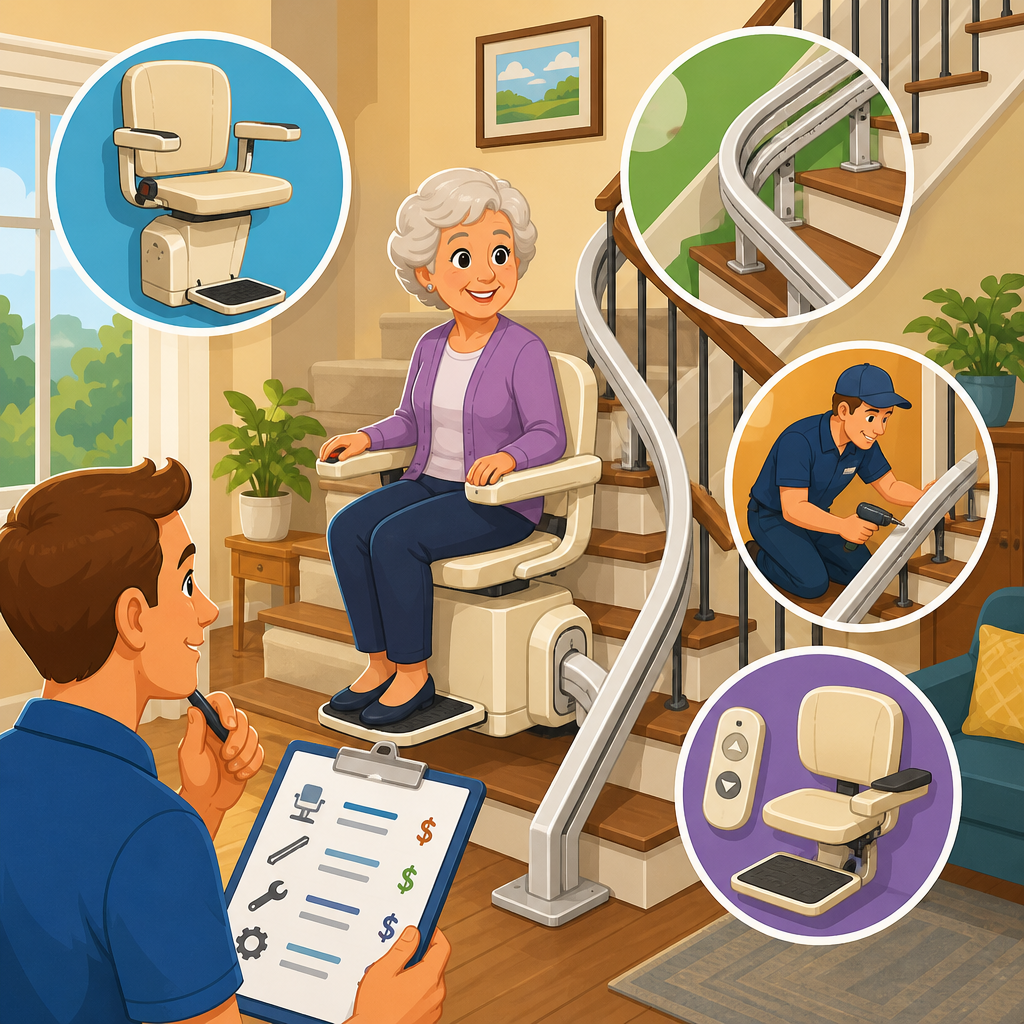
Stair lift quotes can look deceptively simple, yet the final number reflects several separate cost drivers: the chair lift itself, the rail that carries it, the installation labor, and any add-on features required for safety or convenience. When homeowners ask, “How much do chair lifts cost?” the most accurate answer is that a basic straight stair lift often starts around $2,500 to $5,500 installed, while curved stair lifts commonly range from $10,000 to $20,000 or more because they require a custom rail. In projects I have reviewed with dealers and mobility contractors, the quote almost always becomes clearer once each line item is separated and tied to the staircase design, user needs, and home conditions.
A stair lift is a powered chair that travels along a rail mounted to the stair treads, helping a person move between floors without climbing steps. The equipment package usually includes the motor, transmission, seat, armrests, footrest, safety sensors, battery system, and call-send controls. The rail is the track fixed to the stairs, not the wall, and it may be straight, curved, hinged, or extended at the top or bottom landing. Installation covers measuring, delivery, mounting, testing, and user instruction. Add-on costs can include powered swivel seats, folding rails, upgraded upholstery, heavy-duty capacity, service plans, and electrical work. Understanding these categories matters because two quotes with the same total price can represent very different products, warranties, and long-term value.
This topic sits at the center of any cost and financing discussion because the quote shapes every later decision: whether to buy new or used, rent temporarily, finance monthly, or pursue veterans’ benefits, Medicaid waiver support, or state assistive technology programs. It also helps families compare a stair lift against alternatives such as first-floor living modifications, residential elevators, ramps, or moving to a single-level home. A well-built stair lift can preserve independence and reduce fall risk, but only if the model matches the user’s mobility, body size, transfer ability, and staircase geometry. That is why this guide breaks down chair lift costs comprehensively and explains what should be included before you sign a contract.
What a Stair Lift Quote Actually Includes
A proper stair lift quote should identify four core components: equipment, rail, installation, and optional upgrades. If a proposal lists only one lump-sum price, ask for an itemized version. Itemization makes it easier to compare brands such as Bruno, Harmar, Stannah, Savaria, Access BDD, and Handicare, because each dealer may package options differently. One company may include two remote controls, a folding footrest, and a longer labor warranty in the base price, while another bills each item separately. Without line-by-line detail, the lower quote is not always the better value.
Measurements are critical. For a straight stair lift, the dealer typically measures from the upper landing down the stair nosings to the lower landing. For a curved stair lift, a technician creates a detailed survey that captures turns, intermediate landings, parking positions, and any obstructions such as radiators, door swings, trim, or narrow hallways. In my experience, many pricing surprises happen because the first phone estimate assumed a standard staircase, but the site visit revealed a hinge rail was needed to prevent the track from blocking a doorway. A serious quote should follow an in-home assessment, not just a rough phone conversation.
Buyers should also verify what is excluded. Common exclusions include permit fees where applicable, moving furniture, carpentry to reinforce damaged treads, electrical outlet installation near the charger point, and post-warranty service. Some dealers include the first service visit during the labor warranty period; others charge trip fees even for minor adjustments. Ask specifically whether the quote covers delivery, tax, disposal of packaging, training for caregivers, and removal of an existing unit if you are replacing one. These details affect the real out-of-pocket cost.
Equipment Costs: What You Pay For in the Chair Lift Itself
The equipment portion of the quote is the chair lift unit that rides the rail. For a straight model, the base equipment cost often falls between $2,000 and $4,000 before installation, depending on seat design, weight capacity, ride quality, battery capacity, and brand positioning. Most modern units are battery powered and charge at stations on the rail, which allows operation during a power outage. That battery backup is now standard on quality lifts and should not be treated as a premium feature. If a quote relies on an older non-battery design, consider that a drawback, not a savings.
Heavy-duty equipment raises cost because it uses a larger chassis, wider seat, reinforced transmission, and stronger motor. These models may support 350 to 600 pounds depending on the manufacturer, but buyers should read the rated capacity carefully because capacity can be tied to seat width, track angle, or user positioning. Some heavy-duty models also require a wider staircase to maintain safe clearance. In practical terms, this means a standard unit that works well for one user may be unsafe for another, even if both can physically sit on it. Fit and transfer safety matter as much as the weight rating.
Seat and control features also influence pricing. Manual swivel seats cost less than powered swivel seats, but a powered swivel can be worthwhile if the user has limited trunk strength or hand function. Powered footrests reduce bending, which is especially helpful for people with hip precautions or severe arthritis. Folding arms, seat belts, obstruction sensors, overspeed governors, and lockable keys are common features that should be standard. Premium upholstery, slimmer folding profiles, and higher-end diagnostic systems can add cost without necessarily changing basic function. The right approach is to pay for features that solve an actual mobility problem, not a showroom checklist.
Rail Costs: Why Staircase Shape Changes the Price So Much
The rail is often the single biggest reason stair lift quotes vary so widely. Straight rail systems are standardized, easier to ship, and faster to install, which keeps cost manageable. Curved rails are custom-fabricated to match the exact geometry of the staircase, including bends, spirals, quarter turns, half landings, and parking positions. That custom manufacturing requires a detailed survey, engineering review, and longer lead time, so the rail cost alone can exceed the entire installed price of a straight stair lift. This is why homeowners are often surprised when a curved unit costs three or four times more than an apparently similar chair.
Rail length matters, but layout matters more. A long straight staircase may still cost less than a short curved staircase because straight rail sections are modular. By contrast, every bend in a curved rail introduces fabrication complexity. Top overruns and bottom overruns, which extend the rail beyond the staircase so the rider can mount or dismount away from the edge, add material and can improve safety significantly. A parking curve that moves the chair away from a hallway can also add cost, yet it may be essential in a narrow entry or shared family space.
Hinged rails deserve special attention. If the lower end of the track would block a doorway, hallway, or walking path, a manual or powered hinge can lift the rail section out of the way. Powered hinges cost more but reduce effort for the user. In homes with front-door access immediately beside the staircase, a hinge rail is one of the most common quote adjustments I see. It is not cosmetic; it solves a clearance problem that can make the installation practical.
| Cost Factor | Typical Range | What Drives the Price |
|---|---|---|
| Straight stair lift installed | $2,500–$5,500 | Standard rail, basic seat, short installation time |
| Curved stair lift installed | $10,000–$20,000+ | Custom rail fabrication, complex survey, longer lead time |
| Heavy-duty upgrade | $500–$2,500+ | Higher capacity chassis, wider seat, stronger drivetrain |
| Hinged rail | $500–$1,500+ | Needed to clear a doorway or traffic path |
| Powered seat or footrest options | $300–$1,500+ | Reduced user effort, easier transfers, better ergonomics |
| Rental setup for straight lift | $300–$1,500 setup plus monthly fees | Short-term need, reused equipment, dealer inventory |
Installation Costs: Labor, Home Conditions, and Time on Site
Installation is usually straightforward for a straight stair lift because the rail mounts to the stair treads, not the wall. In a typical wood staircase with good access, experienced technicians can complete the job in a few hours. That said, the labor price still reflects travel, delivery, assembly, anchoring, charging setup, testing, and user training. In many markets, installation is bundled into the total quote rather than billed separately, but it still affects the final price. If you are comparing estimates, ask whether installation labor includes follow-up adjustments after the first week of use.
Older homes can increase labor costs. Uneven treads, fragile finishes, unusually steep stair angles, or narrow spaces may require slower work and more setup time. Technicians sometimes need to modify mounting points to maintain proper chair height and footrest clearance. While stair lifts do not usually require major remodeling, a safe installation depends on structurally sound stairs. If there is rot, looseness, or previous damage, a contractor may need to repair the staircase before the lift can be mounted. That repair cost generally sits outside the stair lift quote.
Electrical needs are often modest because most units charge from a standard household outlet. However, the charger location must match the rail design and parking points. If no outlet exists nearby, adding one can cost extra, especially in finished spaces where running wiring is difficult. Local permit rules vary. Some jurisdictions require permits for accessibility equipment, while others do not. Reputable dealers know the local requirements and should explain them plainly. Good installation is not just about getting the chair to move; it is about reliable charging, safe clearances, and a clean transfer at both landings.
Add-On Costs, Warranties, and Ongoing Ownership Expenses
Add-ons can be useful, but they are also where quotes become hard to compare. Common extras include power swivel seats, powered folding footrests, upgraded fabrics, larger seats, retractable seat belts, call-send stations, diagnostic displays, and outdoor packages with weather-resistant materials. Outdoor stair lifts cost more because they need corrosion-resistant rails, sealed covers, and components rated for temperature swings and moisture. They can be excellent solutions for garage entries or porch steps, but climate exposure shortens service life if maintenance is neglected.
Warranties vary substantially. Many manufacturers offer long coverage on the drivetrain or major components, but shorter coverage on batteries, remotes, or labor. Labor is often the hidden issue. A one-year labor warranty can leave the owner paying trip and service charges long before the main equipment warranty ends. Batteries are wear items and usually need replacement every few years depending on usage patterns, charging consistency, and temperature. Budgeting for batteries, annual maintenance, and occasional service calls gives a more realistic picture of lifetime cost than focusing only on the purchase price.
Used and rental stair lifts can reduce upfront cost, especially for straight staircases. Rentals are common for temporary recovery after surgery or for hospice situations, but they are far less available for curved stairs because the custom rail is the expensive part. A used straight lift can be a sensible option when sold through an established dealer who inspects the motor, gearbox, batteries, carriage, and safety circuits, then installs a rail suited to your stairs. Private-party purchases are riskier because missing parts, weak batteries, and unsupported older models can erase any savings quickly.
How to Compare Quotes and Control the Total Price
The best way to compare chair lift costs is to request at least three written quotes and ask each dealer the same questions. Confirm the model name, weight capacity, folded width, warranty terms, battery type, included options, lead time, and service response policy. Ask whether the dealer uses factory-trained technicians or subcontractors, and whether annual maintenance is recommended by the manufacturer. I also advise families to test the seat height, swivel function, arm width, and footrest position in person whenever possible. A cheaper lift that is awkward to transfer onto is not a bargain.
For cost control, focus first on staircase type and user needs. If the staircase is straight, new, used, and rental options are usually available, giving you leverage. If the staircase is curved, ask whether a reconditioned chair can be paired with a newly fabricated rail, which some dealers offer. Decline cosmetic upgrades that do not improve safety or comfort. Keep essential safety features, including seat belts and obstruction sensors, and do not remove top or bottom overruns solely to cut cost if they improve boarding safety. Also ask about financing plans, HSA or FSA eligibility, and any local nonprofit or veterans’ assistance programs that may offset the purchase.
As the hub for the broader cost and financing topic, this guide establishes the core pricing framework: equipment, rail, installation, and add-on costs determine what you will actually pay for a stair lift. Straight stair lifts usually fall within a manageable mid-thousands range, while curved systems command a premium because the rail is custom built. The smartest buyers insist on itemized quotes, verify warranties and service terms, and match the lift to the user rather than shopping by price alone. If you are collecting estimates now, use this breakdown to question every line item, compare total value, and move forward with a stair lift that fits both your staircase and your budget.
Frequently Asked Questions
What is usually included in a stair lift quote?
A stair lift quote typically combines several separate cost categories into one total, which is why it can look simpler than it really is. In most cases, the quote includes the stair lift chair unit itself, the rail or track the chair travels on, installation labor, and standard features such as a seatbelt, swivel seat, footrest, and call/send controls. For a straight staircase, many quotes also include basic mounting hardware and routine setup because the rail is usually a standard configuration that can be cut to length on site.
What homeowners should pay attention to is whether the estimate clearly breaks out each component. The chair is only one part of the system. The rail can represent a major share of the total, especially on curved or multi-landing stairs where a custom-fabricated track is required. Installation costs can also vary depending on the complexity of the staircase, electrical access, and the time needed to assemble and test the unit safely. Some companies bundle these line items together, while others list them separately.
It is also important to ask whether the quote includes delivery, warranty coverage, permits if needed, service follow-up, and removal of packaging or old equipment. A quote that seems lower at first glance may exclude items another provider includes as standard. The most useful quote is one that shows exactly what equipment is being provided, what rail design is required, what labor is covered, and whether any add-on costs could still be added later.
How much do chair lifts cost for straight stairs versus curved stairs?
The biggest pricing divide in the stair lift market is usually between straight and curved systems. A basic straight stair lift often starts around $2,500 to $5,500 installed, depending on the brand, lift capacity, seat style, and included features. Straight lifts are more affordable because they use standardized rails and are faster to install. In many homes, a straight stair lift can be measured, ordered, and installed without the custom engineering required for more complex layouts.
Curved stair lifts are significantly more expensive, commonly ranging from $10,000 to $20,000 or more. That higher price is driven mainly by the rail. A curved staircase requires a custom-built track made to match the exact turns, landings, and angles of the home’s staircase. The manufacturer typically uses detailed measurements or a digital scan to design the rail, then fabricates it specifically for that home. That custom process adds engineering, production time, and shipping costs on top of the chair unit itself.
Even within those ranges, prices can move up based on staircase length, multiple bends, intermediate landings, heavy-duty capacity needs, and optional features. A short curved staircase with a simple bend will usually cost less than a long staircase with several turns and tight transitions. For that reason, homeowners should be cautious about broad “starting at” price claims. They can be useful for setting expectations, but the actual quote depends heavily on the stair configuration and the rail design required.
Why does the rail add so much to the total cost of a stair lift?
The rail is one of the most important cost drivers because it is not just a piece of metal attached to the stairs. It is the structural guide that supports and directs the lift safely over the full length of the staircase. On a straight stair lift, the rail is typically a standard product that can be cut to fit, which keeps manufacturing costs lower. On a curved stair lift, however, the rail must be custom-designed to match the staircase exactly, and that custom fabrication is what causes pricing to rise so sharply.
A curved rail has to account for every bend, landing, angle change, and termination point. It must be engineered so the chair can travel smoothly, maintain safe clearance, and stop in the right position for getting on and off. In many cases, the rail also includes special overrun sections at the top or bottom so the user can dismount in a safer location away from the edge of the stairs. Those extra sections can improve safety and convenience, but they also increase material and design complexity.
Rail cost can also be affected by staircase length, mounting requirements, parking locations, and whether the homeowner wants the rail to fold or tuck away to reduce obstruction. A longer rail uses more material, and a more complicated path demands more engineering. Because of that, two homes with similar-looking stairs may still receive noticeably different quotes. When comparing estimates, it helps to ask how much of the price is tied specifically to the rail and whether any part of the rail design is considered an optional upgrade rather than a standard necessity.
What installation costs should homeowners expect in a stair lift quote?
Installation costs cover much more than simply attaching a chair to the staircase. A professional installation normally includes bringing the equipment into the home, assembling the rail system, securing it to the stair treads or approved mounting points, charging and testing the unit, adjusting seat and safety features, and making sure the lift operates smoothly from end to end. The installer should also demonstrate how to use the lift properly, including seat rotation, folding components, and call/send controls.
For straight stair lifts, installation is often relatively straightforward and may be included in the package price. Because the rail is standardized, setup can usually be completed in a few hours. Curved stair lifts are different. Their installation can take longer because the custom rail sections must be aligned precisely, tested carefully, and adjusted for the home’s exact layout. Labor charges may therefore be higher, especially if access is difficult or if the staircase presents unusual installation challenges.
Homeowners should also ask whether the quote includes any electrical work, trim modifications, or travel charges. Most modern stair lifts run on batteries that charge from a standard household outlet, but the installer may still need convenient power access near the rail. If an outlet is not available in the right location, additional work may be needed. A complete quote should spell out whether all labor is included or whether there could be separate charges for extended installation time, complex site conditions, or post-installation adjustments.
What add-on features can increase the price of a stair lift, and are they worth it?
Add-on features can raise the total cost of a stair lift, but many of them provide meaningful safety, comfort, or usability benefits. Common upgrades include power swivel seats, powered folding footrests, folding rails, upgraded upholstery, higher weight-capacity models, and key locks or advanced remote controls. These options may seem secondary compared with the base chair and rail, but for many users they can make everyday operation much easier and safer.
For example, a power swivel seat can help users get on and off more easily at the top landing, especially if they have limited strength or balance. A powered footrest can be valuable for someone who has difficulty bending down to fold the lift after use. A folding rail is often useful when the bottom of the staircase opens into a doorway, hallway, or high-traffic area where a fixed rail could create a tripping hazard or block movement. In those cases, the add-on is not just a convenience feature; it may solve a practical problem in the home.
Whether the extra cost is worth it depends on the user’s mobility needs and the staircase layout. Some homeowners can comfortably use a basic model and may not need premium upgrades. Others may benefit greatly from options that reduce manual effort and improve transfer safety. The best approach is to ask which features are included as standard, which are optional, and which are being recommended for medical or layout reasons rather than simple preference. A well-prepared quote should help homeowners separate true necessities from elective upgrades so they can make a confident, informed decision.