Stair lifts for amputees can turn a hazardous staircase into a predictable, usable part of daily life, but choosing the right model requires more than comparing prices or upholstery colors. In practice, the best chair lifts for disabled users are the ones that match a person’s mobility pattern, transfer ability, home layout, and long-term needs. An amputee may use a prosthesis full time, part time, or not at all; may rely on one strong leg, crutches, a walker, or a wheelchair; and may have balance, pain, or skin sensitivity issues that make a standard seat uncomfortable or unsafe. Those details change what “best” actually means.
When I evaluate stair lifts for amputees, I start with function rather than features. A stair lift is a motorized chair that travels on a rail fixed to the stairs, carrying the user between floors while reducing fall risk. The core components are the rail, drive system, seat, armrests, footrest, call stations, safety sensors, and power supply, usually with battery backup. For amputees, the key buying questions are straightforward: Can the user transfer onto and off the seat safely? Does the footrest and seating position support the residual limb or prosthesis comfortably? Is the seat stable enough for one-sided loading? Will the controls work for someone with limited hand strength or balance? And will the lift still fit the user if mobility changes later?
This matters because stairs are one of the most common danger points in the home. The CDC has long identified falls as a leading source of injury for older adults, and the risk rises when strength, sensation, or balance are reduced. Amputation can shift body mechanics significantly. Many users put more force through one hip, one knee, and one arm during transfers. Others fatigue faster because prosthetic walking demands more energy than typical gait. A properly chosen chair lift reduces that daily strain, preserves independence, and often delays or avoids the need for a first-floor move or major remodeling.
This guide serves as a hub for shoppers researching the best chair lifts for disabled users, with a specific focus on amputees. It covers the major lift types, the seat and safety features that matter most, sizing and stair measurements, practical questions to ask dealers, common mistakes, and the tradeoffs between standard and premium configurations. If you are comparing straight stair lifts, curved stair lifts, perch seats, heavy-duty models, or outdoor systems, this article gives you the framework to decide confidently and to identify which related reviews and buying guides you should read next.
Understand how amputation type changes stair lift requirements
The first step is identifying how the user moves today, not how a brochure assumes they move. A below-knee amputee who walks well with a prosthesis usually needs a different seat height and footrest setup than an above-knee amputee who transfers with a walker and removes the prosthesis at home. Bilateral amputees often need more lateral stability, better arm support, and enough landing space to position assistive devices before sitting. Upper-limb amputation can also affect stair lift choice because many standard controls are designed for easy thumb use on one side of the chair.
In home assessments, I pay close attention to transfer style. Some users perform a controlled stand-pivot from a cane or walker. Others back up to the seat and lower themselves primarily with one leg and both arms. If a user cannot safely rotate, a powered swivel seat can be more than a convenience; it can be the difference between independent use and caregiver dependence. If a residual limb is sensitive, a wider seat, adjustable arm width, and a footrest that prevents dangling are critical. The best chair lifts for disabled users are those that accommodate asymmetric loading without making the rider feel like they are slipping sideways.
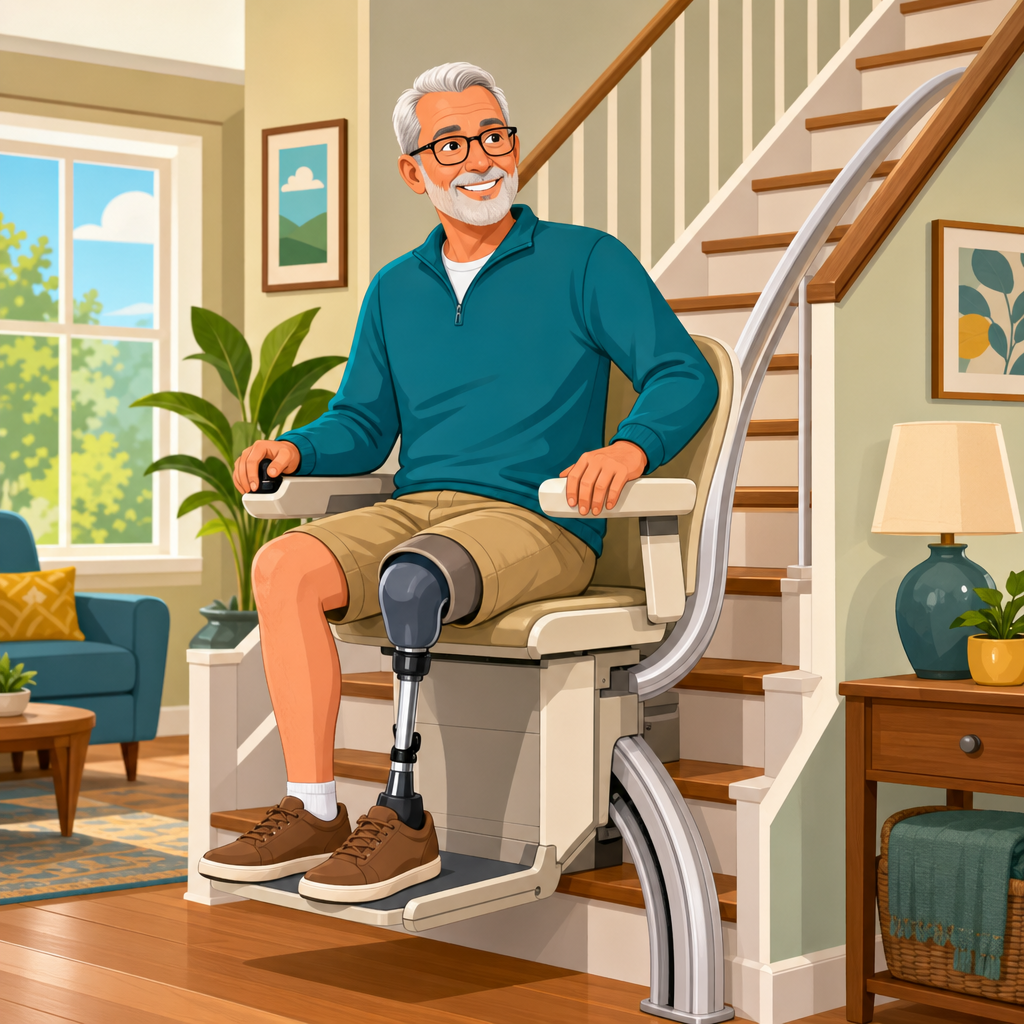
Prosthesis use adds another layer. Many amputees wear a prosthesis outside the home but prefer not to use it indoors, especially at night. That means the lift should work in both conditions. Check whether the footrest can support either a prosthetic foot or the intact foot without forcing the knees too high. For someone with edema or volume fluctuations in the residual limb, seat edge pressure matters. Thick padding sounds attractive, but overly soft cushions can destabilize transfers. Medium-firm support usually performs better.
Choose the right stair lift type for the staircase and user
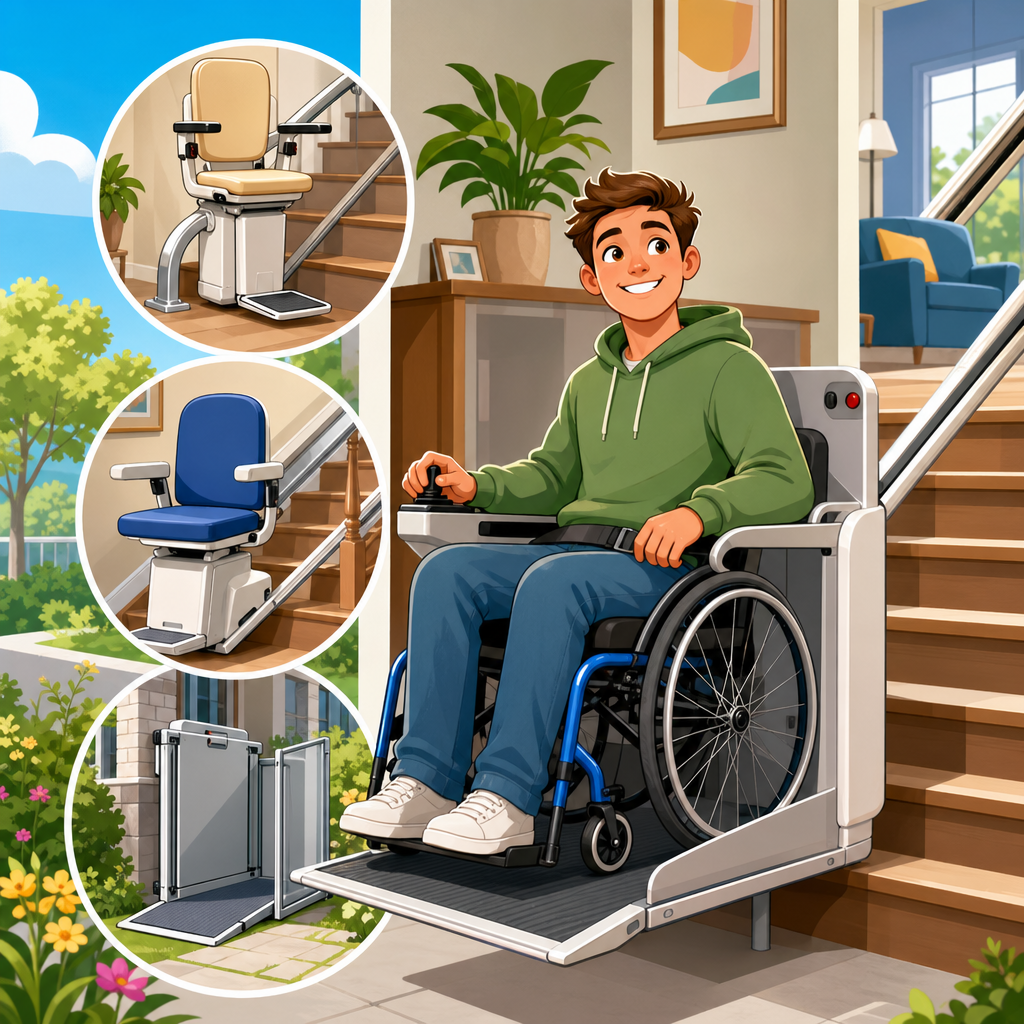
The main stair lift categories are straight, curved, standing or perch, heavy-duty, and outdoor. Straight stair lifts fit staircases that run in one line with no turns or intermediate landings. They are typically the least expensive and fastest to install because the rail is standardized and cut to length. Curved stair lifts are custom-built to follow turns, spirals, or landings. They cost more, but they are often the only safe option when a user cannot manage a transfer at a mid-landing or walk the final few steps.
For amputees, straight versus curved is not only an architectural decision. It is also about transfer safety at the top and bottom. I have seen homes where a straight model technically fits, but the upper landing is too tight for a walker turn or for positioning a prosthesis. In those cases, a hinged rail, parking point, or curved rail that ends farther from the edge can dramatically improve safety. Perch lifts, which let the user lean rather than sit fully, are usually poor matches for most amputees because they demand substantial balance and lower-body control. They may work for a small subset of users with minimal amputation-related instability, but they should never be the default recommendation.
Heavy-duty stair lifts deserve careful consideration. These models generally offer higher weight capacities, broader seats, stronger drivetrains, and more generous arm spacing. They are not only for larger users. An amputee with broad shoulders, a bulky prosthesis, or a need for more transfer room may fit better in a heavy-duty chair. Outdoor stair lifts can also be useful when garage access or porch steps create the main barrier. Look for weather-resistant rails, sealed controls, and covers rated for sun and moisture exposure.
Prioritize seat, transfer, and control features that improve safety
Most buying mistakes happen here. Shoppers focus on rail type, then treat the seat as interchangeable. It is not. For amputees, seat height, seat depth, armrest geometry, swivel function, and footrest design directly affect whether the lift can be used independently. A seat that is too low increases the force needed to stand. A seat that is too deep can press behind the intact knee and destabilize the pelvis. Flip-up armrests are helpful, but solid arm support during sit-to-stand is even more important.
Powered swivel seats are worth serious attention, especially for users who have trouble twisting at the top landing. The chair rotates away from the staircase, allowing a safer exit onto the landing rather than toward the stairs. Manual swivel seats cost less and are reliable, but they require adequate trunk control and hand function. Powered footrests also help users who cannot bend easily or who struggle to lift a prosthesis into place. Safety sensors on the footrest and carriage stop the lift if it meets an obstruction, which matters in homes with pets, children, or narrow stairs.
Controls should be simple, responsive, and operable with either hand when possible. Joystick-style controls are often easier than tiny toggles for users with reduced dexterity. Remote call/send stations let one user park the lift away from the main living area or call it back without climbing steps. Seat belts are standard, but a retractable belt with easy reach is preferable to a stiff lap strap that encourages nonuse.
| Feature | Why it matters for amputees | What to ask the dealer |
|---|---|---|
| Seat height | Supports safer stand-to-sit and sit-to-stand transfers | Can height be adjusted during installation? |
| Swivel seat | Reduces twisting and exit risk at the landing | Is powered swivel available at one or both ends? |
| Footrest size | Stabilizes intact foot and may support prosthesis | How much usable depth and width does it have? |
| Armrest design | Provides leverage for one-sided transfers | Are armrests sturdy, padded, and flip-up? |
| Controls | Affects use with limited grip or one hand | Can the control be mounted on either armrest? |
| Weight capacity | Adds margin for user size and equipment | Is the listed capacity full-travel tested? |
Measure the stairs correctly and plan the landing space
Accurate measurements are the foundation of a good installation. Dealers usually measure from the top landing down along the stair nosings to the bottom floor, then record stair width, number of steps, clearance from walls or handrails, and obstructions such as doors, radiators, or low trim. For amputees, landing space deserves extra scrutiny. A lift can fit the staircase yet still be unsafe if there is not enough room to line up a walker, turn with a crutch, or place a wheelchair nearby for a transfer.
Minimum stair width varies by model, but many standard seated lifts need roughly 28 to 30 inches of clear space, while heavy-duty models often require more. Do not rely on a single number from a product page. What matters is folded width, usable seat width, knee clearance during travel, and whether others can still use the stairs. If the rail projects into a doorway or blocks access at the bottom, a hinged rail can solve the problem by folding out of the way when parked.
I also advise clients to simulate the top and bottom transfer before purchase. Place a chair at approximate seat height and practice the approach with the user’s usual device. That quickly reveals whether a powered swivel, offset rail end, or different parking position is necessary. If the person transfers with a wheelchair, note whether the landing allows the chair to sit parallel, angled, or directly in front. Small layout details make a big difference in real-world use.
Compare brands, service support, and total ownership cost
The best chair lifts for disabled users are not always the ones with the flashiest feature list; they are the ones backed by dependable service. In this category, established brands such as Bruno, Harmar, Handicare, and Stannah are frequently considered because they have broad dealer networks, replacement parts availability, and documented installation standards. Model specifics vary by region, but the evaluation process is consistent: review warranty coverage, battery type, service response times, rail customization options, and technician training.
Ownership cost includes more than purchase price. Straight lifts commonly cost far less than curved lifts, but maintenance, battery replacement, and service calls should be discussed up front. Most modern units run on rechargeable batteries even when plugged into household power, allowing operation during outages. Those batteries are consumable parts and usually need replacement after several years, depending on use and charging conditions. Ask whether diagnostic codes are displayed and whether local technicians stock common parts.
Used and reconditioned stair lifts can be attractive for budget reasons, particularly straight models. They can be a sensible option if the dealer replaces wear components, verifies battery health, updates safety checks, and provides a meaningful warranty. For curved stair lifts, used options are less common because rails are custom-made for a specific staircase. Financing, veterans’ programs, state assistive technology programs, Medicaid waiver support in some states, and local nonprofit grants may help offset costs. Coverage is inconsistent, so buyers should verify all funding sources early.
A practical buying process for amputees and caregivers
A strong buying process begins with a mobility assessment, ideally involving the user, caregiver, occupational therapist if available, and dealer. Document how the person transfers, what device they use on each floor, whether the prosthesis is worn indoors, and what the hardest time of day is for stair use. Nighttime bathroom trips, post-therapy fatigue, and carrying laundry are common stress points that expose weak product choices. Next, schedule an in-home evaluation from a dealer who has experience with complex transfers, not just standard installs.
During the demonstration, have the user perform an actual sit, ride, swivel, and exit sequence. Do not accept a showroom impression as proof of fit. Ask about seat adjustment range, ride smoothness, start-stop behavior, charge point location, folded dimensions, and emergency lowering procedures. Request a written quote that separates equipment, rail type, power options, installation, warranty, and service terms. If two lifts feel similar, favor the dealer who gives the clearest answers about long-term support.
Finally, think ahead. If the user’s strength, prosthetic tolerance, or living arrangement changes within the next few years, will this lift still work? A slightly more expensive configuration can be the better value if it avoids replacement later. Read the related product reviews, straight-versus-curved comparisons, heavy-duty model roundups, and funding guides in this buying hub before signing a contract. The right stair lift should feel stable, predictable, and easy enough to use every day without hesitation. Start by booking a detailed home assessment and asking the dealer to optimize the lift around the transfer, not around the staircase alone.
Frequently Asked Questions
What features should amputees prioritize when choosing a stair lift?
The most important features depend on how the user transfers onto the seat, what mobility aids they use, and whether they wear a prosthesis all day, only sometimes, or not at all. For many amputees, transfer stability matters more than cosmetic upgrades. A stair lift should offer a secure seat at a practical height, sturdy armrests for leverage, and controls that are easy to operate with limited reach or balance. A swivel seat at the top landing is especially valuable because it allows the rider to turn away from the staircase and stand up onto the landing rather than toward the stairs. Locking the seat in place during that transfer adds another layer of safety.
Seat size, footrest design, and folding clearance are also important. Some amputees need extra seat width for comfort or a higher seat position to reduce strain on the stronger leg during standing. Others benefit from a footrest that can safely support a prosthetic limb or accommodate asymmetrical positioning. If the user relies on crutches, a cane, or a walker, the space left on the staircase when the lift is folded should be checked carefully. In short, the best stair lift is not simply the most advanced model; it is the one that supports the user’s real transfer pattern, balance needs, and daily routine with the fewest compromises.
Is a standard stair lift enough, or should amputees consider a customized model?
In some cases, a standard stair lift works very well, especially when the user has consistent mobility, good upper-body control, and a straightforward staircase. However, many amputees benefit from at least some level of customization. That does not always mean a fully specialized system, but it often means selecting options such as a different seat height, powered swivel, powered footrest, heavier weight capacity, or a rail design that better fits tight landings and unusual stair geometry. For a person who has trouble bending, balancing on one leg, or positioning a prosthesis during transfers, those details can make a major difference in safety and confidence.
Customization becomes even more important when mobility is expected to change over time. For example, a user may currently walk with a prosthesis but later need more support due to pain, overuse of the sound limb, arthritis, or changes in endurance. Homes with curved stairs, narrow staircases, doorways near the top or bottom landing, or limited transfer space may also require a more tailored solution. A reputable stair lift provider should assess the staircase and the user’s movement pattern together, not treat them as separate issues. That kind of evaluation helps ensure the final setup works in daily life, not just in a showroom demonstration.
How do transfer ability and balance affect the right stair lift choice for an amputee?
Transfer ability is one of the most important factors in stair lift selection because the ride itself is usually the easy part; getting on and off safely is where most risk occurs. An amputee who can stand briefly on one strong leg may do well with a standard seated model if the seat height, armrest support, and landing space are appropriate. But someone with limited balance, bilateral limb loss, weakness, dizziness, or difficulty controlling a prosthesis may need features that reduce the amount of twisting, bending, or unsupported standing required. A powered swivel seat, a seatbelt that is easy to manage one-handed, and controls located within comfortable reach can all improve safety.
The layout of the landing matters just as much as the chair itself. If there is not enough room to position crutches, a walker, or the body safely during a transfer, even a high-quality stair lift can become awkward or hazardous. This is why assessments should focus on how the user approaches the chair, sits down, rides, swivels, and stands up at both ends of the staircase. The right model should minimize unstable movements and support the person’s strongest and most reliable transfer method. For amputees, the best stair lift is one that respects the mechanics of everyday movement, not one chosen solely by weight capacity or brand name.
Can a stair lift work for an amputee who uses a wheelchair, walker, or crutches?
Yes, but the right setup depends on whether the user can transfer independently or with help. A traditional stair lift is designed for seated travel, so the rider must be able to move from their wheelchair, walker, or crutches onto the stair lift seat and then transfer off again at the other level. For some amputees, that is entirely realistic and safe. For others, especially those with bilateral amputations, limited upper-body strength, or poor balance, transfers may be difficult enough that a stair lift is not the ideal solution. In those situations, a platform lift or home elevator may be more appropriate, particularly if the person needs to remain in a wheelchair while changing floors.
That said, many amputees who use mobility aids still do very well with a chair lift when the landings are arranged properly. There should be enough room to park a walker, hold crutches, or position a wheelchair close to the seat without creating a twisting or reaching hazard. The stair lift should also leave adequate clearance for other household members if the staircase is shared. A professional assessment can help determine whether the user’s transfer method is repeatable, safe, and sustainable over time. The goal is not just to make stair travel possible, but to make it predictable, low-stress, and realistic for everyday use.
What home and staircase factors should be evaluated before buying a stair lift for an amputee?
Before buying a stair lift, it is essential to evaluate both the staircase and the spaces at the top and bottom landings. Straight stairs are usually simpler and less expensive to fit than curved stairs, but the overall decision should not be based on rail type alone. The width of the staircase, the amount of standing room at each end, nearby door swings, hallway tightness, handrail placement, and flooring transitions all affect how safely an amputee can approach and exit the lift. A landing that looks adequate on paper may still be problematic if the user needs extra time and space to stabilize, manage a prosthesis, or reposition crutches or a walker.
It is also wise to think beyond current needs. If the user’s mobility changes, will the lift still be suitable? Will the staircase remain usable for others when the chair is folded? Are there power outage features, battery backup systems, or maintenance requirements that matter for a person who cannot safely use the stairs without the lift? A quality in-home assessment should include measurements, observation of mobility patterns, and a discussion of future needs, not just a sales pitch. For amputees, choosing a stair lift is really about matching equipment to human movement and home design at the same time. When that match is done well, the staircase becomes far safer and much more manageable in daily life.