Choosing the best stair lifts for short-statured adults with mobility disabilities requires more than comparing price tags or weight limits. Fit, transfer safety, seat geometry, control placement, and staircase layout matter just as much as motor strength or upholstery. In my experience evaluating home accessibility equipment, the biggest mistakes happen when buyers assume any stair lift for disabled users will automatically suit a shorter rider. That assumption leads to dangling feet, difficult transfers, unsafe belt angles, and armrests that block rather than support movement.
A stair lift, sometimes called a chair lift for stairs, is a motorized seat that travels along a rail mounted to the stair treads or wall supports. For disabled users, it can preserve access to upper floors without the cost and disruption of a home elevator. For short-statured adults, however, the best chair lifts are models with adjustable seat height, shallow seat depth, easy-to-reach controls, supportive footrests, and stable boarding positions at both landings. Those details determine whether the lift feels secure or awkward.
This matters because mobility disabilities rarely exist in isolation. Many shorter adults also manage limited hip flexion, reduced trunk balance, arthritis, spasticity, neuromuscular weakness, or chronic pain. A lift that looks excellent on paper may still fail in daily use if the knees cannot bend comfortably, the joystick sits too far forward, or the swivel mechanism requires too much force. Good buying decisions come from matching the user’s body dimensions and functional abilities to the right lift design, not simply buying the most advertised model.
This guide serves as a hub for anyone researching the best chair lifts for disabled users, with special attention to short-statured adults. It explains what features matter most, which brands and configurations tend to work best, how straight and curved stair lifts differ, what measurements installers need, and where common tradeoffs appear. If you want a practical, reliable framework for comparing stair lifts, this page gives you the essentials.
What Short-Statured Adults Need From a Stair Lift
The best stair lifts for short-statured adults start with proportional seating. Standard seats on many residential lifts are designed around average-height users, which can create a seat pan that is too deep. When that happens, the rider cannot sit back fully while keeping feet flat on the footrest. The result is pressure behind the knees, poorer posture, and less secure belt positioning. Look for models with compact seats, adjustable seat height, or optional shorter seat pads.
Foot support is equally important. If the footrest sits too low or too far forward, shorter users may plantarflex excessively or let their feet hover, increasing fatigue and the chance of catching a shoe on the stairs during boarding. A proper footrest should support the whole foot while leaving the knees bent at a comfortable angle. In several home assessments I have seen, correcting footrest position made more difference to confidence than changing brands.
Controls must also be within easy reach. Many disabled users have reduced shoulder range, weak grip, or tremor. A toggle, rocker, or joystick should be operable with minimal hand strength and without reaching beyond the armrest edge. Remote call stations help caregivers move the chair when needed, but the rider’s primary control should still be intuitive enough for independent use. If possible, test the control while seated all the way back, not leaning forward.
Transfer mechanics deserve special attention. Short-statured adults often benefit from lower stand-to-sit height and shorter reach to the armrests. A powered swivel seat at the top landing can reduce twisting demands, especially for riders with hemiparesis or painful joints. Folding rails, offset hinges, and perch seats may help in certain homes, but they are not universal solutions. The right answer depends on both body mechanics and stair geometry.
Best Stair Lift Types for Different Homes and Disabilities
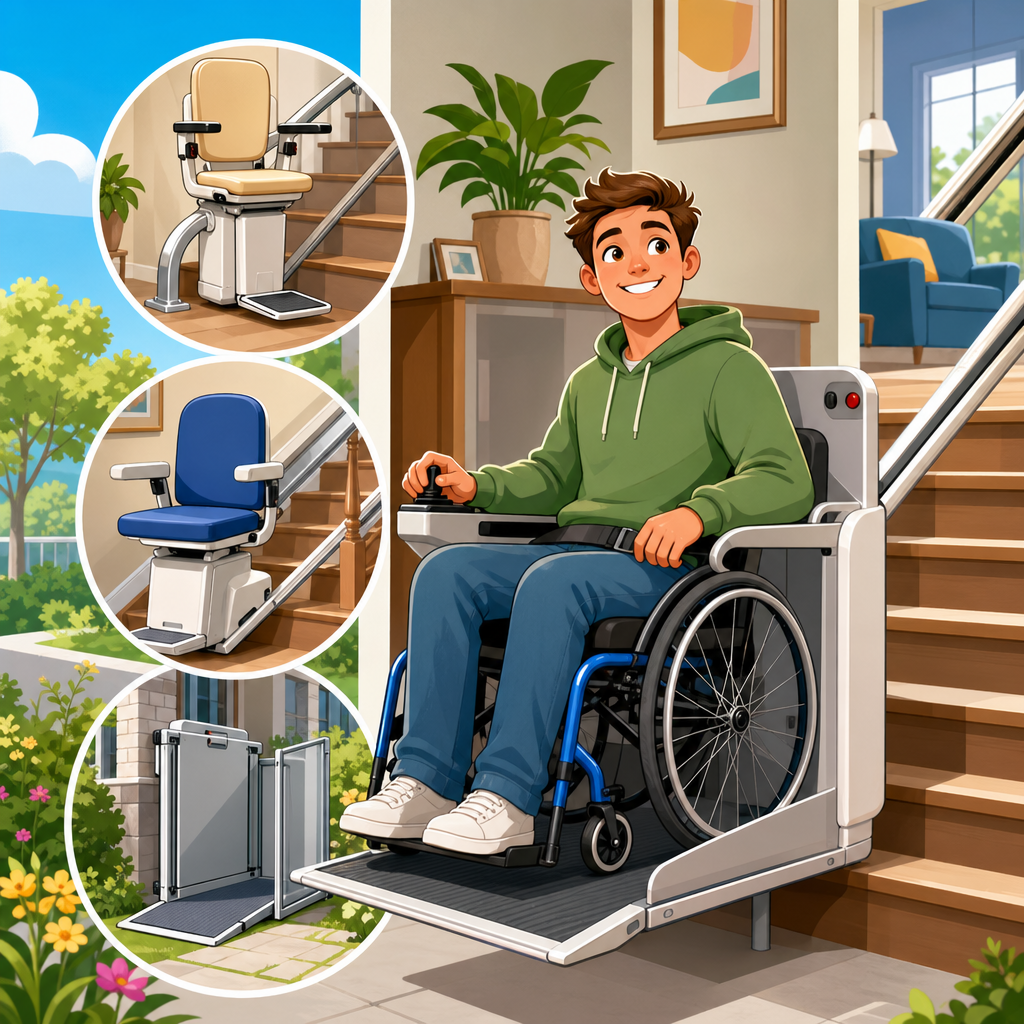
Straight stair lifts are usually the simplest and most cost-effective option. They run on a linear rail and are ideal for staircases without turns, intermediate landings, or curved steps. For short-statured adults, straight lifts can work very well because they often offer dependable ride quality, straightforward controls, and easier servicing. Common examples include Bruno Elan, Harmar SL300, and Stannah 260. These models are widely installed in North America and have established dealer networks.
Curved stair lifts are custom-built for stairs with turns, half-landings, or spiral-like transitions. Brands such as Handicare Freecurve, Bruno Elite Curved, and Stannah Sadler or Sofia variants are often considered when layout complexity is high. The advantage is precise rail routing and smoother access through difficult staircases. The downside is cost and lead time. Because every curve is fabricated to order, buyers should expect a more detailed survey and less flexibility after manufacturing begins.
Outdoor stair lifts deserve mention if the mobility barrier is at the porch, garage, or garden steps rather than indoors. Weather-resistant models from Bruno and Harmar use sealed components, UV-resistant covers, and marine-grade finishes. For shorter adults, outdoor fit still matters; do not assume weatherproofing solves the seating issue. I have seen outdoor lifts installed correctly from an electrical standpoint but poorly from an ergonomic standpoint because no one checked lower-leg length.
Perch stair lifts can help riders who cannot bend the knees fully or struggle to rise from a low seat. They support the user in a semi-standing position with a smaller perch and narrow profile. However, they are rarely the first recommendation for short-statured adults unless there is a specific orthopedic need. For many shorter riders, a perch configuration can feel less stable than a well-fitted seated model because balance demands are higher during travel and transfer.
Features That Matter Most When Comparing Chair Lifts
When buyers ask me how to compare the best chair lifts for disabled users, I focus on five categories: seat fit, transfer safety, control accessibility, ride quality, and service support. Seat width gets attention, but seat depth and seat-to-footrest relationship are often more important for shorter users. A narrower or more compact seat can improve positioning if it allows the rider to sit back fully with the pelvis supported and feet planted.
Swivel seats are essential at the top landing because they reduce the risk of stepping off toward the stairs. Manual swivels are common, but powered swivels can be worth the added cost for users with weakness, spasticity, or painful shoulder rotation. Seat belts should sit low across the pelvis, not across the abdomen. Retractable belts or easy-grip buckles help users with arthritis or one-handed function.
Ride quality depends on rail design, start-stop smoothness, and motor programming. A jerky takeoff can destabilize someone with poor trunk control. Battery-powered systems are standard on most modern lifts and continue to work during power outages because they charge at points on the rail. This is not a luxury feature; it is a safety expectation. Noise level also matters in shared homes, though performance and fit should outrank quietness.
Service support is the most overlooked category. A stair lift is a durable medical access product with moving parts, batteries, limit sensors, and safety edges. Choose a manufacturer with local dealer coverage, available parts, and a clear maintenance plan. The strongest warranty means little if no technician can reach the home quickly.
| Feature | Why It Matters for Short-Statured Adults | What to Ask the Dealer |
|---|---|---|
| Seat depth | Prevents dangling legs and pressure behind knees | Is there a compact seat or adjustable cushion option? |
| Footrest height | Supports stable knee angle and safe travel posture | Can footrest position be matched to lower-leg length? |
| Swivel mechanism | Improves transfer safety at the top landing | Is powered swivel available on this model? |
| Control design | Reduces reach and grip strain | Can the user test the rocker or joystick seated fully back? |
| Rail overrun | Moves boarding point away from stair edge | Can a top or bottom overrun improve entry safety? |
| Dealer support | Ensures maintenance and repairs are realistic | Who services the lift locally, and what is response time? |
Top Brands Commonly Recommended for Shorter Disabled Users
Bruno is consistently strong in build quality, dealer training, and long-term reliability. The Bruno Elan, a straight stair lift, is often a practical choice when space is limited and the rider needs straightforward controls. The Bruno Elite line offers a larger platform and robust feel, but the fit should be checked carefully for shorter adults because a bigger seat is not always a better seat. Bruno’s reputation for sturdy construction and domestic support makes it a frequent shortlist brand.
Stannah is known for refined ride quality, strong safety engineering, and customizable options. In many installations, Stannah seats feel secure and well-finished, and the company has experience with both straight and curved rails. For short-statured adults, the question is whether the chosen seat module and footrest arrangement match body dimensions. Stannah’s curved solutions are especially relevant for homes where precise rail routing is necessary to preserve walkway space.
Handicare offers a broad lineup and is often considered for complex stairs. Models such as the 1100 are notable for slim rail design, while the Freecurve line addresses custom curved layouts. Handicare’s modular approach can be beneficial when space is tight, though comfort depends heavily on the final seat selection and setup. Ask specifically about armrest spacing, seat depth, and control placement during the home assessment.
Harmar remains popular because of model variety and distribution reach. The SL300 is a common straight-lift option, and Harmar also serves outdoor applications well. For budget-conscious buyers, Harmar may present attractive pricing, but the installation quality is critical. An excellent brand can still perform poorly if the assessment is rushed. Among all manufacturers, the best results come when the dealer measures the rider as carefully as the staircase.
How to Measure and Evaluate Fit Before You Buy
The buying process should begin with a functional assessment, not a catalog. At minimum, the evaluator should measure stair width, tread depth, top and bottom landing clearance, obstructions such as doors or radiators, and available power supply. For the rider, key measurements include popliteal height, buttock-to-knee length, hip width, shoulder reach, and transfer style. Popliteal height, the distance from the floor to the underside of the knee while seated, is especially useful for matching seat and footrest relationship.
Ask the dealer to observe an actual transfer. Can the user back up safely to the seat? Do the feet find the footrest without lifting too high? Is one side stronger than the other, affecting armrest use or swivel direction? These details shape equipment choice. A person with multiple sclerosis may need different support than a person with dwarfism and osteoarthritis, even if both are short-statured adults using the same staircase.
It is also smart to discuss future change. Progressive conditions such as muscular dystrophy, Parkinson’s disease, or neuropathy may alter transfer ability over time. In those cases, a powered swivel, larger footrest, or easier seat-belt design may be worth buying now rather than retrofitting later. The best stair lift purchase is not just comfortable on installation day; it remains usable as needs evolve.
Cost, Installation, and When a Stair Lift Is the Right Choice
Straight stair lifts commonly cost far less than curved models, with installed pricing often starting in the low thousands and rising with options, while curved lifts frequently move well into five figures because the rail is custom fabricated. Outdoor units, powered hinges, powered swivels, and upholstery upgrades add cost. Prices vary by region, dealer, rail length, and construction complexity, so site-specific quotes are essential.
Installation for a straight lift is often completed in a few hours, while curved projects take longer because design, fabrication, and fitting are more involved. Most residential lifts mount to the stair treads rather than the wall, which surprises many buyers. Reputable installers test charging contacts, safety sensors, seat swivel locks, and final stop positions before handover. The user should receive hands-on training, not just a manual left on the seat.
A stair lift is the right choice when the user can transfer safely with or without assistance, has sufficient sitting tolerance for the trip, and needs regular access to another floor. It may be the wrong choice when transfers are extremely unsafe, when a wheelchair must travel with the person, or when cognitive impairment makes independent use unreliable. In those cases, a vertical platform lift, limited-use elevator, or first-floor reconfiguration may be the better accessibility solution.
The main takeaway is simple: the best stair lifts for short-statured adults with mobility disabilities are the models that fit the rider’s body and function, not the ones with the biggest marketing presence. Prioritize seat depth, foot support, control reach, transfer safety, and local service. Compare trusted brands like Bruno, Stannah, Handicare, and Harmar, but judge them through actual measurements and a real transfer assessment.
As a hub for best chair lifts for disabled users, this guide should help you ask sharper questions and avoid expensive mismatches. Start with a professional in-home evaluation, request model-specific fit adjustments, and test every transfer step before signing a contract. A well-chosen stair lift restores safe access to the full home, and that practical independence is the benefit that matters most.
Frequently Asked Questions
What features matter most when choosing a stair lift for a short-statured adult with a mobility disability?
The most important factor is proper rider fit, not just whether the lift can carry the person safely by weight. For a shorter adult, seat height, seat depth, back support angle, armrest position, and footrest height all affect comfort and transfer safety. If the seat is too deep, the user may not be able to sit fully back without pressure behind the knees. If the footrest sits too low or too far away, the rider’s feet may dangle, which can reduce stability and make the trip feel insecure. Shorter users also benefit from easy-to-reach controls, including armrest toggles or remote controls that do not require overreaching or strong grip strength.
Transfer safety is equally important. A stair lift should allow the rider to get on and off with minimal twisting, leaning, or sliding. Features such as a swivel seat, lock-in-place seat positions, folding arms, and a compact footrest can make a major difference. In many homes, the staircase layout also influences what works best. Narrow stairs, top landings with limited space, or bottom steps that open into a doorway may require a custom approach. The best stair lift for a short-statured adult is usually one that can be adjusted to their body dimensions and installed in a way that reduces awkward transfers at both ends of the staircase.
Why is a standard stair lift not always a good fit for someone who is shorter?
A standard stair lift may meet basic safety standards and still be a poor physical fit for a shorter rider. Many models are designed around average adult body proportions, which can create several problems for shorter users. The seat may be too high to allow secure foot placement during boarding, the armrests may sit at an uncomfortable angle, and the control switch may be positioned too far forward. During travel, unsupported legs and feet can leave the rider feeling unstable, especially if they already have balance challenges, muscle weakness, or joint limitations.
There is also a practical transfer issue. A person with a mobility disability often relies on repeatable, low-effort movement patterns to sit, rotate, and stand. If the chair geometry does not match their body size, every transfer becomes harder. Over time, that can increase fatigue and raise the risk of slips or near-falls. A poor fit can also discourage consistent use, which defeats the purpose of installing a mobility device in the first place. That is why a well-fitted stair lift should be treated as an accessibility solution tailored to the rider, not as a one-size-fits-all appliance.
How can a buyer tell whether a stair lift will provide safe transfers for a shorter user?
The best way is to evaluate the full transfer sequence, not just the seated ride. A safe transfer begins before the user sits down and ends only after they are fully off the lift at the top or bottom landing. Buyers should look at whether the seat can swivel smoothly and lock securely, whether the user can place both feet firmly during boarding, and whether armrests offer useful support without blocking movement. The user should not have to perch on the edge of the seat, hop backward, or twist excessively to get positioned. For shorter adults, these details are especially important because even small mismatches in height or reach can make a transfer significantly more difficult.
It is also wise to consider how the stair lift interacts with any cane, walker, transfer belt, or caregiver assistance. In some cases, a model with a powered swivel seat or powered footrest improves safety because it reduces bending and manual effort. In other cases, a simpler design may be better if the user needs straightforward, predictable controls. A reputable dealer or installer should assess the user’s body size, mobility pattern, and staircase dimensions together. Ideally, the buyer should request a demonstration or fitting discussion focused specifically on short stature and transfer mechanics rather than accepting a generic sales presentation.
Are customizations or adjustable options worth it for short-statured adults?
In many cases, yes. Adjustable and semi-custom features can make the difference between a stair lift that is merely usable and one that is truly safe, comfortable, and practical every day. For shorter adults, options such as reduced seat height, modified seat depth, alternative footrest positioning, slimmer arm profiles, and repositioned controls may improve posture and support. These adjustments can help the rider maintain better contact with the chair, keep the knees and hips in a more natural position, and avoid the sensation of sliding forward or hanging above the footplate.
Customizations are especially valuable when the user has additional mobility concerns such as limited trunk control, arthritis, spasticity, or reduced hand strength. A stair lift should work with those physical realities, not force the rider to compensate for poor design fit. Although customization can increase upfront cost, it often provides better long-term value by improving confidence, reducing caregiver strain, and lowering the chance of installation regret. For many households, paying for the right configuration the first time is more cost-effective than replacing or modifying an unsuitable lift later.
What questions should families ask a stair lift dealer before buying for a short-statured adult with a disability?
Families should ask whether the recommended model has been successfully fitted for shorter adults before and what specific adjustment range it offers for seat height, seat depth, footrest position, and control placement. They should also ask how transfers will be handled at the top and bottom of the stairs, whether a swivel seat is manual or powered, and how much upper-body strength or coordination the user will need to operate it. Another key question is whether the dealer will evaluate the rider in person rather than relying only on staircase measurements and product brochures.
It is also important to ask about staircase clearance, folded dimensions, safety sensors, maintenance requirements, battery backup, and what happens if the user’s needs change over time. Families should request a clear explanation of why a particular model suits a short-statured rider specifically, not just why it is popular or readily available. A strong dealer should be able to discuss body fit, transfer safety, and daily usability in detail. If the answers stay vague or focus only on price and weight capacity, that is usually a sign to keep looking. The right provider will treat the purchase as an individualized mobility decision, which is exactly what it should be.